What is CFD trading and how does it work?

9 minute read
|6 May 2024
Blue CFD trading graph
Table of contents
  • 1.
    What are CFDs? 
  • 2.
    CFDs vs stocks 
  • 3.
    Advantages of CFD trading 
  • 4.
    How does CFD trading work? 
  • 5.
    Margin and leverage 
  • 6.
    Risks of CFD trading
  • 7.
    How to get started with CFD trading 
  • 8.
    What are the costs of trading CFDs? 
  • 9.
    What instruments can I trade? 
  • 10.
    Develop confidence in CFD trading with CMC Markets 

This video refers to the CMC Markets Platform, formerly known as the Next Generation platform.

What are CFDs? 

A contract for difference is a financial derivative product that pays the difference in settlement price between the opening and closing of a trade. CFD trading enables you to speculate on the rising or falling prices of fast-moving global financial markets (or instruments) such as shares, indices, commodities, currencies, and treasuries. Trading CFDs means that you can either make a profit or a loss, depending on which direction your chosen asset moves. 

Key features:

  • Speculate on rising or falling prices (go long or short).

  • No ownership of the underlying asset.

  • Leveraged product, amplifying both profits and losses.

CFDs vs stocks 

CFDs and stocks differ fundamentally in their structure and purpose. When you buy a stock, you own a share of the company, giving you rights such as dividends and voting power. By contrast, CFDs are derivative instruments that let you speculate on price movements without owning the underlying asset. 

Moreover, CFDs offer leverage, which means you can control a larger position with a smaller capital outlay, unlike stocks, where you need to pay the full value upfront. CFDs are also bidirectional, which means traders can profit from both rising and falling prices, whereas stock investors traditionally benefit only when prices rise. 

The costs and fees also vary when considering CFDs vs stocks: stock trading tends to incur brokerage fees and potential dividend taxes, while CFDs can involve spreads, overnight financing and commission. Finally, some CFDs can be traded outside regular market hours, which offers greater flexibility than just trading stocks during periods when the exchange markets are open. 

Advantages of CFD trading 

  • Leverage: Gain greater market exposure with a smaller deposit. This can magnify potential gains and losses, requiring careful risk management. 

  • Bidirectional trading: Profit from rising (long) or falling (short) markets. 

  • Hedging: Offset losses in a physical portfolio by short-selling CFDs. 

  • Diverse markets: Trade forex, indices, commodities, and cryptocurrencies from one account. 

  • Flexible timeframes: Use for short-term or long-term strategies, depending on goals and market outlook. 

Learn more about CFD advantages and risks

How does CFD trading work? 

When you trade CFDs, you don’t buy or sell the underlying asset (e.g. a physical share, currency pair or commodity). You buy (go long) if you expect prices to rise or sell (go short) if you expect them to fall. Profits or losses depend on the price difference between opening and closing the trade.

Wondering how CFDs work? For every point the price of the instrument moves in your favour, you gain multiples of the number of units you have bought or sold. For every point the price moves against you, you will make a loss.

Example: If you buy 5 CFD contracts on a share at $100 (each contract worth $10 per point) and the price rises to $105, your profit is (5 x $10) x (105 - 100) = $250. If the price falls to $95, your loss is $250.

Margin and leverage 

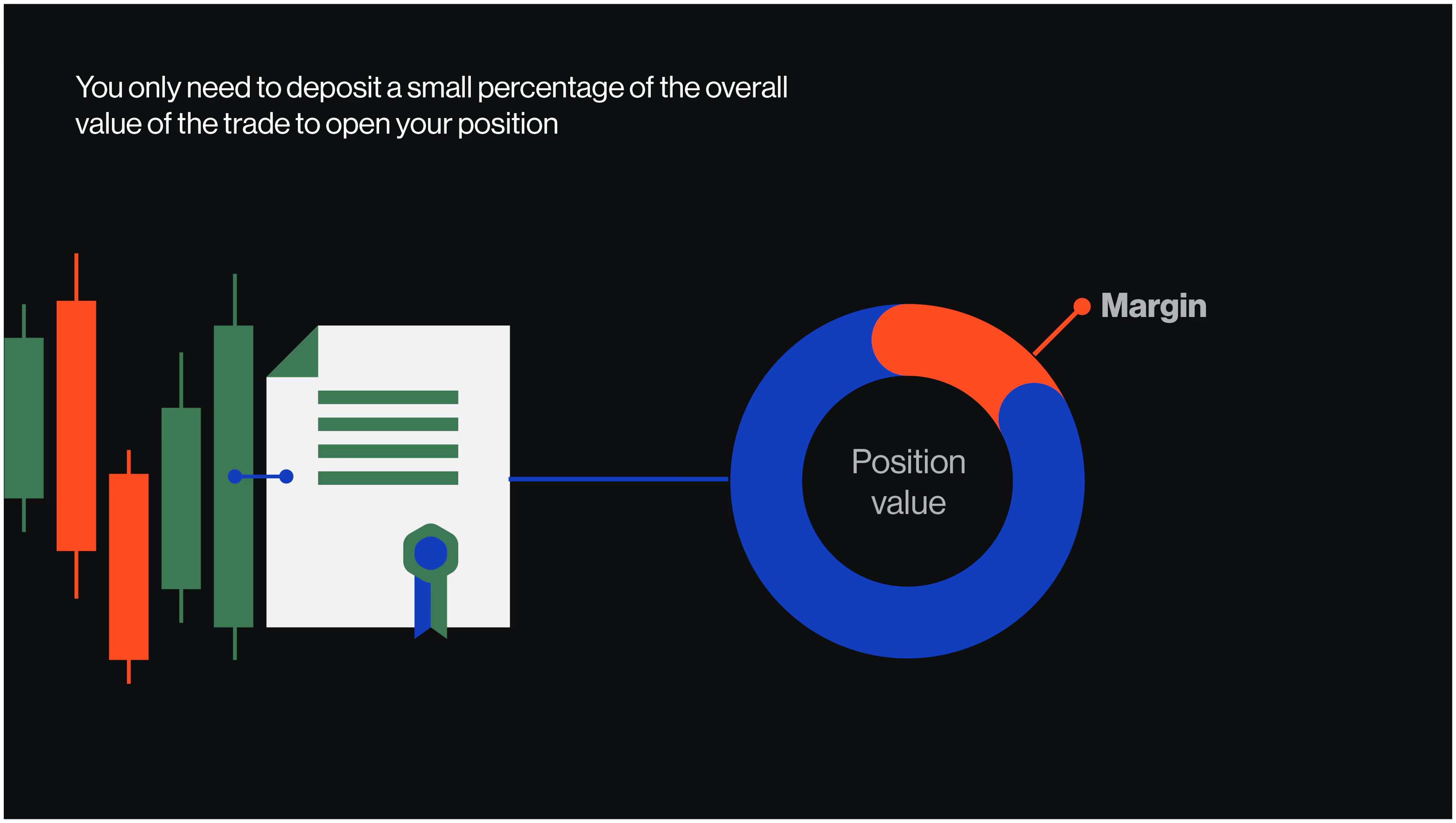
CFDs are a leveraged product, which means that you only need to deposit a small percentage of the full value of the trade to open a position. This is called ‘trading on margin’ (or margin requirement). While trading on margin allows you to magnify your returns, your losses will also be magnified as they are based on the full value of the position. This means that you could lose all of the funds in your account, but as retail CFD accounts have negative balance protection, you cannot lose more than the value of your account.

For example, a 5% margin on a $10,000 position requires only $500. This amplifies both profits and losses, as returns are based on the full position value.

  • Margin: A deposit, typically 5–20% of the position size.

  • Leverage: Magnifies exposure but increases risk of loss.

  • Negative Balance Protection: Ensures retail clients cannot lose more than their deposit.

Learn more about CFD margins and how to calculate them

What is margin and leverage?

Short-selling CFDs in a falling market 

CFD trading enables you to sell (short) an instrument if you believe it will fall in value, with the aim of profiting from the predicted downward price move. If your prediction turns out to be correct, you can buy the instrument back at a lower price to make a profit. If you are incorrect and the value rises, you will make a loss.

Hedging your physical portfolio with CFD trading

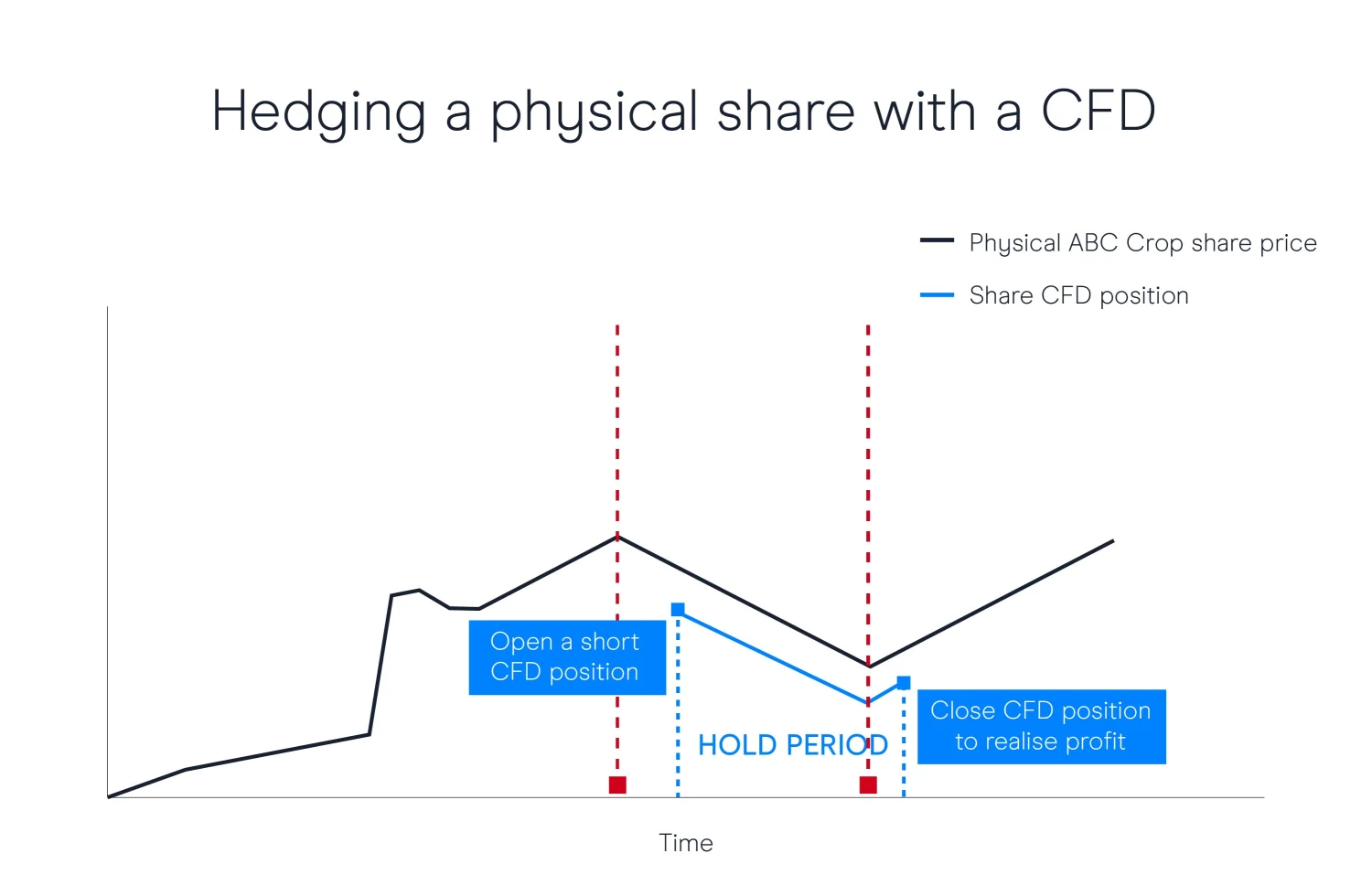
If you have already invested in an existing portfolio of physical shares with another broker and you think they may lose some of their value over the short term, you can hedge your physical shares using CFDs. By short-selling the same shares in CFDs, you can try to make a profit from the short-term downtrend to offset any loss from your existing portfolio. 

For example, if you hold $5,000 worth of physical ABC Corp shares in your portfolio, you could short-sell the equivalent value of ABC Corp with CFDs. Then, if ABC Corp’s share prices fall in the underlying market, the loss in value of your physical share portfolio could potentially be offset by the profit made on your short-sell CFD trade. You could then close out of your CFD trade to secure your profits as the short-term downtrend comes to an end and the value of your physical shares starts to rise again. 

Using CFDs to hedge physical share portfolios is a popular strategy for many investors, especially in volatile markets. 

Risks of CFD trading

CFDs are high-risk due to leverage, which can lead to significant losses. Most retail clients lose money trading CFDs. Always consider if you can afford to lose your investment.

  • Leverage risks: Small price movements can wipe out your deposit.

  • Margin calls: Providers may require additional funds to maintain positions.

  • Market volatility: Rapid price changes and gapping can cause stop-loss orders to execute at unfavourable prices, particularly during volatile market conditions or outside normal trading hours.

  • Holding costs: Daily fees apply to positions held overnight past 5pm New York time, which may exceed profits or increase losses over extended periods.

  • Account close-out: Market prices can change quickly, and if you do not have sufficient funds in your account to cover, some or all positions may be automatically closed to prevent further losses.

How to get started with CFD trading 

Here’s a quick guide to help you get a handle on CFD trading basics: 

  1. Choose a broker and sign up: Select a reputable broker like CMC Markets that offers CFDs across a variety of markets.

  2. Practice with a demo: Use a demo account with virtual funds to test strategies.

  3. Fund your account: After signing up, deposit funds into your trading account. Make sure you meet the broker’s minimum deposit requirements and remember to only commit capital you’re prepared to trade with – and potentially risk losing. 

  4. Explore the platform: Take time to navigate the trading platform, learning about its tools, charting features and order types. Most brokers will have tutorials and resources to help guide new users. 

  5. Select markets: Decide which markets you want to trade in. There are many types of CFDs to choose from, but popular choices include forex, shares, indices, commodities and cryptocurrencies. Trading CFDs means you can easily diversify your trades across multiple asset classes. 

  6. Start buying/selling: Use your own analysis to place your first trade. Decide whether to go long (buy) or short (sell) based on market expectations. 

  7. Monitor and manage positions: Regularly track your trades, making adjustments wherever needed to manage risks and lock in profits. For more control, you can use stop-loss and take-profit orders. 

With CMC Markets, getting started is easier than ever. Our CMC Markets Platform has intuitive navigation and advanced tools while giving you broad access to diverse markets. It doesn’t matter whether you’re a beginner or an experienced trader, CMC has a library of resources like educational guides, demo accounts and real-time insights to support your trading ambitions. 

What are the costs of trading CFDs? 

  • Spread: As in all markets, when trading CFDs, you must pay the spread, which is the difference between the buy and sell price. You enter a buy trade using the buy price quoted and exit using the sell price. As one of the leading CFD providers globally, we understand that the narrower the spread, the less you need the price to move in your favour before you start making a profit or loss. Our spreads are, therefore, always competitive, so you can maximise your ability to net a potential profit. 

  • Holding costs: At the end of each trading day (5 pm New York time), any positions open in your account may be subject to a charge called a 'holding cost'. The holding cost can be positive or negative depending on the direction of your position and the applicable holding rate. 

  • Market data fees: To trade or view our price data for share CFDs, you must activate the relevant market data subscription, for which a fee will be charged. 

  • Commissions (only applicable for shares): Trading CFDs in Australia? You must also pay a separate commission charge when you trade share CFDs. Commissions on AUS-based shares on the CMC Markets CFD trading platform start from 0.09% of the full exposure of the position, and there is a minimum commission charge of $7. 

What instruments can I trade? 

Trade over 12,000 instruments, including: 

  • Forex: EUR/USD, AUD/USD (spreads from 0.5 points). 

  • Indices: ASX 200, FTSE 100. 

  • Commodities: Gold, oil. 

  • Shares: Australian and global companies. 

Develop confidence in CFD trading with CMC Markets 

Build your skills with our free demo account, offering $10,000 in virtual funds. Access to educational resources, including guides, tutorials, and market insights, is available through our Knowledge Hub. Our platform provides advanced charting, over 115 technical indicators, and customisable alerts to support traders at all levels. 

Try our demo account or explore our CFD Knowledge Hub

Disclaimer: This article provides general information only. It has been prepared without taking account of your objectives, financial situation or needs. It is not to be construed as a solicitation or an offer to buy or sell any financial instruments, or as a recommendation and/or investment advice. It does not intend to support an investment decision and it should not be relied upon by you in evaluating the merits of investing in any financial instruments. You should consider your objectives, financial situation and needs before acting on the information in this article. CMC Markets believes that the information in this article is correct, and any opinions and conclusions are reasonably held or made on information available at the time of its compilation, but no representation or warranty is made as to the accuracy, reliability or completeness of any statements made in this article. CMC Markets is under no obligation to, and does not, update or keep current the information contained in this article. Neither CMC Markets nor any of its affiliates or subsidiaries accepts liability for loss or damage arising out of the use of all or any part of this article. Any opinions or conclusions set forth in this article are subject to change without notice and may differ or be contrary to the opinions or conclusions expressed by any other members of CMC Markets.

Join an award winning CFD provider
Practise CFD trading with $10,000 of virtual funds on a risk-free demo account.
Access 12,000+ instruments on our award-winning CMC Markets Platform. Including indices, forex and shares.
Enhance your CFD trading on MetaTrader4 with CMC Markets and access 175+ forex pairs.
Tight spreads and low margin rates.
Support
Support
x

Welcome to CMC Markets Support!

To begin, please select the product your query is related to.