What is forex (FX) trading and how does it work?

15 minute read
|26 Nov 2025
What is forex
Table of contents
  • 1.
    Key takeaways 
  • 2.
    What is forex trading?
  • 3.
    How does forex CFD trading work?
  • 4.
    What are forex currency pairs?
  • 5.
    What are the different types of currency pairs? 
  • 6.
    What is a pip? 
  • 7.
    What is a lot? 
  • 8.
    What is the forex market? 
  • 9.
    How to trade the FX market in Australia 
  • 10.
    Forex trade example
  • 11.
    How does the foreign exchange market work? 
  • 12.
    What moves the foreign exchange markets? 
  • 13.
    When is the forex market open? 
  • 14.
    What are the benefits of CFD forex trading? 
  • 15.
    What are the risks of CFD forex trading? 
  • 16.
    Why trade forex with CMC Markets Australia? 
  • 17.
    How to get started with forex trading in Australia  

Are you curious about what forex trading is and how the market operates? Forex (FX) is a widely traded CFD asset class known for its high trading volumes and near-24-hour pricing. FX trading gives you the flexibility to go long or short. Importantly, it has broad participation, with the Bank for International Settlements (BIS) reporting that over-the-counter forex markets averaged US$7.9 trillion in daily turnover in April 2025. 

If you’re new to the concept and asking what forex trading is and how it works, our practical guide will give you all the essentials, from what FX is to what moves currencies and the potential advantages and risks, as well as answering the question: how does forex trading work with CFDs? 

Key takeaways 

  • Forex = currencies traded in pairs. You buy one currency and sell another (e.g. AUD/USD). 

  • CFD trading lets you go long or short, so you can express views on rising or falling currencies without owning the underlying asset. 

  • Spreads, funding/overnight holding, and slippage might influence results. 

  • Macroeconomic conditions can be a key driver of FX, particularly through shifts in central bank policy, growth, inflation, geopolitics, and terms of trade.  

What is forex trading?

Foreign exchange trading (aka FX trading or forex trading) lets you speculate on price fluctuations within the FX market; a global, over-the-counter (OTC) marketplace where currencies are traded between participants rather than on a single central exchange. The goal of forex trading is to forecast whether one currency’s value will strengthen or weaken relative to another currency.

As a forex trader, you’ll encounter several different trading opportunities due to daily news releases. Daily news releases can create significant price movements in FX markets, which some traders monitor for potential setups and opportunities. Although these same movements can result in rapid and significant losses.

How does forex CFD trading work?

If you’re wondering how forex trading works in a CFD account, the steps below outline a general process that traders may follow in practice.

  • Choose a pair and a direction: Go long (buy) if you expect the base currency to rise. Go short (sell) if you expect it to fall.

  • Size the trade: Positions are measured in units (e.g. micro/mini/standard lots of the base currency).

  • Manage risk: Attach stop-loss and take-profit orders and keep an eye on funding/overnight holding costs if you keep positions open past the session’s cut-off.

  • React to information: FX is sensitive to economic releases (inflation, employment data), central-bank guidance, risk sentiment and more.

Forex market vs. stock market 


Forex market 

Stock market 

Size 

OTC FX averaged US$7.9T per day (April 2025). 

US equities averaged around US$607.7B per day in notional value traded in 2024. 

Hours 

Trades 24/5 (weekdays, depending on location). 

Typically limited to exchange opening hours (plus limited pre/after-hours depending on venue). 

Structure 

Decentralised OTC/interbank market. There’s no single exchange. 

Centralised exchanges and regulated trading sites (e.g., ASX, NYSE, NASDAQ). 

What are forex currency pairs?

Forex is always traded in currency pairs,  for example, GBP/USD (Pound sterling v US dollar). Forex trading works by speculating on the difference in valuation of two currencies. 

For example, if you were to trade GBP/USD and thought the US dollar would weaken against the pound, you could take a position based on that expectation. Looking at the GBP/USD currency pair, the first currency (GBP) is called the 'base currency' and the second currency (USD) is known as the quote currency'. Alternatively, if you think GBP will fall against USD (or that USD will rise against GBP), you could go short.  

What are the different types of currency pairs? 

There are three different types of forex pairs: 

Major pairs: Includes the most traded currencies globally and always involves the US dollar (USD) as either the base or quote currency. These pairs tend to have high liquidity. 

💡 Examples: 

  • AUD/USD (Australian dollar / US dollar) 

  • USD/JPY (US dollar / Japanese yen) 

Minor pairs: Minor pairs are combinations of major currencies that exclude the USD. 

💡 Examples: 

  • AUD/NZD (Australian dollar / New Zealand dollar) 

  • GBP/JPY (British pound / Japanese yen) 

Exotic currency pairs: Consist of one major currency and one from an emerging market. These pairs have higher spreads and lower liquidity, making them more volatile. 

💡 Examples: 

  • GBP/ZAR (British pound / South African rand) 

  • USD/TRY (US dollar / Turkish lira) 

  • USD/MXN (US dollar / Mexican peso) 

What is a pip? 

A pip (percentage in point) is the smallest price movement a forex pair can make. Most currency pairs are quoted to four decimal places, and a pip is typically the fourth decimal place (0.0001). Traders use pips to measure price movements and calculate potential profits or losses in a trade. 

If GBP/USD moves from 1.2500 to 1.2505, that’s a 5-pip movement. 

For pairs that involve the Japanese yen (JPY), a pip is the second decimal place (0.01) instead of the fourth.

What is a lot? 

A lot in forex trading refers to the size of a trade. Since forex is traded in large volumes, lots standardise how much of a currency you buy or sell in one trade. 

There are 3 different types of lot sizes: 

Lot size  

Number of currency units 

Standard Lot 

100,000 

Mini Lot 

10,000 

Micro Lot 

1,000 

Effect of lots on Forex trades: 

  • If you trade 1 standard lot, a 5-pip move would mean $50 gained or lost. 

  • If you trade 1 mini lot, a 5-pip move equals $5 profit or loss. 

  • If you trade 1 micro lot, a 5-pip move equals $0.5 profit or loss. 

Lot size  

Number of currency units 

Pip value 

Standard Lot 

100,000 

$10 per pip 

Mini Lot 

10,000 

$1 per pip 

Micro Lot 

1,000 

$0.10 per pip 

 Lot size directly affects trade risk – larger lot sizes mean bigger potential profits, but also larger potential losses.

What is the forex market? 

The foreign exchange is one of the most widely traded markets in the world, with a total daily average turnover reported to exceed $5 trillion a day. The forex market is not based in a central location or exchange, and is open 24 hours a day from Monday morning through to Saturday morning. A wide range of currencies is constantly being exchanged as individuals, companies, and organisations conduct global business and attempt to take advantage of rate fluctuations. 

The foreign exchange market is used primarily by central banks, retail banks, corporations, and retail traders. Understanding how each of these players interacts with the FX market can help to determine market trends as part of your fundamental analysis. 

  • Central banks are responsible for managing their nation’s currency, money supply, and interest rates. When action is taken by central banks, it is usually to stabilise the nation’s currency. 

  • Retail banks trade large volumes of currency on the interbank market. Banks exchange currencies between each other on behalf of large organisations, and also on behalf of their accounts. 

  • Corporations that have dealt with companies overseas have to take part in the foreign exchange market to transfer funds for imports, exports, or services. 

  • Retail traders account for a much lower volume of forex transactions in comparison to banks and organisations. Using both technical analysis and fundamental analysis, retail traders aim to profit from forex market fluctuations.

How to trade the FX market in Australia 

There are many ways to trade on the forex market, all of which follow the previously mentioned principle of simultaneously buying and selling currencies. If you believe an FX ‘base currency’ will rise relative to the price of the ‘counter currency’, you may wish to ‘go long’ (buy) that currency pair. If you believe the opposite will happen and the market will fall, you may wish to ‘go short’ (sell) the currency pair.

You can engage with the FX market in a number of different ways, including spot trading, futures and options, as well as derivative trading like CFDs. Spot trades exchange currencies at the current market price. Futures and options are contracts linked to a future date and price. CFDs, on the other hand, let you speculate on price movements without owning the underlying asset. 

The forex market was historically traded via a forex broker. However, with the rise of online trading companies, you can take a position on forex price movements with a CFD trading account. 

CFD trading accounts provide a form of derivative FX trading where you do not own the underlying asset, but rather speculate on its price movements. Derivative trading can provide opportunities to trade forex with leverage. As this can be a risky process, forex traders often choose to carry out forex hedging strategies to potentially help offset any currency risk and subsequent losses. 

What is leverage in CFD forex trading? 

When trading forex CFDs, leverage allows traders to control a larger exposure with less of their own funds. The difference between the total trade value and the trader’s margin requirement is usually ‘borrowed’ from the forex broker. Traders can potentially get more leverage on forex than on other financial instruments, meaning they can control a larger sum of money with a smaller deposit. 

Since forex CFDs are traded on margin, you only have to deposit a percentage of the full amount you want to trade. Our margins start from 3.33%, which could be referred to as 30:1 leverage, as the value of the full position would be 30 times the value of the deposit required to open the trade. When trading on margin, it’s important to remember that your profits or losses are based on the full value of the position.​ 

As an example, with 30:1 leverage, you can control a $30,000 position with just $1,000 of margin. 

But there are risks to consider. Leverage increases both gains and losses, and market volatility can raise the likelihood of you rapidly losing funds or even your account closing out. So before you start trading, make sure you have an arsenal of risk-management tools and understand the rules around position sizing. 

What is spread in CFD forex trading? 

The spread in forex trading is the difference between the buy and sell prices of an FX currency pair. When you trade forex pairs, you’re presented with a ‘buy’ price that is often above the market price and a ‘sell’ price that is often below the market price. The difference between these two prices is referred to as the ‘bid-ask’, or ‘buy-sell’ spread. 

Forex trade example

You’ve looked at the news this morning and seen some news that might suggest that the pound may strengthen, so you decide to go long (buy) GBP/USD at 1.2500 with a position size of 10,000 units (1 mini lot).

📈 Trade breakdown 

Currency Pair 

Buy Price 

GBP/USD 

1.2500 

Position Size 

Leverage 

10,000 units (1 mini lot) 

5:1 (20% margin) 

Total position value 

Margin required (deposit) 

$10,000 

$2,000 (20% of $10,000) 

Successful forex trade example

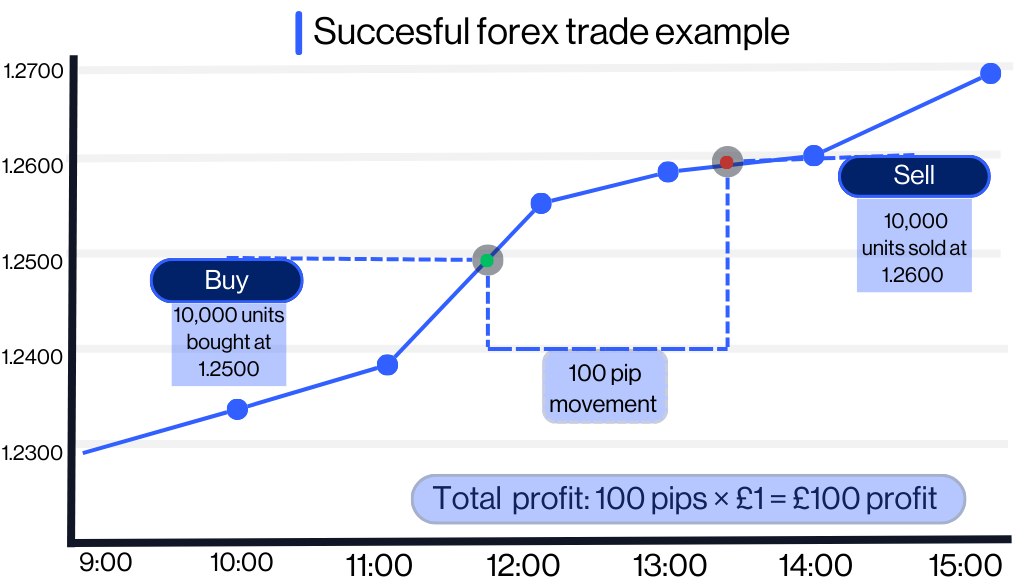
Liniendiagramm eines erfolgreichen EUR/USD-Forex-Trades.

Let’s assume GBP/USD rises to 1.2600, which is a 100-pip increase (1.2600 - 1.2500 = 100 pips) from when you opened your position. You close your trade at 1.2600, locking in a profit of $100. 

Pip value for 1 mini lot (10,000 units) = £1 per pip 

Total Profit: 100 pips × $1 = $100 profit 

Your $2,000 margin deposit remains intact, and you gain $100, leaving you with a new balance of $2,100.

Unsuccessful forex trade example

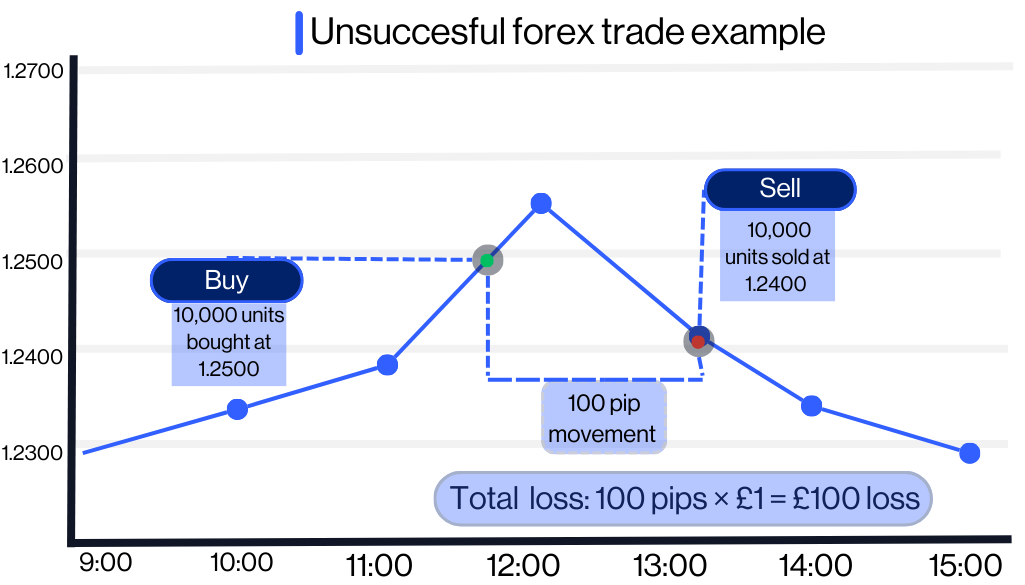
Line chart showing an unsuccessful GBP/USD forex trade: Buy 10,000 units at 1.2500, sell at 1.2400. A 100-pip movement results in a $100 loss.

Now assume GBP/USD falls to 1.2400 (a 100-pip decrease, 1.2500 - 1.2400 = 100 pips). You close your trade at 1.2400, taking a loss of $100. 

  • Pip Value for 1 Mini Lot (10,000 units): $1 per pip 

  • Total Loss: 100 pips × $1 = $100 loss

$100 will be deducted from your $2,000 deposit, leaving a balance of $1,900 

Leverage amplifies both profits and losses, while a 100-pip move resulted in a $100 gain/loss, a larger position size (e.g., a standard lot) would have made this $1,000 instead. 

How does the foreign exchange market work? 

The FX market is decentralised, meaning there’s no single exchange. Trading takes place electronically across a global network of banks, market-makers, and liquidity providers, operating 24 hours a day from Monday morning to Saturday morning (AEST/AEDT). Liquidity tends to peak during London–New York overlaps, with active flows in Asia for AUD, JPY, and regional pairs. 

Participants include central banks (policy and stability), commercial/investment banks (market-making and client flows), corporates (payments and hedging), asset managers (allocation and hedging), and retail traders (speculation and risk management). Understanding how these players behave helps you read trends and liquidity conditions. 

What moves the foreign exchange markets? 

Macro and policy dominate. Below you’ll find four highly durable drivers that you’ll potentially see referenced in economic calendars and FX commentary. 

Political instability and economic performance 

Political instability and poor economic performance can also influence the value of a currency. Politically stable countries with robust economic performance will usually be more appealing to foreign investors, so these countries draw investment away from countries characterised by more economic or political risk. 

Furthermore, a country showing a sharp decline in economic performance could see a loss of confidence and investment, as capital moves to more economically steady countries. 

Interest rates 

Interest rates, inflation rates, and foreign currency rates are all interconnected, and as some rise, others can fall. Central banks control the interest rate as a measure to control inflation. If a central bank wants to decrease inflation, it can increase interest rates in a bid to stop spending and lending. This generally increases the value of money in an economy, as there is less, or ‘more expensive’, money available in the economy. 

On the other hand, when there is more money with less value in an economy, businesses and consumers increase spending and lending through loans and other types of credit. Sellers will then increase prices, causing inflation and a lower-valued currency. These fluctuations in currency value are one of the reasons forex traders may look to trade on interest rate announcements from central banks, like the US Federal Reserve or the Reserve Bank of Australia (RBA). 

Terms of trade 

The terms of trade for a country represent the ratio of export prices relative to import prices. If a country’s export prices rise and its import prices fall, the terms of trade have improved favourably. This increases the nation’s revenue and is followed by an increase in demand for the country’s currency. This increase in demand can cause a rise in the currency’s value. 

Debts 

A nation’s debt can be a large influencer in the variations of its currency price. Countries with large debts in relation to their gross domestic product (GDP) will be less attractive to foreign investors. Without foreign investments, countries can struggle to build their foreign capital, leading to higher rates of inflation and, thus, currency depreciation.​ 

Economic data releases 

The latest data about global economies can shift currencies very quickly because they influence interest-rate expectations and growth outlooks. Some of the most important reports include GDP, inflation, employment data, retail sales and business surveys. Surprises relative to forecasts can move forex more than the headline number itself. Moreover, geopolitical events – think elections, conflicts, sanctions, etc. – and market sentiment can also push traders toward perceived safe-haven currencies or higher-yielding ones. 

When is the forex market open? 

The FX market is described as 24/5 because trading runs from Monday morning to Saturday morning (AEDT/AEST), following the sun across global financial hubs. While pricing is continuous, activity usually clusters around four major sessions: 

  1. Sydney session: Seen as the start of the trading week. Important for AUD and NZD-related pairs. 

  1. Tokyo session: Activity can increase for JPY pairs and currencies across Asia-Pacific. 

  1. London session: Tends to be one of the most liquid periods of the day, with high participation and sometimes major data releases. 

  1. New York session: Overlaps with London (which can increase liquidity as well as volatility). 

Session overlaps matter because more people are active at the same time, which can cause tighter pricing and faster moves – especially during the London–New York overlap.  

What are the benefits of CFD forex trading? 

Some of the main benefits of CFD forex trading that make this asset class a popular choice among traders are: 

  • The ability to trade on margin (using leverage). 

  • Potentially high levels of liquidity mean spreads stay tight, which keeps trading costs low. 

  • Prices react quickly to breaking news and economic announcements (this can be a disadvantage, too). 

  • Trade 24 hours a day, Monday to Saturday (in line with global market hours). 

  • The ability to go long and short. 

  • Wide range of markets. 

Find out more about using leverage in forex trading

What are the risks of CFD forex trading? 

Some of the possible risks involved in CFD forex trading are: 

  • You can lose all of your capital: Leveraged forex trading means that both profits and losses are based on the full value of the position. 

  • Risk of account closeout: Market volatility and rapid changes in price can cause the balance of your account to change quickly, and if you do not have sufficient funds in your account to cover these situations, there is a risk that your positions will be automatically closed by the platform. 

  • Market volatility and gapping: Financial markets may fluctuate rapidly and gapping is a risk that arises as a result of market volatility, and one of the effects of this may mean that stop-loss orders are executed at unfavourable prices​. 

Why trade forex with CMC Markets Australia? 

  • A powerful platform: Advanced TradingView charts, drawing tools, and integrated economic calendars help you analyse and capitalise on opportunities. 

  • Wide product range: Trade a massive selection of FX pairs alongside indices, commodities, and more – all from one account. 

  • Try before you trade: Practise on live-like prices with your own demo account, then move to live when you’re ready. 

  • Get started quickly: and get familiar with our forex products. 

How to get started with forex trading in Australia  

Step 1: Learn the basics: Start with this guide, which covers the essentials of what forex trading is, useful terminology, costs, and what moves currencies. 

Step 2: Choose a trading platform: CMC Markets lets you jump into forex trading in Australia with the CMC Platform or MetaTrader 4. 

Step 3: Open a demo account: This type of account lets you practise in live-like market conditions before risking real capital. Our demo account is free and includes $10,000 of virtual funds. 

Step 4: Practise with virtual funds: Use the demo to learn order types, test how spreads and overnight holding might impact your trades, then practise risk controls like stop-loss and take-profit. 

Step 5: Develop a trading strategy: Craft a repeatable approach that works for you (i.e. timeframe, entry/exit rules, risk limits). Keep it simple at first and use risk management strategies like position sizing and loss limits. 

Step 6: Open a live account when ready: When you’ve practised enough and understand the risks, you can move to live trading. Remember that CFDs involve leverage and won’t be suitable for all types of traders. 

Start forex trading with CMC Markets today. Open a demo account

Bottom line 

Forex trading is a fast-paced, dynamic option, and some traders will focus solely on trading this asset class. They may even choose to specialise in just a few select currency pairs, investing a lot of time in understanding the numerous economic and political factors that move those currencies. 

Ready to turn the theory of what forex trading is and how it works into a structured process? Start forex trading with CMC Markets Australia today.

Forex
Frequently asked questions

What is forex?

FX trading, also known as foreign exchange trading, or forex trading, is the exchange of different currencies on a decentralised global market. It's one of the largest and most liquid financial markets in the world. Forex trading involves the simultaneous buying and selling of the world's currencies on this market.

Learn more

How to trade Forex?

When trading forex, you speculate on whether the price of one currency will rise or fall against another. For example, if you believe that the value of the Australian dollar will rise, relative to the value of the US dollar, you would go ahead and trade the AUD/USD pair. 

What is margin in Forex?

Forex margin rates are usually expressed as a percentage. Your FX broker’s margin requirement shows you the leverage you can use when trading forex with that broker. 

What’s the difference between forex CFD trading and currency trading? 

Forex is always traded in pairs, meaning you sell one currency to buy another. While forex trading and currency trading both involve exchanging one currency for another, forex CFD trading specifically refers to speculative trading on the foreign exchange market, while currency trading can also include non-speculative exchanges like travel money or international business transactions. 

Join an award winning CFD provider
Practise CFD trading with $10,000 of virtual funds on a risk-free demo account.
Access 12,000+ instruments on our award-winning CMC Markets Platform. Including indices, forex and shares.
Enhance your CFD trading on MetaTrader4 with CMC Markets and access 175+ forex pairs.
Tight spreads and low margin rates.