Firmus IPO update, 9 October 2026: Firmus Technologies has withdrawn its planned A$7 billion ASX IPO, citing market conditions. The AFR reports it plans to pursue a Nasdaq listing next year. The section below reflects the position when published on 1 October.
Monthly Outlook: Firmus, Inflation, Earnings
Henry Fisher
Market Analyst, ANZ

Table of contents
- 1.Firmus puts Australia’s data centre boom to the test
- 2.Australia’s inflation problem is not over
- 3.Big Tech reaches another earnings checkpoint
September saw Australian and US equities move in different directions. The S&P 500 finished flat, while the Nasdaq 100 gained 3% as parts of the technology and AI trade continued to push higher. The ASX 200 moved the other way, falling 3%.
Sticky inflation, expectations for further RBA tightening, rising bond yields and higher oil prices all weighed on Australian shares, while ex-dividend trading across some of the market’s largest companies added to the weakness.
October brings three key stories into focus: Firmus’s IPO and Australia’s data centre build-out, the next phase of the inflation and rates debate, and another US earnings season as investors reassess expectations across Big Tech.
Firmus puts Australia’s data centre boom to the test
Australia’s AI infrastructure boom is about to get a major new test.
Data centre operator Firmus Technologies is preparing to raise around A$7 billion through an IPO. Institutional bidding is expected to begin on 8 October, with its prospectus due on 12 October and shares scheduled to start trading on the ASX on 23 October.
If completed at that size, it would be Australia’s second-largest IPO after Telstra’s 1997 float. Firmus could list at a valuation above A$50 billion, with some investment-bank estimates considerably higher.
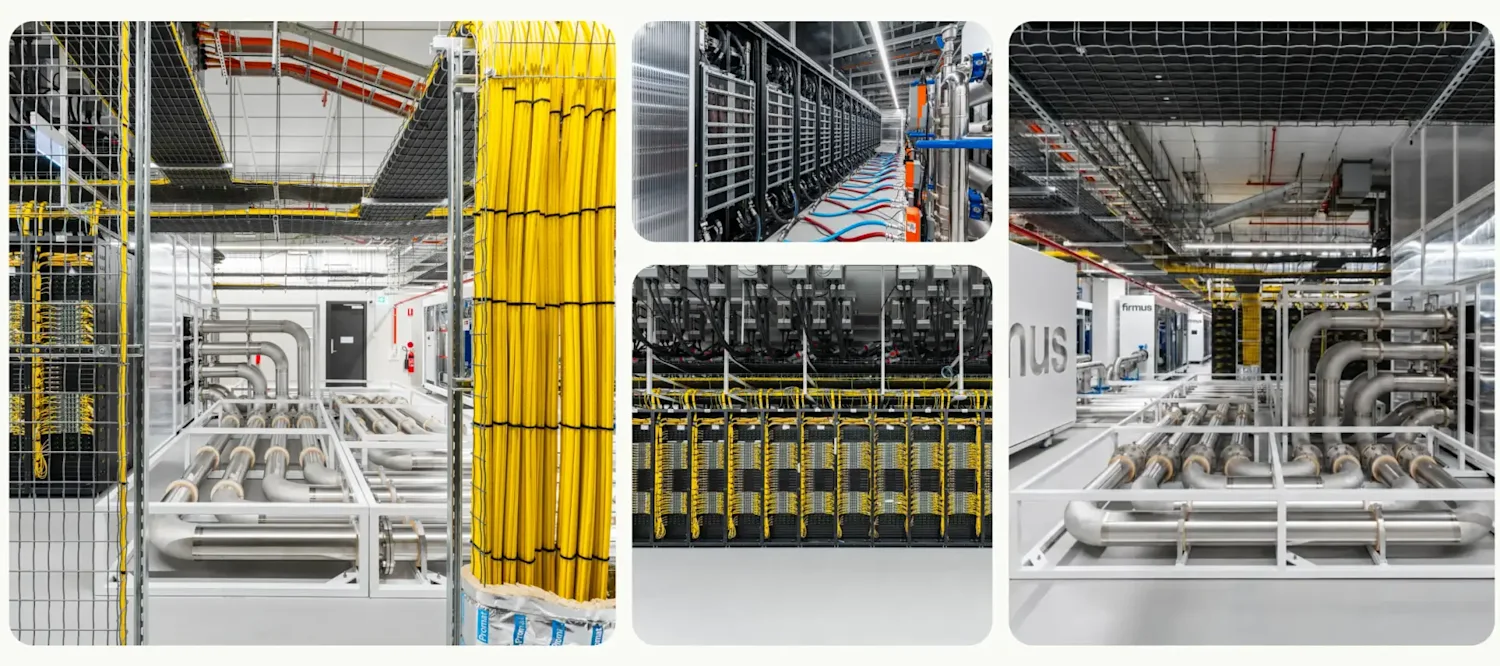
Source: Firmus. NVIDIA GB300 NVL72 systems, Firmus’ Melbourne AI factory
But the headline valuation is only part of the story. Firmus will give investors a new way to assess three big questions hanging over the data centre boom: how strong demand really is, how quickly new capacity can be built, and whether the economics can justify the enormous investment required.
Over the past few months, investor interest in the data centre theme has been building. NEXTDC [NXT] climbed from the 34th most-traded ASX stock on CMC Invest in August to 11th in September. Buys accounted for 88% of total NEXTDC orders in September, up from 68% in August, even as the shares fell around 20% over the month.
NEXTDC’s results also show what the build-out looks like in practice. The company reported FY26 net revenue of A$405 million, up 16%, while underlying EBITDA rose 15% to A$248.8 million. Contracted capacity, meaning capacity customers have agreed to take, more than tripled to 740 megawatts.
Data centre capacity is often measured in megawatts, or MW, which refers to the electrical power available to run servers and supporting equipment. Of NEXTDC’s 740MW contracted to customers, 175MW was being billed at year-end. In other words, around 565MW of contracted capacity had not yet reached the billing stage.
That distinction is important. Winning customer contracts can provide visibility over future demand, but capacity still needs to be built, connected and brought into service before it starts generating revenue.
And building it is not straightforward. The sector faces constraints ranging from access to power, water, land and chips to planning and community opposition. Goodman Group [GMG] recently scrapped plans for a A$1.2 billion data centre in Sydney’s Lane Cove after local backlash. Separately, the Australian Government is developing mandatory national standards for large data centres covering areas including energy and water use.
Both the pace of the build-out and the amount of data centre capacity ultimately required remain highly uncertain. On the technology side, more efficient AI models, better chips and open-source systems could reduce computing requirements for some tasks, while broader adoption and new AI applications could push demand higher.
Firmus and NEXTDC are only part of a broader listed data centre and digital infrastructure market. Other Australian names include DigiCo Infrastructure REIT [DGT] and Macquarie Technology Group [MAQ]. In the US, the sector spans established operators such as Equinix [EQIX] and Digital Realty [DLR], alongside AI infrastructure companies IREN [IREN] and Nebius [NBIS]. Investors can also access the theme through ETFs, including the Global X Data Center & Digital Infrastructure ETF [DTCR].
New to IPOs? CMC Invest’s guide to investing in IPOs explains how new listings work and some of the risks investors may want to consider.
Australia’s inflation problem is not over
October begins with investors digesting another RBA rate rise. On 29 September, the Board lifted the cash rate by 25 basis points to 4.60%, its fourth increase this year and the highest level in 15 years. The decision was unanimous.
The RBA said inflation remains too high, with some upside risks now materialising. Higher global energy prices, rising technology-related costs and continued pressure on domestic capacity were among the factors behind the decision. Higher fuel costs are also starting to flow through to the prices of other goods and services.
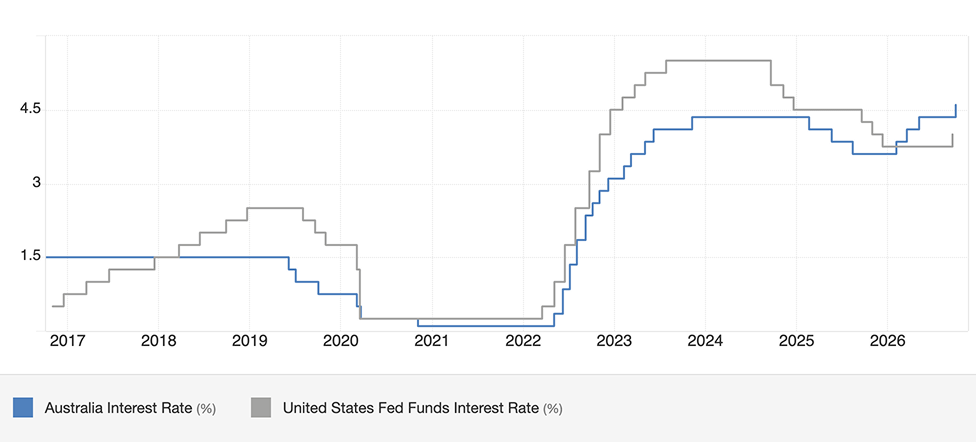
Source: Trading Economics
Fresh inflation data reinforced that concern. On 30 September, the ABS reported annual inflation rose to 4.0% in August, up from 3.5% in July, while trimmed mean inflation held at 3.6%. Monthly CPI data are released about four weeks after the reference month.
Housing costs rose 5.7% over the year and transport costs increased 5.6%, with higher fuel prices contributing to the rise. The bigger concern for the RBA is that underlying inflation remains above its 2% to 3% target range.
There are signs higher rates are having an effect. The RBA noted that consumer spending is easing, housing prices have fallen across most capital cities and new housing lending has declined noticeably. But so far, that slowdown has not been enough to bring inflation back under control.
Deputy Governor Andrew Hauser summed it up neatly in September. Australia has growth around trend, relatively low unemployment and rising real household incomes, but “one big problem”: inflation. The question is whether the tightening already delivered is enough.
Weak productivity makes that problem harder. If the economy cannot produce more efficiently, demand can run into capacity constraints sooner. Higher energy and other input costs can add further pressure if businesses pass them through to customers.
Higher rates can put pressure on indebted businesses, property companies and household spending. Retailers including Wesfarmers [WES], JB Hi-Fi [JBH] and Woolworths [WOW] can provide clues about the consumer. Banks such as Commonwealth Bank [CBA], NAB [NAB], Westpac [WBC] and ANZ [ANZ] may benefit from higher lending rates, but prolonged tightening can also slow credit growth and increase borrower stress.
A key date to watch will be 28 October, when the ABS is scheduled to release September CPI, just days before the RBA’s next meeting on 3 November. The US Federal Reserve also meets on 27 and 28 October, putting the final week of the month firmly in focus for global rates.
In October, investors will be watching whether the incoming data shows the tightening already delivered is starting to work. Developments in the Middle East and oil prices will also matter, given their potential to add further inflation pressure. A crude oil fund is currently the top-performing ASX-listed ETF of the year.
Want to go deeper? CMC Invest’s guide to interest rates explains how changes in rates can flow through the economy and different investments.
Big Tech reaches another earnings checkpoint
September raised the temperature around the AI trade again.
AI developments and breakthroughs now seem to be arriving in a constant stream rather than as isolated events. In September, OpenAI released GPT-6 Astra, Meta [META] launched Muse and expanded its push into AI glasses, while AMD [AMD] broke through US$600 and reached a US$1 trillion market capitalisation for the first time.
We also got a glimpse under the hood of one of the largest private AI companies.
A prospectus reviewed by Reuters showed Anthropic’s revenue jumped around twelvefold to nearly US$4.6 billion in 2025, while its operating loss widened to US$8.06 billion. The Claude maker spent US$7.33 billion on compute and infrastructure, more than its entire revenue for the year, while its two largest customers accounted for almost a quarter of sales. Anthropic’s public market debut is reportedly likely to come after the November US midterms.
CMC Invest activity across Big Tech and AI names appeared more cautious in September.
Buy orders accounted for just 37% of Microsoft [MSFT] total orders, 38% of Palantir [PLTR], 26% of Meta [META], 49% of Micron [MU] and 40% of AMD [AMD] total orders. That is unusually low for popular US technology stocks, where historical CMC Invest data has often shown buy shares closer to 70% to 80%. The shift towards sell orders outnumbering buys could suggest greater hesitation and some profit-taking after recent gains.
US third-quarter earnings season gets underway in mid-October. JPMorgan [JPM] reports on 13 October, with the major banks among the first large companies to report before attention turns towards the technology giants later in the month. Microsoft, Meta and Alphabet [GOOGL] are scheduled to report on 28 October.
For Microsoft, Amazon [AMZN] and Alphabet, cloud growth provides one read on enterprise demand, while capex, margins and cash flow show what it costs to service that demand. The scale of spending remains remarkable. S&P Global Market Intelligence estimates hyperscaler capital expenditure could reach around US$682 billion in 2026 and US$878 billion in 2027.
Meta presents a slightly different equation, with its highly profitable advertising business funding increasingly heavy AI investment. AMD and Micron sit closer to the infrastructure build-out, where processor and memory demand can provide another read on how quickly spending is flowing through the supply chain.
Earnings calls can be especially useful for understanding the story behind the numbers. Management commentary may provide clues on demand trends, pricing power, bottlenecks, capital expenditure and future priorities.
For now, strong earnings have helped support the scale of AI investment. The longer that spending continues, however, the more attention will shift towards what companies are getting back from it.
Disclaimer: This article provides general information only. It has been prepared without taking account of your objectives, financial situation or needs. It is not to be construed as a solicitation or an offer to buy or sell any financial instruments, or as a recommendation and/or investment advice. It does not intend to support an investment decision, and it should not be relied upon by you in evaluating the merits of investing in any financial instruments. You should consider your objectives, financial situation and needs before acting on the information in this article. CMC Markets believes that the information in this article is correct, and any opinions and conclusions are reasonably held or made on information available at the time of its compilation, but no representation or warranty is made as to the accuracy, reliability or completeness of any statements made in this article. CMC Markets is under no obligation to, and does not, update or keep current the information contained in this article. Neither CMC Markets nor any of its affiliates or subsidiaries accepts liability for loss or damage arising out of the use of all or any part of this article. Any opinions or conclusions set forth in this article are subject to change without notice and may differ or be contrary to the opinions or conclusions expressed by any other members of CMC Markets.