Monthly Outlook: Fed, Crypto, Oil

CMC Invest
11 minute read
|2 Sept 2026
Kevin Warsh Monthly Outlook - September
Table of contents
  • 1.
    Warsh and the rate decision
  • 2.
    Crypto’s regulatory test
  • 3.
    Iran war and oil disruption

August saw market attention centre on economic data and interest rate outlook, setting the stage for the US Federal Reserve to decide on its rate policy in mid-September.

Expectations of a rate hike have grown amid elevated inflation readings and a hawkish turn from the Fed’s new chief. This could hinder Bitcoin’s resurgent rally just as a key crypto bill heads to the Senate in September. But the monetary policy path can change quickly with developments in the Middle East, where diplomatic talks could shape the direction of oil prices, inflation and financial markets.

Warsh and the rate decision

New Federal Reserve chair Kevin Warsh provided markets with a rare glimpse on his interest rate policy approach at the Jackson Hole symposium, saying that the Fed “have work to do” to contain inflation that has remained above the Fed’s 2% target for more than five years.

Expectations of a 25-basis point rate hike in September rose to over 60% from about 40% before his speech, as interest rate traders saw the Fed as more inclined to tighten policy after Warsh noted that the US economy held strong and labour markets were near full employment, but inflation remained “too high”.

“Price stability is not self-executing, nor is inflation necessarily mean-reverting. It is the Fed’s job to deliver stable prices,” said Warsh to a global audience of central bankers in attendance at the Jackson Hole economic policy symposium.

Warsh further explained his concerns by noting that 54% of the 199 goods and services components of the personal consumption expenditures price index (PCE) basket showed price increases above 3% over the past 12 months. That compares with 32% in the two decades before the Covid-19 pandemic.

In his speech, Warsh reiterated his commitment to reduce “forward guidance” through Fed statements, press conferences and forecasts, which has been a regular practice since the 2008 global financial crisis.

Instead, he wants financial markets to react to economic data and developments, providing the Fed with market signals from treasury yields, credit conditions and dollar valuations to aid its policy decision-making.

“To get policy right, we also need to get the relationship right between financial markets and the central bank. The Fed needs clear market signals, as unfiltered as possible,” said Warsh.

Economic data due in September will therefore be under added focus ahead of the Fed’s next meeting on 15-16 September.

At its last meeting in July, the Fed maintained rates at 3.5% to 3.75%, citing the need for more data to assess the inflation outlook.

Since then, US inflation as measured by the PCE index rose 3.7% year-on-year in July, ahead of expectations of 3.6%. Core PCE, which excludes volatile items such as food and energy, rose 3.3% y/y and 0.2% month-on-month in July.

Before the next inflation report, market attention will turn to non-farm payrolls and unemployment rate data on 4 September for evidence supporting Warsh’s assessment that the labour market is stable.

The unemployment rate in the US stood at 4.1% in July, a level Warsh described as “low by historical standards”. Trading Economics expects it to remain at the same level in August.

Inflation data will follow on 11 September. Sticky inflation alongside a resilient labour market would strengthen the case for a rate hike, while softer price and employment data could give the Fed more reason to remain on hold.

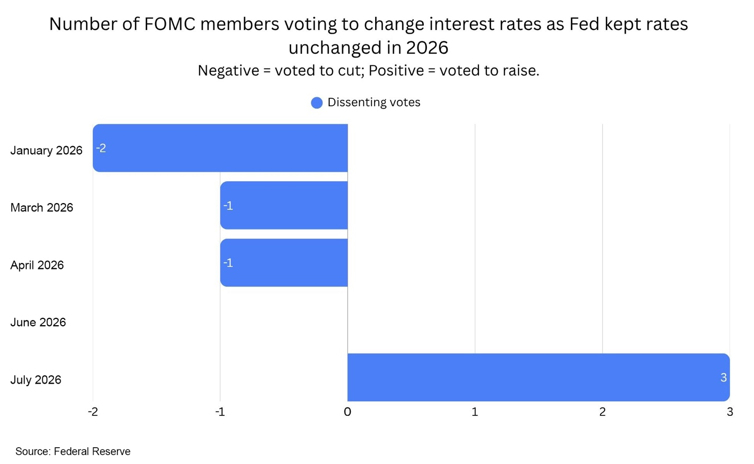
Number of FOMC members voting to change interest rates as Fed kept rates unchanged in 2026

Overall, Warsh’s hawkish stance has raised expectations for a September rate hike, while pressure to tighten policy is also building within the Federal Open Market Committee (FOMC). As shown above, three out of 12 FOMC members voted for a rate hike in July, a sharp reversal from the start of the year when no members backed a hike and two favoured a cut.

With that said, the August jobs and inflation reports could ultimately determine whether policymakers will follow through.

Crypto’s regulatory test

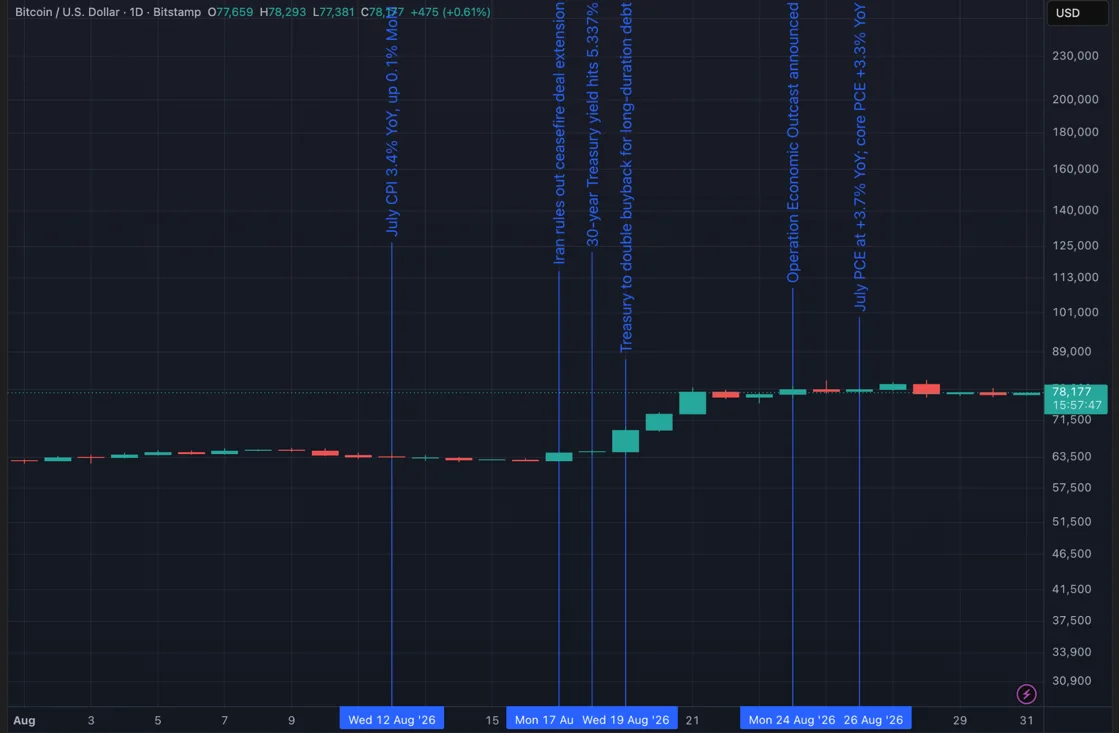
Bitcoin [BTC] staged a strong comeback in August, rising more than 24% to record its best monthly performance in nearly two years.

At the end of August, BTC was trading at about $78,000, roughly 35% higher than the 2026 low of $57,748 hit on 1 July.

Optimism spread to Ethereum [ETH] and Solana [SOL], which surged 31% and 41%, respectively, in August, while crypto-linked stocks such as digital asset exchange Coinbase [COIN] and bitcoin treasury company Strategy [MSTR] rose in tandem, closing the month 22% and 36% higher, respectively.

As shown in the image below, much of the rally came in the second half of August – a period that saw market attention drawn to elevated inflation readings, continued geopolitical tensions, 19-year-high long-term US treasury yields and the US Treasury’s decision to double long-dated debt buybacks.

BTC/USD

These events forced investors to revisit the existing investment narratives around bitcoin such as inflation protection, safe-haven demand and dollar debasement.

Bitwise Chief Investment Officer Matt Hougan was among those revisiting these narratives.

He described the Treasury’s bond buybacks as an attempt to “artificially suppress long-term interest rates”. Hougan also argued that efforts to cut off Iran from the global economy through sanctions under the Operation Economic Outcast campaign strengthened the case for neutral monetary settlement networks such as bitcoin.

However, the foundations for a crypto recovery had already been forming. As discussed in last month’s outlook, bitcoin held by long-term holders (LTH) reached an all-time high in July. At the end of August, supply held by this high-conviction investor group remained robust, falling only about 1% m/m, as some investors booked profits during BTC’s run up to over $80,000.

Renewed demand for spot BTC ETFs provided another source of support. BTC ETFs recorded $3.31bn in monthly net inflow in August, up from $172.43m net inflow in July and $4.51bn net outflow in June, data compiled by SoSoValue showed.

Ethereum and Solana ETFs recorded similar trends. ETH ETFs recorded its highest net inflows in 12 months at $1.76bn, while Solana ETFs inflows jumped to $192.62m in August from $14.62m in June.

Increased institutional interest in tokenisation has helped these two smart-contract blockchains stay relevant over the years. However, in 2026, it was a newer project in Hyperliquid [HYPE] – a decentralised exchange that allows anyone to create future contracts tied to any asset from artificial intelligence (AI) stocks to pre-IPO assets to commodities – that has emerged as the clear winner.

In August, HYPE surged over 55% after US President Donald Trump informed a White House gathering of cryptocurrency executives that the CFTC was “working to bring Hyperliquid into the US in a fully compliant and legal fashion.

With regulations remaining a major crypto catalyst, attention now turns to the CLARITY Act in September. The US Senate is scheduled to hold its first procedural vote on 15 September on the legislation that aims to establish a federal market structure for crypto, including clearer responsibilities for market regulators SEC and CFTC.

The vote, however, is far from certain to succeed, with disagreements emerging on ethics provisions that look to restrict the president, vice president, senior government officials and their spouses from profiting from crypto products.

Having seen President Trump earn $1.4bn in 2025 from his crypto ventures such as World Liberty Financial [WLF], critics led by Senator Elizabeth Warren argued that the current bill must close “massive loopholes” that would still allow Trump to profit from existing crypto interests and by structuring new ones.

Trump, meanwhile, has voiced support for the legislation, with The Block reporting that he called for a “fair version” of the CLARITY Act to be passed at a private meeting. SEC Chairman Paul Atkins has also backed the bill, describing it as “common-sense regulation” that could support crypto businesses, protect investors and encourage financial innovation.

For investors, September will test whether crypto assets can sustain their August rally. Continued ETF inflow, resilient long-term holder supply and regulatory progress support the case, but a failure to advance CLARITY and tighter monetary policy remain key risks.

Iran war and oil disruption

The world is six months into the Iran war. In that time, ceasefire agreements have broken down, while the US offensive has shifted from airstrikes to economic sanctions and naval blockades. The situation remains fluid and susceptible to change.

What has not changed is that another oil shock remains the biggest risk to inflation and interest rate outlook.

In August, the International Energy Agency (IEA) estimated that the global oil market would face a supply deficit of 1.8m barrels per day in Q3 2026, more than double its July estimate of 800,000 barrels per day.

The sharp revision goes to show just how difficult it is to forecast the oil markets right now. Conditions are constantly changing, as highlighted by IEA’s report that an expected recovery of Gulf oil supply following the June ceasefire was disrupted by renewed hostilities.

The global oil market has relied partly on existing inventories to bridge the gap between supply and demand. But the IEA has warned that the inventory buffers are “rapidly depleting” and noted the urgency of the re-opening of the Strait of Hormuz.

Following the expiration and non-renewal of the ceasefire between the US and Iran on 17 August, the Hormuz Strait Monitor reported that the Strait was operating at 1% of pre-war traffic with “effectively zero tankers moving.” At the same time, tankers using the Red Sea as an alternate route to transport crude have faced persistent missile attacks from the Yemen-based Houthi group.

Diplomatic efforts are continuing with Qatar stepping up as the mediator. Reuters reported that Iran and Oman were working on a deal to re-open the Strait, manage traffic and potentially share its revenues. Progress, however, depends on a list of Iranian demands reportedly including an end to US blockade, sanctions relief and compensation.

Pessimism remains high, with prediction markets showing just a 3% chance of the Strait of Hormuz returning to normal by the end of September.

In the US, President Trump looked to shore up American energy independence by signing an agreement with Venezuela to access the South American nation’s rich crude oil reserves. The deal will let American companies develop 17 oil fields with proven oil reserves of 65bn barrels, Venezuela’s acting President Delcy Rodríguez said in a statement posted on Telegram on 29 August.

Chevron [CVX] – the only US oil producer actively producing in Venezuela – was reportedly finalising deals that would give it greater control over its Venezuelan operations and allow it to expand oilfields.

Rivals ExxonMobil [XOM] and ConocoPhillips [COP] were reported to remain on the sidelines, according to the Wall Street Journal, as the firms seek compensation from the Venezuelan government for nationalising their assets in 2007.

US oil majors have emerged among the biggest winners of the oil supply shock. CVX, XOM and COP reported multi-year high quarterly profits during the July-August earnings season, and have returned between 30% and 42% year-to-date to August end. The iShares US Oil and Gas Exploration and Production ETF [IEO] has returned about 52% in the same period.

Oil services company Halliburton [HAL] was also reportedly in talks to provide equipment to oil producers in Venezuela. SLB [SLB] and Baker Hughes [BKR] are also said to be exploring opportunities.

More broadly, higher oil prices and expectations of increased drilling have benefitted drilling contractors such as Nabors Industries [NBR] and Helmerich and Payne [HP], up 68% and 52% year-to-date, respectively. Refiners have also benefitted, with Marathon Petroleum [MPC] more than doubling its share price in 2026, supported by surging global refining margins.

At the other end of the spectrum are airlines, which have faced a sharp increase in fuel cost. The jet fuel crack spread – the price difference between crude oil and refined fuel – surged from about $20 per barrel in January to about $67 per barrel in the fourth week of August, data compiled by the International Air Transport Association showed.

In August, Delta Air Lines [DAL], American Airlines [AAL], Southwest Airlines [LUV] and United Airlines [UAL] fell between 10% and 14%. International peers also declined, with Australia’s Qantas [QAN] down about 5.3%.

At the end of August, Brent crude prices traded over 20% above their pre-war prices at about $90 per barrel.

The Fed entered 2026 on a monetary easing path. The Iran war changed that. Six months on, the initial shock has faded, but the war remains a major risk to inflation, interest rates and even to the AI infrastructure buildout, where investors are starting to show nerves over its expensive financing costs.

Disclaimer: This article provides general information only. It has been prepared without taking account of your objectives, financial situation or needs. It is not to be construed as a solicitation or an offer to buy or sell any financial instruments, or as a recommendation and/or investment advice. It does not intend to support an investment decision, and it should not be relied upon by you in evaluating the merits of investing in any financial instruments. You should consider your objectives, financial situation and needs before acting on the information in this article. CMC Markets believes that the information in this article is correct, and any opinions and conclusions are reasonably held or made on information available at the time of its compilation, but no representation or warranty is made as to the accuracy, reliability or completeness of any statements made in this article. CMC Markets is under no obligation to, and does not, update or keep current the information contained in this article. Neither CMC Markets nor any of its affiliates or subsidiaries accepts liability for loss or damage arising out of the use of all or any part of this article. Any opinions or conclusions set forth in this article are subject to change without notice and may differ or be contrary to the opinions or conclusions expressed by any other members of CMC Markets.