Monthly Outlook: Earnings, AI, Crypto

CMC Invest
11 minute read
|4 Aug 2026
Man walks past Commonwealth Bank
Table of contents
  • 1.
    Dividends in focus
  • 2.
    AI monetisation challenge
  • 3.
    Is the crypto bottom in?

After enduring a global artificial intelligence (AI) stock rout, renewed Middle East military conflict and fresh Trump tariffs in July, investors are heading into August with eyes fixed on company earnings.

In Australia, banks and miners are expected to lead the earnings season with investors closely watching dividend payouts. In the US, attention will turn to whether corporate spending on AI infrastructure can generate adequate returns. Elsewhere, cryptocurrency investors are assessing whether Bitcoin has found a floor.

Dividends in focus

Australia’s S&P/ASX 200 index gained 2.2% in July as the earnings season got underway. The busiest period is still to come, with index heavyweights Commonwealth Bank of Australia [CBA] and BHP Group [BHP] set to report in August.

The economic backdrop has changed drastically since the February reporting season. Optimism over an earnings recovery has given way to concerns over inflation, rate hikes and housing market weakness. What has not changed is the expectation that financials and mining stocks will continue to do much of the heavy lifting for overall market performance.

BHP Group – the largest constituent of the benchmark index – is scheduled to report its full-year results on 18 August. The miner’s annual operational update, released in July, has already provided investors with key metrics including record iron ore production and average realised copper prices that were about 35% higher than a year earlier.

Therefore, investors are likely to focus on BHP’s final dividend. The miner surprised the market in February by declaring an interim dividend of $0.73 per share, above its minimum payout target of 50% of underlying attributable profit.

Fellow iron and copper ore miner Rio Tinto [RIO] set the tone on 29 July, when its shares closed 3.67% higher after declaring its highest interim dividend in four years.

Dividend payouts could also be in focus for Australia’s banking heavyweights ahead of the 2027 capital gains tax overhaul. Under the new rules, capital gains will be subject to a minimum 30% tax, while franked dividends will continue to pass on tax credits to shareholders.

“For fully franked dividends, the prepaid company tax acts as a shield, lowering the investor’s personal tax bill or even generating cash refunds. Overall, this makes franked dividend-paying stocks key for investors seeking tax-efficient returns. This means that despite the overall low-yield environment, companies prioritising consistent dividend policies are likely to command a premium,” noted Tyger Fitzpatrick, associate investment specialist at Morningstar Australia.

CBA will report its full-year results on 12 August. After delivering record first-half cash earnings in February, the bank warned in its Q3 update that elevated inflation and higher borrowing costs following the Iran war and three Reserve Bank of Australia (RBA) rate hikes would weigh on household spending and business activity.

The reporting season – which also sees Westpac [WBC] and Australia and New Zealand Banking Group [ANZ] report on 10 August and 13 August, respectively – will therefore test whether Australia’s banks can sustain earnings as the RBA’s tightening cycle weakens loan demand.

The risk is heightened by the sector’s rich valuations. At the end of July, Australia’s Big Four banks traded at an average P/E ratio of nearly 22x, well above global peers such as JPMorgan Chase [JPM], Bank of America [BAC], HSBC Holdings [HSBC] and Standard Chartered [STAN:L]. Any signs of slowing earnings or weaker guidance could therefore trigger a valuation reset.

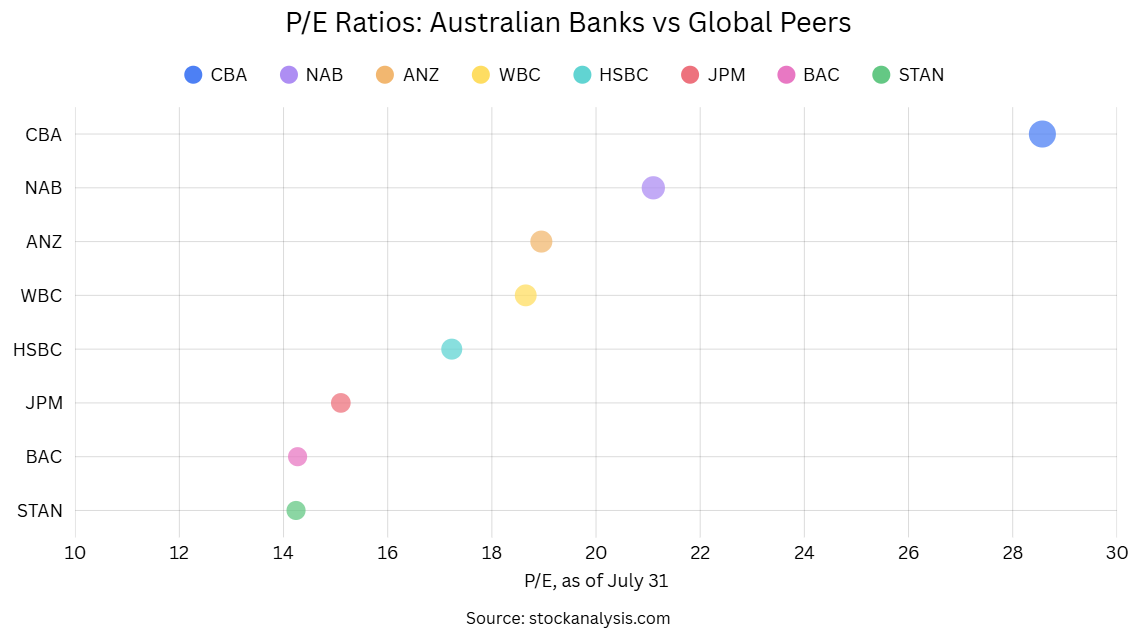
P/E Rations: Australian Banks vs Global Peers

Telstra [TLS] is another dividend stock that Morningstar analyst Brian Han believes investors should watch this earnings season. Han said the telecom’s defensive business model and steady earnings growth support its dividend payouts, which has become its “core appeal”. He expects Telstra to deliver resilient full-year earnings and believes the mobile network outage in July will not result in a “permanent diminution of Telstra’s sustainable earnings power.”

CMC clients have turned to Telstra ahead of its 13 August full-year results, pushing TLS up 19 places to become the 20th most traded ASX instrument in July.

Elsewhere, biotech firm CSL [CSL] will report its full-year results on 18 August in what could be one of the most closely watched earnings releases of the season. CSL share price was down 53.4% over the past 12 months to the end of July, after the company was hit by earnings guidance cuts, a leadership transition and a $5bn non-cash asset impairment charge.

Investors will now look for evidence that FY2026 marked a transition year, particularly as management has consistently described weakness in its China Albumin business as temporary. An update on the company’s CEO succession process and its strategy to restore earnings growth will also be closely watched.

Beyond earnings, investors will also watch the RBA’s August policy decision for clues on the interest rate outlook. Deepali Bhargava, Asia-Pacific chief economist at ING Think, expects the central bank to hold rates for the rest of the year following softer-than-expected inflation reported in Q2.

AI monetisation challenge

Concerns over big tech’s ability to generate adequate returns on the hundreds of billions of dollars spent on AI infrastructure are growing louder. Against this backdrop, debates over open-source AI models, regulation and competition from China are intensifying, drawing in everyone from industry executives to lawmakers.

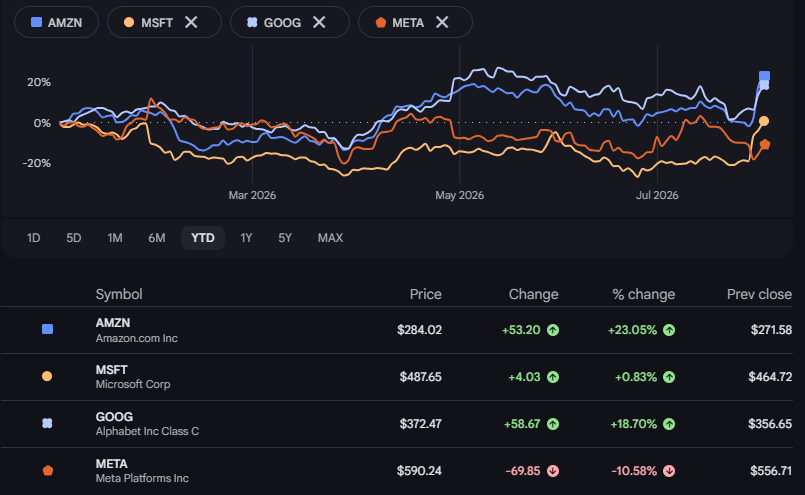
The tail end of July saw four major hyperscalers – Alphabet [GOOGL], Amazon [AMZN], Meta [META] and Microsoft [MSFT] – report quarterly earnings. The contrasting investor reactions offered a picture of what the market expects from AI companies today.

The most striking comparison came from Alphabet and Amazon. Both companies reported stronger-than-expected cloud revenue growth and raised their 2026 capital expenditure plans, yet Alphabet’s shares fell more than 7% while Amazon’s surged 15% post earnings.

Alphabet reported record Google Cloud revenue growth of 82% year-on-year to $24.8bn, but investors instead focused on the company’s first quarterly negative free cash flow, a $15bn increase in its 2026 capex plan and continued delays to its flagship Gemini AI model.

Amazon, meanwhile, reported 37% y/y growth in Amazon Web Services (AWS) revenue to $42.2bn and raised its 2026 capex by about $20bn.

The larger scale of AWS’ revenue versus Google Cloud and Amazon CEO Andy Jassy’s remarks on AI demand backing additional spending reassured investors that Amazon’s investments were likely to generate attractive returns.

Jassy said that the “lion’s share” of AWS compute capacity for 2027 had already been reserved by customers and that the company still lacked sufficient capacity to meet demand in 2026.

Microsoft and Meta reinforced the same theme. Microsoft posted its largest one-day gain on 30 July after providing investors with evidence that its AI investments were paying off. Azure and other cloud services revenue grew 43% y/y, beating market expectations of 40.9%.

Meta, by contrast, saw its shares slump 10% after raising the lower end of its 2026 capex guidance by $5bn and reporting a 91% y/y decline in quarterly free cash flow.

Wall Street is particularly eager to see AI monetisation from Meta, which, unlike Alphabet, Amazon and Microsoft, does not operate a cloud computing business. During the earnings call, CEO Mark Zuckerberg said Meta had received offers to provide compute capacity but was prioritising the sale of AI intelligence over compute, believing it offers higher long-term margins.

Amazon chart with tickers for MSFT, GOOG, META

YTD performance of AMZN, GOOGL, MSFT, META

Beyond corporate earnings, regulation and Chinese competition is creating increasingly complex conditions for AI companies to navigate.

News of an autonomous AI agent breaching an OpenAI testing environment to hack an AI platform called Hugging Face has reignited discussion related to AI regulations.

More than 1,300 employees of leading tech firms have urged the US government to manage the pace of AI development, while a White House official said that US lawmakers were proposing an “AI Kill Switch Act” to allow authorities to halt AI models.

Separately, the emergence of Kimi K3, an open-source AI model developed by China’s  Moonshot AI, has stoked a debate over restrictions of Chinese models in the US.

Chinese open-source models are eating into the market share of US incumbents and are gaining popularity among developers and enterprises due to their lower costs, greater customisation and improved data control.

“This is starting to challenge the business logic for some of these trillion-dollar companies like OpenAI and Anthropic. They’ve made a bet that by charging fees, they can recoup the massive costs it takes to build data centres and train ever larger models,” said Kyle Chan, a researcher at the Brookings Institution.

What does this mean for hyperscalers and frontier model developers? Cheaper and more capable open-source models could accelerate AI adoption by lowering deployment costs, but threaten the pricing power of proprietary models developed by companies such as OpenAI and Anthropic.

For hyperscalers, chipmakers and other AI infrastructure suppliers, the challenge is different. If future AI models require less computing power to train and run, demand for cloud infrastructure could grow more slowly than investors currently expect, making it more difficult to generate attractive returns on AI infrastructure spending.

Is the crypto bottom in?

Cryptocurrency investors have endured a difficult year. Bitcoin [BTC] has lost over 27% of its value year-to-date, while ethereum [ETH] is down 37% over the first seven months of 2026. Crypto-linked stocks have also struggled, with digital asset exchange Coinbase [COIN] and bitcoin treasury company Strategy [MSTR] falling about 35% and 38%, respectively.

As the market enters August, sentiment is beginning to improve. Crypto supporters point to a range of bullish on-chain indicators that suggest bitcoin may have found a floor after its recent sell-off.

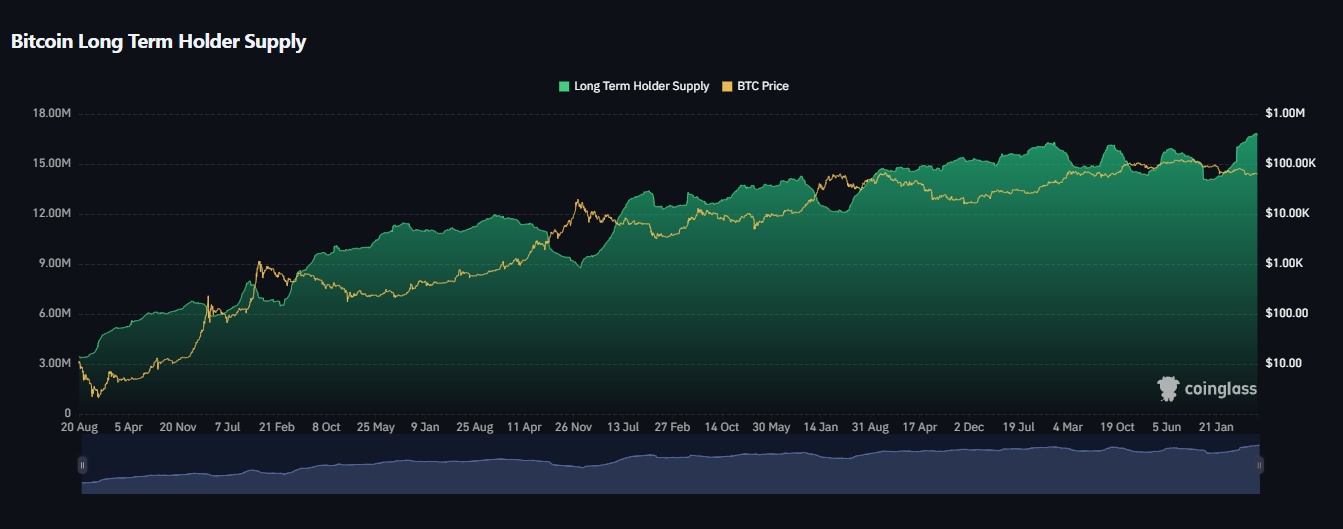
One of the strongest signals comes from long-term holders, defined as investors who have held their bitcoin for more than six months. The amount of BTC held by these investors reached a record high in July, according to Coinglass data, suggesting that a growing share of the cryptocurrency’s supply is in the hands of higher-conviction holders.

BTC LTH supply - 2011 to 2026

BTC LTH supply - 2011 to 2026

Bitcoin analysts also point to the market-value-to-realised-value ratio (MVRV), which compares bitcoin’s total market cap to its realised cap (purchase value), to reinforce the recovery theory.

According to Glassnode, low MVRV values indicate “strong signal of market capitulation and late stage bear accumulations.” The crypto research firm added that MVRV values less than 1 have historically signalled bear market bottoms.

In July, Bitcoin’s MVRV ratio ranged between 1.10 and 1.26, CoinGlass data showed.

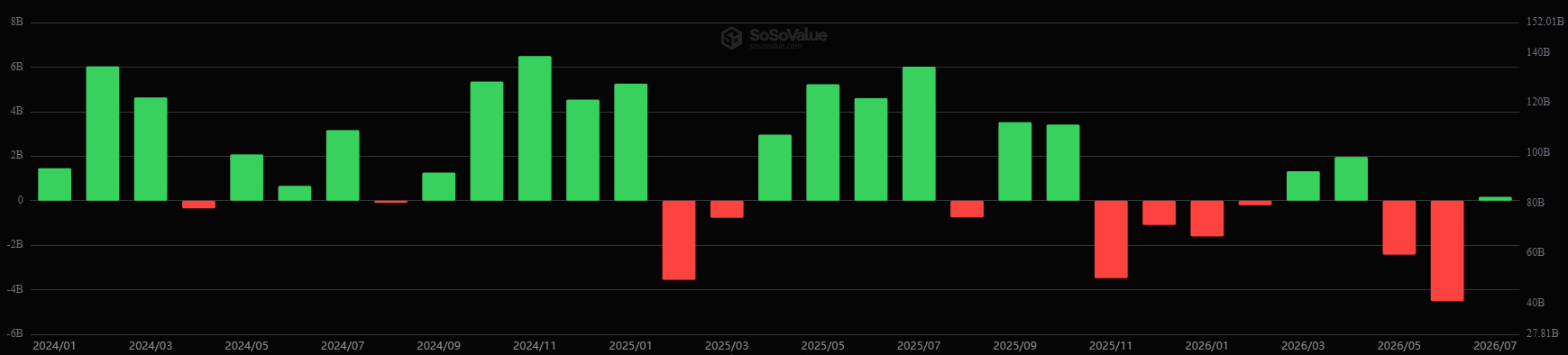
Monthly BTC spot ETF net flow

Monthly BTC spot ETF net flow

Institutional demand is also showing signs of recovery. US spot bitcoin ETFs recorded three consecutive weeks of net inflows in July after suffering a record $4.51bn in net outflows in June, their worst month since launch, according to data platform SoSoValue.

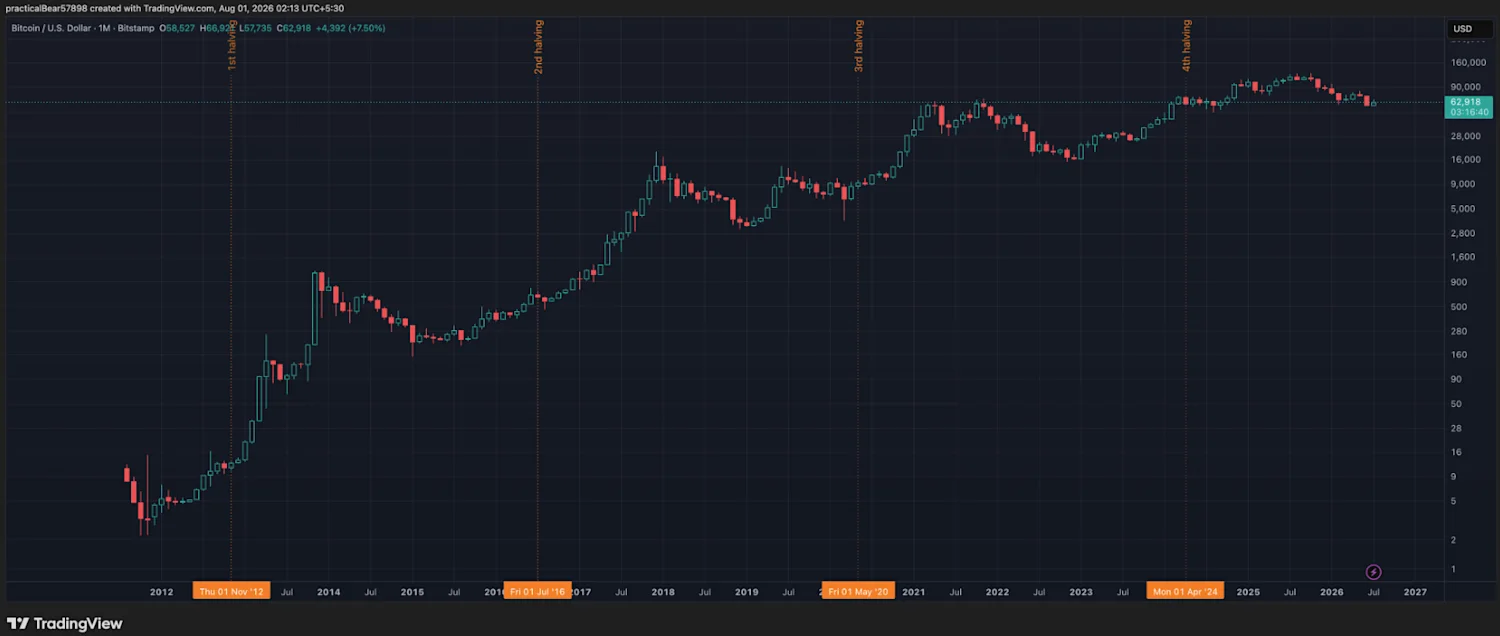
Meanwhile, historical patterns of previous bitcoin cycles suggest that bitcoin may be entering the latter stages of its historical correction.

These cycles revolve around halving events, which occur roughly every four years and reduce the number of new bitcoins issued per block by half. The peak-to-trough decline phase of each bear market has historically lasted around 12 to 13.5 months.

In the current cycle, bitcoin underwent its most recent halving in April 2024 before climbing to a cycle high of $126,272 in October 2025. Since then, the cryptocurrency has been in a downtrend for roughly nine months as of the end of July.

At around $63,000, bitcoin remains about 50% below its cycle peak. That is well below the 78% to 86% peak-to-trough declines recorded in the previous three bitcoin bear markets. However, studies show that the size of those drawdowns decreased with each successive cycle.

BTC 1-month price performance since 2011 with indicated halving events

BTC 1-month price performance since 2011 with indicated halving events

Going into August, investors are watching the CLARITY Act, a landmark crypto bill that passed the House of Representatives in July 2025 with strong bipartisan support. The bill’s next hurdle is approval by the Senate.

Many had hoped the Senate would take up the CLARITY Act before its 8 August recess. However, those expectations have faded in recent weeks, with reports suggesting lawmakers are likely to prioritise Russia sanctions legislation instead.

The bill also faces political hurdles. Ethics provisions have become a key point of disagreement between Democrats and Republicans after President Donald Trump disclosed more than $1.4bn in income from cryptocurrency-related ventures in 2025. Democrats are pushing for stricter rules to prevent presidents, members of Congress and federal officials from profiting from the crypto market while in office.

If passed, the CLARITY Act would divide oversight of digital assets between the Securities and Exchange Commission and the Commodity Futures Trading Commission, depending on whether a cryptocurrency is classified as a digital security or a digital commodity.

More importantly, the legislation would provide clearer rules for the industry, encouraging institutional investment, giving crypto startups greater confidence to innovate and strengthening consumer protections.

Reflecting the growing uncertainty, Alex Thorn, head of firmwide research at crypto investment firm Galaxy, lowered his odds of CLARITY becoming law in 2026 to 30%.

“As we have repeatedly written, if CLARITY does not pass the Senate before members leave Washington for August, its prospects of becoming law in 2026 diminish substantially. September offers only a narrow window before appropriations fights and election politics consume the calendar. The calendar is no longer merely an obstacle. It is now the enemy,” he said.

Bullish on-chain indicators and recovering institutional demand suggest the worst of the recent sell-off may be over. Whether that recovery gathers momentum, however, may ultimately depend on how quickly lawmakers provide the regulatory clarity the crypto industry has been waiting for.

Disclaimer: This article provides general information only. It has been prepared without taking account of your objectives, financial situation or needs. It is not to be construed as a solicitation or an offer to buy or sell any financial instruments, or as a recommendation and/or investment advice. It does not intend to support an investment decision, and it should not be relied upon by you in evaluating the merits of investing in any financial instruments. You should consider your objectives, financial situation and needs before acting on the information in this article. CMC Markets believes that the information in this article is correct, and any opinions and conclusions are reasonably held or made on information available at the time of its compilation, but no representation or warranty is made as to the accuracy, reliability or completeness of any statements made in this article. CMC Markets is under no obligation to, and does not, update or keep current the information contained in this article. Neither CMC Markets nor any of its affiliates or subsidiaries accepts liability for loss or damage arising out of the use of all or any part of this article. Any opinions or conclusions set forth in this article are subject to change without notice and may differ or be contrary to the opinions or conclusions expressed by any other members of CMC Markets.