Why are investors paying attention?
The idea of humanoid robots is not new. The world's first full-scale humanoid robot, WABOT-1, was unveiled in Japan in 1973. What has changed is that several factors are converging to make the technology increasingly compelling from an investment perspective. Four stand out.
1. Demographics are driving structural labour shortages
Many developed economies are facing a significant demographic shift. People are living longer and populations are ageing, increasing demand for healthcare, aged care, logistics and other essential services. At the same time, birth rates are falling and growth in the working-age population is slowing or declining. Across the OECD, the working-age population (typically defined as those aged 20 to 64) is projected to decline by around 8% by 2060, with declines exceeding 30% in more than a quarter of member countries.
This creates a growing imbalance: more people needing goods and services, but fewer workers available to provide them.
These demographic pressures are already contributing to labour shortages, creating strong incentives to automate repetitive, physically demanding and difficult-to-fill roles. As these trends are expected to persist for decades, the long-term economic case for technologies that can supplement the workforce continues to strengthen.
2. Artificial intelligence is making general-purpose robots possible
Traditional industrial robots have been used in factories for decades, but they typically perform a single repetitive task inside carefully controlled environments.
Recent advances in artificial intelligence are changing that.
Large language models, computer vision, reinforcement learning and vision-language models are giving robots a much better understanding of their surroundings, allowing them to interpret instructions, recognise objects, adapt to changing environments and perform a broader range of tasks.
But AI doesn't just make robots more capable. It also changes how they learn, improve and share capabilities over time.
Every robot deployed generates valuable real-world data. Combined with advances in simulation and synthetic training environments, this creates a powerful feedback loop where real-world deployments improve the underlying AI models, making both existing robots and future deployments more capable through software updates.
This collective learning may prove to be one of humanoid robotics' greatest advantages. Think about learning tennis. You can spend a decade practising until your serve, footwork and shot selection become second nature, but you can't simply transfer that embodied knowledge to someone else. Every player has to build those skills through years of practice.
Humanoid robots could be fundamentally different. A newly manufactured robot can boot up for the first time already equipped with capabilities that took millions of hours of real-world experience, simulation and training to develop. As more robots are deployed, that shared knowledge can continue to improve, with new skills, refinements and software updates distributed across every compatible robot. Rather than every worker independently climbing the same learning curve, each new robot could begin where the last one left off.
3. Manufacturing is finally catching up
Building a capable humanoid robot has long been technically possible. Building one cheaply enough for widespread commercial adoption has been the bigger challenge.
That is beginning to change.
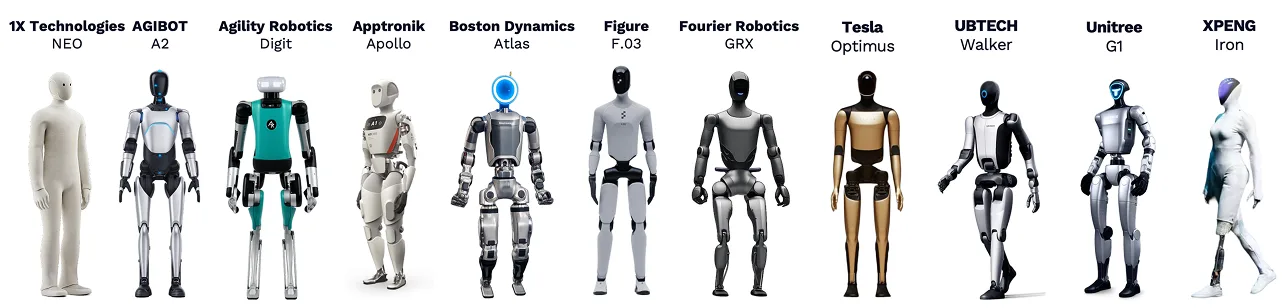
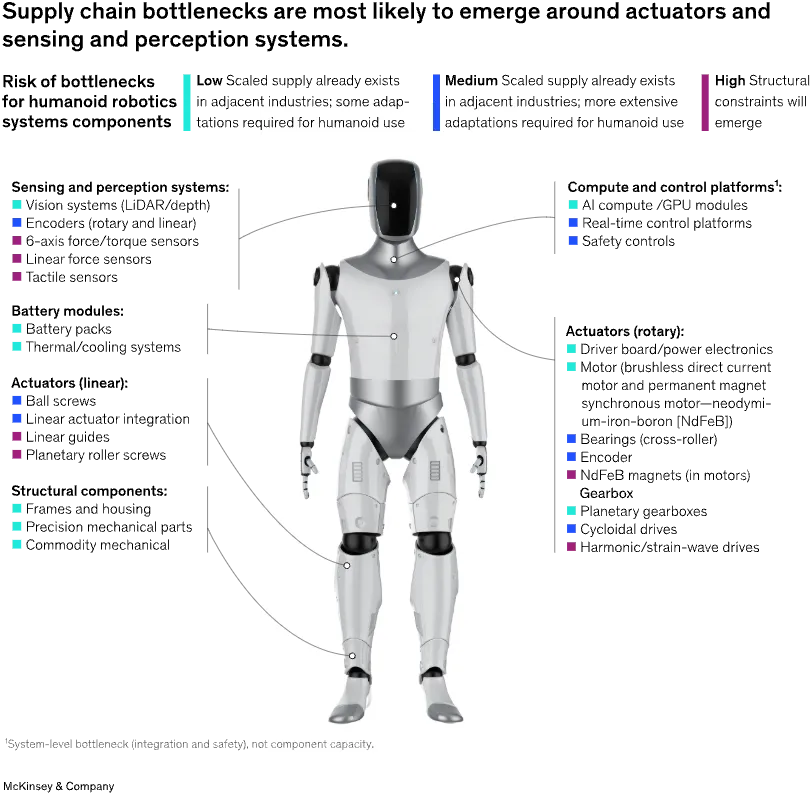
Many of the technologies underpinning electric vehicles, including batteries, electric motors, sensors, actuators and advanced manufacturing techniques, are now being applied to humanoid robotics. Companies such as Tesla, XPeng and BYD are leveraging expertise developed through EV production to help reduce costs and scale manufacturing. In many ways, the electric vehicle industry has unintentionally built much of the manufacturing foundation humanoid robotics now relies on.
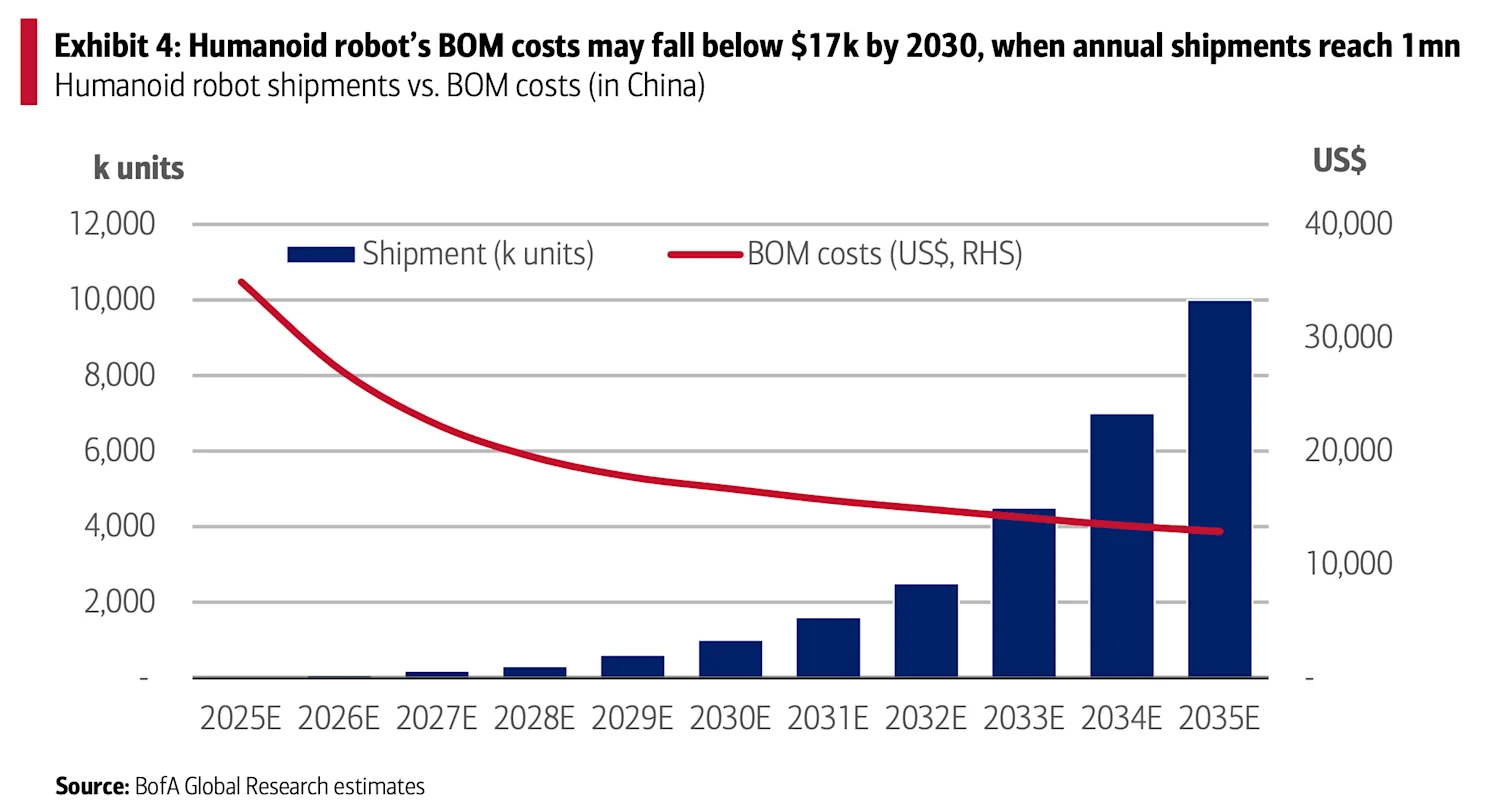
At the same time, falling component costs and improvements in manufacturing efficiency are making humanoid robots increasingly economical for certain commercial applications. BofA Global Research estimates the bill of materials (BOM) cost of a humanoid robot could fall to US$13,000 to US$17,000 per unit by 2030 to 2035, driven by economies of scale and improved component design.