The space economy: how falling launch costs, satellites, and SpaceX are reshaping an industry

6 minute read
|18 Nov 2026
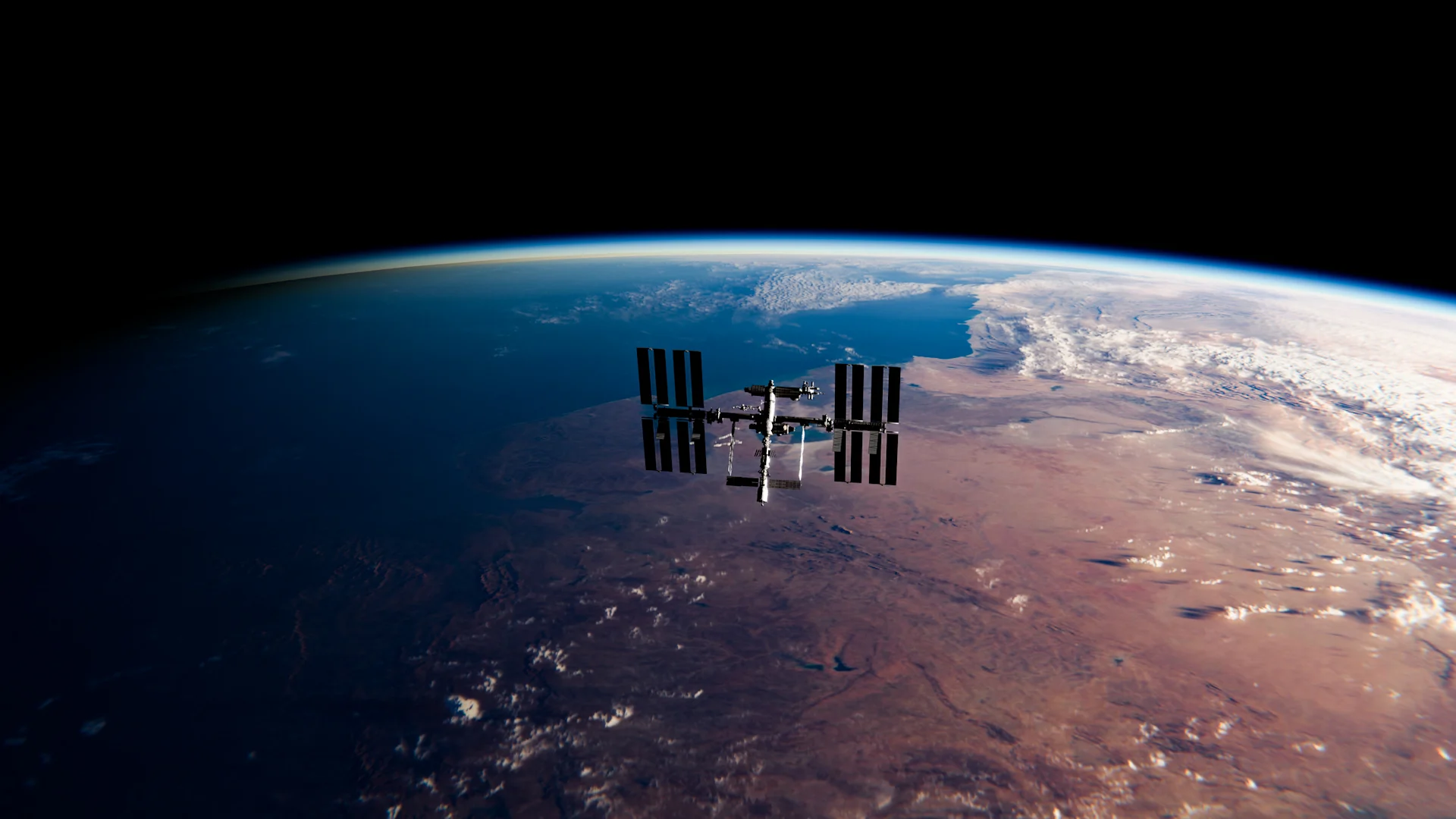
International Space Station (ISS) Orbiting Earth in Space - SpaceX & NASA Research
Table of contents
  • 1.
    What is the space economy, and why does it matter? 
  • 2.
    Why falling launch costs changed everything 
  • 3.
    SpaceX low Earth orbit launch cost per kg  
  • 4.
    Where does SpaceX fit in the space economy? 
  • 5.
    The wider ecosystem: satellites, communications, orbital compute, and defense 
  • 6.
    How do leading space companies compare? 
  • 7.
    Top traded space stocks on CMC Invest in Australia 2026 

This article is brought to you by ARK Invest

Written by: Tasha Keeney, CFA, ARK Invest Director of Research, Autonomous Tech. & Robotics and Daniel Maguire, ARK Invest Research Analyst 

What is the space economy, and why does it matter? 

The space economy is the full set of activities, products, and services that create value from space: launch, satellites, communications, Earth observation, navigation, and defense. It matters now because falling launch costs have lowered the price of reaching orbit, enabling commercial applications that previously were uneconomical and encouraging greater government spending. According to SpaceX, the total addressable market for a vertically integrated space provider is ~$28.5 trillion, including ~$2 trillion for space and connectivity. 

Why falling launch costs changed everything 

ARK’s research suggests that, thanks to reusable rockets, SpaceX has cut launch costs by roughly 95%, from about $15,600 per kilogram in 2008 to under $1,000 (in 2025 dollars). SpaceX has a decade-long lead in recovering orbital-class boosters. It first landed one in 2015 and has since completed more than 670 landings as of October 2026. Blue Origin’s New Glenn completed its first orbital-class booster landing in November 2025. Both Blue Origin and China have completed two such landings, more than a decade after SpaceX achieved the first. 

ARK's research applies Wright's Law, the observation that costs fall by a constant percentage with each cumulative doubling of output. For launch, that is about 17% per doubling of total mass sent to orbit. On that trajectory, ARK's research suggests that Starship could extend the trend toward $100 per kilogram at scale, thanks to full reusability.  

SpaceX low Earth orbit launch cost per kg  

Stage 

Period 

Cost per kg to Low Earth Orbit (LEO) 

Change vs. 2008 

Falcon 1 

2008 

~$15,600 

Baseline 

Falcon 9, partially reusable 

2025 

Under ~$1,000 

~95% lower 

Starship, fully reusable (ARK forecast) 

At scale 

~$100 

~99% lower 

 Because each doubling of cumulative launch mass makes the next one less expensive, reusability and launch cadence matter more than any single mission. These cost declines also have second-order effects. Lower launch costs, enabled by fully reusable rockets, could make new categories viable, most notably orbital compute. 

Where does SpaceX fit in the space economy? 

SpaceX is the clearest example of the cost curve at work. It builds, launches, and reuses its own rockets, then uses that capacity to deploy its own satellite network. SpaceX earns revenue from: 

  • Launch services: commercial satellite operators, NASA missions, and national security payloads flown on Falcon 9 and Falcon Heavy. 

  • Starlink: broadband subscriptions for consumers, businesses, and governments, plus direct-to-cell service delivered through carrier partnerships such as T-Mobile. Recent spectrum acquisitions should enable SpaceX to launch Starlink Mobile and become a major US mobile carrier. 

  • Government and defense: Dragon crew and cargo missions for NASA, and Starshield services for the U.S. Space Force and Department of Defense. 

These businesses reinforce one another. Starlink gives SpaceX steady demand for its own launches, higher cadence lowers the cost of each launch, and cheaper launches make it less expensive to expand Starlink. Few competitors control launch, satellites, and customers at the same time. 

SpaceX at a glance (as of October 2026) 

Field 

Detail 

Founded 

2002 (El Segundo, CA) 

Founder 

Elon Musk 

CEO 

Elon Musk; President & COO Gwynne Shotwell 

Headquarters 

SpaceX Starbase, Starbase, Texas 

Core businesses 

Launch, Starlink, Starshield, AI (xAI/Grok) 

Listing 

Publicly traded on Nasdaq (SPCX) since June 12, 2026  

The wider ecosystem: satellites, communications, orbital compute, and defense 

Less expensive access to orbit supports a broader ecosystem in which satellites, connectivity, compute, and defense increasingly depend on space-based infrastructure. This convergence, where advances in launch, communications, and computing reinforce one another, ties each layer back to cost per kilogram. 

Satellites and connectivity 

Satellites provide broadband and communications, navigation, Earth observation, and weather data. About 17,000 satellites were active in orbit as of October 2026, and Starlink accounted for roughly two-thirds of them. Starship, which is designed for full reuse, is intended to launch larger next-generation Starlink satellites. Notably, each Starship equipped with v3 Starlink satellites should deliver ~20x the bandwidth that the Falcon 9 currently lofts, accelerating Starlink’s capacity expansion. The cash generated from Starlink, will help fund SpaceX’s more ambitious orbital data center aspirations.   

Orbital compute 

Orbital compute is computing power placed in Earth orbit, usually on satellites or space-based data-center nodes, so data can be processed, stored, routed, or analysed in space. It is emerging alongside growing backlash against Earth-based data centers, which face scrutiny over electricity demand, water use for cooling, land use, grid strain, and local environmental impact. 

The economics depend on launch cost. Our research suggests that at scale, orbital data centers could be ~25% less expensive than terrestrial compute, thanks to Starship’s full reusability.  

Space and national security 

Space underpins intelligence, communications, navigation, and missile warning. Defense priorities are shifting toward data, connectivity, AI, and autonomy, all of which rely on space-based networks. As launch becomes cheaper and more frequent, governments can field larger constellations that are harder to disrupt than a few exquisite satellites. 

How do leading space companies compare? 

Space companies generally fall into three groups: launch providers, satellite operators, and component and service suppliers. Many span more than one group. SpaceX, Blue Origin, and Rocket Lab illustrate different business models. 

SpaceX, Blue Origin, and Rocket Lab (as of October 2026) 


SpaceX 

Blue Origin 

Rocket Lab 

Focus 

Heavy launch, satellite broadband, mobile carrier, human spaceflight, AI 

Heavy launch, lunar landers, satellite broadband 

Small and medium launch, spacecraft and components, satellite constellation 

Launch vehicles 

Falcon 9, Falcon Heavy, Starship (in development) 

New Glenn 

Electron (small), Neutron (medium, in development) 

Reusability 

Falcon 9 first stages routinely reflown; full Starship reuse is a design goal 

New Glenn partially reusable, orbital class booster landed twice 

Electron has flown mainly as an expendable vehicle. Neutron is being developed as a partially reusable rocket 

Other businesses 

Starlink, Dragon, Starshield, xAI/Grok, Starlink Mobile (in development) 

Blue Moon lunar lander, TeraWave (future broadband constellation) 

Space Systems: satellite buses, solar, components, broadband constellation 

Ownership 

Public 

Private  

Public 

Over the coming years, reusability and launch cadence likely will shape which companies can serve growing demand for constellations and orbital infrastructure. Falling launch costs started a platform shift, moving space from occasional missions toward continuously operated infrastructure. 

Top traded space stocks on CMC Invest in Australia 2026 

The following were the top-traded space stocks on CMC Invest in 2026: 

Rank 

Stock 

Ticker code 

1 

SpaceX 

SPCX 

2 

Rocket Lab 

RKLB 

3 

AST SpaceMobile 

ASTS 

4 

Redwire 

RDW 

5 

Planet Labs 

PL 

6 

Intuitive Machines 

LUNR 

7 

Firefly Aerospace 

FLY 

8 

Virgin Galactic 

SPCE 

9 

EchoStar 

ECHO 

10 

BlackSky 

BKSY 

Related ARK ETF: ARK Space & Defense Innovation ETF (ARKX:US) 

Investors interested in the space and defense innovation theme can also explore this actively managed ETF, which invests in companies involved in these areas. 

Disclaimer: 

This article was produced by ARK Investment Management LLC (“ARK”) for informational purposes only and should not be relied upon as the basis for any investment decision. It does not constitute, either explicitly or implicitly, any provision of services or products by ARK. The production of this material is not an endorsement by ARK for the products and services offered by CMC Markets Stockbroking Limited (“CMC Invest”) and its affiliates, and ARK disclaims liability for any loss, damage, or legal liability arising directly or indirectly from reliance on the information presented.  All statements made regarding companies are strictly beliefs and points of view held by ARK and are not endorsements by ARK of any company or security or recommendations by ARK to buy, sell or hold any security. Historical results are not indications of future results.   

CMC Invest makes no representation or warranty as to the accuracy, reliability or completeness of any statements made in this article. Neither CMC Markets nor any of its affiliates or subsidiaries accepts liability for loss or damage arising out of the use of all or any part of this article. All trading involves risk, seek independent advice.