Monthly Outlook: Summit, Buildout, Hikes

Henry Fisher
Senior Content Specialist
12 minute read
|4 May 2026
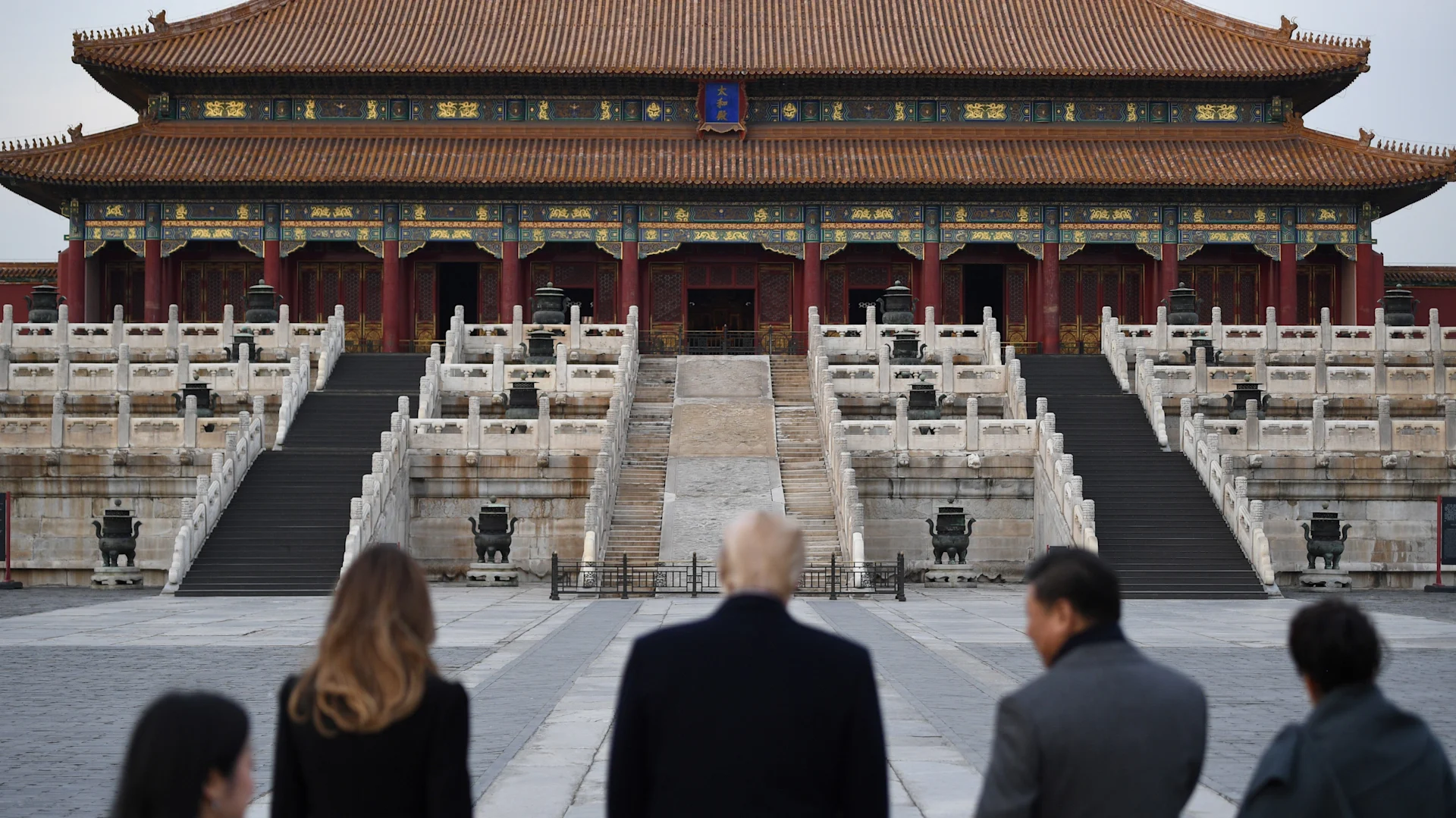
US President Donald Trump, First Lady Melania Trump, China's President Xi Jinping and his wife Peng Liyuan look at the Forbidden City in Beijing on November 8, 2017
Table of contents
  • 1.
    Trump-Xi summit: a new trade framework?
  • 2.
    Microsoft and beyond: Australia’s data centre buildouts
  • 3.
    Interest rate divergence: the US vs Australia

April delivered a powerful rebound in global equities, with the S&P 500 surging 10.4% for its strongest month since November 2020 and the Nasdaq jumping 15.3%, its best performance since April 2020. The ASX lagged but still posted a 2.2% gain. Against this backdrop, May brings three key storylines for investors to navigate. The Trump-Xi summit in Beijing takes centre stage, with trade and tariffs in focus. In Australia, a wave of hyperscaler investment led by Microsoft’s A$25bn commitment is accelerating data centre development and refocusing attention on ASX-listed operators. Meanwhile, shifting interest rate dynamics continue to shape the macro outlook.

Trump-Xi summit: a new trade framework?

US President Donald Trump and his Chinese counterpart Xi Jinping are expected to meet in Beijing on May 14 and 15, marking the first visit by a US president to China since Trump’s own trip in November 2017. Back then, Trump called his meeting with Xi “absolutely terrific”, but the positive optics quickly gave way to a tit-for-tat trade war in 2018.

This time, the visit follows more than a year of escalating tariff battles and a temporary truce agreed in October 2025, when the US eased tariffs and China committed to pausing rare-earth export restrictions.

Early signals from both sides suggest the summit could offer a chance to improve relations, with Xi telling Trump in February to make 2026 a year of “win-win cooperation”. Meanwhile, US Trade Representative (USTR) Jamieson Greer said that Washington was looking for “stability”.

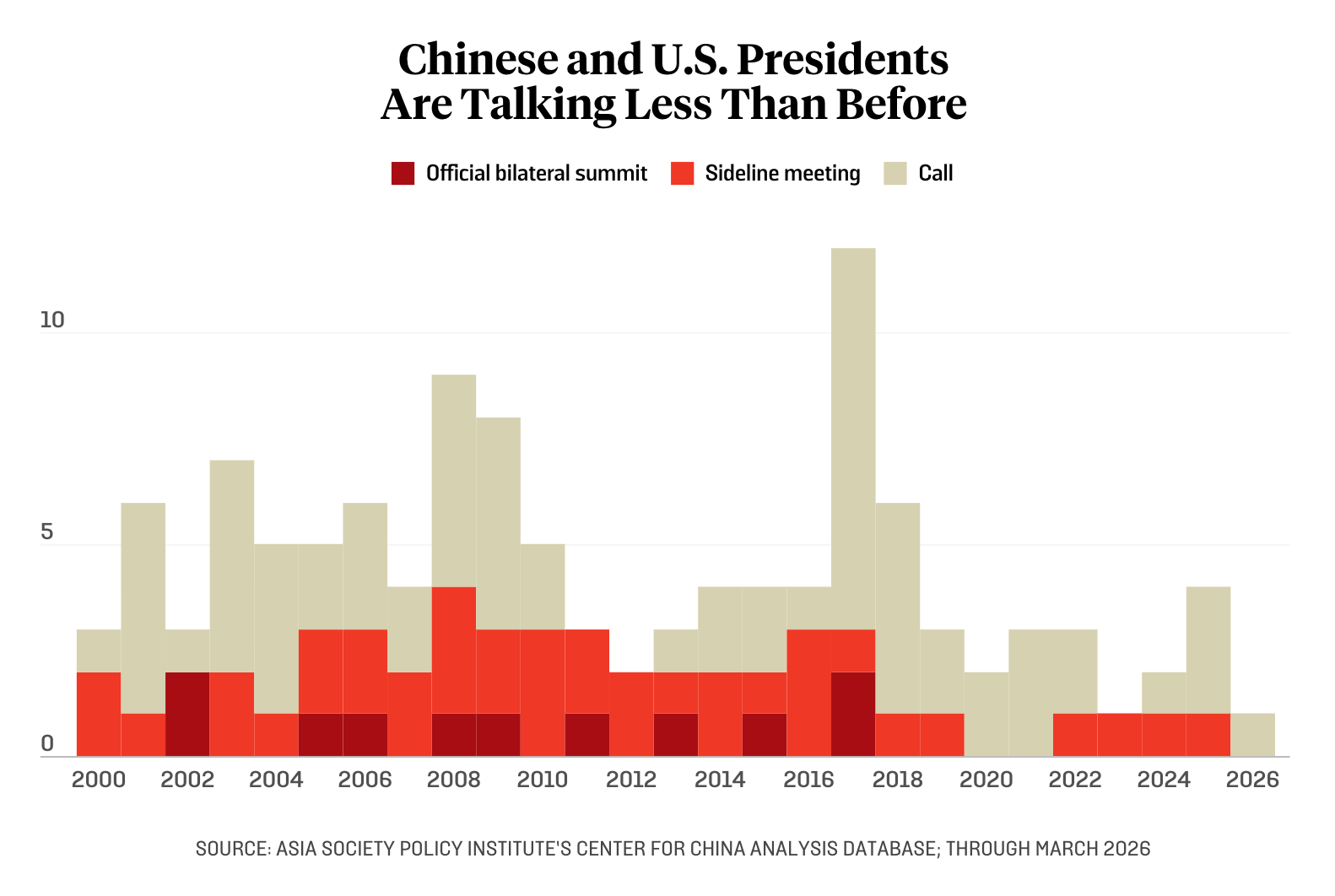
Chinese and U.S. Presidents Are Talking Less Than Before

Beijing is well-prepared. China has built economic leverage heading into the summit by punishing foreign entities that shift supply chains away from China, restricting foreign AI chips in state-funded data centres, barring use of US and Israeli cybersecurity software, and reportedly weighing curbs on solar manufacturing equipment exports to the US.

This playbook echoes a similar tactic deployed ahead of the October 2025 deal, when China expanded rare earths export controls to five new elements just weeks before sitting down to negotiate.

Trump, meanwhile, enters the summit with diminished tariff leverage after the US Supreme Court struck down tariffs imposed under the International Emergency Economic Powers Act.

Washington has maintained pressure through unfair trade investigations into 16 trading partners, including China, which could allow tariffs under Section 301 of the Trade Act of 1974. The US also accused China in late April of stealing AI labs’ intellectual property on an industrial scale.

Overall, the US-China relationship remains far from the rosy facade diplomats portray to the public. According to Neil Thomas and Haolan Wang of the Asia Society Policy Institute’s Centre for China Analysis, it would be a mistake to expect a “spectacular breakthrough” from the Trump-Xi meet in May.

“The objective in Beijing should not be to resolve the US-China rivalry, but to impose more discipline on it. In a relationship defined by strategic competition, the most valuable outcome would be a predictable operating system,” wrote Thomas and Wang in a column for Foreign Policy.

That “predictable operating system” has a name: the Board of Trade.

USTR Jamieson Greer said the US and China were discussing a new trade framework that determines non-strategic products the two countries could trade on “areas of mutual benefit”. This concept of “managed trade” focuses on “import commitments rather than mutual tariff reductions,” said the Council on Foreign Relations.

“The United States expects ongoing trade with China and will continue to engage to ensure that trade is based on reciprocity and balance,” according to President Trump’s 2026 Trade Policy Agenda.

Here are some import/export items that could form part of this managed trade setup between the US and China:

  • Rare earths: For the US, the major agenda of the summit will be to ensure stable supply of rare earth elements (REE), which comprise a broad group of 17 elements that are used in everything from smartphones and jet fighters to electric vehicles and medical instruments.

  • Agricultural goods: China has already committed to purchase at least 25 million metric tons of soybeans from the US in each of 2026, 2027 and 2028. China has also resumed purchase of US sorghum and hardwood and softwood logs as a part of the October 2025 deal.

  • Aircraft: Bloomberg reported that Boeing [BA] is set to close one of its largest sales in its history with a 500-aircraft order for 737 Max jets from Chinese airlines, set to be unveiled during the Xi-Trump meet.

  • Jet Engines: In 2025, the US imposed an export ban, which was later lifted, on American-made jet engine parts from GE Aerospace [GE] to the Commercial Aircraft Corp of China.

  • Oil and gas: China is expected to increase imports of US energy as the Trump administration ramps up domestic production under “drill, baby, drill” initiatives.

  • Semiconductors: In January, the US allowed Nvidia [NVDA] to export its second-most powerful AI chip, H200, to China under strict conditions.

  • Automobiles: Reuters reported that Trump was open to the idea of allowing Chinese EV maker BYD [BYDDY] to start a plant in the US, which has sparked concern among US lawmakers.

Ultimately, this summit is unlikely to resolve the rivalry, but it may reset the rules of engagement. Trump's track record shows that trade policy and deal-making can shift narratives and move markets fast, and this shapes up as another defining moment.

The focus should be less on optics and more on what is actually, tangibly agreed. How prices respond across sectors most exposed to trade and supply chains may offer a faster, clearer read on what truly matters than the political commentary and noise that will inevitably follow.

Microsoft and beyond: Australia’s data centre buildouts

Microsoft’s [MSFT] commitment to spend A$25bn ($17.86bn) in AI infrastructure in Australia by 2029 has brought investor attention back to data centre stocks listed on the ASX. The announcement is a five-fold increase on Microsoft's initial A$5bn commitment made in October 2023 which was described as the company's largest-ever single investment in Australia.

Microsoft is not alone. Amazon [AMZN] has announced plans to invest A$20bn between 2025 and 2029 to expand its data centre infrastructure in Australia, while Alphabet [GOOGL] is reportedly exploring establishing a major data centre, valued around A$20bn, in the Asia-Pacific region.

While the AI data centre buildout is not a new theme for investors, one underappreciated dimension is how national security and data sovereignty concerns are making each country’s buildout structurally independent from others’.

Hyperscalers cannot simply centralise capacity in one location and serve the world. Governments are increasingly requiring that sensitive data be processed and stored locally. That creates an opportunity for domestic operators.

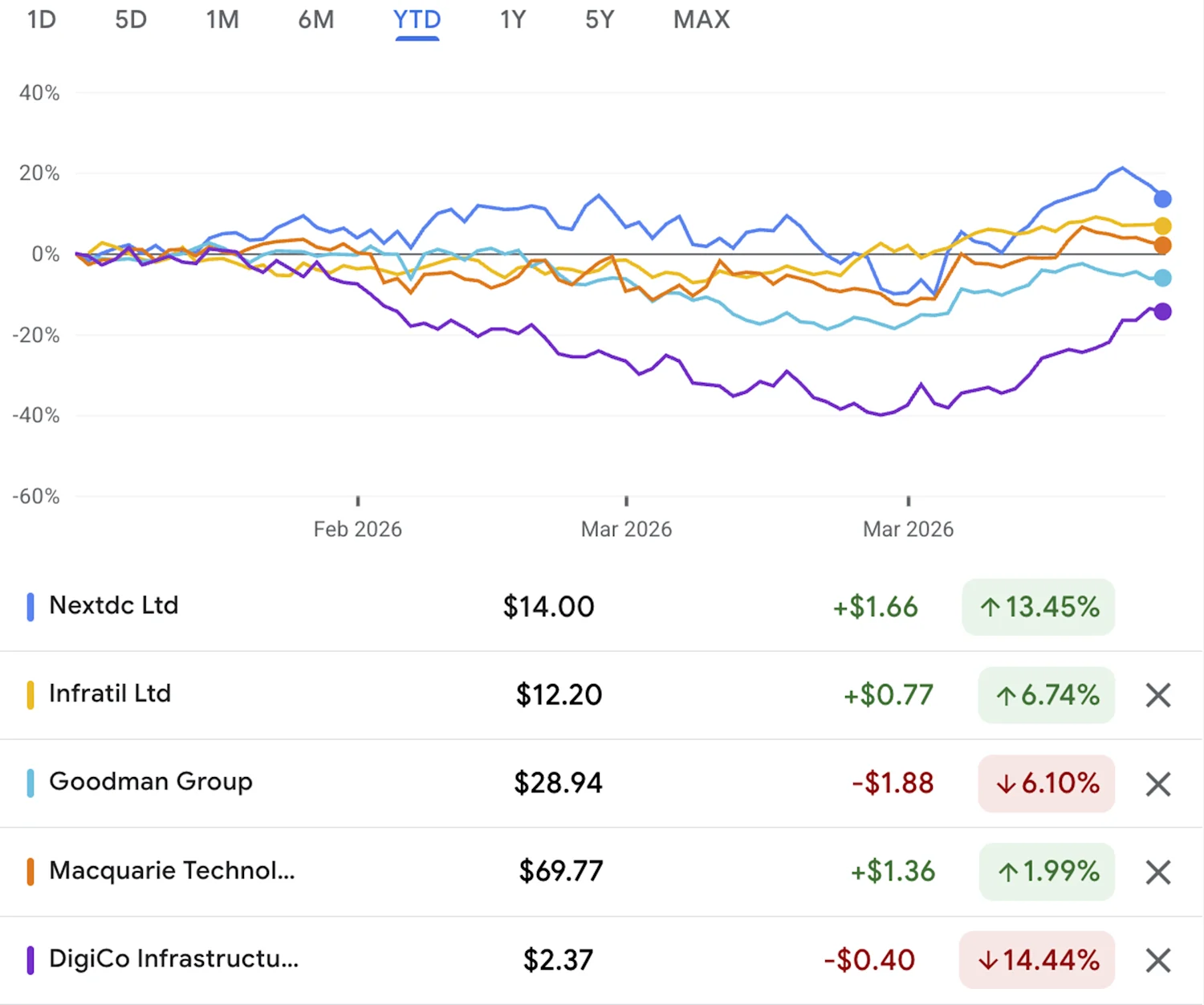
Aussie Data Centre Performance 2026

Source: Google Finance, 30 April 2026

The most direct ASX beneficiary is NextDC [NXT], Australia’s largest listed pure-play data centre developer. In December, OpenAI announced its Australian expansion and said it would work with local partners such as NextDC. The two firms signed a Memorandum of Understanding to develop a data centre in Sydney, which the Australian Financial Review reported will be the biggest in the southern hemisphere.

In April, NextDC announced its largest-ever contract, securing 250 MW of contracted capacity from an “AAA-rated” customer. Citi analysts suggested the company could be Microsoft. NextDC has previously worked with Microsoft on an edge data centre in the Pilbara, giving mining companies including BHP [BHP] cloud connectivity in a remote industrial region.

CMC Invest client order flow showed NextDC was the most actively traded stock in Australia’s AI data centre theme, ranking 52nd among all ASX instruments in both March and April. NXT shares are up 15% year-to-date.

Beyond NextDC, two other ASX-listed names offer meaningful exposure. Infrastructure investor Infratil [IFT] holds a 49% stake in CDC Data Centres, the largest privately owned data centre business across Australia and New Zealand, with 372 MW of capacity. Infratil also holds a minority stake in Wellington-based Contact Energy [CEN], which supplies Microsoft with renewable energy certificates.

Goodman Group [GMG], with a broader global focus than its Australian peers, has approximately 700 MW in completed data centre properties worldwide. The firm commenced a 90 MW facility in Sydney in 2026. Smaller players such as Macquarie Technology [MAQ] and DigiCo Infrastructure REIT [DGT] also remain in the data centre mix.

Nvidia-backed Firmus Technologies will provide investors with further options if it lists on the ASX later in 2026.

As data centres evolve into the backbone of the AI economy, supporting cloud computing, autonomous vehicles, robotics, defence systems and enterprise software, the investment case continues to broaden and deepen.

However, there are near-term risks related to the capital-intensive nature of operations. NextDC, for example, carries an elevated debt-to-EBITDA ratio of 12.88 against a backdrop of negative free cash flow, while its A$750m floating-rate note issuance in April exposes it to interest rate hike risk.

Shareholders in NextDC and Goodman Group have also absorbed meaningful dilution from capital raisings. NextDC raised A$1.5bn in 2026, while Goodman Group raised A$4bn in 2025 through new share issuance. With data centre construction pipelines stretching into 2028 and 2029, further equity raising cannot be ruled out.

If AI represents a multi-year structural shift, the infrastructure buildout supporting it is where some of the most tangible value accumulation may occur, through earnings growth, long-term contracted capacity and rising asset values.

But the same buildout also introduces potential bottlenecks, in power availability, construction timelines, component supply and financing costs, that cut both ways. Where those bottlenecks are severe, they can weigh on returns and progress for some players, but where a company provides a critical good or service and holds pricing power in a constrained part of the supply chain, they can also be a positive catalyst.

Memory stocks are a recent example of how quickly that dynamic can move.

The degree to which AI now shapes returns and sentiment across global markets, and has done for some time, makes this a story worth following closely.

Interest rate divergence: the US vs Australia

The US Federal Reserve (Fed) left interest rates unchanged for the third consecutive meeting at 3.5% to 3.75% on April 29. Only Stephen Miran, the Fed governor, voted against the decision just as he had done when the Federal Open Market Committee (FOMC) previously met on March 18.

Earlier, Fed officials had said it was still “too early" to judge how the war in the Middle East would affect the US economy. With the conflict now in its ninth week, Fed chair Jerome Powell struck a cautious tone regarding the “highly uncertain” economic outlook due to the ongoing conflict in the Middle East.

Notably, during the April meeting, three board members said they did not support “the inclusion of an easing bias” in the FOMC statement.

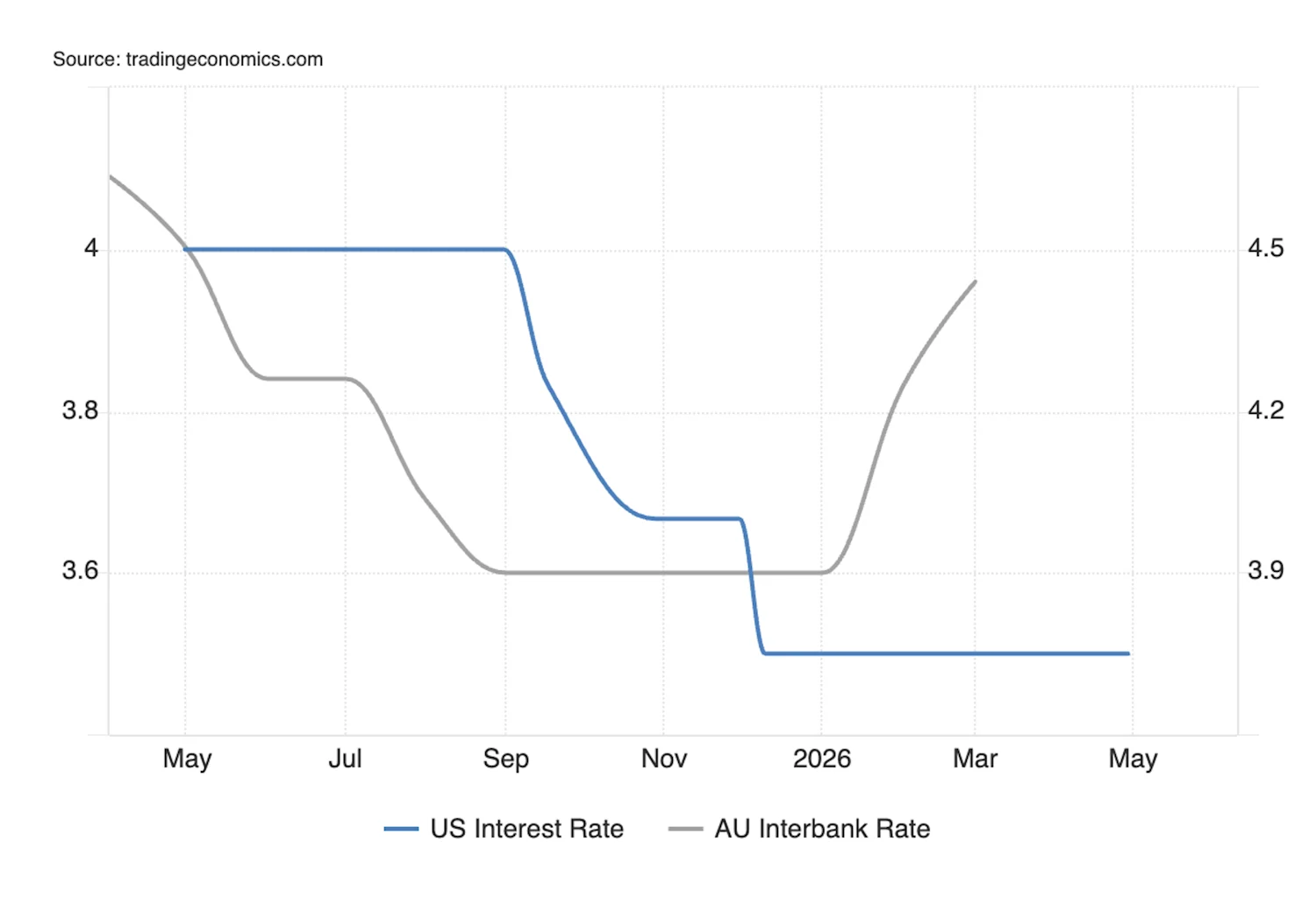
Interbank rate divergence

Across the Pacific, the story is one of divergence. While the Fed has cut rates six times between August 2024 and December 2025, the Reserve Bank of Australia (RBA) has taken a more conservative approach, cutting rates only three times in the same period before reversing course entirely in 2026 with two consecutive 25-basis-point hikes in the March quarter. Markets are currently pricing in a further hike to 4.35% at the 5 May decision, with the RBA's rate expectations tracker putting the probability at 74%.

Australia’s inflation problem has been emerging since the second half of 2025, due to lower-than-expected unemployment rates, strong wage growth and a “red-hot” Western Australian property market. The Iran war’s energy shock has since added further price pressure.

There is a growing narrative, though still a deeply contested and debated one, that the Fed has room to cut rates further, unlike the RBA, due to productivity gains delivered by artificial intelligence (AI) advancements in the US.

The most direct articulation of that view has come from Kevin Warsh, who was nominated by President Trump to succeed Powell as Fed Chair when Powell's tenure expires in May.

In a November 2025 Wall Street Journal op-ed, Warsh described AI as a “significant disinflationary force” and called on the Fed to reform its monetary policy to unlock the benefits of AI.

“The Fed’s bloated balance sheet, designed to support the biggest firms in a bygone crisis era, can be reduced significantly. That largesse can be redeployed in the form of lower interest rates to support households and small and medium-size businesses,” wrote Warsh.

Warsh may well be heading the mid-June FOMC meeting as the Fed Chair, but the geopolitical conditions he inherits are unlikely to give him the clean runway for rate cuts that he advocates and President Trump desires.

According to a CNBC Fed Survey, only 58% of the 26 respondents see any rate cut in 2026, while Michael Feroli, chief US economist at JP Morgan, forecasts the Fed will hold rates for the rest of 2026.

ING Think was more optimistic, forecasting two rate cuts in September and December 2026, saying a more dovish Fed chair taking office and key elections will keep up the political pressure for rate cuts.

The rate differential between Australia and the US is expected to support the Australian dollar, according to ING, which was among the best performing currencies in April. ING sees AUD/USD rates climbing further to 0.75 by year-end, up from 0.7158 at the time of writing.

For ASX investors, higher Australian rates could create clear winners and losers. Banks may benefit from wider net interest margins. Insurers could earn higher investment income, while cash-rich companies and defensive sectors such as supermarkets, healthcare and utilities may emerge as safe-haven plays.

On the negative side, REITs, property developers, biotechs, consumer discretionary firms, leveraged small caps and growth stocks could face pressure as borrowing costs rise and household spending tightens.

Since the start of the year, the S&P/ASX Consumer Staples Index [XSJ] has returned 9.14% year-to-date compared to a nearly 15% decline in the S&P/ASX Consumer Discretionary Index [XDJ], as of April 29’s close.

As ever, interest rates remain one of the most important variables in investing, and one all investors can benefit from understanding and monitoring. The divergence playing out between the RBA and the Fed makes this a particularly interesting moment, and how the RBA moves from here looks set to be one of the more critical storylines not just of May, but the entirety of 2026.
Disclaimer: This article provides general information only. It has been prepared without taking account of your objectives, financial situation or needs. It is not to be construed as a solicitation or an offer to buy or sell any financial instruments, or as a recommendation and/or investment advice. It does not intend to support an investment decision and it should not be relied upon by you in evaluating the merits of investing in any financial instruments. You should consider your objectives, financial situation and needs before acting on the information in this article. CMC Markets believes that the information in this article is correct, and any opinions and conclusions are reasonably held or made on information available at the time of its compilation, but no representation or warranty is made as to the accuracy, reliability or completeness of any statements made in this article. CMC Markets is under no obligation to, and does not, update or keep current the information contained in this article. Neither CMC Markets nor any of its affiliates or subsidiaries accepts liability for loss or damage arising out of the use of all or any part of this article. Any opinions or conclusions set forth in this article are subject to change without notice and may differ or be contrary to the opinions or conclusions expressed by any other members of CMC Markets.