Monthly Outlook: Rotation, SK Hynix, Russell

CMC Invest
12 minute read
|6 Jul 2026
Skyline of Sydney in Australia
Table of contents
  • 1.
    Banks lose momentum as investors seek growth
  • 2.
    SK Hynix's US debut to test AI memory optimism
  • 3.
    Is it too late to buy Russell 2000?

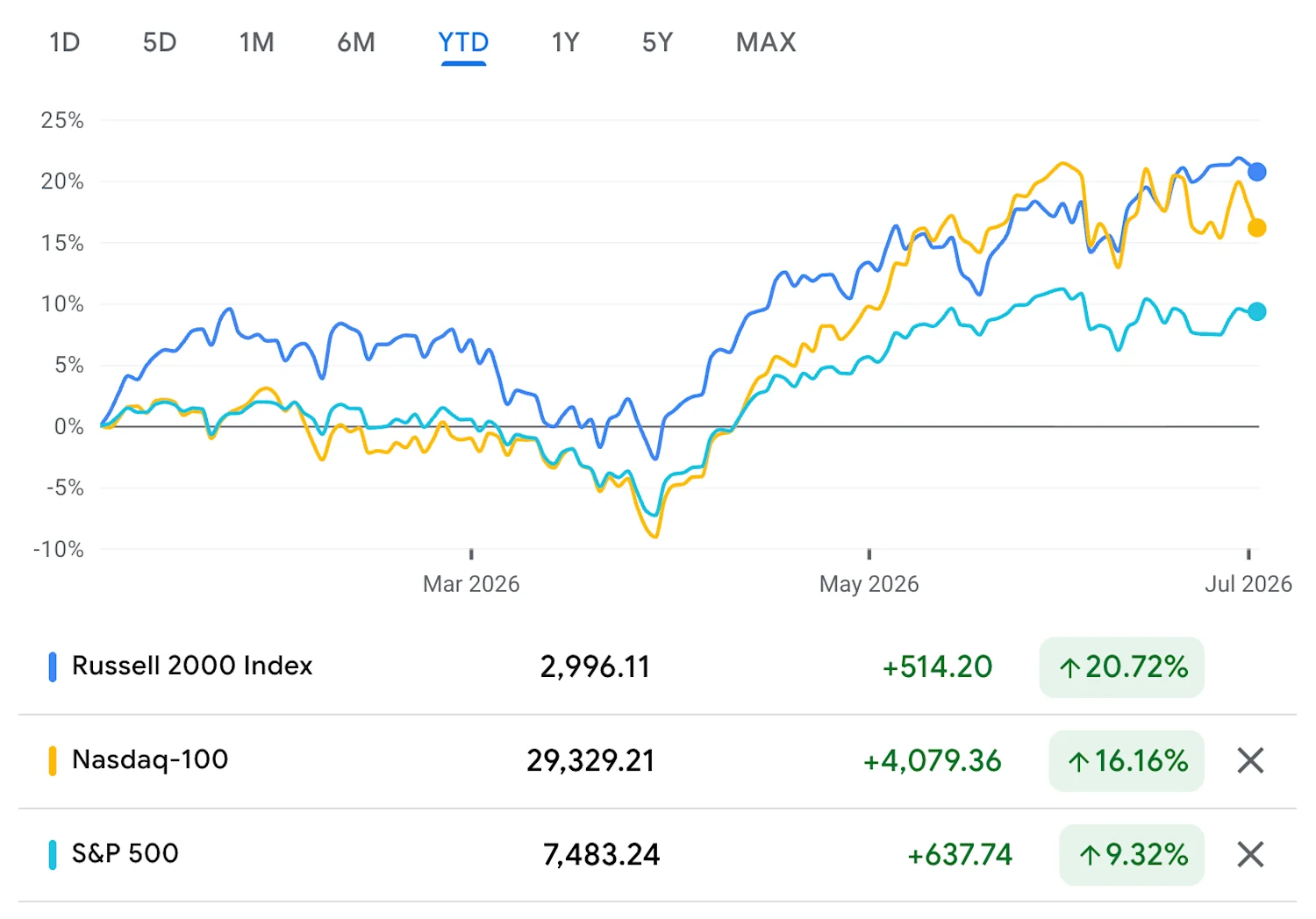
June closed out the best quarter for US equities since 2020, as easing geopolitical tensions helped the benchmark S&P 500 and tech-heavy Nasdaq-100 gain more than 15% and 21%, respectively.

The rally was not limited to large caps, with the Russell 2000 outperforming the S&P 500 in the first half of the year, prompting investor interest in the small cap index. In Australia, value-seeking investors took to accumulating beaten-down technology and healthcare stocks. Looking ahead, appetite for the artificial intelligence (AI) trade faces another test when South Korean memory chipmaker SK Hynix completes its secondary listing in New York.

Banks lose momentum as investors seek growth

Australia’s benchmark S&P/ASX 200 index returned just 0.7% in the first half of 2026, as a hawkish Reserve Bank of Australia weighed on investor appetite.

June's CMC Invest monthly client trading data pointed to a rotation in trading activity, with increased interest in select technology and healthcare stocks and softer activity in financials.

Although the S&P/ASX 200 Financials Index [XFJ] gained 1.7% in June, CMC Invest trading data suggested investor interest in Australia's Big Four banks softened. Commonwealth Bank of Australia [CBA], National Australia Bank [NAB], Westpac [WBC] and ANZ Group [ANZ] all slipped lower in the rankings of the most traded ASX-listed shares during the month.

The shift in sentiment was most evident in Commonwealth Bank. The number of trades in CBA shares on the CMC Invest platform fell 40% from May to June, marking the largest month on month decline among the Big Four banks. Buy orders also dropped to 49% of total CBA orders in June from 74% in May, while the share price edged 0.24% lower.

Higher domestic interest rates have complicated the outlook for the sector. While elevated rates may continue to support banks' net interest margins, they also risk slowing mortgage lending and weighing on credit growth. Australia's housing market is already showing signs of cooling, with home price declines accelerating in Sydney and Melbourne amid affordability and cost of living pressures. Following three rate hikes in 2026, the RBA's cash rate stood at 4.35%, its highest level since November 2011.

Investors are increasingly weighing these risks against the sector's strong profitability. In May, the Australia Institute reported that mortgages accounted for 39.3% of the Big Four's profits in 2025, underscoring the importance of housing activity to future earnings.

AU Instruments Mentioned

June performance

H1 2026 performance

S&P/ASX 200 Index

0.54%

0.74%

S&P/ASX 200 Financials index

1.76%

0.52%

S&P/ASX 200 Healthcare index

13.26%

-22.73%

CBA

-0.24%

3.89%

NAB

1.42%

-8.57%

ANZ

0.43%

-0.48%

WBC

-2.19%

-6.95%

CSL

18.77%

-32.68%

RMD

0.45%

-19.35%

WTC

-8.36%

-51.80%

XRO

-3.92%

-36.66%

Against this backdrop, investors appeared to turn towards stocks where valuations and expectations had already reset.

Chief among them was healthcare major CSL [CSL], which has endured a difficult run since the start of 2025 due to a loss of confidence in its turnaround story, which we covered extensively in June’s outlook report. Despite this, CSL’s long-standing reputation as one of Australia’s most consistent blue-chip compounders appears to have kept bargain hunters and loyal investors engaged.

CSL retained its position as the most-traded ASX-listed stock among CMC Invest clients in June, as trading activity increased 18% from May. The stock also recorded buy orders of more than 70% for the second consecutive month, suggesting investors continued to accumulate shares after a steep derating.

An 18.77% surge in share price in June helped CSL snap a five-month losing streak and raised hopes that the Australian biopharmaceutical giant may have finally found a bottom.

ResMed [RMD] is another healthcare name that returned to investor focus. Its share price fell nearly 20% in the first half of 2026. RMD rose to become the 20th most-traded ASX-listed stock in June, up from 27th in May among CMC Invest clients. Trading activity on the platform increased 22%, with more than three-quarters of orders on the buy side.

Overall, the S&P/ASX 200 Healthcare index [XHJ] rose over 13% to become the best performing sectoral index in Australia during the month of June. 

In technology, CMC Invest clients showed a preference for logistics software firm WiseTech Global [WTC], which ranked above all four major Australian banks to become the second-most traded ASX-listed stock in June. Trading activity increased 45% month-on-month, with buy orders accounting for 77% of activity on the CMC Invest platform in June.

Trading in WTC shares, which have plunged more than 69% over the past 12 months, was particularly volatile in June. A two-day sell-off followed a sharp rebound after reports said that founder Richard White was being investigated by the Australian Federal Police over allegations relating to a woman’s immigration status and financial vulnerability.

Elsewhere, Xero [XRO], a small business-focused software company, recorded one of the most significant improvements in the rankings of the most traded ASX-listed shares on the CMC Invest platform in June, climbing from 15th to 6th. The total number of trades on Xero increased 58% month on month.

Looking ahead to July, investors will be watching whether renewed interest in beaten-down healthcare and technology stocks translates into broader share price gains. While CSL and ResMed enjoyed a strong June, the likes of WiseTech and Xero continued to attract increased trading activity despite weaker performance. Equally important will be whether Australia's Big Four banks continue to lose momentum, given their outsized influence on the S&P/ASX 200.

SK Hynix's US debut to test AI memory optimism

SK Hynix, the world’s largest high-bandwidth memory (HBM) chipmaker by revenue, is expected to list its American depositary shares on the Nasdaq under the ticker “SKHY” on 10 July, in a move that would allow more investors to gain exposure to the memory semiconductor boom, which remains concentrated among a small number of companies.

An ongoing AI infrastructure buildout has made memory the hottest trade over the past 12 months. With SK Hynix, Samsung Electronics [SSNLF] and Micron Technology [MU] controlling 100% of HBM supply, investors looking for direct exposure to the HBM market are not exactly spoilt for choice.

HBM has become a critical part of the AI infrastructure because it helps address the “memory wall,” which is a bottleneck caused by CPU and GPU processing speeds outpacing the speed at which memory chips supply them with data. HBM is designed to sit closely with processors and supply CPUs and GPUs with large volumes of data at high speed.

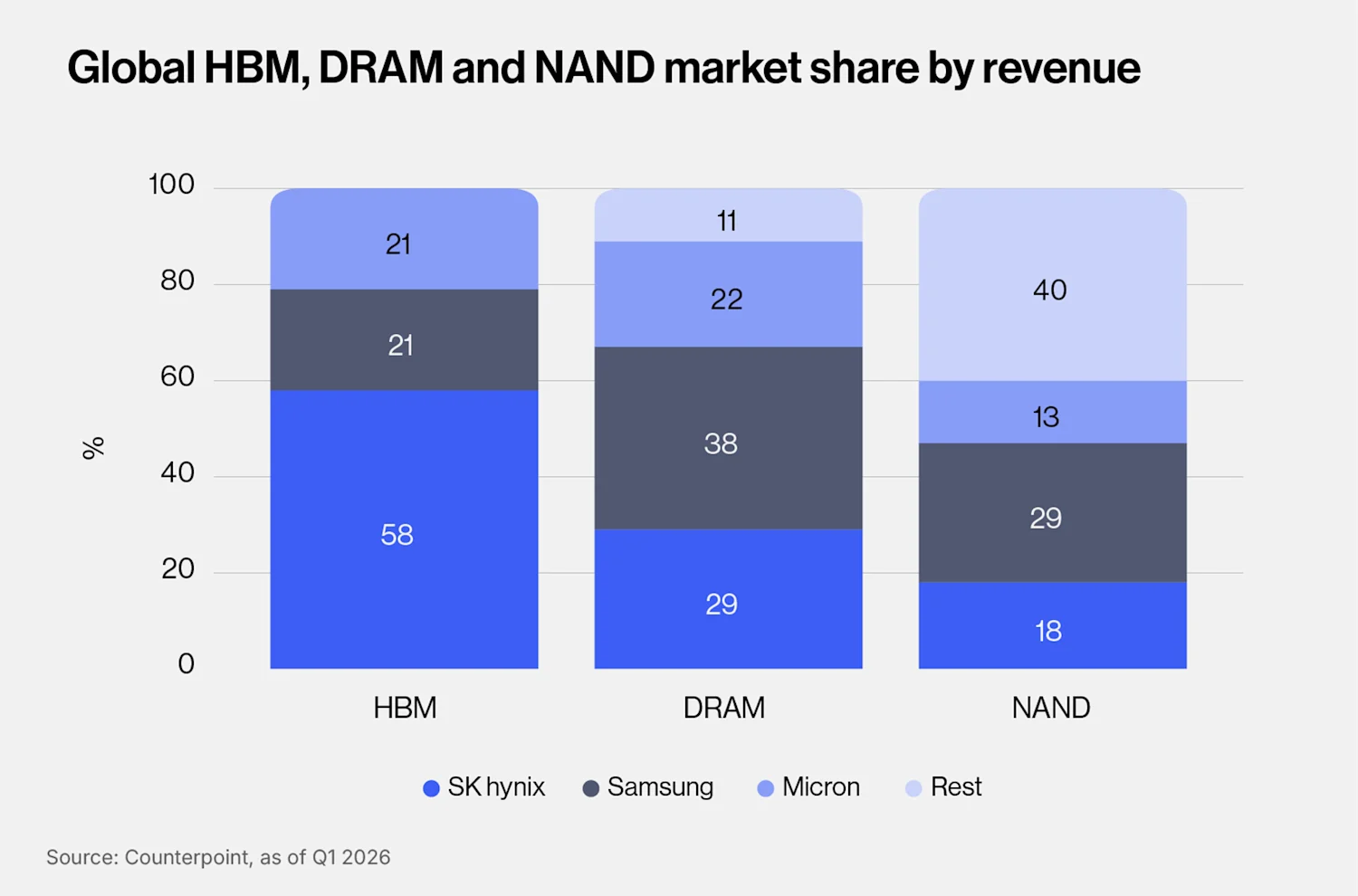
SK Hynix’s dominance in the memory market does not stop at HBM. It is the second-largest producer of DRAM and NAND flash memory chips, behind Samsung.

For context, DRAM acts as short-term working memory for AI processors, while HBM is a more advanced form of DRAM created by stacking them vertically to deliver higher bandwidth. NAND, by contrast, provides long-term data storage for AI systems.

Global HBM, DRAM and NAND market share by revenue

Such a profile makes SK Hynix a rare full-stack memory manufacturer with leadership across the most important parts of the AI memory supply chain. Given the capital intensity and technological complexity of the memory semiconductor industry, SK Hynix bulls believe the company’s position will remain difficult for outsiders to challenge in the near term.

SK Hynix’s main competition in its core HBM market is coming from within. Between Q1 2025 and Q1 2026, compatriot Samsung increased its HBM market share from 13% to 21% at the expense of SK Hynix’s loss of market share from 69% to 58%, data compiled by Counterpoint showed.

The research firm added that Samsung’s HBM market share is expected to increase gradually after becoming the first company to supply the latest generation of HBM chips (HBM4) to Nvidia [NVDA] in early 2026. In response, SK Hynix announced in mid-June that it shipped samples of HBM4 chips to major customers.

Other risks SK Hynix investors must consider are valuation, the historically cyclical nature of the memory semiconductor industry and the possibility that the AI infrastructure investment cycle slows or fails to meet elevated expectations.

By the end of June, SK Hynix’s Seoul-listed shares had risen more than ninefold over the previous 12 months. That meteoric rally made SK Hynix the world’s 14th-most valuable listed company, with a market capitalisation of more than $1.16 trillion. Such a rich valuation leaves little room for error for a company that posted a ₩9,138bn loss as recently as fiscal 2023, when global memory prices fell sharply due to oversupply.

For now, memory supply remains tight. Research firm TrendForce said AI system upgrades are expected to drive HBM demand growth through 2026 and into 2027. Micron’s recent results offered another sign of strong demand, with the company announcing that customers had committed $22bn under long-term supply contracts to secure future memory chip supply.

The risk is that today’s shortage, record cash flows and additional capital in the form of customer commitments are prompting the next wave of supply.

Leading memory producers – and challengers such as China’s ChangXin Memory Technologies – are accelerating capital expenditure and ramping up production to capture the AI-driven demand boom. In June, SK Hynix and Samsung pledged to invest ₩3,200tn to build new semiconductor fabrication plants and accelerate ongoing projects. Micron, meanwhile, guided for fiscal 2026 capex of about $27bn, up from earlier expectations of around $20bn to $25bn.

Jefferies expects memory prices to remain elevated through 2027, forecasting that tight AI-driven supply conditions will persist until 2028 before meaningful relief emerges as new capacity comes online.

SK Hynix is expected to raise up to $29.4bn through its secondary listing, making it the second-biggest share sale after SpaceX’s [SPCX] record $85.7bn IPO in June.

SK Hynix will use part of the proceeds from its secondary listing to fund an upcoming fabrication plant, which is expected to come online in 2027.

Is it too late to buy Russell 2000?

The Russell 2000 [RUT], a US small-cap stock index, delivered its strongest first-half performance in more than three decades. The index returned 21.86% in the first six months of 2026, outperforming both the S&P 500 and the Nasdaq 100 over the same period.

However, the Russell 2000 entering July is materially different from the index that delivered those headline returns. Following its scheduled reconstitution in late June, many of its strongest AI-linked performers graduated to the Russell 1000, making July the first opportunity to see how the index performs with a new mix of sector and company exposures.

Understanding what changed helps explain how the index's return drivers and sector exposures have evolved.

The Russell 2000 tracks the 2,000 smallest companies in the broader Russell 3000 index [RUA] by market capitalisation. The Russell 3000, in turn, covers about 98% of the investable US equity market.

A closer look at constituent performance showed that a major driver of the Russell 2000’s outperformance was the same force powering large-cap markets: the AI infrastructure boom.

Google Finance Russell 2000 Index July 2022

Source: Google Finance

Among the Russell 2000’s standout performers was Bloom Energy [BE], an on-site power generation company whose shares surged more than 1,100% over the past year following deals to supply its fuel-cell technology to power AI data centres.

Other AI ‘picks and shovels’ names also delivered strong gains. High-speed copper and optical interconnect products maker Credo Technology Group [CRDO], advanced printed circuit board producer TTM Technologies [TTMI] and optical packaging manufacturing services provider Fabrinet [FN] returned between 90% and 360% over the past year to 30 June.

The issue for investors entering the Russell 2000 trade in July is that its biggest winners are no longer part of the small-cap index. Bloom Energy, the index’s top performer, saw its market capitalisation surge from about $5bn to more than $80bn over the past year, making it far too large to remain classified as a small-cap stock.

As a result, Bloom Energy, Credo Technology, Fabrinet and other top-performing constituents were promoted to the large-cap Russell 1000 Index on 26 June as part of the scheduled semi-annual index reconstitution.

This materially changed the Russell 2000’s appeal. Miles Lewis, portfolio manager and principal at Royce Investment Partners, noted that the top 20 stocks in the index – just 1% of its constituents – generated about 40% of its returns in the first six months of the year.

Put simply, the Russell 2000 that investors buy in July is no longer the same index that delivered the strong first-half rally. After the late-June reconstitution, all of its former top 10 constituents moved up to the large-cap Russell 1000 Index, as 244 companies joined the Russell 2000 and 160 left.

A comparison of iShares Russell 2000 ETF [IWM] holdings before and after the reconstitution showed a clear shift in sector exposure. The index’s weight to industrials and information technology fell, reflecting the promotion of AI-linked winners.

In their place, the post-reconstitution Russell 2000 has become more tilted towards healthcare, financials and consumer discretionary.

That makes the index less concentrated in the AI infrastructure stocks that drove much of its first-half outperformance, but potentially more useful as a diversification tool for investors looking for exposure beyond increasingly expensive technology names.

Nevertheless, small caps can give investors the opportunity to uncover undervalued gems. The challenge is that finding them can be difficult among thousands of companies that many investors may not be familiar with.

With exchange-traded funds such as the iShares Russell 2000 Growth ETF [IWO] and iShares Russell 2000 Value ETF [IWN], investors can take a more targeted approach to small cap investing and align their exposure based on their risk appetite.

For example, investors looking for growth-focused stocks and innovation-led companies can tap into IWO, which tracks small-cap companies with higher price-to-book ratios, stronger historical sales growth and higher forecasted growth.

IWN, by contrast, tracks small-cap companies with lower price-to-book ratios, lower historical sales growth and lower forecasted growth, which may appeal to investors seeking exposure to lower-valued small-cap companies that may be more sensitive to changes in the economic cycle.

Disclaimer: This article provides general information only. It has been prepared without taking account of your objectives, financial situation or needs. It is not to be construed as a solicitation or an offer to buy or sell any financial instruments, or as a recommendation and/or investment advice. It does not intend to support an investment decision and it should not be relied upon by you in evaluating the merits of investing in any financial instruments. You should consider your objectives, financial situation and needs before acting on the information in this article. CMC Markets believes that the information in this article is correct, and any opinions and conclusions are reasonably held or made on information available at the time of its compilation, but no representation or warranty is made as to the accuracy, reliability or completeness of any statements made in this article. CMC Markets is under no obligation to, and does not, update or keep current the information contained in this article. Neither CMC Markets nor any of its affiliates or subsidiaries accepts liability for loss or damage arising out of the use of all or any part of this article. Any opinions or conclusions set forth in this article are subject to change without notice and may differ or be contrary to the opinions or conclusions expressed by any other members of CMC Markets.