Monthly Outlook: Copper, Software, Warsh

Henry Fisher
Senior Content Specialist
10 minute read
|3 Feb 2026
Shadow on Salesforce building
Table of contents
  • 1.
    Copper’s turn next?
  • 2.
    Software wanders in pixel purgatory
  • 3.
    Which way, Kevin Warsh?

January was an energetic month, marked by sharp moves and volatility in multiple directions. Several of the themes highlighted in our last edition saw meaningful follow-through, though not always in a straight line. Silver surged before selling off sharply in the final days of the month, memory stocks extended their rally, while clarity on crypto regulation remained elusive.

As February unfolds, attention is shifting to whether copper’s recent strength marks it out as the next commodity to watch, alongside questions about how AI is reshaping software business models and what Kevin Warsh’s nomination as US Federal Reserve Chair could mean for monetary policy.

Copper’s turn next?

Copper surged 42% last year, its biggest annual gain since 2009, putting it firmly back on investors’ radars. Often referred to as “Dr Copper” for its reputation as a barometer of global growth, the metal’s recent strength is raising questions about whether it may be signalling a broader turning point in the global economy. Copper sits at the centre of modern economies, with widespread use across power grids, electric vehicles, AI data centres, renewable energy, housing and manufacturing. It has no easy replacement in most of these applications, making supply and demand dynamics especially important.

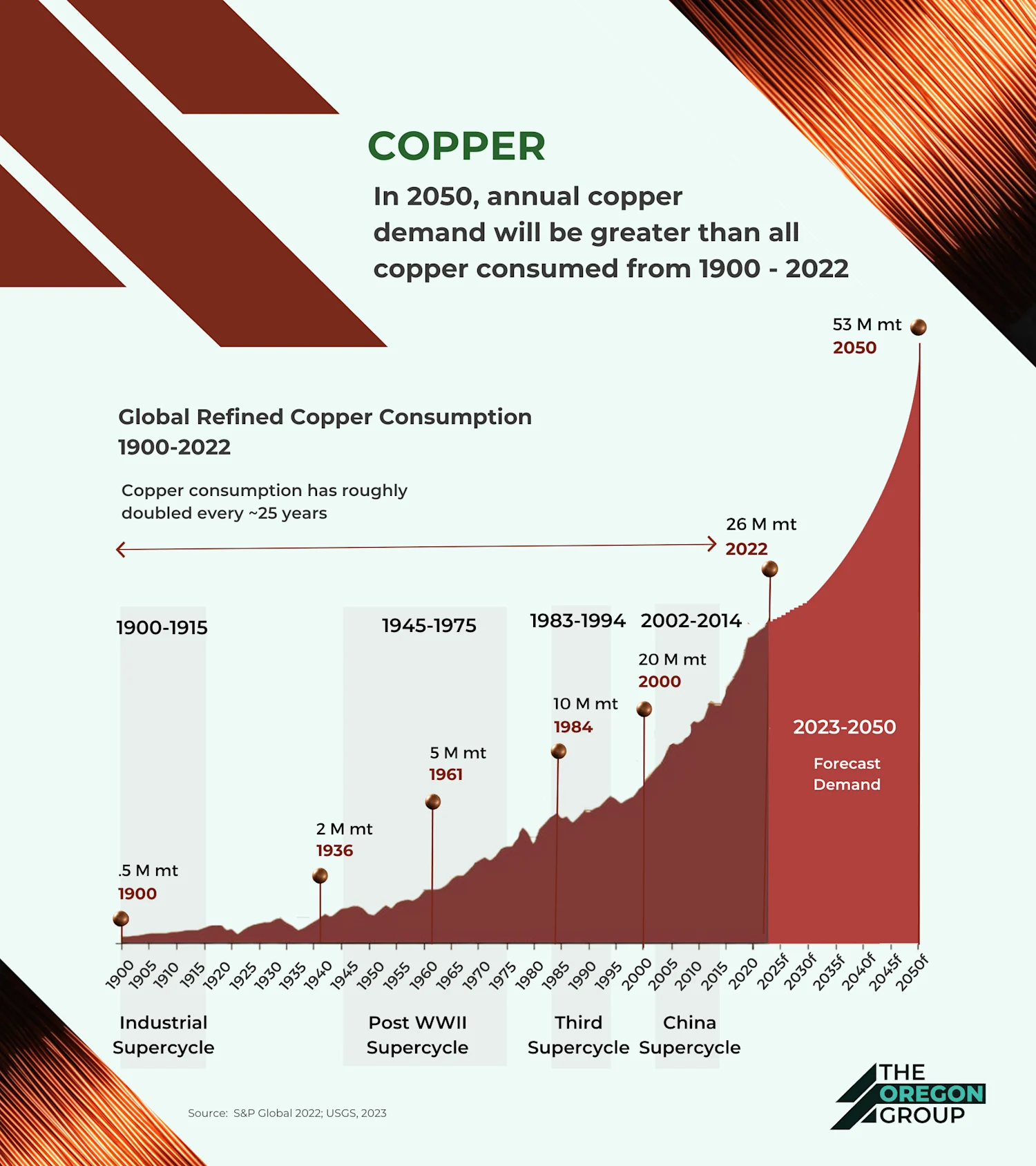
The recent strength in copper prices reflects a widening gap between demand and supply. S&P Global estimates copper demand could rise from 28 million tonnes in 2025 to 42 million tonnes by 2040, a roughly 50% increase that highlights the metal’s growing role across the global economy. New mines are slow and costly to develop, ore grades at existing mines are declining, and major new discoveries have been limited.

TOG-2050-Copper-Demand-DRAFTv1

Source: The Oregon Group

Investors typically gain exposure to copper through copper miners and ETFs rather than the physical metal. Common reference points include producers such as Freeport-McMoRan [FCX], BHP Group [BHP] and Rio Tinto [RIO], alongside diversified ETFs like Global X Copper Miners ETF [COPX]. On the ASX, Global X Copper Miners [WIRE] has also attracted attention among the CMC Invest community, moving from the 68th most traded ASX instrument in December to the 25th most traded in January.

Despite long-term structural demand and supply constraints, copper prices remain exposed to cyclical and policy-related risks. Economic conditions, shifts in policy settings and changes in supply dynamics can all contribute to volatility. China is also a key risk factor, given its outsized influence across the copper market. It accounts for roughly 50% of global demand, while also producing around 50% of the world’s refined copper, giving it significant sway over both consumption and supply.

It is also worth noting that many rare earths and uranium stocks also participated in a broader rally across materials and strategic resource sectors in January. Notably, the top three ASX300 performers are all uranium stocks: Deep Yellow [DYL], Lotus Resources [LOT] and Paladin Energy [PDN]. More broadly, all 10 of the top 10 ASX 300 companies year to date are mining and resource stocks, with five of them uranium names.

Software wanders in pixel purgatory

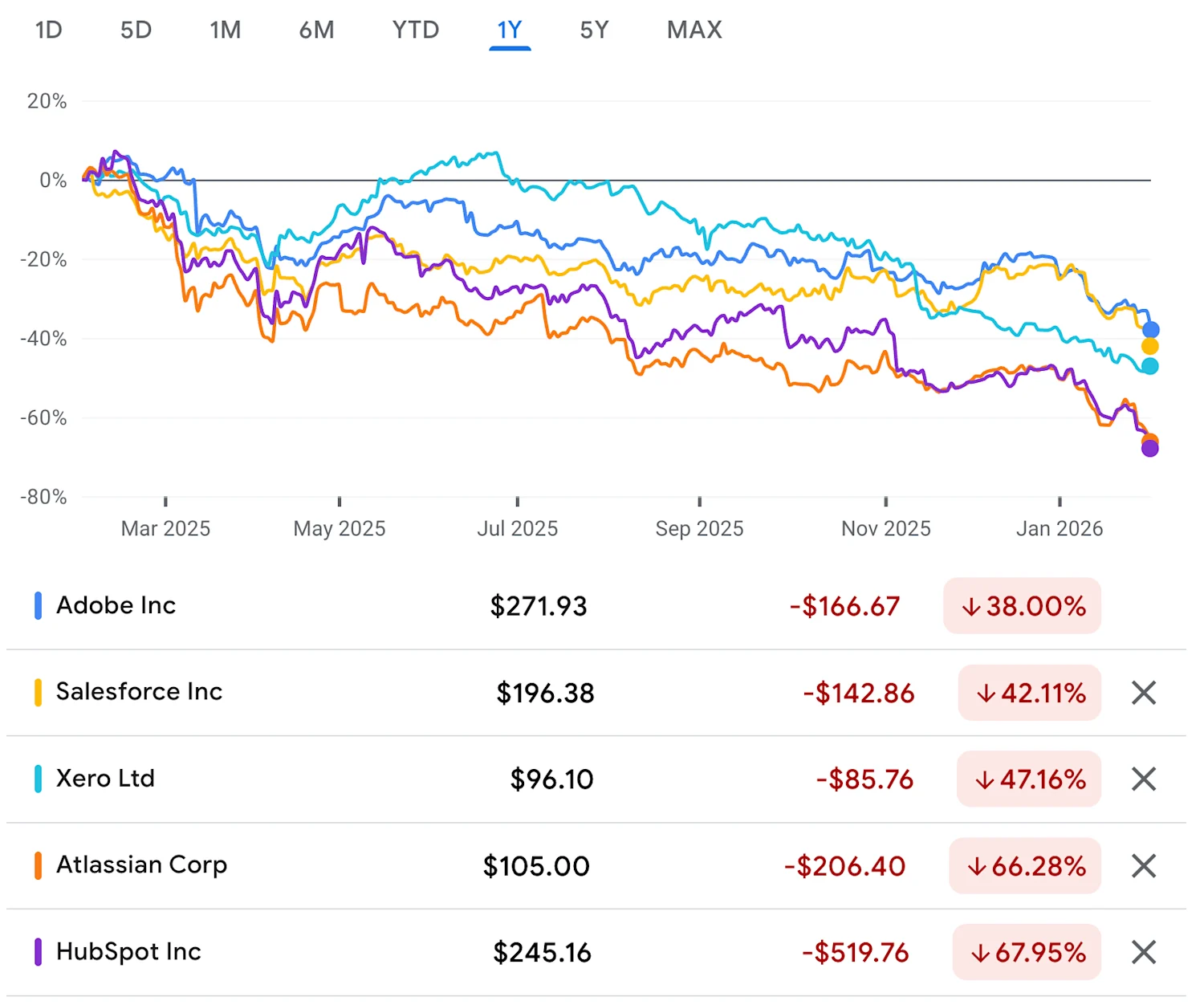
The software sector sold off in January, extending a broader downward trend over the past 12 months. Rapid advances in AI have become a major source of concern for SaaS (software-as-a-service) stocks in particular.

In particular, increased competition and new AI tools are accelerating the commoditisation of software, meaning software products are becoming easier to replicate and less differentiated. That benefits consumers through lower prices and more choice, but for incumbent companies it puts pressure on margins and weakens moats.

SaaS 1Y Chart

Source: Google Finance, 4 February 2026

A key driver of this shift is the growing capability and accessibility of AI tools. Anyone can now use AI to assist with a wide range of everyday tasks. This includes creating and editing images and video, drafting emails, summarising documents, preparing presentations, analysing data, updating CRM records, handling customer queries, and generating sales or marketing content. Many of these tasks have traditionally sat inside large SaaS platforms. Looking ahead, AI agents may also allow users to build their own custom tools or stitch together open-source alternatives with minimal effort.

There are deeper structural issues too. SaaS businesses are typically unprofitable in their early years, as they invest heavily in staff, product development, and sales before reaching sustainable cash flows. Predictable subscription revenue supported high valuations. In the wake of AI, can customer retention really be assumed to look the same in 10 years?

Pricing is another challenge. Per seat models can make sense when software is used directly by people. They make less sense when AI works quietly in the background or when tasks shift to automated agents. This is pushing software companies toward more complex usage-based pricing, which could be harder to sell and forecast.

AI also introduces new costs. Running models, improving them, and building AI features is expensive. While AI is often seen as a way to boost efficiency, the reality is that it requires ongoing investment. In many cases, customers may be asked to pay more now, before any long-term savings show up. Adobe Creative Cloud costs about $113.50 per month in Australia. ChatGPT costs roughly $35. Adobe still leads on depth and professional workflows, but the pricing gap is wide. There is a lot of lunch there for AI tools to eat over time.

Despite these concerns, many SaaS companies have yet to see revenues or subscription numbers decline in line with share prices. In fact, both have generally continued to trend higher.

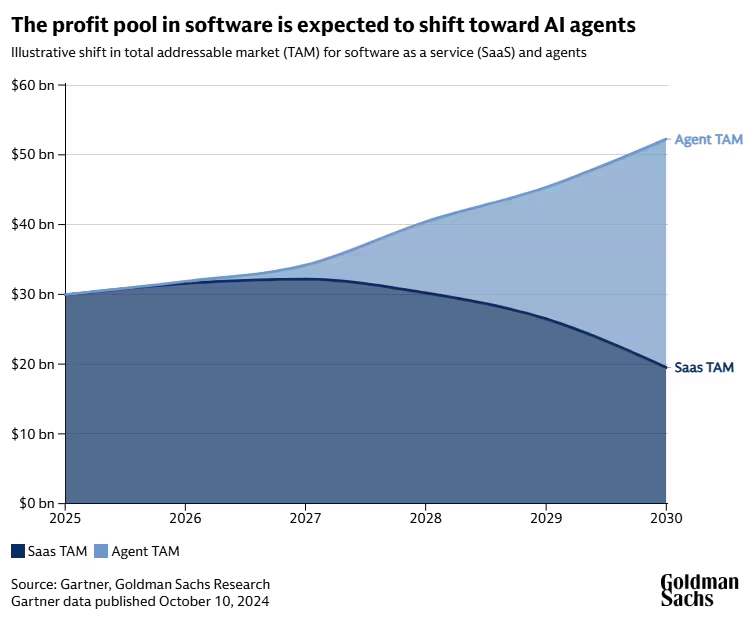
In 2025, Salesforce’s [CRM] subscription revenue grew about 10% year over year, while Atlassian’s [TEAM] revenue rose roughly 20%. Adobe [ADBE] Creative Cloud has around 41 million paid subscribers, nearly double the total from five years earlier. The business added roughly 4 million users during 2025. This resilience is consistent with a view from Goldman Sachs that the entire software market may continue to expand, despite a significant shift toward AI agents.

Goldman Sachs software shift to agents

Source: Goldman Sachs, AI Agents to Boost Productivity and Size of Software Market

The sustained growth so far, alongside the potential for expansion in a more agentic world, raises an important question. Have recent sell-offs gone too far? Many CMC Invest clients appear to think so. Client trading activity shows a clear skew towards buying. In January, around 79% of Adobe trades were buys. For Xero [XRO], the figure was closer to 89%.

A key issue for investors is where value ultimately accrues. Even if the sector as a whole continues to grow, it cannot be assumed that incumbents capture the bulk of the upside. In a more agentic world, value may flow to model providers, agent platforms or new layers within the software stack.

Another factor worth considering is that AI disruption may actually strengthen the position of some leading software incumbents rather than disrupt them. Moats such as network effects and switching costs could still play a fortifying role. Palantir [PLTR] sits deep inside government workflows, handling sensitive data under long-term contracts. That data is not about to be handed to a random startup with a clever demo. Google [GOOG] represents a different version of the same advantage, spanning email, documents, search, photos, and cloud infrastructure within a single, tightly connected ecosystem.

In an AI-driven world, where data access, security, and integration matter more, those embedded positions could become harder to displace. That may be where software still has real defensive strength. If the backend is just a spreadsheet or something close to it, then investors should probably be more cautious.

Which way, Kevin Warsh?

Kevin Warsh is a name investors will be hearing a lot more of in the months ahead. He has been nominated by Donald Trump to replace Jerome Powell as Chair of the US Federal Reserve, a role that would also see him chair the Federal Open Market Committee and place him at the centre of decisions on interest rates and monetary policy.

A single line may offer a useful summary of his thinking. Warsh wrote in November, “Inflation is a choice, and the Fed’s track record under Chairman Jerome Powell is one of unwise choices.” His underlying argument is that sustained inflation is created by policy decisions, not by accidents such as supply shocks or temporary price spikes. That view echoes the thinking of his former teacher at Stanford, Milton Friedman, who famously argued that “inflation is always and everywhere a monetary phenomenon.”

Source: Uncommon Knowledge, Hoover Institution

While his appointment is not expected until May, markets are already reacting and speculating about the implications for the path of monetary policy. Much of the debate centres on whether Warsh may lean hawkish or dovish. A hawkish stance prioritises controlling inflation, often through higher interest rates, even if that slows economic growth. A dovish stance favours lower rates to support growth and financial conditions, even if that increases the risk of higher inflation.

Kevin Warsh’s policy stance has varied over time. He has historically been viewed as hawkish on inflation, favouring restraint during his time at the Fed, but more recently has suggested interest rates could fall, pointing to productivity gains from AI and other factors that may ease inflation pressures.

Trump has repeatedly called for lower interest rates, so nominating someone with a hawkish track record and a preference for a more restrained Fed may seem counterintuitive. But the decision could be less about rates and more about a broader regime shift. Warsh’s economic philosophy appears to broadly align with wider administration objectives that emphasise fiscal discipline and a government pullback to allow the private sector to step forward.

Regardless, Warsh would be an influential voice, but not a controlling one. The FOMC is the 12-member body responsible for setting US monetary policy, including interest rates and the Fed’s balance sheet. It is made up of a mix of members aligned with the Democratic and Republican parties, alongside non-partisan career economists.

Decisions are made collectively, based on debate, voting and incoming economic data. Warsh can help set the tone of discussions and contribute to the policy debate, but outcomes continue to be driven by the Committee as a whole. It is also important to consider how other policy tools, such as quantitative easing, may operate alongside interest rate changes.

So what can investors do for now? First, understand how interest rates work and why they matter for markets. Second, follow incoming US economic data over the coming months, which will continue to shape the policy outlook. Third, build context by learning more about Warsh’s views, including his recent Hoover Institution interview above, and monitoring administration commentary for clues about policy priorities rather than reacting to headlines alone.

Another interesting point of connection is Warsh’s current role as a partner at Duquesne Family Office, the investment firm run by Stanley Druckenmiller. Druckenmiller also worked closely with US Treasury Secretary Scott Bessent in the 1990s. As the Financial Times noted in a profile roughly a year ago, “the pair [Bessent and Warsh] embody the way Druckenmiller interprets markets and economic policy.”

The relationship between Druckenmiller and Bessent has been described as unusually close, with Bessent likening it to a “father and son” dynamic. According to the FT, the two have at times spoken more than a dozen times a day, underscoring the depth of their shared thinking and ongoing exchange of macro views. In that context, Druckenmiller’s thinking and the holdings of Duquesne Family Office may help shed light on the macro framework behind Warsh’s thinking.

Disclaimer: This article provides general information only. It has been prepared without taking account of your objectives, financial situation or needs. It is not to be construed as a solicitation or an offer to buy or sell any financial instruments, or as a recommendation and/or investment advice. It does not intend to support an investment decision and it should not be relied upon by you in evaluating the merits of investing in any financial instruments. You should consider your objectives, financial situation and needs before acting on the information in this article. CMC Markets believes that the information in this article is correct, and any opinions and conclusions are reasonably held or made on information available at the time of its compilation, but no representation or warranty is made as to the accuracy, reliability or completeness of any statements made in this article. CMC Markets is under no obligation to, and does not, update or keep current the information contained in this article. Neither CMC Markets nor any of its affiliates or subsidiaries accepts liability for loss or damage arising out of the use of all or any part of this article. Any opinions or conclusions set forth in this article are subject to change without notice and may differ or be contrary to the opinions or conclusions expressed by any other members of CMC Markets.

Support
Support
x

Welcome to CMC Markets Support!

To begin, please select the product your query is related to.