From memory chips to mega caps: What top funds are buying now

Henry Fisher
Senior Content Specialist
8 minute read
|20 Feb 2026
Smart Money Q4 2025
Table of contents
  • 1.
    Memory boom draws in heavyweights
  • 2.
    Capital chases strength in emerging markets
  • 3.
    Mega-cap dominance persists
  • 4.
    What the smart money bought last quarter

Each quarter, we dig through the latest fund filings to see what some of the world’s biggest investors have actually been buying and selling. The Q4 2025 updates highlight three clear takeaways:

  • Memory is still going strong: Large investors continue backing chip and memory companies linked to AI data centre growth.

  • Emerging markets are gaining traction: Capital is moving into select overseas markets tied to technology supply chains and digital expansion.

  • Big tech remains front and centre: Alphabet, Amazon and Meta continue to attract significant buying from major funds.

Let’s take a closer look under the hood at each of these trends.

Memory boom draws in heavyweights

As we outlined in our Monthly Outlook for January, memory stocks have rallied strongly over the past year and entered 2026 with solid momentum. Q4 2025 filings show that top managers were active in the space as well.

In particular, US memory manufacturer Micron Technology (MU) attracted significant buying from large fund managers during the quarter. The stock has become a focal point within the AI infrastructure theme, especially as hyperscalers accelerate data centre buildouts.

According to HedgeFollow data, hedge funds tracked on the platform added approximately $5.75B worth of Micron shares in Q4 alone.

Several prominent managers materially increased their exposure:

  • Renaissance Technologies lifted its stake by roughly 1.8 million shares, an increase of about 150%.

  • Appaloosa Management added close to 1 million shares, expanding its position by approximately 200%.

  • Bridgewater Associates initiated a new holding of around 888,000 shares.

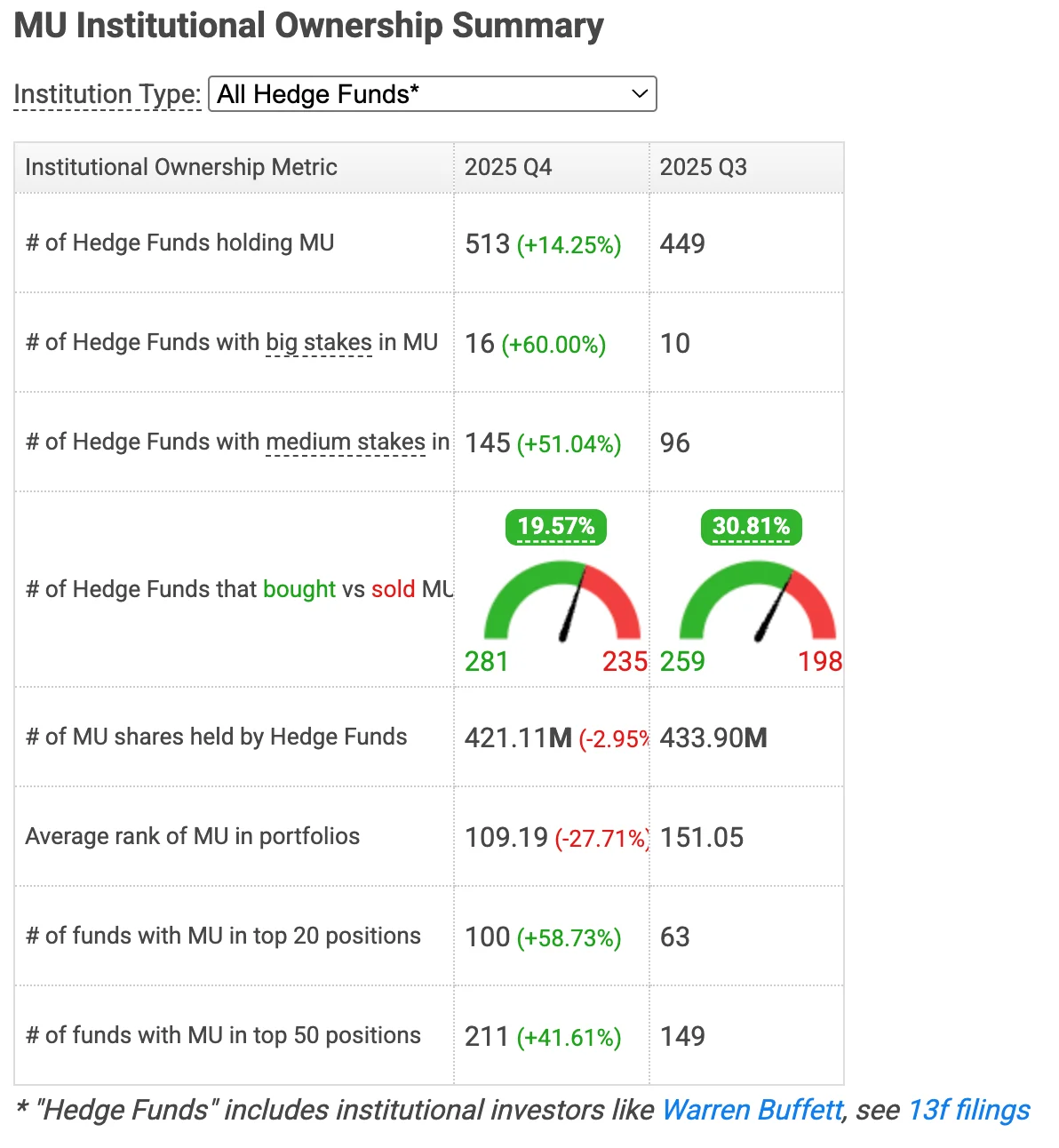
Beyond these headline moves, broader institutional ownership of Micron increased across multiple measures between Q3 and Q4 2025.

Micron Institutional Dashboard Q4 2025

Risk factor: Memory and semiconductor companies operate in an industry known for sharp swings in supply, demand and pricing. Periods of strong earnings can be followed by rapid slowdowns. Currently, expectations are closely tied to continued AI data centre spending. If major technology companies reduce or delay capital expenditure, demand could soften. Geopolitical tensions, particularly around Taiwan and key chip manufacturing hubs, also remain important risks.

What this could signal: Recent increases in investment activity in select memory and semiconductor stocks could suggest that leading funds are looking to benefit from the ongoing AI buildout, fuelled by rising capital expenditure from hyperscalers. This supports not only chipmakers, but also companies supplying specialised equipment, data centre infrastructure and power solutions. When demand in parts of this ecosystem grows faster than supply can adjust, bottlenecks can emerge. In those areas, companies may gain pricing power or margin support, at least while capacity remains tight.

Capital chases strength in emerging markets

After a strong 2025, emerging markets remain firmly on the radar of many major investors heading into 2026. Here are some key moves on that front:

  • Stanley Druckenmiller initiated a new position in Brazil ETF (EWZ) and increased his stake in Sea Ltd (SE) by around 244%, while also adding Coupang.

  • David Tepper initiated a new position in the South Korea ETF (EWY), representing approximately 2.6% of his fund.

  • Kora Management added to MercadoLibre (MELI), Sea Ltd, Grupo Financiero Galicia and Kaspi.kz.

The iShares MSCI Emerging Markets ETF (EEM) is up 8.53% year to date. However, this has not been a uniform emerging markets rally.

ETF Name

Ticker

YTD return

iShares MSCI South Korea

EWY

35.3%

iShares MSCI Turkey

TUR

23.9%

iShares MSCI Brazil

EWZ

19.3%

iShares MSCI Taiwan

EWT

14.4%

iShares MSCI China

MCHI

1%

iShares MSCI India

INDA

-1.5%

Source: BlackRock iShares Fund List

China and India are broadly flat year to date, while South Korea, Taiwan, Brazil and Turkey have posted much stronger gains. Country specific drivers such as technology exposure in North Asia and commodities in parts of Latin America have played an important role. Looking beneath the surface is essential for context.

The top five holdings in EEM are:

  • 13.2% Taiwan Semiconductor Manufacturing (Taiwan)

  • 5.2% Samsung Electronics (South Korea)

  • 3.8% Tencent (China)

  • 3% Alibaba (China)

  • 2.9% SK Hynix (South Korea)

Taiwan Semiconductor, Samsung and SK Hynix have delivered strong returns this year and have helped lift the index. By contrast, Tencent and Alibaba are down year to date and have weighed on overall performance. In that sense, EEM’s return reflects a tug of war between markets and sectors, with strength in North Asian technology offsetting weakness in parts of China.

Two factors supporting emerging markets are worth watching:

  1. A weaker US dollar: The US dollar fell around 9.4% in 2025, one of its weakest years in some time. When the dollar declines, emerging market currencies often strengthen, which can lift local sharemarkets and boost returns for global investors. It also makes US dollar-denominated debt cheaper to repay, easing financial pressure. In simple terms, a weaker dollar can act as a tailwind for emerging market assets.

  2. Stronger earnings growth: According to State Street, analysts expect emerging market companies to grow earnings per share by around 21% this year, compared with roughly 15% in the US and 13% in other developed markets. Earnings per share, or EPS, measures how much profit a company makes for each share. Faster earnings growth can support higher share prices over time. The stronger profit outlook in emerging markets may help explain why some investors are allocating capital there.

Risk factor: Emerging markets can be more volatile than developed markets for several reasons. They are generally smaller in size and may be more reliant on foreign capital flows. Political changes, currency fluctuations, and shifts in global investor confidence can move these markets quickly. Even when economic growth forecasts appear strong, investment returns may still be uneven and less predictable.

What it may signal: The increase in emerging markets exposure could suggest some investors are identifying rotation opportunities beyond the US, particularly in regions benefiting from structural tailwinds such as AI-linked supply chains and commodity strength. Rather than a blanket move, the positioning appears targeted at markets leveraged to global growth themes.

Mega-cap dominance persists

While AI infrastructure has emerged as the dominant thematic narrative, a significant share of capital from large players continues to flow into mega-cap technology. On a total value basis, the Magnificent Seven remain among the most heavily bought stocks by large institutional investors.

Three companies in particular received notable attention:

Alphabet (GOOG/GOOGL)

  • Stanley Druckenmiller increased his Alphabet position by more than 270%.

  • Berkshire Hathaway continues to hold a meaningful Alphabet position at around 2% of its portfolio, with no major new activity this quarter.

  • Viking Global established a new Alphabet position, representing roughly 2% of its portfolio.

Amazon (AMZN)

  • Bill Ackman increased his Amazon position by approximately 65%, making it one of his largest additions for the quarter.

  • Seth Klarman initiated a new position in Amazon, which now represents 9.28% of his fund and ranks as his second-largest holding.

  • Stanley Druckenmiller added close to 69% to his Amazon stake.

Meta Platforms (META)

  • Bill Ackman initiated a new Meta position, now accounting for approximately 11.4% of his portfolio.

  • David Tepper increased his Meta exposure by around 62%, bringing it to roughly 5.8% of his fund.

Risk factor: Heavy capital expenditure does not automatically translate into higher returns. If AI investments take longer than expected to generate revenue, or if competitive pressures compress margins, earnings growth could disappoint. There is also the broader risk of technological disruption, regulatory pressure or slower digital advertising and cloud growth. Large platforms may be dominant today, but they are not immune to execution risk.

What this may signal: Recent buying in Alphabet, Amazon and Meta may suggest that some fund managers still see leadership concentrated within a smaller group of dominant platforms, what some are calling a shift from the “Magnificent Seven” to a more focused “Mag Three”. All three companies are guiding to aggressive 2026 capital expenditure plans, signalling continued investment in AI infrastructure, cloud and data capabilities. For investors, this may indicate that scale, balance sheet strength and the ability to fund AI internally remain key differentiators.

What the smart money bought last quarter

Quarterly buying totals from DATAROMA, which tracks 79 value-focused investors, show concentrated buying in big tech during Q4 2025.

Symbol

Stock

Buys

MSFT

Microsoft Corp.

16

AMZN

Amazon.com Inc.

11

META

Meta Platforms Inc.

10

V

Visa Inc.

9

TSM

Taiwan Semiconductor S.A.

8

GOOG

Alphabet Inc. CL C

7

RKT

Rocket Companies Inc.

6

LYV

Live Nation Inc.

6

NVDA

NVIDIA Corp.

6

GOOGL

Alphabet Inc.

6

TXN

Texas Instruments

6

FERG

Ferguson Enterprises Inc.

6

DASH

DoorDash Inc.

5

UNP

Union Pacific

5

FISV

Fiserv Inc.

5

A note on 13F filings

While 13F filings provide valuable transparency into institutional positioning, they have limitations. Filings are backward-looking and reflect holdings at quarter end, not current exposure.

In some cases, reported positions may reflect tactical trades rather than long term conviction. As such, 13F data is best used to identify themes, not as a standalone signal.

Want to follow the smart money?

With CMC Invest, you can create your own smart money watchlist, track stocks in real time using TradingView charts, and access analyst insights from TipRanks, all in one platform.

Monitoring where experienced investors are allocating capital can help you spot emerging themes and shifting market trends. While their positions should not be followed blindly, they can provide useful signals about where conviction is building.

Whether you are a long-term investor or more active in the market, each reporting season offers fresh ideas to explore.

Log in or sign up to get started.

Disclaimer: This article provides general information only. It has been prepared without taking account of your objectives, financial situation or needs. It is not to be construed as a solicitation or an offer to buy or sell any financial instruments, or as a recommendation and/or investment advice. It does not intend to support an investment decision and it should not be relied upon by you in evaluating the merits of investing in any financial instruments. You should consider your objectives, financial situation and needs before acting on the information in this article. CMC Markets believes that the information in this article is correct, and any opinions and conclusions are reasonably held or made on information available at the time of its compilation, but no representation or warranty is made as to the accuracy, reliability or completeness of any statements made in this article. CMC Markets is under no obligation to, and does not, update or keep current the information contained in this article. Neither CMC Markets nor any of its affiliates or subsidiaries accepts liability for loss or damage arising out of the use of all or any part of this article. Any opinions or conclusions set forth in this article are subject to change without notice and may differ or be contrary to the opinions or conclusions expressed by any other members of CMC Markets.

Support
Support
x

Welcome to CMC Markets Support!

To begin, please select the product your query is related to.