US midterms 2026: what investors need to know

Henry Fisher
Market Analyst, ANZ
7 minute read
|12 Oct 2026
US Flag building
Table of contents
  • 1.
    What are the midterms? 
  • 2.
    What are the polls saying? 
  • 3.
    Do markets rally after US midterm elections?
  • 4.
    The midterm watchlist
  • 5.
    The practical takeaway 

The past few years have demonstrated the power of politics to move markets. From Trump’s election victory and tariff uncertainty to conflict in the Middle East, investors and traders have had no shortage of political risks to navigate.

The US midterms on 3 November 2026 are the next major political test. Trump will remain president, but control of Congress is at stake, with potential implications for his policy agenda and financial markets. For investors and traders, the election raises important questions about what could change, how markets might respond and what history can tell us about previous midterm cycles.
What are the midterms? 

Midterm elections take place halfway through a president’s four-year term. On 3 November, US voters will elect all 435 House members, 35 of the Senate’s 100 seats and 36 governors, along with state and local officials, according to Morgan Stanley and USAGov. 

Trump is not being elected and will remain in the White House. Voters will decide which party controls each chamber of Congress for the next two years. Republicans currently hold both by narrow margins. 

Congress makes laws, approves spending and conducts investigations. The House has particular influence over budgets and taxation, while the Senate confirms senior appointments and judges. A Democratic win would make new legislation harder to pass. A Republican hold would give the administration more room to pursue its agenda. 

A Democratic victory would not automatically unwind existing tariffs. The president retains substantial influence over trade, foreign policy, regulation and immigration, regardless of who controls Congress. Morgan Stanley argues that these durable policy themes may matter more to markets than the result itself. 

What are the polls saying? 

As at 12 October Democrats lead the generic congressional ballot by roughly 7–9 points in most national averages. Forecast models, including Decision Desk HQ, give Democrats a 76% chance of taking control of the House and a 56% chance of winning the Senate, suggesting a much tighter contest for the latter. 

National polling only tells part of the story. House elections are decided district by district, while control of the Senate could hinge on six key battleground states: Alaska, Iowa, Maine, Michigan, Ohio and Texas. Democrats need a net gain of four seats for an outright majority, while a 50–50 split would leave Republicans in control through the vice-president's casting vote. 

Do markets rally after US midterm elections?

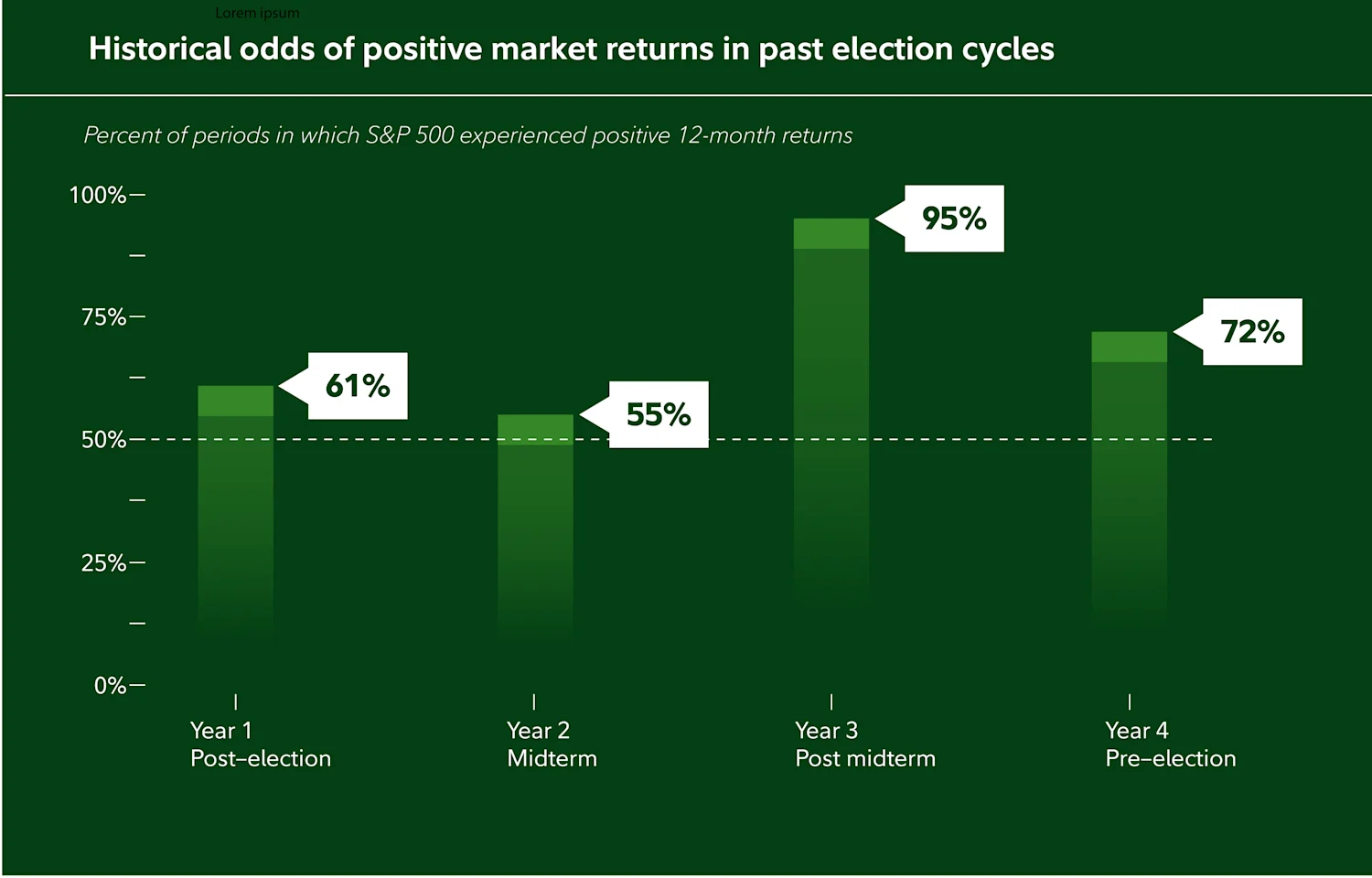
Historical performance has been mixed around the vote, but stronger in the period that follows. Capital Group’s analysis found that the president’s party has lost an average of 27 House seats and three Senate seats across the past 23 midterms. It also found that the S&P 500 Index returned an average of 15.4% in the year following a midterm since 1950. According to Fidelity, the S&P 500 has delivered positive 12-month returns 95% of the time following midterm elections since 1950. 

Fidelity Mid Terms Data

Source: Haver Analytics and Fidelity Investments. Based on historical S&P 500 returns from 1950 to the present by election-cycle year. “Odds” represents the percentage of instances that the market went up (number of times the market went up divided by the total number of instances).

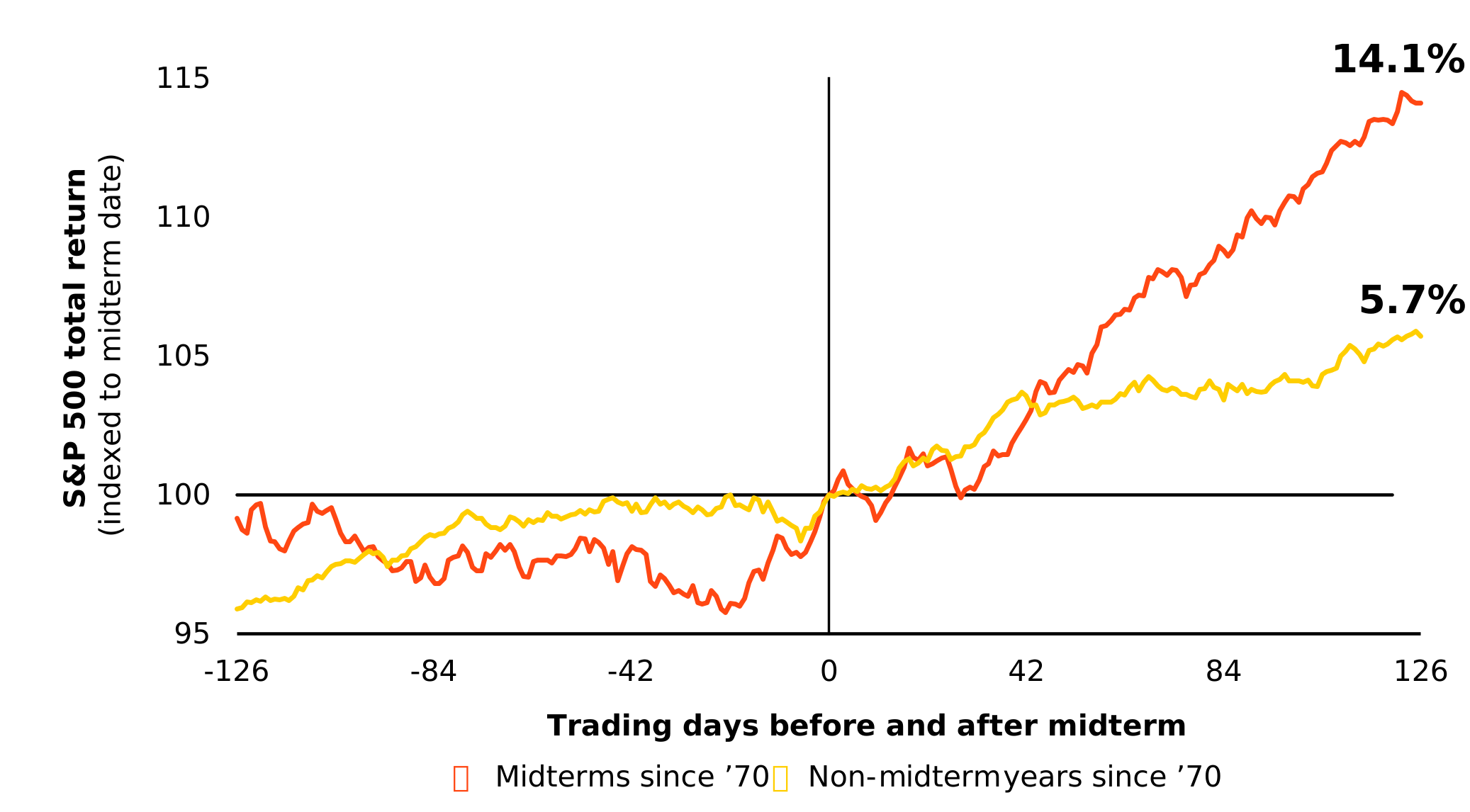
That broader pattern comes with some important nuances around timing and election outcomes. In its analysis of midterm election data dating back to 1970, BlackRock found that equities have tended to rise in the month before voting as polling clarified expectations. The S&P 500 returned an average of 14.1% in the following six months, with returns averaging 10.4% when the president’s party lost control of Congress, compared with 16.1% when unified control was gained or Congress remained divided. 

BlackRock Mid term data

Source: BlackRock, What history says about 2026 midterm elections and market performance

One possible explanation is that markets are responding to uncertainty. Campaigns create competing proposals on tax, spending and regulation, leaving investors to price a range of possible outcomes. As polling narrows those possibilities and the result becomes known, some uncertainty may fade, which has often supported equities. However, this pattern is not guaranteed. Divided government may limit sweeping policy changes, but can also produce budget standoffs. Unified government may allow faster action, but may also create larger policy shifts for markets to absorb. 

Whatever the outcome in Congress, broader economic forces will continue to shape markets. Fidelity's research suggests that earnings, business investment and broader economic conditions have historically been more important drivers of long-term returns than elections. Investors may take some confidence from the historically favourable market performance following midterms, although past returns are no guarantee of future outcomes. For traders, potential volatility around the election may present both opportunities and risks. 

The midterm watchlist

The midterms could affect how much of Trump's legislative agenda can advance through Congress, but the election result alone will not determine the direction of financial markets. Even under political gridlock, equities, bonds, currencies and commodities may move in response to inflation, interest rates, economic growth and geopolitical developments.

For investors and traders, several markets, companies and indicators may be worth following:

  • US share indices: The S&P 500 provides a broad gauge of US equities, while the Nasdaq 100 is more exposed to large technology companies and AI. The Russell 2000, made up of smaller US businesses, may be more sensitive to domestic growth, taxes and borrowing costs. Comparing their performance could reveal which parts of the market are responding most strongly.

  • Individual companies and sectors: Nvidia (NVDA) and Microsoft (MSFT) have exposure to AI and technology policy, while UnitedHealth (UNH) and Humana (HUM) may be sensitive to healthcare funding and regulation. JPMorgan (JPM) offers exposure to financial regulation, Exxon Mobil (XOM) to energy policy, and Lockheed Martin (LMT) to defence spending. Company earnings and industry developments will remain important alongside political policy expectations.

  • US government bonds: The 2-year and 10-year Treasury yields are important indicators of interest rate expectations and longer-term borrowing costs. Changes in fiscal spending, inflation expectations and concerns about US government debt could influence yields. Bond prices generally move in the opposite direction to yields.

  • Currencies: The US Dollar Index (DXY), along with currency pairs such as AUD/USD and EUR/USD, may respond to changes in trade policy, interest rate expectations and investor risk sentiment. For Australian investors holding US assets, exchange rate movements can also affect returns when converted into Australian dollars.

  • Commodities: Gold may respond to changes in the US dollar, interest rates and demand for defensive assets. World Gold Council research suggests economic policy matters more to gold prices than party affiliation alone. Brent crude oil is another market to follow, particularly given the influence of Middle East tensions, global supply disruptions and US energy policy.

  • Cryptocurrencies: Bitcoin (BTC), Ethereum (ETH) and crypto-related companies such as Coinbase (COIN) may respond to developments in US digital asset regulation. The future of market structure legislation remains relevant following the SEC's proposed crypto regulatory framework. However, liquidity, interest rates and broader investor sentiment may also influence prices.

  • Volatility and economic indicators: The Cboe Volatility Index (VIX) measures expected S&P 500 volatility over the next 30 days and could help gauge market uncertainty. US inflation, employment figures, Federal Reserve decisions and Treasury yields will also be important in assessing the wider economic backdrop.

Looking further ahead, the midterms could also serve as a referendum on Trump's second term, with cost-of-living pressures, tariffs and foreign policy among the issues shaping voter sentiment. The results may offer early clues about the political landscape ahead of the 2028 presidential election.

The practical takeaway 

The midterms may change the balance of power in Washington, but they will not change the wider forces shaping markets. For investors and traders, the result is best viewed as one potential source of volatility and clarity within a broader picture defined by economic data, earnings, interest rates and geopolitics. 

Disclaimer: This article provides general information only. It has been prepared without taking account of your objectives, financial situation or needs. It is not to be construed as a solicitation or an offer to buy or sell any financial instruments, or as a recommendation and/or investment advice. It does not intend to support an investment decision, and it should not be relied upon by you in evaluating the merits of investing in any financial instruments. You should consider your objectives, financial situation and needs before acting on the information in this article. CMC Markets believes that the information in this article is correct, and any opinions and conclusions are reasonably held or made on information available at the time of its compilation, but no representation or warranty is made as to the accuracy, reliability or completeness of any statements made in this article. CMC Markets is under no obligation to, and does not, update or keep current the information contained in this article. Neither CMC Markets nor any of its affiliates or subsidiaries accepts liability for loss or damage arising out of the use of all or any part of this article. Any opinions or conclusions set forth in this article are subject to change without notice and may differ or be contrary to the opinions or conclusions expressed by any other members of CMC Markets.