Monthly Outlook: Oil, Qantas, AI

Henry Fisher
Senior Content Specialist
10 minute read
|2 Apr 2026
Oil well in sunrise
Table of contents
  • 1.
    Oil Shock: Markets Brace for Higher-for-Longer Conditions
  • 2.
    Qantas: A High-Conviction Trade Facing Rising Fuel Risk
  • 3.
    TSMC: The AI Bottleneck

With Brent crude trading above $100 a barrel and the Middle East conflict showing no signs of easing, governments, corporations, investors and consumers are preparing for a scenario where energy prices, inflation and even interest rates move higher the longer the war disrupts oil flows through the Strait of Hormuz.

CMC Invest client order flow from March reinforces this shift. Energy-linked assets moved from the periphery to the centre of investor focus within weeks. Data also suggests that despite the sharp fall in equity valuations, artificial intelligence-driven (AI) companies with pricing power remain popular as we move into April.

Oil Shock: Markets Brace for Higher-for-Longer Conditions

Trump’s “American Energy Dominance” plan was straightforward: supercharge domestic oil and gas production, increase energy exports, lower crude prices and take pressure off inflation. And for much of 2025, oil markets remained relatively stable. Brent traded within the balanced $60-70 per barrel range that boded well for both producers and consumers. That changed almost overnight when US-Israeli strikes ignited a conflict that resulted in the near-closure of the Strait of Hormuz.

With crude trading at over $100 per barrel as of 31 March, Australia’s paradoxical position as a major crude exporter that imports refined petroleum products has never been more visible. The CMC Invest community identified this early as oil and gas producers Woodside Energy [WDS] broke into the top 10 most-traded ASX instruments in March, rising to 5th from 13th, while Santos [STO] surged to 20th from 55th.

Yet the order flow tells a more nuanced story. Across both WDS and STO, the buy-sell split sits far closer to 50/50 than an overwhelmingly buy-led flow. Clients are not yet making a high-conviction directional bet. They are keeping their powder dry, waiting for the Hormuz situation to declare itself. The surge in popularity of BetaShares Crude Oil Index ETF [OOO], which offers direct exposure to crude oil price movements, suggests that hedging remains the name of the game for the moment.

This positioning looks tactically sensible heading into April. The range of outcomes from here remains unusually wide. A diplomatic resolution and Hormuz reopening could see Brent retrace sharply toward $80, reversing much of the energy trade’s recent gains almost overnight. A sustained or escalating disruption keeps energy stocks structurally supported, with further upside if supply constraints deepen. 

Trading data suggested that CMC Invest clients showed stronger conviction in US-based oil and gas producers such as ExxonMobil [XOM] and Chevron [CVX], as the duo recorded buy participation of 73% each, in March – a sharp contrast from the 50/50 buy-sell split seen in Australian oil and gas exporters. Policy support for the industry in the US is key here as investors bet on the resurgence of the American fossil fuel sector.

The reality on the ground in Australia stands in stark contrast to the bullish sentiment around domestic oil and gas producers. Local media reported in late March that hundreds of fuel stations had run out of either petrol or diesel, highlighting emerging supply strains as refined product availability across Asia tightens. According to the BBC, diesel prices in Cairns, Queensland were around 85% higher than pre-war levels.

A region synonymous with resource abundance now finds itself scrambling for fuel, reflecting a decades-long shift away from domestic refining. In the early 2000s, Australia had eight refineries and was close to self-sufficient in meeting its petroleum needs. Today, only two remain – Ampol [ALD] in Brisbane and Viva Energy Group [VEA] in Geelong – supplying roughly 17% of domestic refined petroleum demand.

The concern now is that sustained elevated fuel costs will feed through into higher freight charges, which are then passed on to food, medicine and other essential goods. The result is a second wave of inflation hitting just as the Reserve Bank of Australia (RBA) weighs the prospect of additional rate hikes later in the year, following back-to-back hikes in February and March to lift rates from 3.6% to 4.1%.

Economists at Westpac [WBC] and CommBank [CBA] expect the RBA to hike rates again in May.

“The longer this war goes on, the greater the impact will be. But we continue to act to prepare and shield Australians from the worst of it,” Prime Minister Anthony Albanese told reporters on 27 March.

Qantas: A High-Conviction Trade Facing Rising Fuel Risk

Qantas [QAN] shares fell nearly 14% in March on rising fuel costs, yet no stock in the CMC Invest dataset attracted stronger conviction. QAN’s ranking surged from 122nd to 20th among the most-traded ASX instruments, with buy sentiment jumping from 50.4% in February to 84.9% in March, which was the strongest directional shift in the entire dataset.

Clearly, investors in Australia see the recent price drop as a buying opportunity for a company that reported record first-half underlying profit at the end of February. Investor conviction in QAN appears to be driven by factors such as its pricing power within a duopolistic domestic aviation market where Qantas and Virgin Australia [VGN] control nearly 99% of domestic flights as of early 2026.

The numbers from Qantas’ H1 FY26 results were impressive. The company’s ongoing fleet renewal helped increase domestic revenue by 5% year-on-year during the period on the back of increased capacity and new routes. Jetstar was a key performer as the low-cost airline unit reported a 12% y/y jump in underlying EBIT supported by a new, more fuel-efficient fleet.

But the H1 FY26 result was built on fuel prices that no longer exist.

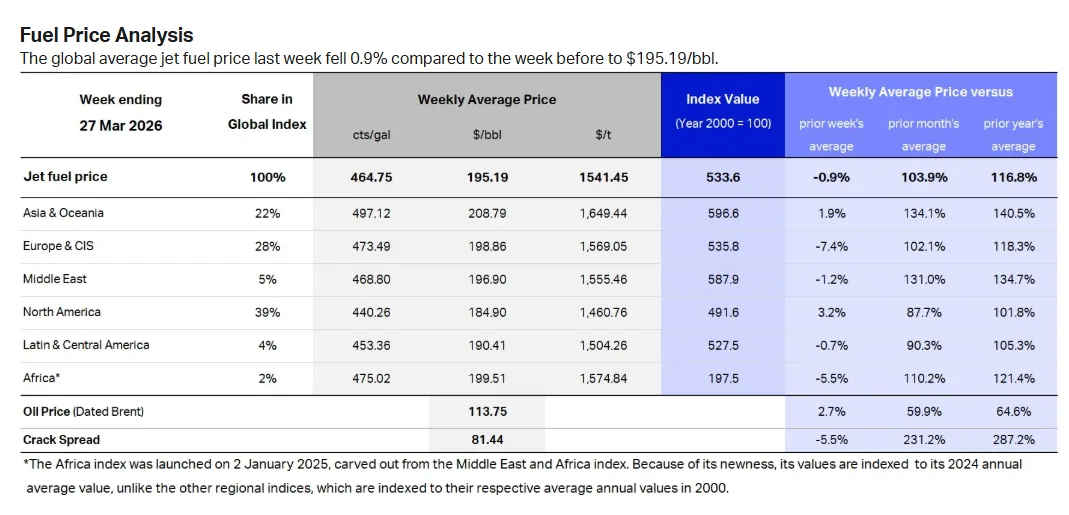
Jet fuel has doubled, from around $100 per barrel at the end of 2025 to over $200 per barrel by late March. The more important number is the crack spread – the difference between crude oil and refined jet fuel. According to S&P Global Platts data, the weekly average crack spread jumped from $27.83 per barrel on 27 February to $86.22 per barrel by 20 March.

Fuel price monitor April Month Ahead

Source: IATA Fuel Monitor

This is where Qantas’ hedge position becomes more vulnerable than it first appears. The airline is more than 80% hedged against crude oil for the half-year ending June. But those hedges track Brent, not jet fuel. BofA estimates that for every $10 per barrel increase in refining margins sustained over 90 days, Asian airlines could see net profits fall by an average of 6%.

With the crack spread currently sitting at more than three times its pre-conflict level, the maths will make QAN bulls uncomfortable.

Qantas is reviewing fares every two weeks and has already raised international fares by 5% in early March. The airline told Reuters that its European routes were operating as scheduled and were more than 90% full in March, around 15 percentage points above typical levels for the month.

With Middle Eastern carriers, including Qatar Airways, Emirates and Etihad operating below normal capacity – having suspended select routes over affected airspace – an opportunity has emerged for Qantas to capture Australia-Europe passengers through its Singapore routes.

“We’re just keeping an eye on our markets and making sure we can deploy as much capacity as we practically can in the short term to get as many people where they want to go. And that includes looking at ways to find more capacity to get into Europe,” said Cam Wallace, Qantas’ head of international flying, during a Tourism Australia conference, as reported by the Australian Financial Review (AFR).

According to Macquarie analyst Ian Myles, Qantas could generate additional revenue between A$330,000 and A$660,000 a day for no additional costs by increasing its passenger load, which will amount to between A$30m and A$60m over three months.

Myles added higher fuel prices would reduce Qantas’ FY2026 earnings by about A$315m, but this would be partly offset by higher fares and stronger demand on UK routes, leaving a net impact of around A$174m, as verified by AFR.

TSMC: The AI Bottleneck

The AI boom is running into a hard constraint. It is not power, data or capital. It is the capacity at Taiwan Semiconductor Manufacturing Company [TSM].

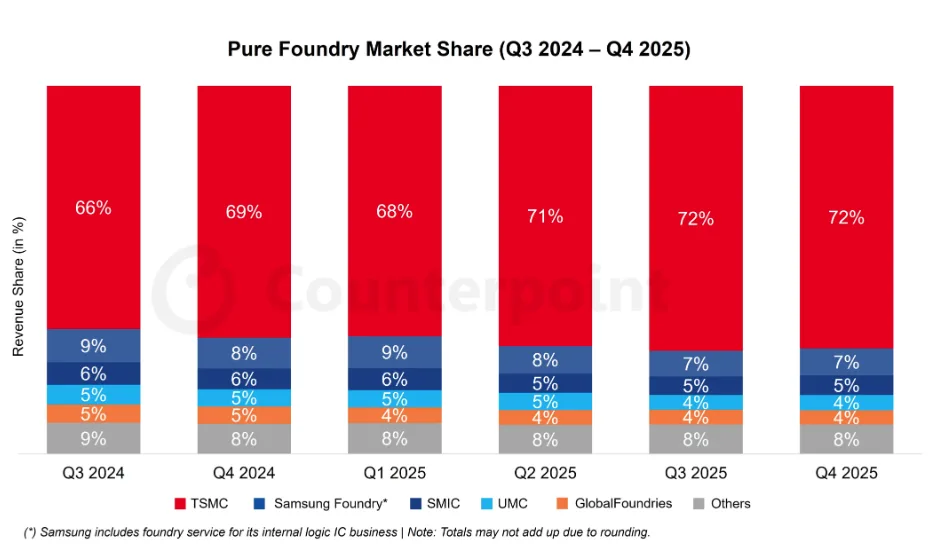
According to Counterpoint’s latest global foundry data, TSMC’s market share rose from 66% in Q3 2024 to 72% by Q4 2025. Second-placed Samsung Electronics [SSNLF] held about 7% at the end of the year.

For high-end AI chips that use 3-nanometre technology, TSMC’s share is likely even higher. Capacity for these chips remains so constrained that Taiwan-based DigiTimes reported that TSMC is prioritizing AI leaders such as Nvidia [NVDA], Advanced Micro Devices [AMD], Broadcom [AVGO] and Marvell [MRVL], alongside long-term customers like Apple [AAPL] and MediaTek [MDTKF].

Chip designers are exploring alternatives such as Samsung. Others are considering vertical integration to secure supply, such as the reported “Terafab” plant being jointly developed by Elon Musk’s Tesla [TSLA], xAI and SpaceX.

Pure Foundry Market Share

Source: Counterpoint Research, March 18th 2026

Speaking at the Q4 2025 earnings call, TSMC Chairman and CEO C.C. Wei did not mince words on the supply situation:

“The capacity is very tight. We work very hard to narrow the gap so far. Probably this year, next year, we have to work extremely hard to narrow the gap.”

Narrowing that gap will require both capital and time. Despite revenue rising 35.9% y/y to over $122bn in 2025, TSMC is not slowing down. The company is deploying record earnings into a capital expenditure plan of $52bn to $56bn in 2026, one of the largest investment cycles in semiconductor history.

To put it into context, TSMC’s 2026 capex is more than two times the reported $20bn to $25bn initial capex at Musk’s Terafab project. It also represents a 27-37% increase from the $40.9bn spent by TSMC in 2025.

Geographical expansion is a key part of this strategy. TSMC is building a more diversified manufacturing footprint across the US, Japan and Europe, while still relying heavily on a geo-politically vulnerable Taiwan. It has already started volume production at its Arizona fab, with plans to build additional facilities to form a full-scale “gigafab cluster.”

But the reality is that the supply constraint the AI industry is facing appears no closer to easing, with meaningful capacity additions still years away, leaving the ecosystem exposed to structural risk.

When asked whether the current capex plan could balance supply and demand, Wei replied:

“It takes two to three years to build a new fab. So even if we start to spend $52-56bn, the contribution to this year (2026) is almost none, and 2027, a little bit. So we are actually looking for 2028-29 supply, and we hope it’s a time that the gap will be narrow."

In the meantime, TSMC is focusing on extracting more output from existing capacity. This includes reallocating 6-inch and 8-inch wafer capacity to advanced nodes, as well as converting 5-nm capacity to support 3-nm processes wherever necessary.

TSMC’s willingness to commit roughly 43% to 46% of 2025 revenue to capex reflects strong conviction in AI demand. Wei said he has been speaking directly to “customers’ customers” to validate demand. He called AI a “megatrend” that is “starting to grow into our daily life.”

When asked whether potential power supply constraints at data centres was a factor to consider, Wei said:

“Their (data centres and hyperscalers) message to me is, silicon from TSMC is a bottleneck, and asked me not to pay attention to all others, because they have to solve the silicon bottleneck first.”

TSMC presents yet another company with pricing power. The company has increased the average selling price of its wafers by about 20% for the second year in a row in 2025, a trend that is likely to become the “new normal” as demand continues to outpace supply.

CMC Invest client positioning reflects this shift. TSMC climbed from 14th to 11th in the US rankings, while buy participation rose from 61.9% to 75.3%, signalling a build-up in conviction around the AI-driven semiconductor trade.

Disclaimer: This article provides general information only. It has been prepared without taking account of your objectives, financial situation or needs. It is not to be construed as a solicitation or an offer to buy or sell any financial instruments, or as a recommendation and/or investment advice. It does not intend to support an investment decision and it should not be relied upon by you in evaluating the merits of investing in any financial instruments. You should consider your objectives, financial situation and needs before acting on the information in this article. CMC Markets believes that the information in this article is correct, and any opinions and conclusions are reasonably held or made on information available at the time of its compilation, but no representation or warranty is made as to the accuracy, reliability or completeness of any statements made in this article. CMC Markets is under no obligation to, and does not, update or keep current the information contained in this article. Neither CMC Markets nor any of its affiliates or subsidiaries accepts liability for loss or damage arising out of the use of all or any part of this article. Any opinions or conclusions set forth in this article are subject to change without notice and may differ or be contrary to the opinions or conclusions expressed by any other members of CMC Markets. 

Support
Support
x

Welcome to CMC Markets Support!

To begin, please select the product your query is related to.