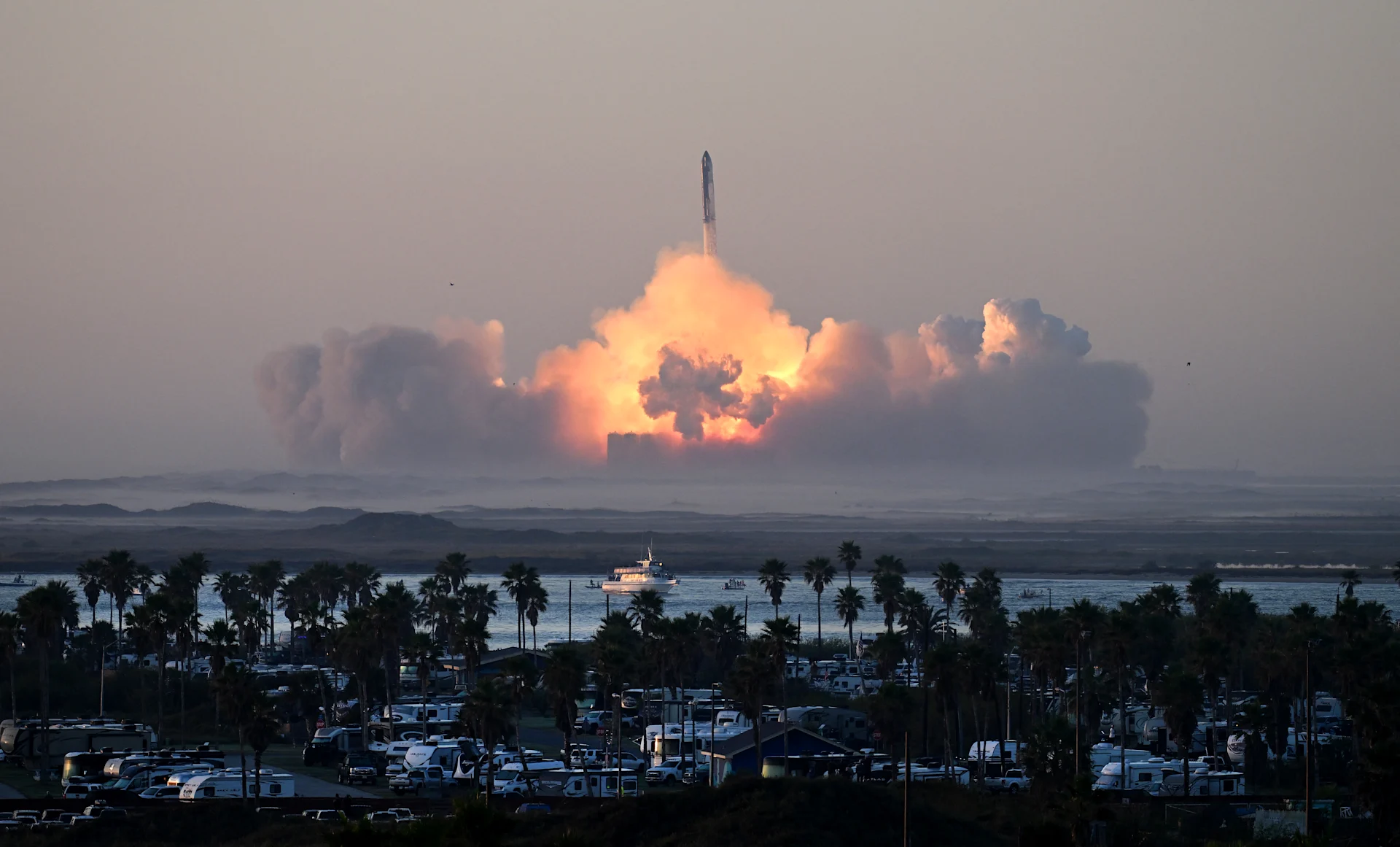
Twenty-four years after Elon Musk founded it with the goal of dying on Mars, SpaceX is planning to list as early as 12 June. The S-1 prospectus hit the US Securities and Exchange Commission on 20 May. The company plans to list on both the Nasdaq and Nasdaq Texas exchanges under the ticker SPCX, with the offering being underwritten by a syndicate of Wall Street's largest investment banks, led by Goldman Sachs, Morgan Stanley, Bank of America, Citi and JPMorgan.
The prospectus opens with a Musk quote about waking up excited for the future. That tone tells you everything.
“You want to wake up in the morning and think the future is going to be great—and that’s what being a space-faring civilization is all about. It’s about believing in the future and thinking that the future will be better than the past. And I can’t think of anything more exciting than going out there and being among the stars.”
This is not an IPO being sold on a price-to-earnings multiple. It is being sold on a thesis about civilisation itself.
One company, three businesses, and only one of them makes money
SpaceX is really three businesses bolted together. There is Space (rockets, the Dragon capsule, and launch services for paying customers). There is Connectivity (Starlink broadband and direct-to-mobile). And there is AI (xAI, the Grok chatbot, the X social platform, and the COLOSSUS data centres). The AI arm only joined the group in February 2026 when SpaceX absorbed Musk's other company xAI, but the financials have been retrospectively combined as if it had always been part of the group.
The numbers paint a clear picture. In 2025, SpaceX generated $18.7 billion in revenue, up from $10.4 billion in 2023. That is roughly 34% compound annual growth. But Starlink is doing nearly all the heavy lifting. Connectivity alone produced $11.4 billion in revenue and $7.2 billion in operating cash earnings, with revenue up almost 50% year-on-year. The Space division lost $657 million, mostly because SpaceX poured $3 billion into developing its next-generation Starship rocket. And the AI segment burned $6.4 billion against just $3.2 billion in revenue.
The cash burn is impossible to ignore
The total net loss for 2025 was $4.9 billion. Accumulated losses since SpaceX was founded now total $41 billion. Total debt sits at $29 billion. And here is the number that should make every investor pause: SpaceX spent $20.7 billion on capital projects in 2025, then another $10.1 billion in just the first three months of 2026. Of that quarterly figure, $7.7 billion went into AI infrastructure alone.
The result? Cash on the balance sheet fell from $24.7 billion at the end of 2025 to $15.9 billion by 31 March 2026. That is nearly $9 billion of cash burned through in a single quarter. This IPO is not a vanity exercise. SpaceX needs the money, and further capital raises could follow.
That disconnect between ambition and valuation is already fuelling heated debate among investors online. In a Reddit thread titled “SpaceX IPO Overpriced?” on r/stocks, one commenter wrote:
“Its only 110x sales. Operating margin is 43% so That means you need 250+ years to redeem your investment. Does that sound like the investment opportunity of the century?”
The comment may be tongue-in-cheek, but it captures the core tension surrounding the IPO: whether investors are buying a transformative infrastructure platform for the next century, or simply paying an extraordinary premium for a futuristic narrative.
Starlink is the cash cow funding everything else
Roughly 9,600 Starlink satellites are now in orbit. SpaceX owns about 75% of all active manoeuvrable satellites currently circling Earth. The service has 10 million subscribers across 164 countries, with median home download speeds of 225 Mbps. Average revenue per user has fallen from $99 to $66 per month over three years, which might sound bad but actually reflects a classic deflationary playbook: cut prices, win more customers, grow faster than the price falls.
The launch business that enables all this has already pulled off a quiet revolution. According to NASA's own figures, Falcon 9 cut the cost of reaching orbit from roughly $18,500 per kilogram to about $2,700 per kilogram. That is an 85% reduction the agency has publicly acknowledged. With its new Starship rocket, SpaceX is aiming to cut that figure by another 99%.
The real bet is moving data centres into space
This is where the prospectus gets genuinely ambitious. SpaceX argues that electricity grids on the ground simply cannot scale to meet AI's energy demand. US electricity generation grew at just 0.1% per year between 2008 and 2023. The Sun, by contrast, contains 99.8% of the solar system's energy, and solar panels in orbit can generate more than five times the power per unit area than panels on Earth.
So the plan is to put the data centres in orbit. Starting from 2028, SpaceX intends to deploy AI computing satellites powered by solar energy and cooled by radiating heat into space. The long-term ambition is to launch 100 gigawatts of compute capacity per year. For context, that would require roughly one million metric tons of payload sent to orbit annually. The total mass humanity has launched into orbit across all of history is about 45,000 metric tons (as of mid-2026).
This is what Starship is for. There is also a partnership with Tesla and Intel called Terafab, which aims to manufacture one terawatt of compute hardware every year.
The $45 billion detail buried in the filing
Tucked into the "Recent Developments" section is a disclosure that probably belongs on the front cover. Anthropic, the AI company behind the Claude chatbot and a direct competitor to xAI's Grok, has signed an agreement to pay SpaceX $1.25 billion per month through May 2029. That is roughly $45 billion in committed compute revenue. Either side can walk away with 90 days' notice, so it is not ironclad. But the message is unmistakable: in the AI race, raw computing power, not the models themselves, is the real bottleneck. Even direct rivals are forced to rent it from xAI's data centres.
In April, SpaceX also announced an agreement giving it the right to acquire AI coding startup Cursor for $60 billion, or alternatively receive a $10 billion payment, underscoring how strategic AI infrastructure and distribution have become.
For xAI and SpaceX, the agreement strengthens the case for their AI infrastructure strategy. It points to strong demand for large-scale compute capacity and could provide a meaningful new revenue stream to help offset heavy capital expenditure. More broadly, it adds credibility to the AI growth narrative heading into the IPO.
SpaceX is quietly trying to become a fourth tech platform
Two smaller mentions in the prospectus hint at much bigger ambitions. The first is Macrohard, a project being developed with Tesla. The name is a deliberate jab at Microsoft. The goal is to build, in the prospectus's own words, "a fully AI-operated software company," using AI agents to replace traditional software businesses entirely.
The second is the Money Product, a payments, banking and lending service planned for launch on the X platform. Together, these signal that Musk is trying to turn X into something like China's WeChat: an all-in-one super-app for messaging, finance and AI services. That gives the bull case a fourth growth lever beyond rockets, Starlink and AI compute.
It is also worth noting that about one fifth of SpaceX's 2025 revenue came from US government agencies, including NASA crew missions and national security launches. That is both a competitive moat and a political risk in a polarised Washington.
Three main risk areas stand out in the prospectus
First is Starship. Every major growth story, including next-generation Starlink, satellite-to-mobile, orbital AI compute, the Moon and Mars, depends on one rocket that has flown 11 test flights and has yet to deliver a single payload to orbit. SpaceX expects that to happen in the second half of 2026. In this industry, delays are the norm. Investors should assume Starship and other key develops will likely take longer than hoped.
Second is Musk control. SpaceX is using a dual-class share structure that gives Class B shares ten votes each. Elon Musk owns roughly 42% of the equity but controls approximately 85% of the voting power. This lets him (and a small group of insiders) elect the majority of the board. SpaceX will list as a “controlled company,” which allows it to bypass some standard corporate governance protections that normally safeguard ordinary shareholders. There is no key-person insurance on Musk, who is simultaneously running Tesla, Neuralink, and The Boring Company. Shareholder disputes must go through a Texas business court or mandatory arbitration. If you’re uncomfortable investing in a company where one person has this level of control, this stock is probably not for you.
Third is the AI burn rate. Losing $6.4 billion on $3.2 billion of revenue is not a path to profitability, and the prospectus openly admits the company may never make money in this segment.
There are also two smaller risks worth flagging. SpaceX does not insure its rockets or satellites, which means any catastrophic failure hits the balance sheet directly.
In one of the more striking disclosures, the prospectus includes the following in its discussion of geopolitical and security risks:
“The increasing militarization of space and the potential development of space-based warfare capabilities may expose our assets and operations to heightened geopolitical and security risks, including the risk that foreign governments or other actors could target our satellites or related infrastructure. Certain foreign governments have publicly discussed the potential use of anti-satellite weapons against the Starlink constellation.”
Taken together, these risks highlight just how unconventional this IPO really is. At times, the prospectus reads more like a Christopher Nolan script than a traditional public market filing.
Bottom line
This is an IPO that demands an unusual kind of investor: someone willing to underwrite a multi-decade thesis about the future of civilisation on the back of one reliably profitable business (Starlink), one capital-incinerating bet (AI), and one founder who insists on controlling everything.
The bull case is that SpaceX becomes the AWS of physical infrastructure for the 21st century, owning launch, connectivity, compute, and eventually orbital energy in ways no competitor can match. The bear case is that Starship slips, AI economics never work out, and the $28.5 trillion total addressable market remains a slide in a prospectus.
Either way, when it prices, this will be the most consequential IPO of the decade. Read the S-1 yourself before forming a view.