Nuclear’s second act: Hype cycle or the beginning of a new energy era?

Henry Fisher
Senior Content Specialist
13 minute read
|11 May 2026
Nuclear Power Plant in Distance
Table of contents
  • 1.
    From nuclear winter to renewed interest
  • 2.
    Why nuclear is back on the agenda
  • 3.
    How to invest in nuclear
  • 4.
    The key tailwinds
  • 5.
    Structural risks within the nuclear theme
  • 6.
    So, does the nuclear renaissance stack up?

Three key takeaways

  1. Nuclear is moving back into focus after decades of stagnation, driven by energy security concerns, decarbonisation goals, and a surge in electricity demand from AI infrastructure.

  2. The investment opportunity spans far beyond uranium, covering miners, utilities, reactor developers, and a deep industrial supply chain, each with different risk and return profiles.

  3. The long-term case is compelling, but execution risks remain real, including cost overruns, regulatory hurdles, and uncertainty around next-generation reactor technologies.

From nuclear winter to renewed interest

For most of the past 40 years, nuclear energy has been an industry in stagnation.

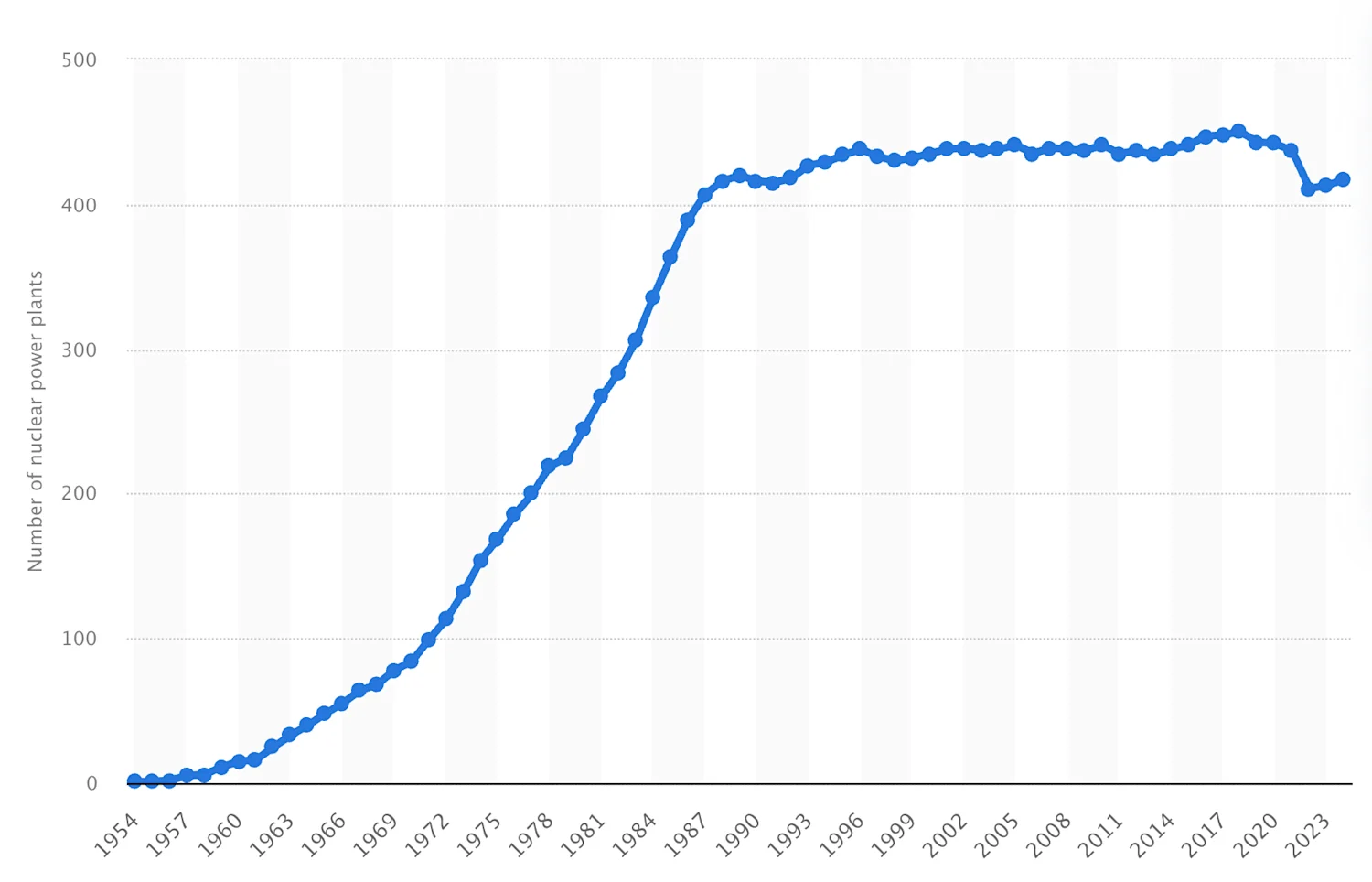
Major accidents at Three Mile Island in 1979 and Chernobyl in 1986 reshaped public perception and policy. Governments slowed approvals, investors stepped back and new builds declined sharply. The result was what many now call a “nuclear winter”, a long period of underinvestment across the entire value chain.

That stagnation had consequences. Uranium supply chains thinned out. Engineering capability contracted. Capital stopped flowing.

Number of operational nuclear reactors worldwide from 1954 to 2024

Screenshot 2026-05-08 at 11.27.23 am

Source: Statista 2026, Published by Won So, Jan 20, 2026

Now, that backdrop is starting to shift.

In 2024, nuclear reactors worldwide generated 2,667 TWh of electricity, the largest amount ever produced in a single year, surpassing the previous record set in 2006.

Over 75 reactors are under construction across the world. About 120 further reactors are planned.

At the same time, more than 20 countries pledged to triple their nuclear energy capacity by 2050 at COP28. Six additional countries joined that commitment at COP29 in Azerbaijan.

Policymakers increasingly frame nuclear not just as a clean energy source, but as a strategic asset tied to national security and grid reliability. Even in Australia, where domestic nuclear power remains politically sensitive, the conversation has begun to reopen. In May 2026, New South Wales’ upper house passed a bill to repeal the state’s 1986 prohibition on uranium mining and nuclear facilities, marking the most significant policy shift in decades. However, the ban remains in place for now, with the legislation still requiring lower house approval and royal assent, meaning any real shift in supply could remain some way off.

So is this the end of the nuclear winter, or just a temporary thaw?

Why nuclear is back on the agenda

Three forces sit behind the renewed interest:

1. Energy security has become non-negotiable

Recent geopolitical tensions exposed the fragility of global energy systems. Countries that relied heavily on imported fossil fuels faced price shocks and supply disruptions.

Nuclear offers something few alternatives can match: reliable, always-on power that is largely independent of weather and global fuel markets.

That matters more than ever. The Russian invasion of Ukraine in 2022, combined with supply chain disruptions from Niger and Kazakhstan, prompted utilities across Western nations to urgently re-examine procurement strategies that depended on fuel from higher-risk jurisdictions.

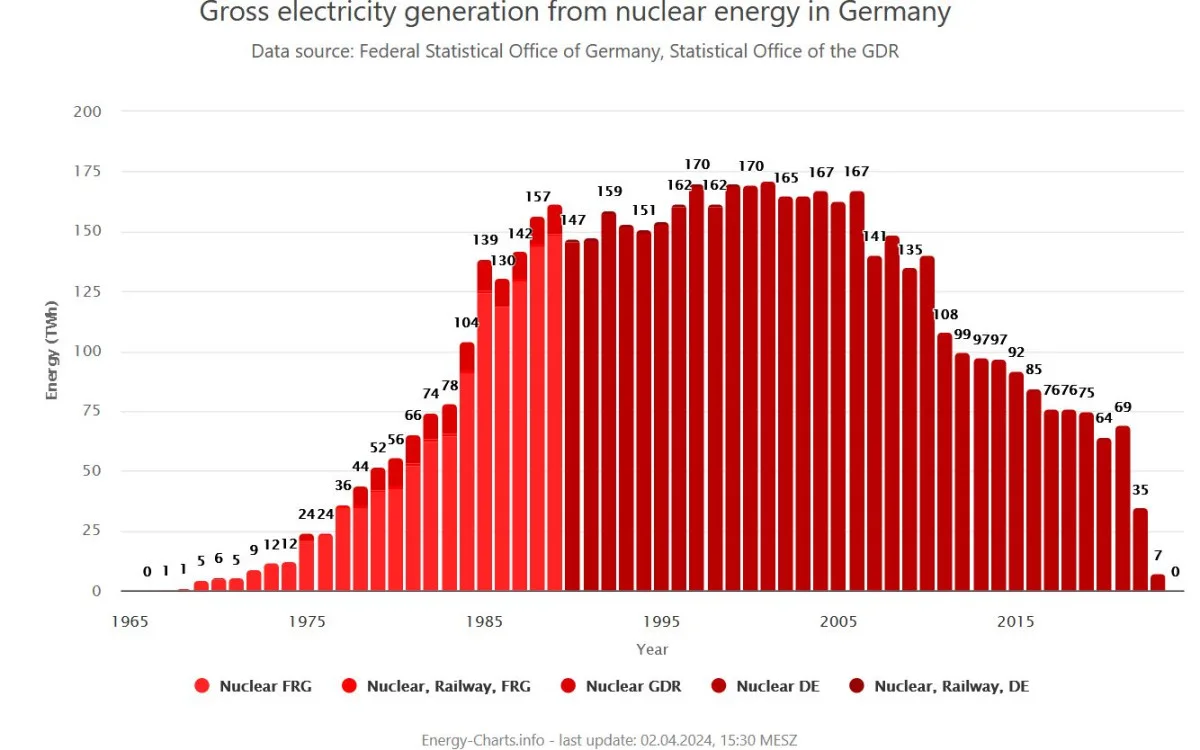
Germany is the starkest example. The country completed its phase-out in April 2023 after two decades of deliberate wind-down, only to find itself acutely exposed when Russian gas supplies collapsed following the invasion of Ukraine. By 2025, the new government was already exploring a reversal, proposing SMR construction and potential restarts. A March 2025 poll found 55% of Germans now support restarting closed nuclear plants.

oneyearnuclearupdate-nuclearlifespan

2. Decarbonisation has limits without baseload power

Solar and wind continue to scale rapidly, but they come with a structural constraint. They are intermittent.

Battery storage helps, but at large scale it becomes expensive and complex. Industrial economies need consistent, round-the-clock electricity.

Nuclear fills that gap. It produces near-zero emissions and operates at an average global capacity factor of 83%, meaning it generates at more than four-fifths of its maximum output around the clock. North American reactors perform even better, averaging 90%.

In 2024 alone, global nuclear plants helped avoid 2.1 billion tonnes of CO₂ emissions, equivalent to almost twice the carbon footprint of the entire global aviation industry.

3. AI is creating a new demand shock

This is the newer piece of the puzzle.

Data centres consumed approximately 415 TWh of electricity in 2024, around 1.5% of global electricity supply. The International Energy Agency projects that figure to more than double, reaching approximately 945 TWh by 2030. (IEA, Energy and AI, 2025)

AI-focused data centres can draw as much electricity as power-intensive factories such as aluminium smelters, but they are far more geographically concentrated. Nearly half of all data centre capacity in the United States sits in just five regional clusters.

These facilities cannot tolerate downtime. They need stable, continuous power, exactly the profile nuclear delivers.

The result: large technology companies are moving rapidly to secure nuclear power directly. In 2024 and 2025, big tech companies signed contracts for more than 10 gigawatts of potential new nuclear capacity in the United States alone. The pipeline of conditional offtake agreements between data centre operators and small modular reactor (SMR) projects grew from 25 GW at the end of 2024 to 45 GW by early 2026.

Notable deals include:

  • Microsoft signed a 20-year power purchase agreement with Constellation Energy to restart Pennsylvania's Three Mile Island Unit 1, targeting delivery of over 800 MW by 2028.

  • Google committed to purchasing 500 MW of power from Kairos Power's SMRs from 2030, and in May 2025 invested in Elementl Power for three additional US reactor sites totalling 1.8 GW.

  • Amazon backed 5 GW of SMR projects with X-energy in October 2024, and is exploring additional projects in Virginia with Dominion Energy.

  • Meta struck agreements with Vistra, TerraPower, and Oklo that could deliver up to 6.6 GW of electricity by 2035.

How to invest in nuclear

While nuclear is commonly grouped as a single investment theme, it is not a uniform one. It spans a broad value chain, offering multiple ways for investors to gain exposure, from uranium supply to power generation and advanced reactor development. Each segment is driven by different factors, meaning risks and opportunities are not evenly distributed across the sector.

Understanding the structure helps clarify where opportunities and risks sit.

1. Uranium: the fuel

At the base of the value chain sits uranium.

All nuclear reactors rely on it, regardless of technology. That makes it the most direct and often simplest way to gain exposure.

The investment case here is increasingly structural. Global uranium requirements are currently around 68,920 tonnes per year and are projected by the World Nuclear Association to reach over 107,000 tonnes by 2040 under a reference scenario, and potentially 204,000 tonnes under a high-growth scenario.

Meanwhile, supply has struggled to keep pace. In 2025, global uranium mine production reached approximately 173 million pounds, against primary reactor demand of roughly 204 million pounds, a deficit that analysts expect to widen materially toward 2030.

The uranium spot price surged from around $29/lb in early 2021 to a peak above $106/lb in February 2024, before settling back. Long-term contract prices reached a 14-year high of $86.50/lb in December 2025.

The decade of low prices between 2011 and 2020, when spot prices hovered around $20 to $30 per pound and remained well below production costs for many operations, triggered severe industry contraction, with major mines including the Ranger mine in Australia shutting permanently. New uranium mines typically take 10 to 15 years from discovery to first production, meaning the supply response to higher prices is structurally slow.

There are two main avenues for gaining exposure to uranium: physical uranium vehicles, which aim to track the price of uranium itself and offer direct exposure to the commodity, and uranium miners, which provide indirect exposure, with returns influenced by both uranium prices and company-specific factors.

Physical uranium vehicles:

  • Sprott Physical Uranium Trust (U/UN:CA, SPUT:GB)

Key uranium exploration and producer names include:

  • Cameco (CCJ:US)

  • Paladin Energy (PDN)

  • Boss Energy (BOE)

  • Denison Mines (DNN:US)

  • Uranium Energy Corp (UEC:US)

  • Energy Fuels (UUUU:US)

2. Utilities: the power producers

These are the companies that own and operate nuclear plants.

The United States operates the world's largest nuclear fleet, with 94 reactors generating approximately 782 TWh in 2024, supplying around 20% of the nation's electricity. France derives around 70% of its electricity from nuclear, the highest share of any large economy.

Utilities benefit directly from rising demand for clean, reliable electricity. Increasingly, they are signing long-term agreements with large energy users including data centre operators. This part of the market tends to offer more stable cash flows but less leverage to uranium prices.

Key names include:

  • Constellation Energy (CEG:US)

  • Duke Energy (DUK:US)

  • Southern Company (SO:US)

  • Exelon (EXC:US)

3. Reactor developers: the growth segment

This is where much of the innovation sits.

Companies in this space are developing next-generation reactors, particularly small modular reactors, or SMRs. These are smaller, factory-built nuclear units designed to be deployed faster, with lower upfront costs and greater flexibility than traditional large-scale plants. The IEA projects SMRs could contribute up to 80 GW of capacity by 2040 in an upside scenario, while the IAEA estimates they could account for 24% of all new nuclear capacity added through 2050 in a high-growth case.

As of 2024, more than 127 SMR designs were under development globally, with over 33 designs entering pre-licensing with regulators, a 65% year-on-year increase.

Key players include:

  • NuScale Power (SMR:US)

  • Oklo (OKLO:US)

  • Rolls Royce Holdings (RR/:GB)

  • BWX Technologies (BWXT:US)

  • GE Vernova (GEV:US)

  • Mitsubishi Heavy Industries (7011:JP)

  • Lightbridge Corp (LTBR:US)

Even with a growing field of developers, SMRs remain an emerging technology, with significant uncertainty around execution, economics and real-world rollout. These challenges are outlined in the risks section below.

4. Broad sector exposure

For those looking to take a broader view across uranium, miners and the nuclear value chain as a whole, ETFs can offer a diversified way to access the theme.

Global nuclear and uranium ETFs include:

  • Global X Uranium ETF (URA:US)

  • VanEck Uranium and Nuclear ETF (NLR:US)

  • Sprott Uranium Miners ETF (URNM)

  • Sprott Junior Uranium Miners ETF (URNJ:US)

  • Range Nuclear Renaissance Index ETF (NUKZ:US)

  • Themes Uranium & Nuclear ETF (URAN)

  • First Trust Bloomberg Nuclear Power ETF (RCTR:US)

  • Direxion Daily Uranium Industry Bull 2X Shares (URAA:US)

  • Range Global Nuclear Renaissance ETF (NUCL:US)

ASX listed options include:

  • Global X Uranium ETF (ATOM)

  • Betashares Global Uranium ETF (URNM)

  • VanEck Uranium and Nuclear Technologies ETF (NUKL)

These funds vary meaningfully in exposure. Some focus primarily on uranium miners, while others include utilities, reactor developers, engineering firms and physical uranium. Investors should also be aware that smaller funds may have lower liquidity and higher volatility, making it important to review each fund’s structure, holdings, fees and management team before investing.
The key tailwinds

Several structural drivers support the long-term case:

  1. Chronic underinvestment: Years of underfunding have constrained supply, leaving global uranium mine output below reactor demand. With new projects taking years or even decades to develop, supply may remain tight even as demand grows, limiting the market's ability to respond and potentially putting sustained upward pressure on uranium prices over time.

  2. Policy support is deepening: Over 140 nuclear industry companies, 14 of the world's largest banks, including Citibank, Morgan Stanley and Goldman Sachs, and at least 15 major energy users have pledged support for nuclear expansion targets. The IAEA has now raised its nuclear capacity projections for five consecutive years.

  3. AI-driven demand: The pipeline of data centre to nuclear offtake agreements reached 45 GW globally by early 2026, a figure that has grown rapidly and shows no sign of slowing.

  4. Energy independence: Countries want more control over their energy systems. Nuclear helps deliver that, particularly as Western nations move away from Russian-linked uranium and fuel cycle services following the US Prohibiting Russian Uranium Imports Act, signed into law in May 2024.

  5. Long asset lives: Once built, nuclear plants can operate for decades. The IEA's Net Zero Emissions Scenario sees nuclear capacity reaching 1,079 GW by 2050, nearly triple current levels. The IAEA's high case scenario projects capacity reaching 992 GW by 2050, up from 377 GW today.

Structural risks within the nuclear theme

Nuclear may be gaining momentum as a clean and reliable energy source, but it remains one of the most complex and capital-intensive industries in global infrastructure. Behind the long-term growth narrative sits a range of structural risks that can materially shape costs, timelines and returns across the broader nuclear ecosystem.

  1. High capital intensity: Nuclear plants are expensive to build. The two new AP1000 reactors at Georgia Power's Vogtle plant in the United States, the only new large reactors completed in the US in recent decades, saw their estimated all in cost increase by 140% since construction began in 2011 and came in more than six years behind schedule. A study of 180 nuclear projects found that final costs exceeded initial budgets on average by 117%, with construction taking on average 64% longer than projected.

  2. Regulatory complexity: Nuclear remains one of the most heavily regulated industries in the world. Approval processes are long and uncertain. Policy shifts in either direction can shape the outlook, though they typically take time and significant political effort to implement.

  3. Technology uncertainty: Next-generation reactors, particularly SMRs, are not yet widely proven at commercial scale. Of the SMR designs worldwide, only a handful are operational, with two in Russia and one in China. The experience so far is sobering: costs for NuScale's SMR design more than doubled between 2015 and 2023, rising from $9,964 per kW to $21,561 per kW and ultimately forcing the cancellation of its flagship Utah project in late 2023 despite more than $1.4 billion in US Department of Energy backing. In Europe, SMR startups including Newcleo and Naarea have faced serious financial difficulties, and several French SMR projects have been suspended.

  4. Supply chain constraints: Fuel enrichment remains a bottleneck, particularly for advanced reactors. More than 900 million pounds of uranium demand through 2035 remains uncontracted, which could tighten supply and support prices, while also creating uncertainty for utilities and reactor developers reliant on long-term fuel availability.

  5. Market volatility: Uranium prices and nuclear-related equities can move sharply. The uranium spot price swung from above $106/lb in early 2024 to the low $60s before rebounding into the high $80s in the second half of 2025. Investor sentiment can shift quickly in thematic sectors.

So, does the nuclear renaissance stack up?

Nuclear energy is no longer viewed purely through the lens of past accidents. It is increasingly seen as part of the solution to some of the world's biggest energy challenges. Record generation, a surge in tech company power deals, rising IAEA forecasts, and tightening uranium supply all point toward a sector in structural transition.

But investors should stay grounded. This is a complex, capital-intensive industry with long timelines and real execution risk. History shows cost overruns are the norm, not the exception. Not every SMR design will reach commercial scale. Not every company will succeed.

Just as importantly, market narratives and valuations can move faster than underlying fundamentals. Uranium prices and nuclear-related equities have historically been cyclical, shaped not just by long-term demand, but by sentiment, contracting cycles and supply responses. Periods of optimism can lead to sharp re-ratings, followed by equally pronounced corrections when expectations adjust.

At the same time, the structural drivers are hard to ignore. Energy security, decarbonisation, and rising electricity demand are not short-term trends. They are reshaping the global energy system, and nuclear sits at their intersection in a way it has not for decades.

For investors, the question is not whether nuclear grows, though the direction of travel appears constructive. As with many thematic investment opportunities, the critical question is how that growth translates into investment outcomes, and where in the value chain it converts into sustainable returns.

In a theme this broad, outcomes are unlikely to be uniform. Different parts of the value chain are exposed to different risks, timelines and economic drivers. That is where careful selection and ongoing scrutiny matter.

Disclaimer: This article provides general information only. It has been prepared without taking account of your objectives, financial situation or needs. It is not to be construed as a solicitation or an offer to buy or sell any financial instruments, or as a recommendation and/or investment advice. It does not intend to support an investment decision and it should not be relied upon by you in evaluating the merits of investing in any financial instruments. You should consider your objectives, financial situation and needs before acting on the information in this article. CMC Markets believes that the information in this article is correct, and any opinions and conclusions are reasonably held or made on information available at the time of its compilation, but no representation or warranty is made as to the accuracy, reliability or completeness of any statements made in this article. CMC Markets is under no obligation to, and does not, update or keep current the information contained in this article. Neither CMC Markets nor any of its affiliates or subsidiaries accepts liability for loss or damage arising out of the use of all or any part of this article. Any opinions or conclusions set forth in this article are subject to change without notice and may differ or be contrary to the opinions or conclusions expressed by any other members of CMC Markets.