How support and resistance levels help investors read the market

4 minute read
|26 Nov 2025
How support and resistance levels help investors read the market

This article is brought to you by TradingView 

When discussing trading and analytical approaches to trades, we often hear the terms support and resistance. These concepts are commonly used by traders of all levels, from beginners to professionals, as part of their analysis when considering market conditions. 

What support and resistance actually mean 

Support is a price level at which a declining asset finds enough buying interest to stop its fall and possibly reverse direction. At this level, demand may exceed supply, which could result in the price moving upward as sellers become scarcer and buyers step in.  

Conversely, resistance refers to a price level where a rising asset encounters enough selling pressure to halt its ascent or push it back down. At these levels, supply outweighs demand, and the price struggles to climb any higher.   

For example, if Apple stock price repeatedly drops to $250 and holds above it without breaking lower, that level becomes a strong support. Similarly, if the pair rises to $270 multiple times but fails to break above, that price becomes a resistance level. 

Investors often gravitate toward whole numbers, like $250 or $270, when analysing stock prices. These amounts serve as psychological markers — a sort of "line in the sand" for price movements. 

Such price points tend to attract attention and orders, turning into natural support or resistance zones. On a chart, an investor needs to identify at least two rebounds and two pullbacks to confirm the existence of support and resistance in specific price ranges.
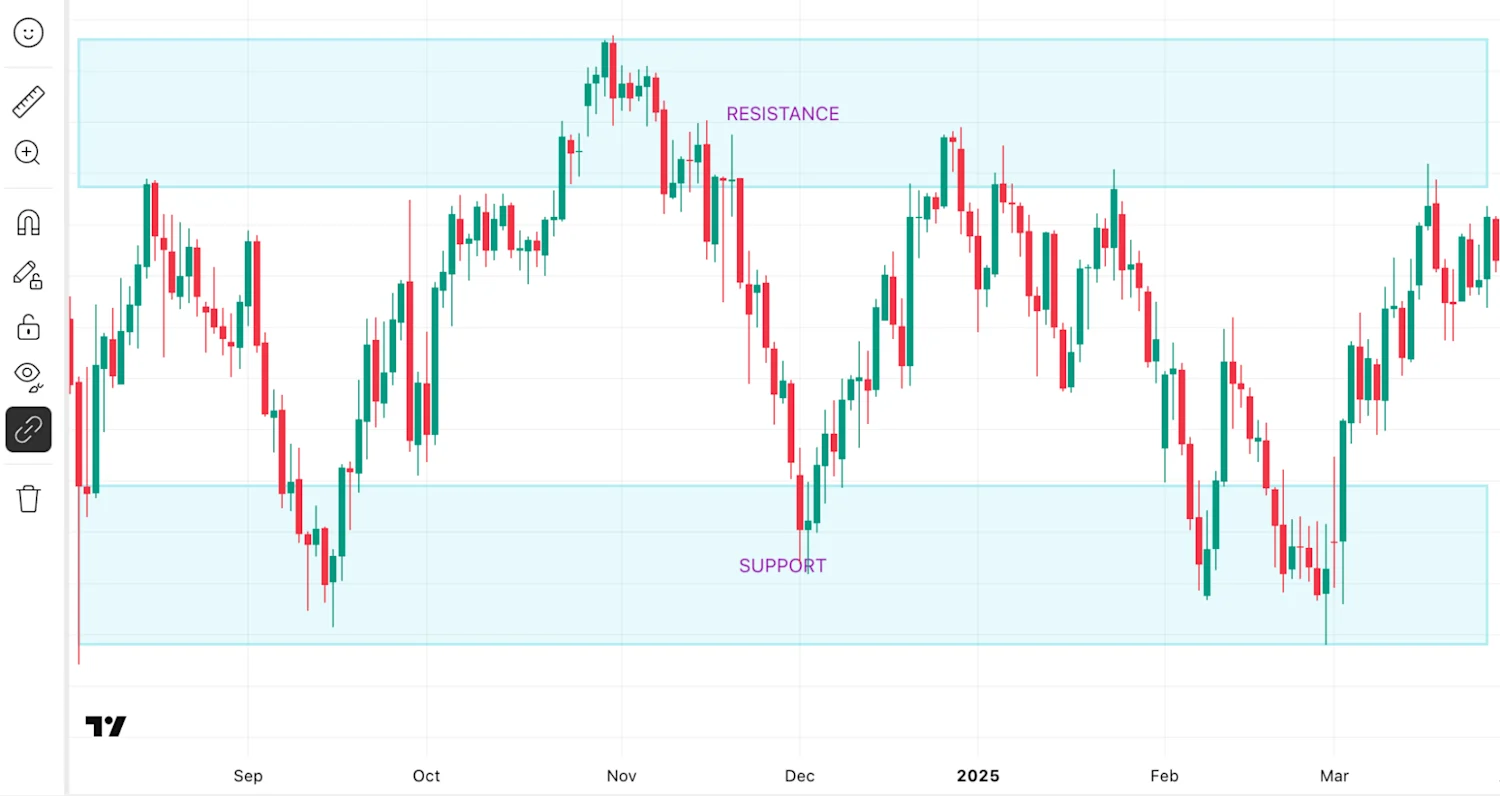
TradingView Support and Resistance 1

When a significant number of investors identify the same price level as important, it becomes a self-fulfilling prophecy: their collective actions reinforce that level’s importance as support or resistance. 

For traders, these zones may provide signals that some participants use to help inform potential entry or exit points. They also help in more effectively setting stop-loss and take-profit orders. 

Note: Support levels can sometimes turn into resistance (and vice versa), indicating a potential trend reversal.  

How support becomes resistance (and vice versa) 

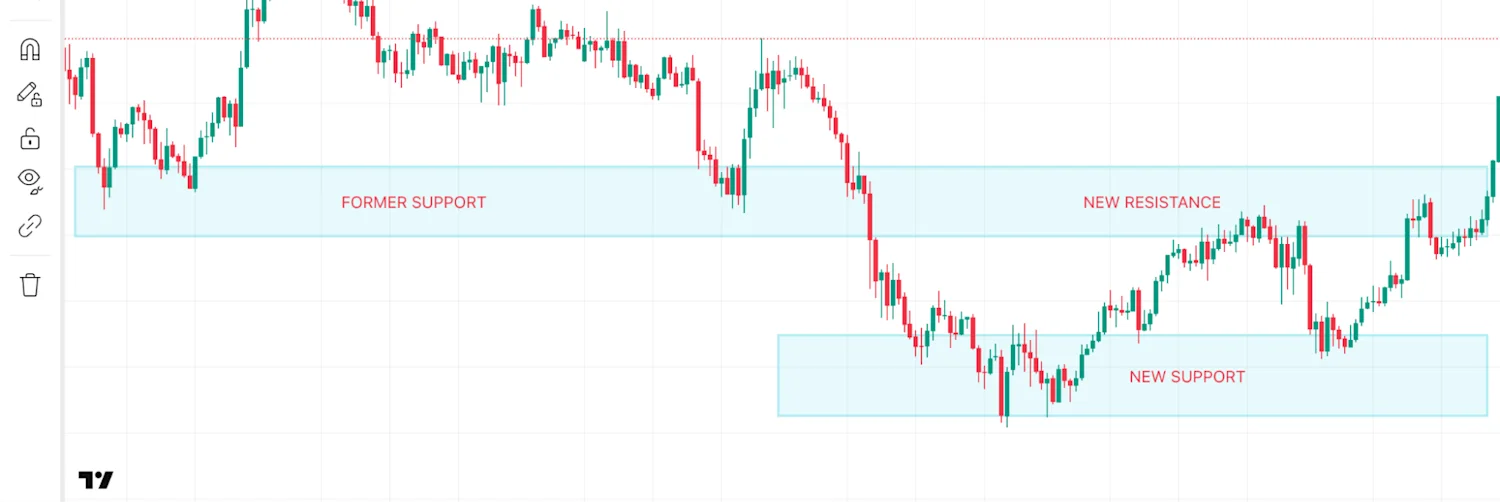
Role reversal is a key concept in technical analysis. When a support level is broken (i.e., the price falls below it), it could become resistance. Previous buyers who are now at a loss often sell when the price returns to that level, creating selling pressure.  

On the other hand, when resistance is broken (the price rises above it), it can turn into support. Sellers who previously shorted at that level may now view it as an attractive entry point for buying. 

This phenomenon reflects psychological anchoring, where investors remember significant price levels and adjust their expectations accordingly. Levels associated with major price action tend to remain relevant for some time, with investors often placing stops and limit orders around them. 

TradingView Support and Resistance 2

Identifying new trends and drawing support or resistance lines is just one step in the technical analyst's work.  

To improve forecasting, analysts should take a broader perspective — understanding how these price ranges fit within the overall market conditions. Excellent technical analysis is usually accompanied by fundamental analysis, which provides insights into the bigger picture and enhances predictive accuracy. 

Conclusion 

Support and resistance levels are more than just lines on a chart; they reflect the collective psychology of market participants.  

Recognising these levels may help investors anticipate potential price movements, respond more strategically, and consider how their approach aligns with prevailing market sentiment. 

Whether you trade shares, ETFs, or crypto, understanding support and resistance is foundational to technical analysis — which, as we’ve seen, is most effective when paired with solid fundamental analysis.

Trade smarter with TradingView on CMC Invest

See your investments in a new light. TradingView on CMC Invest brings professional charting to your shares, ETFs and cryptocurrencies, all in one seamless experience.

Track price action with precision. Explore multiple chart types, timeframes and popular indicators like RSI and MACD. Draw, analyse and plan your next move with powerful tools built directly into your platform.

On desktop

  1. Search for any instrument in the top bar

  2. Select the advanced chart icon to open a full screen TradingView experience

On mobile

  1. Search for your instrument

  2. This opens the product overview, where the TradingView chart appears by default

  3. Tap the two circle icons to switch chart style or enter full screen mode for analysis on the go

New to the platform? Watch our platform video guide to explore what’s on offer and learn how to open TradingView on desktop.

Log in or create your CMC Invest account to start charting today.

Disclaimer: The research content has been prepared by third party provider, TradingView ©. CMC Invest shall not be held responsible for any loss that you may incur, either directly or indirectly, arising from any investment based on, or otherwise as the result of the correctness, completeness, accuracy, currency, or timeliness of the research or from any reliance on the research provided. 

Invest with Australia's favourite non-bank stockbroker.
$0 brokerage on the ASX* and in the US, UK, Canada and Japan^
Access 45,000+ stocks, ETFs and more from one account
Canstar Broker of the Year –15 years in a row
*First buy up to $1,000, per security, per day. Excludes margin loan settled trades.^FX spreads apply.
Support
Support
x

Welcome to CMC Markets Support!

To begin, please select the product your query is related to.