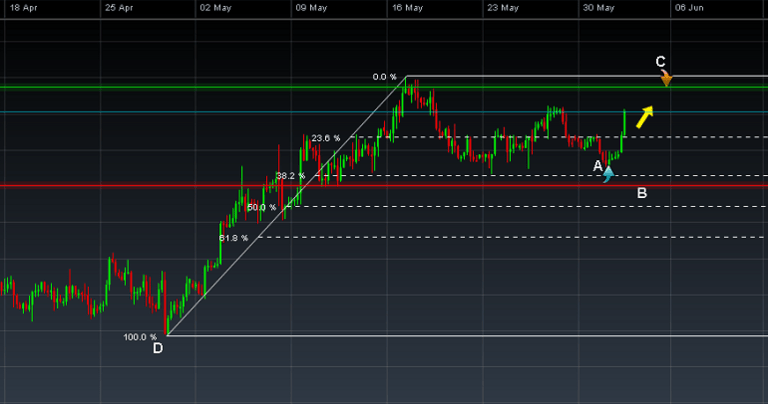
Diagram guide:
A – Trade entry point
B – Stop loss
C – Price forecast (exit level)
D – Fibonacci technical analysis
There are various strategies that traders may use when swing trading stocks. In this example, we've shown a swing trade based on trading signals produced using a Fibonacci retracement.
The three most important points on the chart:
Any swing trading system should include these three key elements.
About stop loss and exit points:
The stop loss level and exit point don't have to remain at a set price level as they will be triggered when a certain technical set-up occurs, and this will depend on the type of swing trading strategy you are using.
Timeframe:
The estimated timeframe for this stock swing trade is approximately one week. It's important to be aware of the typical timeframe that swing trades unfold over so that you can effectively monitor your trades.
Five swing trading strategies for stocks
We've summarised five swing trade strategies below that you may use to identify trading opportunities and manage your trades from start to finish. Apply these swing trading techniques to the stocks you're most interested in to look for possible trade entry points. You may also use tools such as CMC Markets' pattern recognition scanner to help you identify stocks that are showing potential technical trading signals.
Strategy 1: Fibonacci retracement
The Fibonacci retracement pattern can be used to help traders identify support and resistance levels, and therefore possible reversal levels on stock charts.
How it works:
Stocks often tend to retrace a certain percentage within a trend before reversing again, and plotting horizontal lines at the classic Fibonacci ratios of 23.6%, 38.2% and 61.8% on a stock chart can reveal potential reversal levels.
Traders often look at the 50% level as well, even though it does not fit the Fibonacci pattern, because stocks tend to reverse after retracing half of the previous move.
Example trade:
Some stock swing traders could enter a short-term sell position if price in a downtrend retraces to and bounces off the 61.8% retracement level (acting as a resistance level), with the aim to exit the sell position for a profit when price drops down to and bounces off the 23.6% Fibonacci line (acting as a support level).
Strategy 2: Support and resistance triggers
Support and resistance lines are fundamental concepts in technical analysis and are often used by traders when developing swing trading strategies.
Support levels:
A support level refers to a price area on a chart below the current market price where buying interest has previously been strong enough to slow or reverse a decline. When price approaches this level, it may indicate potential buying activity, although outcomes can vary depending on broader market conditions.
Traders who use technical analysis may monitor price movements around support levels to identify potential trading opportunities, while also applying risk management techniques such as setting stop-loss orders.
Resistance levels:
Resistance represents a price area above the current market price where selling activity has previously been strong enough to slow or reverse an upward move. When price nears this level, it may signal potential selling interest, though this is not guaranteed.
Some traders may interpret a bounce from a resistance level as a possible indication of weakening momentum, but any decisions should be supported by additional analysis and appropriate risk management.
A key thing to remember when it comes to incorporating support and resistance into your swing trading system is that when price breaches a support or resistance level, they switch roles – what was once a support becomes a resistance, and vice versa.
Strategy 3: Channel trading
Channel trading involves identifying a stock that appears to be trending within a defined range, or channel, on a price chart. This method is commonly used in technical analysis to observe how prices move between areas of potential support and resistance.
Example setup:
If a trader plots a channel around a bearish trend on a stock chart, they may observe that price tends to move lower after reaching the upper boundary of the channel. This behaviour can be interpreted as a potential continuation of the existing trend, although it is not a guaranteed outcome.
Important note:
When analysing channels, traders often focus on aligning their observations with the prevailing trend. For example, in a downtrend, they may look for indications that the trend could continue lower, unless the price breaks out of the channel in the opposite direction, which could suggest a possible change in trend.
As with all trading approaches, outcomes depend on market conditions, and no strategy ensures success.
Strategy 4: 10- and 20-day SMA
Another of the most popular swing trading techniques involves the use of simple moving averages (SMAs).
What SMAs do:
SMAs smooth out price data by calculating a constantly updating average price which can be taken over a range of specific time periods, or lengths. For example, a 10-day SMA adds up the daily closing prices for the last 10 days and divides by 10 to calculate a new average each day. Each average is connected to the next to create a smooth line which helps to cut out the 'noise' on a stock chart.
The length used (10 in this case) can be applied to any chart interval, from one minute to weekly. SMAs with short lengths react more quickly to price changes than those with longer timeframes.
How to use this system:
With the 10- and 20-day SMA swing trading system, you apply two SMAs of these lengths to your stock chart.