Yen signals a potential reversal as support cracks
The Japanese yen is testing key support after breaking below its recent uptrend and short-term moving averages, signalling a potential shift in USD/JPY momentum. Further downside is possible if support fails, although macro factors and a recovery in trend could still support renewed gains.

Founder, Mott Capital Management
The Japanese yen is at a critical inflexion point as we head into a long weekend, ahead of major US economic data releases, including the non-farm payroll report on 3 April. The yen has broken below an uptrend that began on 16 February, a key level of support in recent weeks. It has also fallen below both the 10-day and 20-day exponential moving averages, suggesting a potential shift in trend.
If the yen breaks support at ¥158.5, USD/JPY could decline towards the next support level near ¥157.5. A move below that level could quickly see USD/JPY fall further towards the ¥154.5-¥155 range.
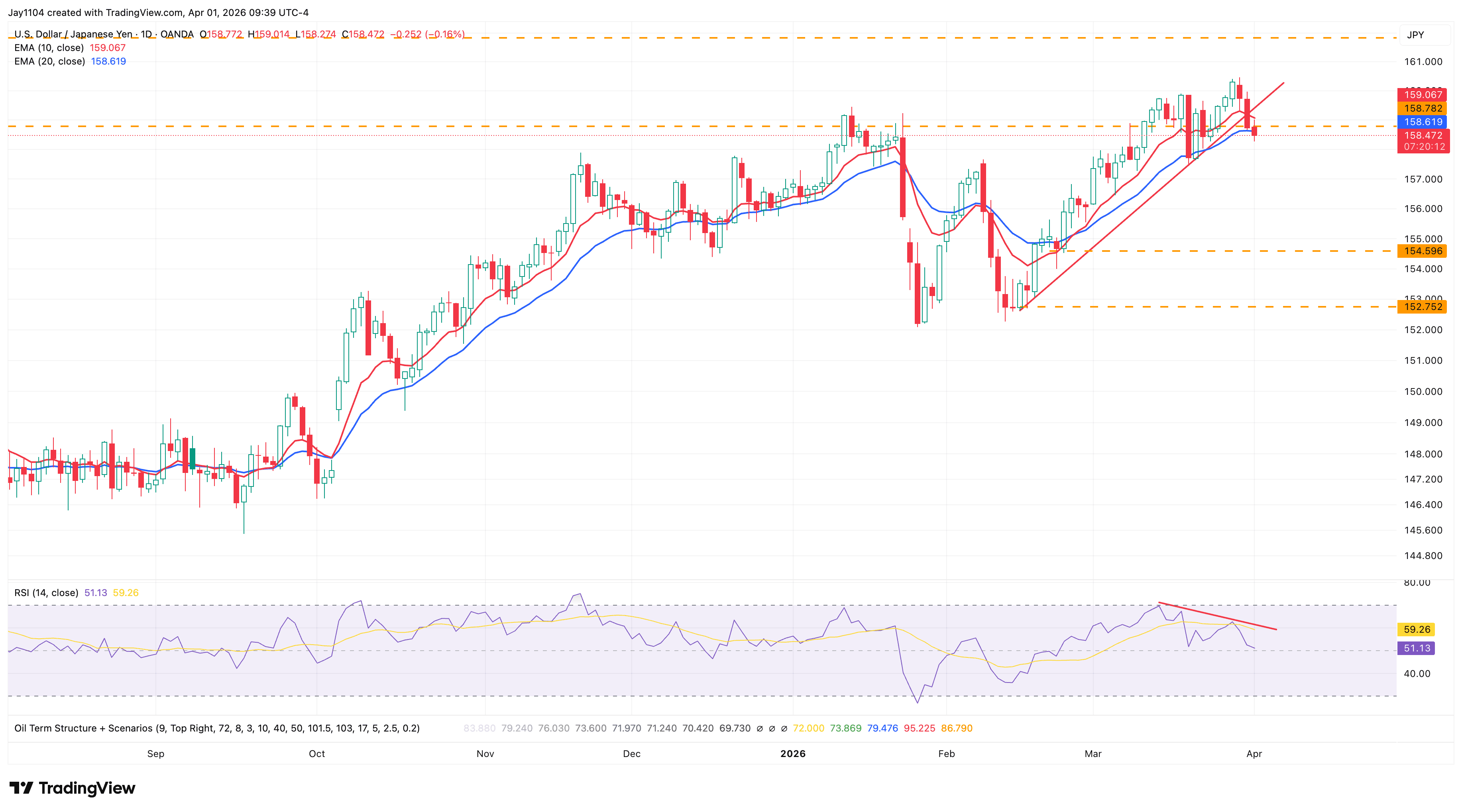
Source: TradingView, 2 April 2026
However, if the yen manages to hold this level and reclaim the prior uptrend, there remains scope for further gains, with a potential move towards the 2022 highs in the ¥161.5– ¥162 area. One factor suggesting a possible shift in trend is the relative strength index, which is beginning to decline, indicating that momentum may be turning. This could be an early sign that USD/JPY is weakening, meaning the yen is strengthening against the dollar.
It is also possible for the yen to strengthen against the dollar during periods of risk aversion, as it is often viewed as a safe-haven currency. With tensions between the US and Iran ongoing, this dynamic could come into play. Additionally, oil prices can be a significant headwind for USD/JPY; rising oil prices tend to weigh on the pair, while falling oil prices may help stabilise and strengthen it.
DAX extends recovery – US–Iran conflict eases slightly, macro data and inflation in focus
The DAX continues its recovery as geopolitical tensions between the US and Iran show tentative signs of easing. Investors are now turning their attention to key economic data and inflation signals.