Forex trading examples

3 minute read
|16 Apr 2024
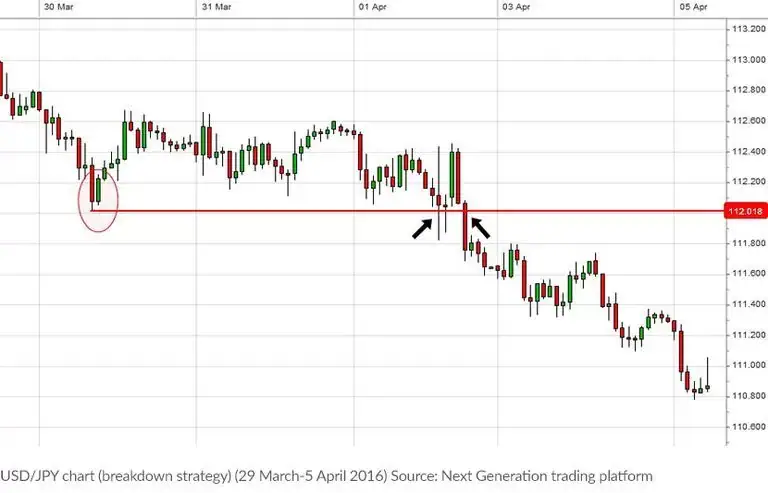
USD/JPY chart (breakdown strategy) (March - April 2016)
Table of contents
  • 1.
    Forex trading example 1: buying AUD/GBP
  • 2.
    Forex trading example 2: selling XYZ
  • 3.
    Holding costs

Your profit or loss is determined by the difference between the entry and exit price on a trade. Remember that prices are always quoted with the sell price on the left and the buy price on the right. You enter a trade via one and exit via the other.

Forex trading example 1: buying AUD/GBP

AUD/GBP is trading at 0.55951/0.55961.

You decide to buy $50,000 because you think the price of AUD/GBP will go up. AUD/GBP has a tier 1 margin rate of 3.33%, which means that you only have to deposit 3.33% of the total position’s value as position margin. Therefore, in this example your position margin will be $1665 (3.33%*50,000).

Outcome A: profitable trade

Your prediction was correct and the price rises over the next hour to 0.56161/0.56171. You decide to close your long trade by selling at 0.55981 (the current sell price).

The price has moved 20 points (0.56161-0.55961) in your favour.

Your profit is (0.56161-0.55961)*50,000= $100.

Outcome B: losing trade

Unfortunately, your prediction was wrong and the price of EUR/GBP drops over the next hour to 0.55761/0.55771. You feel the price is likely to continue dropping, so to limit your losses you decide to sell at 0.55761 (the current sell price) to close the trade.

The price has moved 20points (0.55961-0.55761) against you.

Your loss is (0.55961-0.55761)*50,000= –$100.

Forex trading example 2: selling XYZ

EUR/USD is trading at 1.13010 / 1.13020.

Let's assume poor German manufacturing data indicates that the euro is likely to fall against the US dollar in the coming days. You decide to sell $70,000 because you think the price of EUR/USD will go down.

EUR/USD has a tier 1 margin rate of 3.33%, which means that you only have to deposit 3.33% of the total position’s value as position margin. Therefore, in this example your position margin will be $2,610.65 (3.33% x [$70,000 x 1.13015]).

Outcome A: profitable trade

Your prediction was correct and EUR/USD drops over the next hour to 1.12510 / 1.12520. You decide to close your short trade by buying at 1.12520 (the current buy price).

The price has moved 49 points (1.13010 – 1.12520) in your favour.

Your profit is ([$70,000 x 1.13010] – [$70,000 x 1.12520]) = $343.

Outcome B: losing trade

Unfortunately, your prediction was wrong and the price of EUR/USD rises over the next hour to 1.13800 / 1.13810. You feel the price is likely to continue rising, so to limit your losses you decide to buy at 1.13810 (the current buy price) to close the trade.

The price has moved 80 points (1.13010 – 1.13810) against you.

Your loss is ([$70,000 x 1.13010] – [$70,000 x 1.13810]) = –$560.

Holding costs

If you hold your position past 5pm New York time (10pm UK time), your account will be debited or credited at the prevailing holding rate. If you have bought a higher yielding currency, you may receive interest; if you have bought a lower yielding currency, you may be charged interest. For more details on our FX overnight holding rates, please refer to the 'Product Overview' section on the platform for the relevant pair.

The forex market offers some of the lowest margin rates for CFD traders, find out more about forex leveraged trading.

Forex
Frequently asked questions

What is forex?

FX trading, also known as foreign exchange trading, or forex trading, is the exchange of different currencies on a decentralised global market. It's one of the largest and most liquid financial markets in the world. Forex trading involves the simultaneous buying and selling of the world's currencies on this market.

Learn more

How to trade Forex?

When trading forex, you speculate on whether the price of one currency will rise or fall against another. For example, if you believe that the value of the Australian dollar will rise, relative to the value of the US dollar, you would go ahead and trade the AUD/USD pair. 

What is margin in Forex?

Forex margin rates are usually expressed as a percentage. Your FX broker’s margin requirement shows you the leverage you can use when trading forex with that broker. 

How much money do I need to start trading forex CFDs?

There’s no single minimum that everyone must abide by. The amount you need depends on your strategy, position size (lots), the margin required, and other factors. Many traders start with a demo account first so they can practise their sizing and risk controls before jumping into a live account. 

What’s the difference between forex CFDs and stocks?

Forex trading uses currency pairs. The market is decentralised and operates on a 24/5 basis. Stocks, on the other hand, are shares in listed companies traded on centralised exchanges with set trading hours. Forex prices react very quickly to macro data and central-bank policy, whereas stocks are more influenced by company earnings and how the sector is performing at large. 

How can I learn more about the forex CFD market?

There are plenty of online resources available that can help you learn to trade forex. You can find out more about the basics from our learn forex section, which covers a wide range of topics, including margin and leverage, pips, forex market hours, and forex trading strategies. 

To help you get to grips with our platform and FX trading, you can open a forex demo account to practise with $10,000 of virtual funds. 

Can I trade forex on mobile? 

Yes. You can practise and trade using the CMC Platform on your mobile device. 

Which forex CFD pairs can I trade? 

You can trade on over 300 forex pairs with us, including major crosses like EUR/USD, GBP/USD, and AUD/USD, with spreads from just 0.5 pips on our standard account and 0.0 pips on our FX Active account, as well as minor and exotic currencies. 

How do I start trading on forex with CMC Markets?

To start trading on forex with us, you can open a standard or FX Active account on our CMC Platform to access over 300+ currency pairs, including major, minor, and exotic options and 160+ pairs on MT4. You may wish to practise your forex trading strategies on our demo account first, before trading with real money through a live account.

What is an FX Active account?

FX Active is an account type designed for high-volume forex traders. It offers spreads from 0.0 pips on six major FX pairs and a 25% spread discount on all other FX pairs. 

Clients can access 300+ FX pairs on the CMC Markets platform, or 160+ pairs on MetaTrader 4. A commission of 0.0025% per transaction applies to trades placed through an FX Active account. 

Find out more information on out FX Active page