Transitioning from a demo account to a live account is a significant step for many CFD traders. It marks the move from practising in a simulated environment to making decisions with real capital. Whether you are new to trading or already experienced, there are important differences to be aware of when trading with CMC Markets. The good news is that the platform itself remains familiar, and the steps to prepare are both clear and straightforward.
This guide explains what changes when you move from demo to live on the CMC platform, what stays the same, and the practical information that will help you feel confident in taking the next step.
Key steps to prepare for live trading
You can apply for a live account from the login page or within the platform. On the login page, click the blue "Live" button under "Sign up for an account" to open the application. If you are already logged in, select the blue "Open a Live Account" button in the menu bar next to your total and available margin.
Before you place your first live trade, a few quick tasks will help you get set up smoothly:
Complete your knowledge test – It is designed to confirm that you have the core knowledge to trade.
Fund your account – Once you have opened a live account, the “Open a live account” button will switch to “Fund your account.” Adding funds can be done directly within the platform.
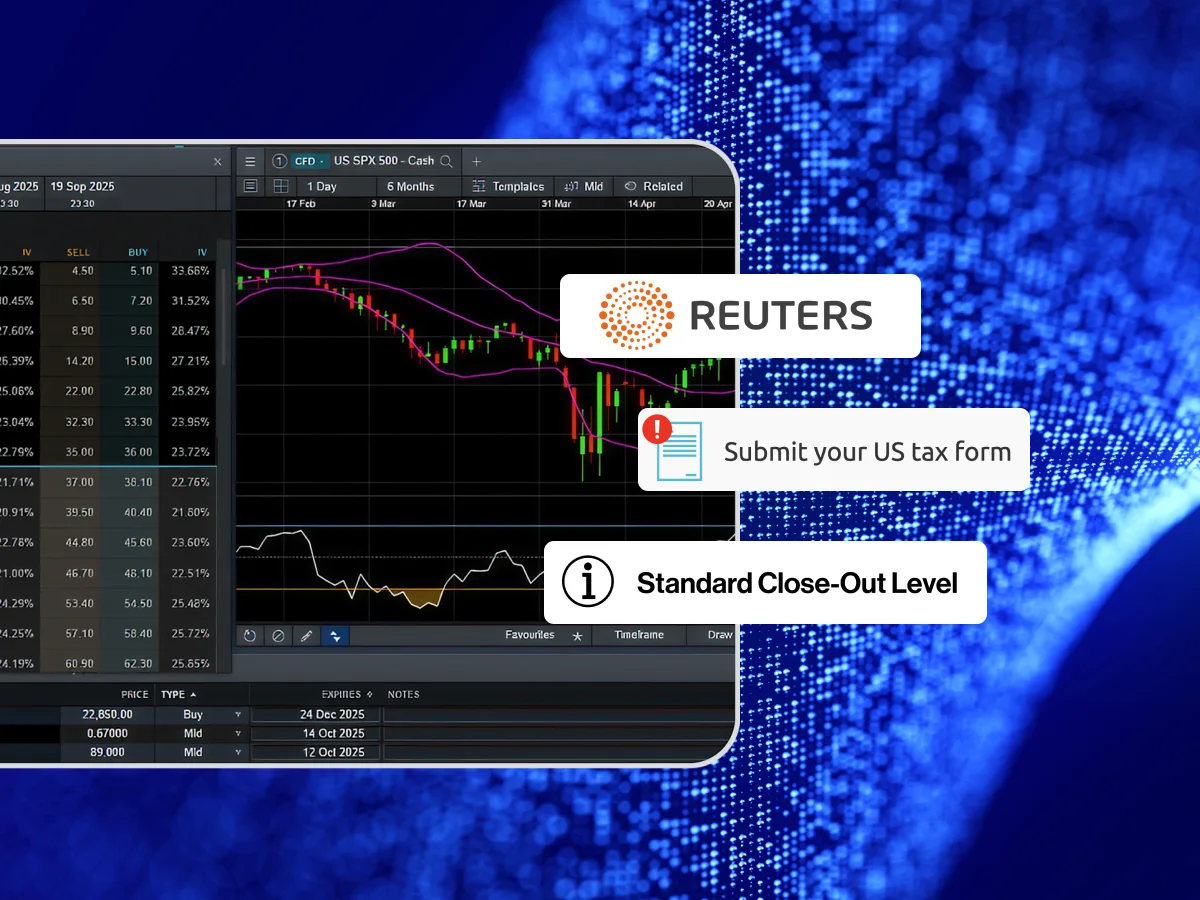
Submit a US tax form (optional) – Clients trading US share CFDs may be prompted within the platform to complete a W-8BEN form. The W-8BEN is an IRS document establishing that you are not a US resident for tax purposes. Providing it can allow a reduced rate of US withholding tax to apply under relevant tax treaty arrangements. You can still trade US shares without submitting the form, but the standard withholding rate will apply.
Activate market data – To view real-time share prices, you’ll need to activate market data. You can do this either through the product library or via settings. In the product library, search for the share you’re interested in. Where the buy and sell prices normally appear, you’ll see a ‘Click to Activate’ button, which will enable market data. Alternatively, you can go to Settings > Market Data and activate the relevant market data from there. Please note that while some market data is free, others will incur a monthly fee, which will be deducted directly from your account. Once activated, you’ll have access to live pricing for your selected shares.
What’s new in the live platform?
If you’ve been using the demo account and following along with our CMC platform guide, you’ll already be familiar with how everything works. The good news is that the live account experience is almost identical, so you can transition smoothly without needing to learn the platform again.
Your charts, order tickets, watchlists, layouts and tools all function in exactly the same way. The navigation you’ve practised in demo mode transfers seamlessly into live trading, allowing you to focus on your strategy and decision-making rather than re-learning the system.
As highlighted earlier, a live account gives you the ability to fund with real money. In addition, it offers a few key enhancements: you can activate live market data for shares, which isn’t available in demo mode, and you’ll gain access to the Reuters newsfeed, providing a direct stream of the latest financial market updates.
Trading psychology
While the platform feels the same, trading live introduces something no demo can replicate: real risk. With your own capital at stake, your psychology can come into play.
Research in behavioural economics and psychology shows that people often behave differently when real money is on the line. In demo environments, traders may take risks they would not consider in live conditions. Real capital tends to create more cautious and emotionally driven decision making.
Common emotions that influence live trading include:
Hesitation, for example second-guessing before entering or closing a trade
Excitement, for example overconfidence after a trade that goes in your favour
Fear, for example cutting profitable positions too early or holding onto losing positions for too long
Some key tips for managing your trading psychology:
Start with smaller trades to reduce pressure and build confidence gradually.
Use stops and limits to help manage risk and add structure to your approach.
Keep a journal to track not only trades but also the emotions and thought processes behind them.
Review regularly to identify patterns in behaviour that may affect performance. Use our Performance Analytics tool to see which strategies and patterns are generating the most profit, where improvements may be needed, and how much risk you are currently taking on.
Practical maths every trader should know
Successful trading relies on clear maths. There is a range of calculations you should understand and keep handy when placing and closing trades, as well as when holding positions over time.
Margin
Margin is the deposit required to open a position. It allows you to control a larger trade size with a smaller amount of capital.
Example:
You want to buy 500 CFDs of a stock priced at AUD 10
Total position value = 500 × 10 = AUD 5,000
Margin requirement (20%) = 20% of 5,000 = AUD 1,000
So, you would need AUD 1,000 in margin to open this trade
Learn more: Calculating margins
Profit and loss (P&L)
P&L is the difference between the price at which you enter a trade and the price at which you exit. It represents the profit you make or the loss you incur on a position. Your P&L changes as the price of the product moves.
Example:
You buy 100 CFDs of a stock at AUD 20
The price rises to AUD 20.80
Profit = (20.80 – 20.00) × 100 = AUD 80
Learn more: CFD calculations
Maintenance margin and close out rules
A maintenance margin is the minimum amount of funds you must keep in your account to keep a leveraged trade open. If your account balance falls below this level, your position will be automatically closed. The maintenance margin helps protect both you and the broker from losses, and ensures there are enough funds in your account to cover your trades.
At CMC Markets, the maintenance margin is set at 50% of the initial margin. The initial margin is the upfront amount required to open a trade. If your account equity falls below 100% of the initial margin requirement, your account will be placed on margin call. When equity drops to 80% of the initial margin requirement, you will receive an email prompting you to either add funds or reduce your exposure to avoid reaching the liquidation (close-out) level. The 80% margin call and 50% maintenance margin levels are calculated using your total margin utilisation figure. This figure is the reference point for both the margin call warning and the final close out. For clarity, your standard close out level shows the 50% figure. You can view these levels, along with other key details such as your estimated unrealised P&L, in the account balance window by clicking on your account balance.
A maintenance margin example:
Imagine you want to go long on a $10,000 position in a share CFD of your choice. To place the trade, you only need the initial margin of 20%, which is $2,000. You open the trade, and because you are using $2,000 of available funds to support it, your total margin utilisation figure shows $2,000. Your standard close out level, displayed in your account balance, would be $1,000 (50% of the initial margin).
Now, let’s say the market moves against you and your account balance falls to 80% of the initial margin ($1,600). At this point, you receive a margin call warning email. This alert tells you that you may need to top up your account to bring it back above the $2,000 initial margin requirement.
Let’s say you do not add funds and the market keeps moving further against you. Your balance eventually falls to 50% of the initial margin ($1,000). You have now hit the critical maintenance margin level, and at this point your position will be automatically closed out if you have not topped up your margin.
So in this example:
You needed $2,000 to open the $10,000 trade.
At $1,600 (80%), your margin utilisation triggers a margin call. You will also receive a courtesy email prompting you to add funds or reduce your exposure.
At $1,000 (50%), the standard close out level is reached and your trade is closed if no extra margin has been added.
Spread
The spread is the difference between the buy price (ask) and the sell price (bid) of a financial instrument. It’s effectively the cost of opening and closing a trade.
Bid = sell price (what you can sell at)
Ask = buy price (what you can buy at)
Spread = Ask – Bid
When you open a trade, you always deal at the less favourable side of the spread (buy at the ask, sell at the bid). This means you start slightly behind, and the market needs to move in your favour to cover this cost.
Example (AUD/USD):
Quote: 0.6600 (bid) / 0.6602 (ask)
You buy 10,000 units at 0.6602
If the market doesn’t move and you immediately sell at 0.6600, your cost is:
(0.6602 – 0.6600)×10,000 = USD $2
That USD 2 is the spread cost of your trade.
For most CFDs (forex, indices, commodities), the spread is the main cost. For share CFDs, commission usually applies instead.
Conclusion
Moving from demo to live trading is an important step. With the right preparation, it does not have to feel overwhelming. The platform remains familiar, the changes are manageable, and you now know the key concepts and practical maths that matter most.
Trading with real capital introduces new dynamics, but by starting carefully and continuing to learn, you will be well placed to manage risk and grow as a trader. Get in touch with our sales team if you would like further assistance with your transition.
Explore our full library of trading guides and educational resources.
Disclaimer: This article provides general information only. It has been prepared without taking account of your objectives, financial situation or needs. It is not to be construed as a solicitation or an offer to buy or sell any financial instruments, or as a recommendation and/or investment advice. It does not intend to support an investment decision and it should not be relied upon by you in evaluating the merits of investing in any financial instruments. You should consider your objectives, financial situation and needs before acting on the information in this article. CMC Markets believes that the information in this article is correct, and any opinions and conclusions are reasonably held or made on information available at the time of its compilation, but no representation or warranty is made as to the accuracy, reliability or completeness of any statements made in this article. CMC Markets is under no obligation to, and does not, update or keep current the information contained in this article. Neither CMC Markets nor any of its affiliates or subsidiaries accepts liability for loss or damage arising out of the use of all or any part of this article. Any opinions or conclusions set forth in this article are subject to change without notice and may differ or be contrary to the opinions or conclusions expressed by any other members of CMC Markets.