SB Energy IPO
LISTED: Rumoured
Founded in 2019, SB Energy develops critical data centre and power infrastructure for the AI economy. Read more.

Be one of the first to own shares in selected IPOs with CMC Invest, or trade on their potential valuations before they list.
When you invest, your capital is at risk.




Apply for selected IPOs through CMC Invest. Open an account today so you can apply when the next opportunity arises.
Availability and allocation are not guaranteed.
When you invest, your capital is at risk.
Register for IPO alerts to receive updates on future offers, application windows and listing information.
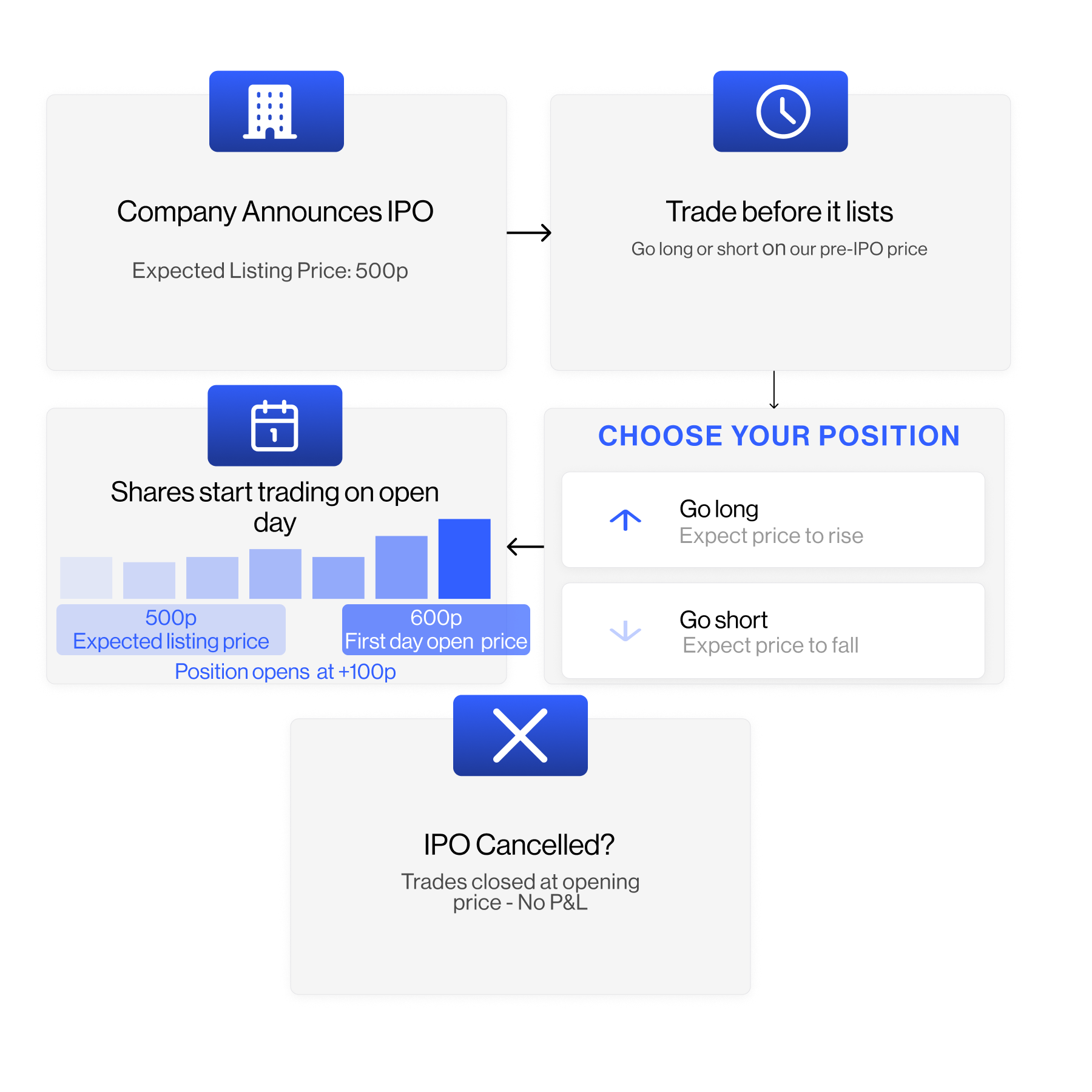
Example: ABC Company is expected to list at 500p.
If you think the price will move higher, you would go long (buy)
If you think the price will move lower, you would go short (sell)
Once the company is listed on a stock exchange and the shares start trading in the underlying market, the company rolls into our listed share spread bet/CFD. This means your position continues and you retain full control over when to close it.
Leveraged trading products such as spread bets and CFDs magnify profits and losses equally, so it’s important to manage risk carefully.
If the IPO is cancelled or doesn’t happen for any reason, your open trades will be closed at the price at which they were opened, and no profit or loss will be realised.
Instrument | |
|---|---|
Pricing is indicative. Past performance is not a reliable indicator of future results.
For active traders, our pre-IPO grey markets enable you to trade on a company's potential IPO valuation before it lists. Go long or short through a spread bet or CFD.
01 Find the asset
02 Choose your direction
03 Set your trade size
04 Monitor, then decide when to close


Whether you want to apply for shares in a selected IPO or trade a potential listing before it happens, choose your route and get started.
When you invest, your capital is at risk.
An initial public offering, or IPO, is when a private company offers its shares to the public for the first time and lists on a stock exchange.
No. IPO access is available for selected offers only and may depend on availability and eligibility requirements.
Open an eligible CMC Invest account, add funds, review the available offer details and submit an application during the offer period.
No. Allocations depend on the terms of each offer and the level of demand. You may receive fewer shares than requested or no allocation.
Trading on a company before it lists on a stock exchange, also known as grey markets, allows you to take a spread bet or CFD position on a company’s potential share price before its initial public offering (IPO).
Unlike investing through an IPO application, you're not buying or applying for shares. You're placing a spread bet or CFD position based on a synthetic price which reflects market expectations of a potential IPO valuation. The pre-IPO price can move significantly as new public information and market sentiment evolve.
Your trade rolls into the listed share spread bet/CFD once the company lists. Your position remains open and you retain control over how long you wish to keep it open, and when to close it.
You can start trading once the pre-IPO market is open, right through to beyond its IPO, after the company has listed on an exchange. The pre-IPO spread bet or CFD rolls into a listed share spread bet/CFD once the company has listed. Your position remains open and you can decide when you wish to close it.
The pre-IPO instrument provides synthetic exposure to the expected share price of a company before it lists on a stock exchange. Before listing, prices are based on our assessment of the company’s expected list price, drawing on publicly available information such as:
The indicative IPO price range, where available
Valuations of comparable listed companies
Market conditions and sentiment
Prices are not based on private secondary market transactions and may differ significantly from private market valuations. There is no active underlying market on a company’s shares before it lists, which means there is no exchange-traded reference price that we can use before the IPO. This may have the following implications:
Prices may be volatile
Spreads may be wider than for other share spread bets and CFDs
The product cannot be hedged in the open market
The IPO may open at a price materially different from the pre-IPO price, potentially exposing you to gap risk and potentially significant losses
Price updates vary by company and depend on how close the IPO date is. As more information becomes publicly available, including updates to the expected price range or demand for the shares, prices may be updated more frequently. Updates may be irregular and pricing may change quickly.
Pre-IPO markets can move quickly and may be volatile. It's important to note that there is a risk the IPO opens at a price significantly different from the pre-IPO level. This is known as 'gap risk' and is an inherent feature of pre-IPO trading. The divergence can occur because pre-IPO pricing is based on expectations, while the listing price is determined by the actual IPO process and early exchange trading.
As spread betting and CFD trading involves leverage, your potential profits and losses are magnified based on the full value of the trade. Retail client accounts, however, have negative balance protection, which means that you can't lose more than your account value.
If your margin level is insufficient to maintain your position, it may be automatically closed out. Learn about managing your risk
Yes. You can buy, or go long, if you expect the price to rise, or sell, or go short, if you expect it to fall.
Yes. You can close your position during our normal trading hours at any time from when the pre-IPO instrument is made available on our platform until it transitions to the listed share spread bet or CFD at IPO.
When the company successfully lists, your pre-IPO spread bet or CFD transitions seamlessly into a standard spread bet/CFD on the listed share. The instrument then references exchange-based pricing and normal trading conditions apply. There is no forced settlement or manual intervention required – the position continues under the same listing. Your position remains open and you retain control over when to close it.
When the company lists, your pre-IPO instrument converts into a standard share spread bet or CFD, depending on which product you're trading. From that point, pricing is based on the underlying exchange-traded share. You can close your position during normal market hours, subject to market conditions. Spreads may initially be wide and volatility may be high while the market establishes a price.
If the IPO is cancelled, or the company says it will not go ahead, open positions will be cancelled at the original execution price, so no profit or loss is realised. Positions closed before the cancellation won't be reversed, and remain binding.