OpenAI IPO: What UK investors need to know in 2026
OpenAI, the company behind ChatGPT, has filed confidentially for what could be one of the biggest stock market listings in history , with a reported valuation of up to $1tn. Here are the key facts about the OpenAI IPO, including the expected date, valuation estimates, company financials and risks.
The above are estimates only. See below for further information.
Disclaimer: CMC Markets is an execution-only service provider. The material (whether or not it states any opinions) is for general information purposes only, and does not take into account your personal circumstances or objectives. Nothing in this material is (or should be considered to be) financial, investment or other advice on which reliance should be placed. No opinion given in the material constitutes a recommendation by CMC Markets or the author that any particular investment, security, transaction or investment strategy is suitable for any specific person. The material has not been prepared in accordance with legal requirements designed to promote the independence of investment research. Although we are not specifically prevented from dealing before providing this material, we do not seek to take advantage of the material prior to its dissemination.
OpenAI is an artificial intelligence company best known for creating ChatGPT, the AI chatbot that launched in November 2022 and became the fastest-growing consumer application in history. Founded in 2015 as a non-profit research lab, it has since restructured into a for-profit public benefit corporation and now operates as the world’s most valuable startup.
Will OpenAi IPO live up to its valuation?
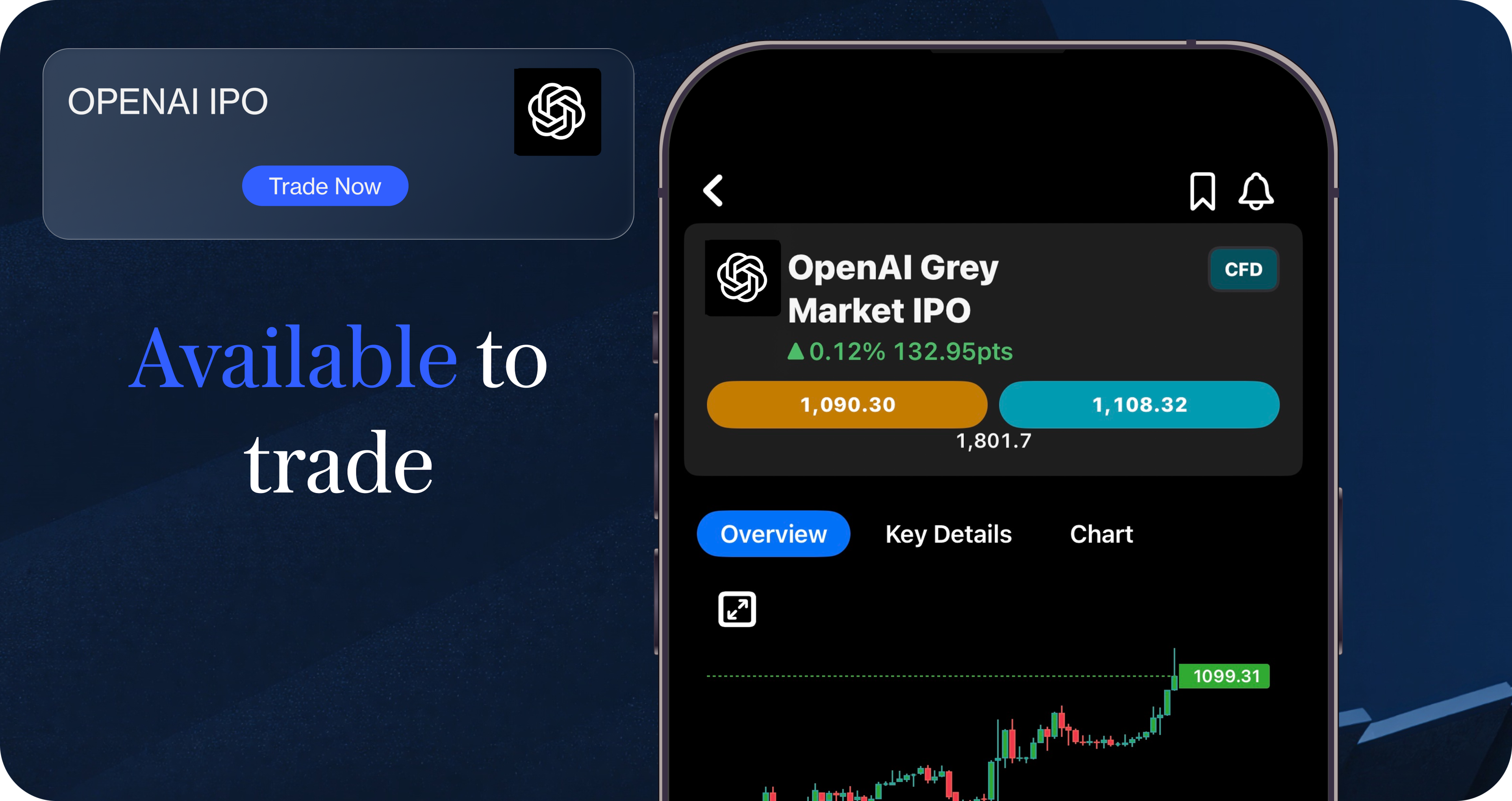
Go long or short on OpenAi expected listing price with our pre IPO market, before it hits the exchange.
OpenAI’s core products and services:
ChatGPT – an AI assistant used by more than 800 million people weekly for writing, research, coding and conversation
GPT API and enterprise platform – allows businesses to build AI-powered tools on top of OpenAI’s models. More than one million companies use this platform
DALL·E – an AI image-generation tool that creates visuals from text prompts
Codex and coding tools – AI-powered code generation and debugging for software developers
Sora – a video-generation model that creates short clips from text descriptions
How does OpenAI make its money?
OpenAI sells access to its AI models through subscriptions, business licences and strategic partnerships. Unlike traditional software companies, its costs are dominated by the computing power required to train and run its models.
OpenAI’s revenue comes from several key streams.
ChatGPT subscriptions
API and enterprise licensing
Microsoft partnership and revenue share
Advertising (launched January 2026)
Strategic licensing deals
ChatGPT subscriptions – individual users pay $20 per month for ChatGPT Plus or $200 per month for ChatGPT Pro, which offer faster responses, advanced features and priority access. Subscription revenue from ChatGPT’s hundreds of millions of users is OpenAI’s largest income source.
API and enterprise licensing – businesses pay usage-based fees to access OpenAI’s models through its API. More than one million companies use these tools to power their own products and services.
Microsoft partnership and revenue share – Microsoft has invested over $13bn in OpenAI and integrates its models into products such as Copilot and Azure AI. Under their agreement, Microsoft receives a 20% share of OpenAI’s revenue.
Advertising – in January 2026, OpenAI began showing ads to some US users of the free ChatGPT tier. This is an early-stage revenue stream, but one with significant growth potential given ChatGPT’s user base.
Strategic licensing deals – OpenAI earns revenue from large one-off licensing agreements with enterprise clients and governments, including partnerships tied to the $500bn Stargate AI infrastructure project with SoftBank and Oracle.
OpenAI’s CFO Sarah Friar confirmed in January 2026 that annualised revenue had passed $20bn, up from $6bn in 2024 (Reuters, January 2026).
What is the OpenAI IPO launch date?
OpenAI has not confirmed an official IPO launch date. However, the Wall Street Journal reported in January 2026 that the company is laying the groundwork for a public listing in the fourth quarter of 2026.
According to the WSJ, OpenAI is holding informal talks with Wall Street banks and has hired key finance executives to oversee investor relations. The company reportedly wants to go public before rival Anthropic, which is also preparing a late-2026 listing.
There are reasons the timeline could slip. OpenAI must still complete a major pre-IPO funding round at a reported $830bn valuation. It also needs to finalise its restructuring from a non-profit to a for-profit public benefit corporation (Fortune, January 2026).
How to get exposure to OpenAI IPO?
Open a spread betting or CFD trading account
With our pre-IPO market, you can take a position on OpenAI through a spread bet or CFD trade ahead of its listing, and speculate on whether its price will rise or fall against our expected listing price after its IPO.
Practise with a demo account
If you’re unfamiliar with leveraged trading, you can open a demo account to practise trading with virtual funds. Familiarise yourself with pricing, volatility, and managing risk before trading with real capital.
Your position rolls into the listed market
Once OpenAI lists on a stock exchange and its shares start trading in the underlying market, your position rolls into our listed share spread bet or CFD. This means your position continues, and you retain full control over when to close it.
What happens if the IPO is cancelled
If the OpenAI IPO is cancelled or doesn't happen for any reason, your open positions will be closed at the price they were opened, and no profit or loss will be realised.
What could OpenAI be worth at IPO?
There is significant speculation around the OpenAI share price and what the company’s market cap could be at IPO. In October 2025, an employee share sale valued OpenAI at $500bn. By December 2025, the Wall Street Journal reported that OpenAI was seeking $100bn in new funding at an $830bn valuation, with some reports suggesting the IPO itself could target $1tn or more (WSJ, December 2025).
For context, Meta was valued at $104bn when it went public in 2012, and Uber at $82bn in 2019. If OpenAI lists near $1tn, it would be among the largest IPOs in history. Sceptics point out that OpenAI’s price-to-sales ratio at $830bn would be roughly 65 times 2025 revenue – far higher than most technology companies.
Note: these estimates are speculative and based on private market transactions and media reports. Valuations can change significantly before and after an IPO and do not indicate future share price performance.
What are OpenAI’s financials like?
Past performance is not a reliable indicator of future results
OpenAI’s revenue growth has been rapid. The company went from roughly $2bn in annualised revenue at the end of 2023 to $6bn in 2024, and its CFO confirmed the figure surpassed $20bn by the end of 2025 (Reuters, January 2026). That growth has been driven by paid ChatGPT subscriptions, rapid enterprise adoption and expanding API usage.
However, OpenAI remains heavily loss-making. The company does not expect to reach profitability until around 2030, and internal projections suggest losses of $14bn in 2026 alone. HSBC analysts estimate OpenAI may need over $207bn in additional funding by 2030 to maintain operations, even accounting for projected revenue growth. For investors, the gap between revenue growth and the path to profitability is a key metric to watch.
Why are investors interested in this IPO?
OpenAI has experienced significant recent growth: ChatGPT attracted 800 million weekly active users faster than any consumer application in history, and revenue has roughly tripled year on year. The global AI market is projected to exceed $1tn in the coming years, and OpenAI sits at the centre of that expansion.
Brand recognition gives OpenAI a significant edge, albeit competitive pressures remain. ChatGPT has become a household name – synonymous with generative AI in the same way Google became synonymous with search. This level of consumer awareness is difficult for competitors to replicate, and it gives OpenAI a strong foundation for expanding into new products and markets.
Strategic partnerships strengthen its position further. Microsoft has invested over $13bn and integrates OpenAI’s models across its product suite. The $500bn Stargate Project, a joint AI infrastructure venture with SoftBank and Oracle, signals the scale of ambition. For investors, the question is whether this first-mover advantage can translate into lasting market dominance and, eventually, profits.
What are the risks and challenges?
The AI regulatory landscape is changing rapidly. The EU AI Act imposes new obligations on foundation-model providers, the UK’s AI Safety Institute is expanding its oversight role, and US executive orders continue to shape the sector. OpenAI also faces an ongoing lawsuit from co-founder Elon Musk, who is seeking up to $134bn in damages, along with separate litigation over alleged harms caused by its chatbot. Any of these issues could affect the company’s operations and share price.
Profitability pressure is intense. OpenAI has committed to over $1.4tn in data-centre and infrastructure spending over the coming years. It expects losses of $14bn in 2026 alone, and profitability is not forecast until 2030. HSBC estimates a $207bn funding gap by 2030, which means the company may need to raise additional capital even after an IPO. History shows that high-profile tech IPOs do not always deliver for early investors.
Competition is fierce and accelerating. Google’s Gemini has grown its web traffic share from 5.7% to 21.5% in the past 12 months, according to Similarweb, while ChatGPT’s share has dropped from 86.7% to 64.5% over the same period. Anthropic, xAI and Meta are all investing heavily. There is also the structural risk of OpenAI’s ongoing conversion from a non-profit to a for-profit entity, which creates governance uncertainty that public market investors typically dislike.
Who are OpenAI’s competitors?
Past performance is not a reliable indicator of future results The generative AI sector is one of the most competitive in technology. OpenAI’s rivals include:
Anthropic (Claude) – the most direct competitor, reportedly targeting $20–$26bn in revenue for 2026 and planning its own late-2026 IPO. Backed by Amazon and Google.
Google DeepMind (Gemini) – Google’s AI division has rapidly gained market share and benefits from Apple Intelligence integration. Parent company Alphabet [GOOGL] trades on the Nasdaq.
xAI (Grok) – Elon Musk’s AI venture, also reportedly preparing for an IPO. The company has reportedly built the world’s largest AI supercomputer.
Meta AI (Llama) – Meta [META] offers open-source AI models, pressuring competitors on price and accessibility.
Microsoft (Copilot) – despite being OpenAI’s largest backer, Microsoft [MSFT] also competes directly through its own Copilot products built on OpenAI’s technology.
Some traders and investors choose to gain indirect exposure to the AI sector through publicly listed companies, such as Alphabet [GOOGL], Meta [META] and Microsoft [MSFT]. These companies have diverse business models and associated risks..
OpenAI’s key differentiator is its first-mover brand advantage with ChatGPT and the depth of its Microsoft partnership. However, Chinese AI firms such as DeepSeek are emerging as formidable rivals, offering comparable performance at a fraction of the cost. Readers with an interest in the AI sector should keep an eye on industry developments.
1. OpenAI confidential S-1 (8 June 2026) and reports of a shift to 2027 :
6. OpenAI recapitalisation completed 28 October 2025; OpenAI Foundation retains control; Microsoft holds ~27% and has invested ~$13.8bn — (paywalled); The Hill, 28 October 2025.
11. ChatGPT Go at $8/month confirmed in OpenAI's advertising announcement. Plus at $20/month and Pro at $200/month should be checked against the live pricing page at openai.com/chatgpt/pricing on the day of publication, as prices change. https://openai.com/index/testing-ads-in-chatgpt/