What does SpaceX do?
Space Exploration Technologies Corp, known as SpaceX, is a US aerospace manufacturer and space transportation company founded by Elon Musk in 2002. It designs, builds, and launches rockets and spacecraft, operates the Starlink satellite broadband network, and, since February 2026, holds an AI business following its all-stock merger with xAI.
SpaceX core products and services
SpaceX operates across several business lines, each at different stages of growth.
Falcon 9 and Falcon Heavy – reusable orbital launch vehicles that have completed more than 600 missions. Falcon 9 completed over 160 orbital missions in 2025.
Starlink – a satellite broadband network of more than 10,000 satellites in low Earth orbit, serving over 10 million subscribers globally as of February 2026. It's SpaceX's primary revenue growth engine.
Starship – a next-generation, super-heavy launch vehicle designed to carry humans and cargo to the Moon, Mars, and beyond. Development is ongoing and capital-intensive.
Dragon spacecraft – carries crew and cargo to the International Space Station under NASA contracts.
xAI – SpaceX completed an all-stock merger with Elon Musk's artificial intelligence company xAI in February 2026, adding an AI dimension to the business.
Investors should note that Starlink has been discussed separately as a potential IPO candidate. No Starlink IPO has been confirmed. This article focuses on SpaceX as the parent company.
How does SpaceX make money?

Past performance is not a reliable indicator of future results
SpaceX earns revenue across three core areas:
Rocket launch services
Starlink subscriptions
Government and defence contracts
As SpaceX is a private company, it does not publicly disclose its accounts. All figures cited in this article are analyst and media estimates.
Rocket launch services – SpaceX carries satellites, cargo, and crew into orbit for commercial and government customers. It accounted for more than half of all global orbital launches in 2024, according to the American Enterprise Institute, and approximately 60% of commercial satellite launches according to industry estimates. Customers include NASA, the US Department of Defense, and private satellite operators worldwide.
Starlink subscriptions – Consumers and businesses pay a monthly fee for satellite broadband access. Starlink is SpaceX's fastest-growing revenue stream and, according to Bloomberg reporting in 2023, was on course to generate more revenue than the launch business by 2024.
Government and defence contracts – SpaceX holds long-term agreements with US Space Force and NASA, including the Artemis programme. These provide a degree of revenue predictability that commercial launch contracts alone do not.
What is the SpaceX IPO date?

SpaceX has not confirmed an official IPO date. Media reports, including coverage from Bloomberg1, have pointed to a potential 2026 listing. However, the precise timing is currently unknown.
The February 2026 merger with xAI adds complexity: integrating an AI company into SpaceX's structure could delay or complicate any listing process. Regulatory approvals covering xAI's operations and Starlink's international spectrum rights add further uncertainty.
A dual-class share structure is also reportedly under consideration, similar to models used by Tesla and Alphabet. This would allow Musk to retain voting control after a public listing. UK retail investors should be aware that dual-class structures limit shareholder influence over key company decisions.
For context, major IPOs rarely move quickly from speculation to listing. Uber and Airbnb both experienced extended periods of public speculation before their eventual public debuts. Treat any reported 2026 window as an indication, not a commitment.
What could SpaceX be worth at IPO?
Valuation and share price are different things:
A company's valuation is its total estimated worth
The share price depends on how many shares are issued and what proportion is made available to the public
Neither figure has been officially confirmed by SpaceX.
Secondary SpaceX share sales in late 2025 implied a valuation of approximately $800bn, according to media reports.2 Estimates have since risen to a range between $1.5tn to $2tn, with Bloomberg reporting in April 2026 that SpaceX's confidential IPO filing targets a valuation of approximately $1.75tn.3
Analysts typically arrive at these estimations by using:
Revenue multiples
Discounted cash flow models
Comparable company analysis
SpaceX's private status, which means that there are no audited public accounts., makes any estimate highly uncertain.
SpaceX's growth-driven valuation profile sets it apart from established defence and aerospace names. Its scale, reusable rocket technology and satellite broadband network distinguish it from other companies currently operating in the sector, with no publicly-listed company offering a direct comparison.
Valuations are sensitive to factors including:
Interest-rate expectations
Starlink subscriber growth
Broader technology market sentiment
These areas can move significantly between a listing announcement and the first day of trading.
What do SpaceX's financials look like?
As mentioned, SpaceX is a private company and so does not publish its accounts. Until SpaceX files for an IPO and publishes a prospectus, investors will not have access to audited financial statements. As a result, the figures below are from analyst estimates and attributed media reporting. These figures haven't been verified by SpaceX and so should be treated with caution.
Bloomberg reported in 2023 that SpaceX was on course to record revenue of around $9bn that year across its launch and Starlink businesses, with sales projected to reach approximately $15bn in 20244. Starlink was expected to account for the majority of SpaceX revenue from 2024 onwards.
Analyst estimates suggest revenue has grown substantially, from approximately $4.6bn in 20225, with Starlink subscriber growth –which reached 9 million globally by December 20256 – as the primary driver.
Profitability is harder to assess. SpaceX re-invests heavily, and Starship development alone is extraordinarily capital-intensive. Media reports suggest the company has moved toward overall profitability in recent years, with Starlink again the primary contributor7.
Why are investors interested in the SpaceX IPO?
Investor interest in SpaceX is driven by a combination of:
Reusable rocket technology
Substantial market opportunity
Elon Musk's influence
Reusable rocket technology
SpaceX has achieved something no other company has managed at commercial scale: reusable orbital rockets. The most-flown Falcon 9 booster has now completed 34 missions. SpaceX's active fleet is averaging approximately 15 flights per booster (as of May 2026), a reusability record that has sharply reduced launch costs across the industry. Starship, if it reaches full operational capability, could reduce cost-per-kilogram to orbit significantly, a prospect that attracts long-term growth investors.
Substantial market opportunity
The market opportunity is substantial. The global space economy was estimated at $570bn in 2023, according to the Space Foundation's The Space Report (July 2024)8, and is projected to exceed $1tn by 2040, according to forecasts from Morgan Stanley9 and Citi10. As the dominant launch provider and operator of the world's largest satellite broadband network, SpaceX is positioned to capture a significant share of that growth. These are projections, not guarantees, and actual outcomes will depend on myriad factors, including competitive dynamics and execution.
Elon Musk's influence
Elon Musk's profile adds its own dynamic. Tesla investors familiar with Musk-led growth narratives are a natural audience for a SpaceX listing. That said, it's important for potential traders or investors to bear in mind that past performance of Musk-led companies is not necessarily a reliable guide to future results.
SpaceX operates in a materially different sector, with its own distinct risk profile. The February 2026 xAI merger introduces an AI dimension to SpaceX's business, which some analysts view as expanding its addressable market. However, it also brings regulatory complexity and integration risk, which could affect the combined entity's path to a listing.
Musk's involvement may be a double-edged sword: his public profile drives retail interest, but also carries headline risk that could affect the share price in ways unrelated to the underlying business performance.
What are the risks and challenges?
Regulatory risk
Execution and valuation risks
Growing competition
Potential limited shareholder influence
Regulatory risk
Regulatory risk is significant and multi-layered. The Federal Aviation Administration (FAA) has delayed Starship launch licences before, and the xAI merger introduces AI regulatory complexity in the UK, US, and EU. Internationally, Starlink's spectrum rights are contested in several markets, which could limit subscriber growth in key regions. Investors should not assume a smooth regulatory path.
Execution and valuation risks
Starship development is expensive. If costs overrun or milestones slip, SpaceX's path to profitability could take longer than expected. An IPO at a valuation of $1tn or more means high expectations are priced in from day one. If post-listing performance falls short, the share price could fall sharply. Past high-profile IPOs, including Deliveroo and WeWork, serve as a reminder that strong brands do not always translate into strong post-listing returns.
Growing competition
Competition is growing across all of SpaceX's business lines. Blue Origin (backed by Jeff Bezos) is scaling its New Glenn rocket; Rocket Lab is expanding its launch capability; and Amazon's Project Kuiper is preparing to challenge Starlink in satellite broadband.
Potential limited shareholder influence
A dual-class share structure, if implemented, would also limit retail investors' ability to influence company decisions. These risks should be weighed carefully alongside the potential opportunity.
Who are SpaceX's competitors?

SpaceX leads the commercial launch market, but competition is increasing across its core business lines.
In launch services, the key rivals are:
Blue Origin [unlisted] – the New Glenn rocket is scaling but has not matched Falcon 9's launch cadence or cost structure
Rocket Lab [RKLB] – focused on small satellite launches and developing the larger Neutron rocket for medium-lift missions
United Launch Alliance – a Boeing [BA] and Lockheed Martin [LMT] joint venture operating the Vulcan Centaur rocket on government contracts
In satellite internet, Starlink's main challengers are:
Amazon Project Kuiper [AMZN] – approved to deploy over 3,200 satellites but not yet at commercial scale, according to Amazon's website
OneWeb, now owned by Eutelsat [ETL] – a European-backed low earth orbit satellite network
Traditional aerospace incumbents Boeing and Lockheed Martin compete for government launch contracts, but carry higher cost structures and have not demonstrated reusable rocket capability at SpaceX's scale.
SpaceX's core advantages are vertical integration (it builds its own engines, software, and ground systems), Falcon 9's reusability economics, and its established launch cadence. No current competitor replicates this combination.
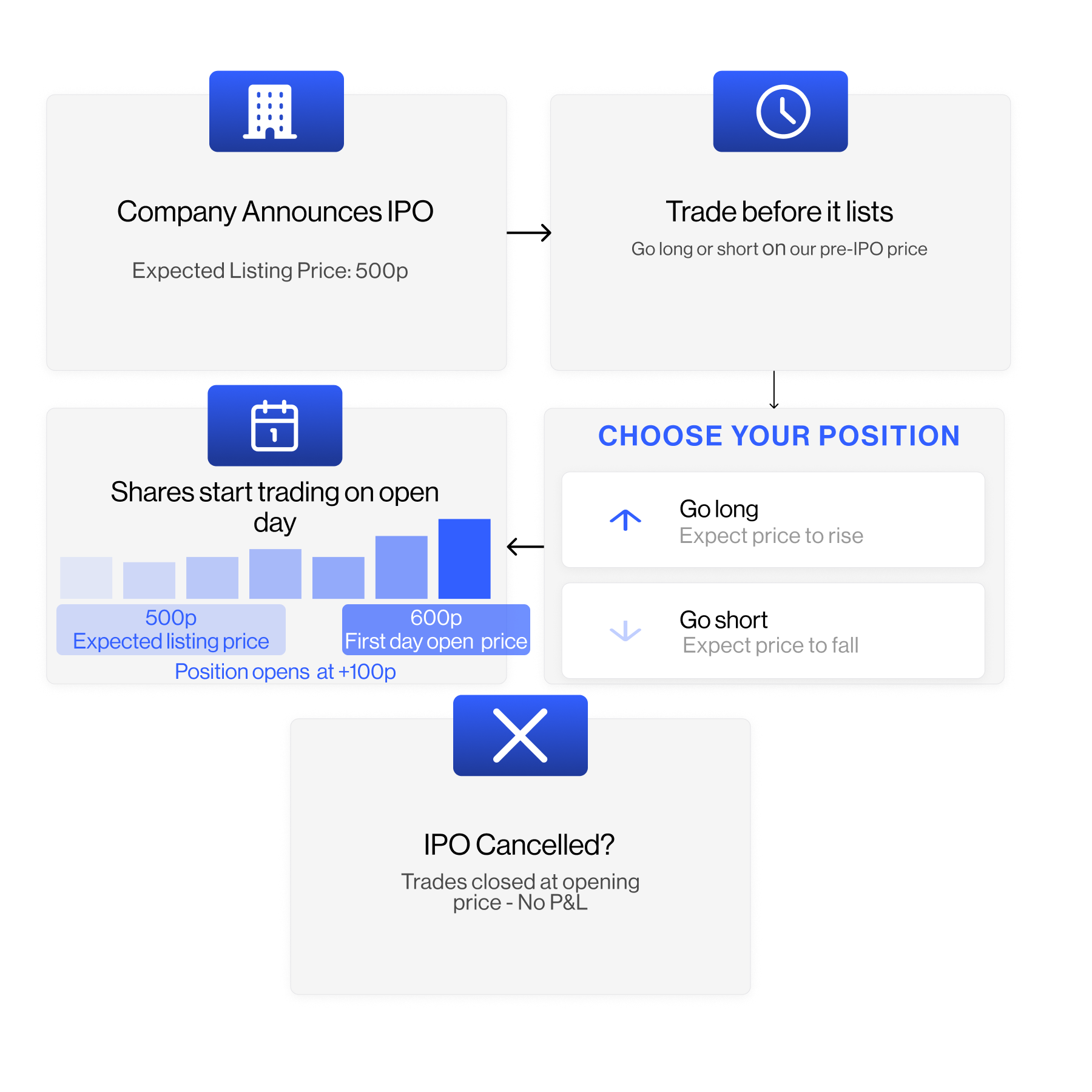
As well as speculating on the SpaceX IPO via our pre-IPO market, you can trade or invest in already-listed competitors, such as Rocket Lab [RKLB], Boeing [BA], and Amazon [AMZN].
How to get exposure to SpaceX pre-IPO
How to buy SpaceX shares when the company goes public
If SpaceX proceeds with a US listing, you'll be able to buy shares directly through our cash equities (share dealing) account, as well as speculate on them via spread betting and CFD trading.
Here's how the process typically works:
Open or log in to your share dealing account with a broker that provides access to US-listed stocks.
Search for SpaceX using its ticker symbol (not yet assigned or confirmed).
Before deciding how much to invest, consider whether this investment is appropriate for your personal financial circumstances and attitude to risk. Only invest what you can afford to lose. You can place a market order (executed at the current available price) or a limit order (executed only if the price reaches a level you specify).
Review any currency conversion costs, as SpaceX is expected to list in US dollars.
Place your order on or after the first day of trading.
Note that IPO shares are typically allocated to institutional investors first. Retail investors generally buy on the open market from the first trading day.
SpaceX IPO FAQS
Starlink is SpaceX's satellite broadband subsidiary. SpaceX is the parent company, which also operates rocket launch services and, following the February 2026 all-stock merger, xAI. Elon Musk has previously suggested Starlink could list separately, but no Starlink IPO has been confirmed.
Secondary share sales in late 2025 implied a valuation of approximately $800bn, according to media reports. Analyst estimates for an IPO scenario have been climbing, and range between $1.25tn and $2tn. These are speculative projections and not figures confirmed by SpaceX.
SpaceX has not ruled out a public listing, and recent secondary share sales suggest preparations may be underway. However, Musk has historically been reluctant to list, citing concerns about public market short-termism. A listing cannot be confirmed as certain, and investors should treat all current reporting as speculation until SpaceX makes an official announcement.
SpaceX has not confirmed an official IPO date. A 2026 listing has been reported by Bloomberg and other outlets, but Elon Musk has not set a public timetable. Timing will depend on market conditions, regulatory approvals, and internal readiness, including the integration of xAI following the February 2026 merger.
Disclaimer: CMC Markets is an execution-only service provider. The material (whether or not it states any opinions) is for general information purposes only, and does not take into account your personal circumstances or objectives. Nothing in this material is (or should be considered to be) financial, investment or other advice on which reliance should be placed. No opinion given in the material constitutes a recommendation by CMC Markets or the author that any particular investment, security, transaction or investment strategy is suitable for any specific person. The material has not been prepared in accordance with legal requirements designed to promote the independence of investment research. Although we are not specifically prevented from dealing before providing this material, we do not seek to take advantage of the material prior to its dissemination.
Footnotes
1Bloomberg, 9 December 2025: bloomberg.com/news/articles/2025-12-09/spacex-said-to-pursue-2026-ipo-raising-far-above-30-billion
2Bloomberg, 13 December 2025: bloomberg.com/news/articles/2025-12-13/spacex-sets-insider-share-deal-at-about-800-billion-valuation
3Bloomberg, April 2026, as reported by CNBC: cnbc.com/2026/04/01/spacex-confidentially-files-for-ipo-setting-stage-for-record-offering.html
4Bloomberg, 6 November 2023: bloomberg.com/news/articles/2023-11-06/spacex-eyes-15-billion-in-sales-next-year-on-starlink-strength
5Wall Street Journal, 17 August 2023: wsj.com/business/elon-musk-spacex-revenue-profit-2023-4f1b37ec
6Starlink official announcement, reported by Yahoo Finance/Benzinga, 26 December 2025: finance.yahoo.com/news/elon-musk-celebrates-starlinks-9-003102854.html
7CNBC citing WSJ internal documents, 17 August 2023: cnbc.com/2023/08/17/spacex-reported-a-profit-in-the-first-quarter-wsj-says.html
8Space Foundation — The Space Report 2024 Q2, 18 July 2024: pacefoundation.org/2024/07/18/the-space-report-2024-q2/
9Morgan Stanley: morganstanley.com/Themes/global-space-economy
10Citi via CNBC, May 2022: cnbc.com/2022/05/21/space-industry-is-on-its-way-to-1-trillion-in-revenue-by-2040-citi.html