Scalping is a short-term trading strategy where investors attempt to profit from small price movements by entering and exiting trades rapidly. These sessions can last anywhere between a few seconds to an hour, therefore, scalpers may perform hundreds of transactions on an average trading day in an attempt to make a profit.
Mastering scalping: A how-to guide

Table of contents
- 1.What is a scalping strategy in trading?
- 2.Price action scalping strategy explained
- 3.What are the best indicators for scalping in trading?
- 4.Is scalping in trading profitable?
What is a scalping strategy in trading?
The principal aim for scalpers is to achieve as many small profits as possible, rather than long-term trading strategies that aim to achieve a small numbers of wins but on a much larger scale. This way, they are able to dip in and out of the market more flexibly.
Scalping is a preferred trading strategy for some traders due to the theory that small price changes are easier to predict than larger ones, and some short-term strategies could potentially carry less risk. As there is a very limited time exposure to the market, scalpers could be less likely to run into overwhelming changes and pitfalls. However, scalping can also present risks from market volatility, as scalpers tend to trade in highly liquid and volatile markets, and this can result in losses.
In particular, scalping strategies are used within the commodities and foreign exchange markets, as these assets are known to fluctuate regularly. Commodities such as gold and cocoa and currency pairs including the USD/EUR can change rapidly in price over a short timeframe, depending on supply and demand, as well as more fundamental and economic indicators.
Scalpers trade derivative products such as spread bets and contracts for difference (CFDs) on the price movements of an underlying asset, whether this be a currency pair, share or commodity, instead of owning the physical asset. This allows them to trade with leverage, which can provide profits if the trade is successful, although losses will be magnified if the markets move in an unfavourable direction.
Price action scalping strategy explained
The scalping strategy tends to focus on price action only, and ignores all other fundamental aspects that may have an effect on an asset’s price. This is an example of technical analysis, where scalpers study price charts with scalping indicators and other price projection tools in order to gather information on both past price data and make future predictions.
Scalping can be compared to various other methods of trading, most noticeably day trading and swing trading, due to their similarities of quick and short-term investments. However, these do not entirely follow the same processes in the world of trading strategies, so in what ways are they different?
Scalping vs day trading
As we can infer from the name, day traders tend to spend a couple of hours on each trade that they invest throughout the day, which may explain why both methods of trading tend to overlap. Many use technical charts and indicators to focus solely on the price patterns of a financial instrument, looking at previous changes in the market to help plan for future trades. Similar to scalping, day traders avoid keeping their bets open overnight, removing any overnight exposure risk.
Scalping vs swing trading
In a similar way, swing trading is a less intense trading strategy than scalping. Trades can be held for a few days, weeks or months, which shows a much slower pace than both scalping and day trading. Traders also focus on acquiring a smaller number of trades but with a larger profit target. A slower pace combined with patience, analytical skills and a less stressful environment make swing trading more appropriate for beginners and retail traders, while scalping is more suited to advanced professionals.
High-frequency scalping strategy
Scalpers tend to favour a market’s volatility. High-frequency scalpers can use automated software to enter and exit hundreds of trades within a fraction of a second, with the aim of capturing rapid price fluctuations.
The foreign exchange market is where a trader can find a vast majority of scalping opportunities. This is because the forex market has the highest trading volume and liquidity of all markets. This causes major currency pairs to contain tighter spreads than most markets, allowing traders to enter and exit positions quickly.
For example, the uncertainty of Brexit and the UK’s future within the European Union, along with recent general elections, had a bounding effect on the British pound. Forex scalpers aim to use this volatility to their advantage by closely monitoring the value of the GBP in the moments before and after a vital decision is made, ready to take advantage of any price fluctuations.
Scalping stocks
Traders typically use a stock scalping strategy more sparingly, as the share market can be very unpredictable. Although some stocks show growth potential, they might not all lead to a point of liquidity that scalpers need in order to enter and exit a trade with speed. In this situation, swing trading stocks is more commonly used, as this employs a longer-term strategy, while also attempting to profit from small price movements.
What are the best indicators for scalping in trading?
Technical analysis tools are used to help an investor identify certain trends and patterns before they place their trade online. In general, the best scalping indicators overlap to work together for a successful scalping strategy. The most common trading indicators include Bollinger Bands, a simple moving average (SMA) as well as an exponential moving average (EMA), and stochastic indicators.
Bollinger Band scalping
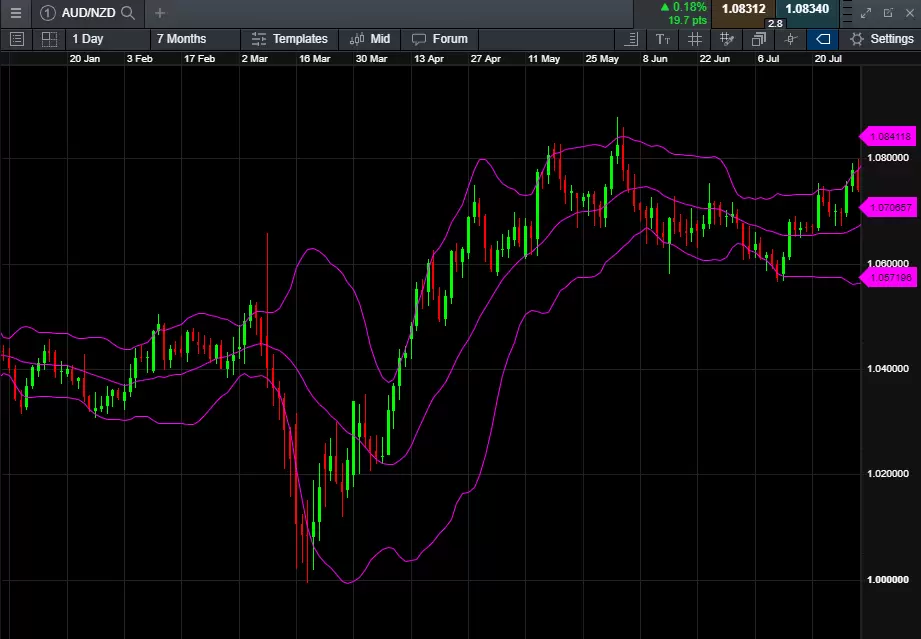
Bollinger Bands are a technical analysis tool that determines whether an asset’s price is high or low on a relative basis. When used with other indicators such as SMA and stochastic oscillators, especially the awesome oscillator, they help to demonstrate when an asset is in overbought or oversold condition. Bollinger Band charts can also be used to assess market volatility, which can be very advantageous for scalpers, as the optimal timeframe for trading with Bollinger Bands is around 1 to 5 minutes.
Moving averages
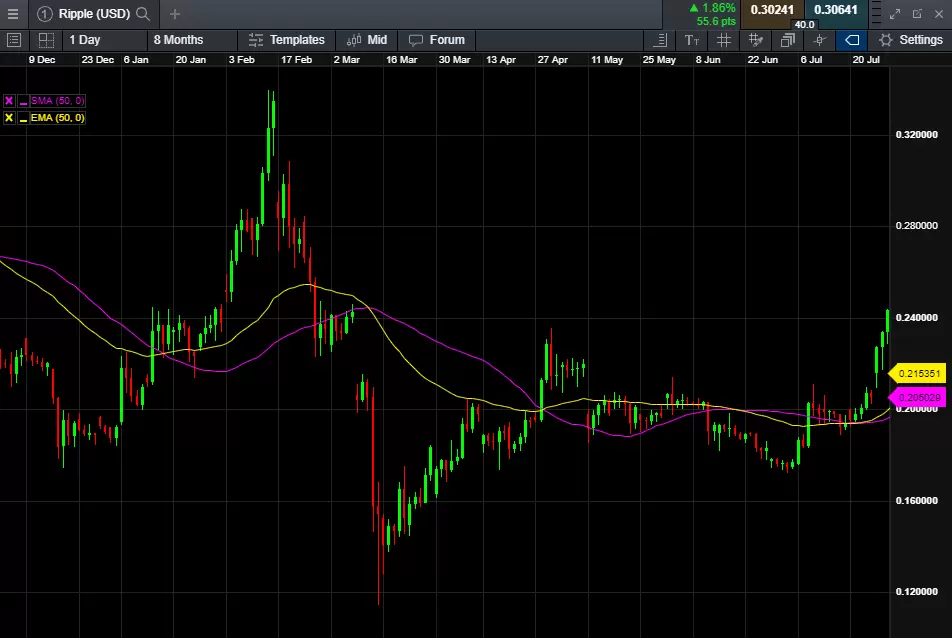
On a chart, the simple moving average (SMA) shows the price of an asset as it wavers over a specific time period. Traders usually use a short-term SMA to highlight the recent variance in price trends or a long-term SMA to identify a trend pattern of whether the price is increasing or decreasing in general. This technical indicator is used in almost every strategy performed by trading professionals, along with the exponential moving average (EMA), which responds even more quickly to price changes, in often less than a minute. Scalpers are able to spot changes more rapidly in order to place their bet.
Stochastic oscillator
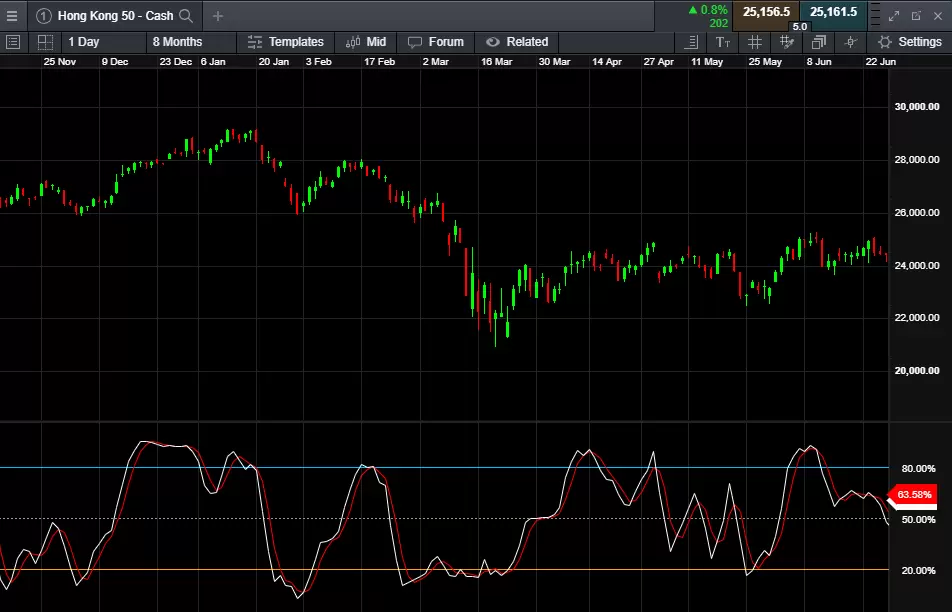
When using a stochastic oscillator, scalpers can view the recent range of an asset’s price in relation to its current price, in order to predict turning points in value. This may make them more cautious to place a trade if the price is predicted to turn in an unfavourable direction, as one big loss can easily outweigh each individual small profit that the scalper has earned so far. This can be an effective scalping indicator to highlight possible warnings, rather than solely opportunities.
Scalping with candlestick patterns
It is fairly common to use trading patterns to identify trends and price movements of an asset, which are often displayed through candlestick charts. Candlestick patterns can be seen as a leading indicator, as they show whether a trend is bullish or bearish, and there are many different types of candlestick formations. Scalpers can use these patterns to identify possible entry and exit points that will result in the highest profit.
Is scalping in trading profitable?
Scalping often reignites the risk versus reward debate, with many traders questioning the risks involved in such a fast-paced strategy. Indeed, no trading strategy ensures consistent gains. Its effectiveness depends on several factors, one of which is the trader’s discipline in executing timely exits. It is important that all scalpers and arbitrage traders in general have a risk management strategy in place.
In order to follow a successful scalping trading strategy, traders need to be aware of the risks. One exit strategy could be to use a stop-loss order, whether basic or guaranteed, where a trader can place a maximum limit on how much money they are willing to bet in total. Once this figure has been succeeded, they will be automatically withdrawn from the trade so that their losses are not multiplied even further.
Takeaways:
Scalpers look to enter and exit positions as quickly as possible, making small but frequent profits from successful trades
The strategy is based on price action and doesn’t take into account fundamental factors
Traders tend to prefer volatile markets where price fluctuations are more common
Popular assets to scalp include stocks and forex, as these markets provide high liquidity
Technical indicators such as moving averages and Bollinger Bands can help traders to spot price movements on charts
Disclaimer: This article provides general information only. It has been prepared without taking account of your objectives, financial situation or needs. It is not to be construed as a solicitation or an offer to buy or sell any financial instruments, or as a recommendation and/or investment advice. It does not intend to support an investment decision and it should not be relied upon by you in evaluating the merits of investing in any financial instruments. You should consider your objectives, financial situation and needs before acting on the information in this article. CMC Markets believes that the information in this article is correct, and any opinions and conclusions are reasonably held or made on information available at the time of its compilation, but no representation or warranty is made as to the accuracy, reliability or completeness of any statements made in this article. CMC Markets is under no obligation to, and does not, update or keep current the information contained in this article. Neither CMC Markets nor any of its affiliates or subsidiaries accepts liability for loss or damage arising out of the use of all or any part of this article. Any opinions or conclusions set forth in this article are subject to change without notice and may differ or be contrary to the opinions or conclusions expressed by any other members of CMC Markets.