Base currency explained: What it means in forex trading

6 minute read
|13 Jul 2026
USD on pavement
Table of contents
  • 1.
    What is a base currency?
  • 2.
    How to read a currency pair 
  • 3.
    Why base currency matters in foreign exchange trading
  • 4.
    Common base currencies in global forex markets
  • 5.
    Practical considerations for traders 

Every currency pair you encounter in forex trading follows the same structure. The base currency sits first, and understanding its role forms the foundation of reading any foreign exchange rate correctly. For Australian traders looking at pairs like AUD/USD, grasping this concept is essential before placing any trade. 

This guide breaks down what base currency means, how it differs from the quote currency, and why this distinction matters when you engage with currency markets. The examples here are hypothetical and for educational purposes only. 

What is a base currency?

The base currency is the first currency listed in a currency pair. It acts as the reference currency for the exchange rate, with every forex quote showing how much one unit of the base currency is worth in the quote currency, which is listed second.

When you trade a currency pair, the base currency is the currency being bought or sold. The exchange rate tells you how much of the quote currency is needed to buy one unit of the base currency.

Base and Quote Currency Visual

The relationship between base currency and quote currency creates the framework for all forex pricing. While the base currency sits first and acts as the reference unit, the quote currency (also called the counter currency) appears second and expresses the value. 

Base Currency 

Quote Currency 

Listed first in the currency pair 

Listed second in the currency pair 

Acts as the reference currency (one unit) 

Expresses the price of the base currency 

The currency you buy or sell 

The currency you pay or receive 

Also called the transaction currency 

Also called the counter currency 

Understanding base and quote currency positions prevents confusion when interpreting price movements. A rising price means the base currency strengthens against the quote currency. A falling price means the opposite. 

How to read a currency pair 

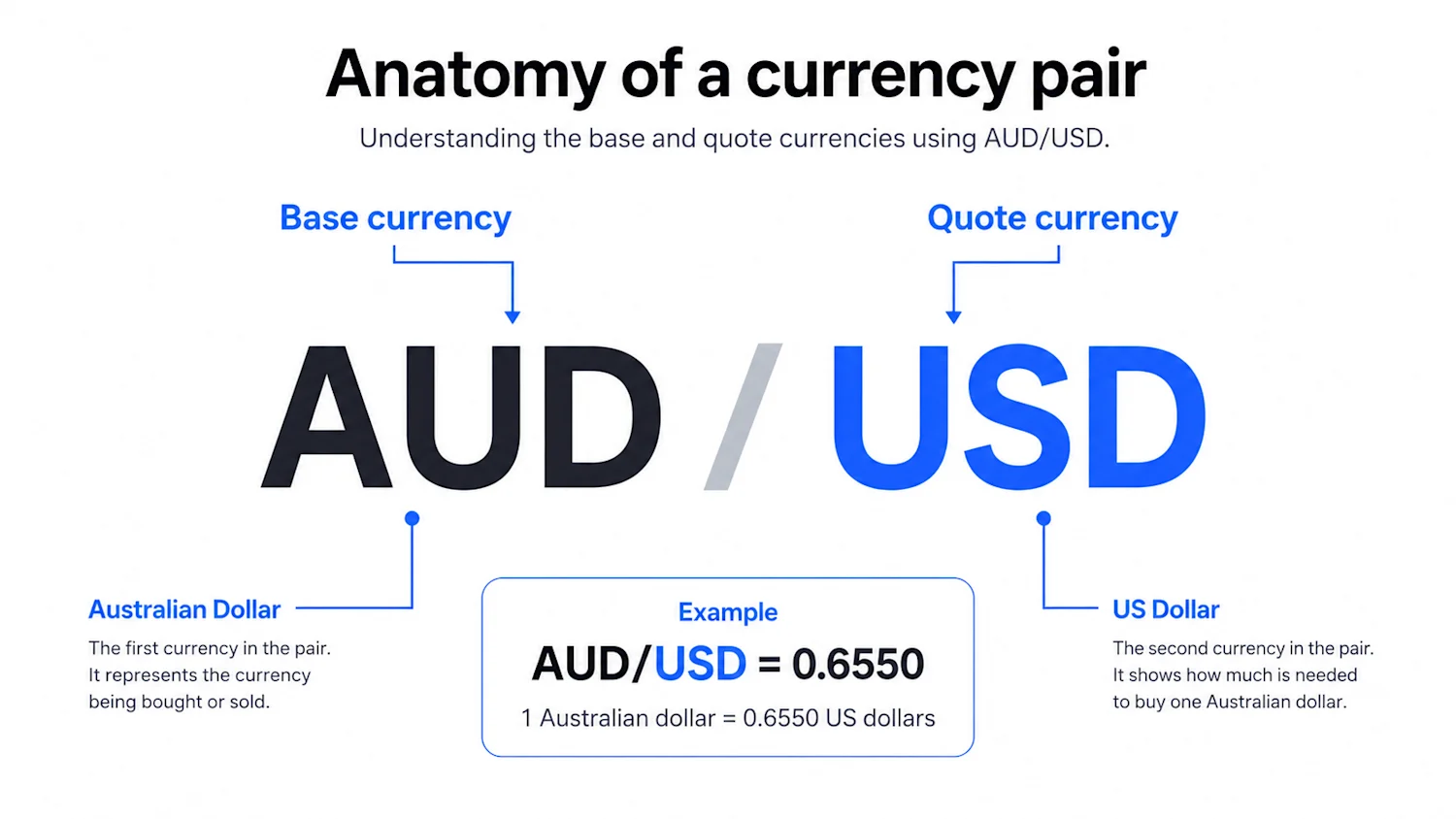
Reading a currency pair becomes straightforward once you recognise the convention. The format always follows this pattern:

BASE/QUOTE = Price

The price tells you how many units of the quote currency you need to buy one unit of the base currency. If EUR/USD equals 1.0850, one euro costs 1.0850 US dollars. 

When the pair price increases, the base currency has appreciated. When it decreases, the base currency has weakened relative to the quote currency. 

The AUD/USD exchange rate provides a familiar example for traders. In this pair, the Australian dollar is the base currency and the US dollar is the quote currency. 

Hypothetical example: If AUD/USD equals 0.6500, one Australian dollar buys 0.65 US dollars. If this rate rises to 0.6700, the Australian dollar has strengthened because it now purchases more US dollars. 

Other common pairs follow the same logic: 

  • EUR/USD: Euro is base, US dollar is quote 

  • GBP/JPY: British pound is base, Japanese yen is quote 

  • USD/CAD: US dollar is base, Canadian dollar is quote 

Why base currency matters in foreign exchange trading

Understanding which currency occupies the base position affects how you interpret market movements and structure trades. Misreading the base currency means misinterpreting whether a price increase represents strength or weakness for the currency you care about. 

For traders monitoring the AUD exchange rate, recognising when AUD sits as the base currency versus when it appears as the quote currency changes everything about how you read the numbers. 

Common base currencies in global forex markets

Certain currencies traditionally appear as the base currency more often than others. While any currency can theoretically appear as the base currency, the global forex market follows long established conventions that determine which currency is normally listed first in a pair.

These conventions have developed over decades of international trading and help ensure currency pairs are quoted consistently across banks, brokers and financial markets worldwide.

The currencies are generally ranked in the following order (highest to lowest). A currency that ranks higher is typically listed first and becomes the base currency when paired with a lower ranked currency:

Common market convention (highest precedence to lowest):

  1. Euro (EUR)

  2. British Pound (GBP)

  3. Australian Dollar (AUD)

  4. New Zealand Dollar (NZD)

  5. US Dollar (USD)

  6. Others (CHF, JPY, etc.)

This is why you see EUR/USD (not USD/EUR) and GBP/USD (not USD/GBP) as standard.

Where AUD Sits in the Hierarchy:

The Australian dollar has an interesting middle position.

AUD typically appears as the base currency against:

  • USD → AUD/USD

  • JPY → AUD/JPY

  • CAD → AUD/CAD

  • CHF → AUD/CHF

However, it becomes the quote currency against the European currencies:

  • EUR → EUR/AUD (standard market convention)

  • GBP → GBP/AUD (standard market convention)

Important note for CMC Markets clients:

On the CMC Markets platform, both versions of major pairs are available for your convenience:

  • Standard: EUR/AUD, GBP/AUD

  • Inverted: AUD/EUR, AUD/GBP

This makes it easier to trade with AUD as the base currency and track its strength directly.

Practical considerations for traders 

For traders engaging with forex markets, several practical points deserve attention. 

First, always confirm which position AUD occupies before interpreting any price movement. A rising number in AUD/USD means something entirely different from a rising number in GBP/AUD. 

Second, understand that the base currency determines your position structure. Buying a currency pair means buying the base currency and selling the quote currency. Selling a pair means the opposite. 

Third, some trading platforms offer additional inverted versions of standard currency pairs for convenience. Always check which currency is listed first before interpreting the exchange rate.

Currency markets operate 24 hours during weekdays and can experience rapid price movements during high-impact economic events. Past exchange rate movements do not indicate future performance. 

Disclaimer: This article provides general information only. It has been prepared without taking account of your objectives, financial situation or needs. It is not to be construed as a solicitation or an offer to buy or sell any financial instruments, or as a recommendation and/or investment advice. It does not intend to support an investment decision and it should not be relied upon by you in evaluating the merits of investing in any financial instruments. You should consider your objectives, financial situation and needs before acting on the information in this article. CMC Markets believes that the information in this article is correct, and any opinions and conclusions are reasonably held or made on information available at the time of its compilation, but no representation or warranty is made as to the accuracy, reliability or completeness of any statements made in this article. CMC Markets is under no obligation to, and does not, update or keep current the information contained in this article. Neither CMC Markets nor any of its affiliates or subsidiaries accepts liability for loss or damage arising out of the use of all or any part of this article. Any opinions or conclusions set forth in this article are subject to change without notice and may differ or be contrary to the opinions or conclusions expressed by any other members of CMC Markets.

Join an award winning CFD provider
Practise CFD trading with $10,000 of virtual funds on a risk-free demo account.
Access 12,000+ instruments on our award-winning CMC Markets Platform. Including indices, forex and shares.
Enhance your CFD trading on MetaTrader4 with CMC Markets and access 175+ forex pairs.
Tight spreads and low margin rates.