Loading...
Loading...
SpaceX shares have lost momentum after a highly anticipated market debut. Investors now need evidence that Starlink growth, Starship progress and improving cash flow can justify the company's elevated valuation.

Chief Market Analyst
SpaceX's stock market debut was viewed as one of the most spectacular listings of recent years. Few companies have attracted such intense interest from both retail and institutional investors. Elon Musk's vision, SpaceX's dominance in the global launch market, the rapid growth of Starlink and the long-term prospect of a Mars mission all pushed expectations to unusually high levels before the IPO.
Only a few weeks after the successful listing, however, the picture looks very different. The shares have given back a significant portion of their initial gains and are currently among the weaker major new issues of the year. Investors are therefore asking whether the investment story has been damaged, or whether the pullback offers a more attractive entry point.
The main reason for the decline appears to be less a deterioration in the operating business than the exceptionally high expectations that were already priced in before the listing.
SpaceX was valued at well above USD 1tn in the private market. After the IPO, its market capitalisation rose even further for a time, meaning that an almost perfect scenario was already embedded in the share price. Further gains would have required exceptionally strong company news.
Instead, the typical post-IPO effect took hold during the first weeks of trading. Early investors and institutions used strong demand to lock in initial profits, while analysts began to assess the valuation more closely against traditional fundamentals. That led to a healthy, albeit painful, correction.
Operationally, little has changed in the investment story. If anything, Starlink continues to develop into SpaceX's most valuable asset.
Customer numbers are growing steadily around the world, new enterprise clients are being added across aviation, shipping and defence, and governments are increasingly turning to satellite-based communications. At the same time, SpaceX continues to improve network capacity by expanding its satellite constellation.
This part of the business is likely to determine the largest share of company value in the years ahead. The traditional rocket business remains technologically impressive, but the more durable cash flows are increasingly being generated by telecommunications.
The IPO has also changed investors' perspective. Private capital providers were willing for years to focus heavily on vision and technological progress, but public-market shareholders are increasingly demanding robust financial metrics.
The decisive question is how quickly Starlink can continue to improve margins and whether free cash flow can rise sustainably. Investors will also watch how far heavy investment in Starship, new satellites and data centres weighs on profitability.
This balance between growth and earnings is likely to play a major role in determining the stock's valuation over the coming quarters.
Alongside Starlink, the Starship programme remains the second key driver of the share price.
Each successful test flight materially increases the company's long-term economic value. If SpaceX can make Starship fully reusable and commercially viable, it could lower transport costs dramatically and further strengthen its technological lead.
The reverse is also true. Major technical setbacks or delays would put pressure on the market's high expectations. Investors should therefore expect individual Starship test flights to remain capable of triggering meaningful moves in the share price.
Rising competition is another reason for the more cautious valuation.
SpaceX remains the clear market leader, but a growing number of companies and state-backed programmes are investing heavily in similar technologies. These include Amazon's Project Kuiper, Blue Origin, Rocket Lab and government space programmes in Europe and Asia.
SpaceX still has a substantial technological lead. Over the longer term, however, competition in both satellite internet and launch services is likely to become much more intense.
After the IPO, investors' focus is shifting from vision to execution. Markets will pay close attention to Starlink subscriber growth, free cash flow, margin improvement in the satellite business and progress on the Starship programme. Large commercial and government contracts, as well as the expansion of international Starlink licences, will also remain important drivers.
The hype is over, but the investment story is not. The sharp decline since the listing should not necessarily be interpreted as a failure of the SpaceX thesis. Instead, the company is going through a normalisation phase often seen after high-profile IPOs, with the market beginning to judge the business more on operating metrics and less on long-term vision.
Long-term structural growth drivers remain intact. Starlink is increasingly developing into a global infrastructure business, while SpaceX continues to build on its technological leadership in the space sector. At the same time, public markets will now focus much more closely on profitability, cash flow and returns on capital than private investors did before the listing.
If SpaceX can demonstrate over the coming quarters that its multibillion-dollar investments are increasingly translating into higher profits and sustainable free cash flow, the current pullback may ultimately be remembered as a necessary consolidation rather than the start of a longer-term downtrend.
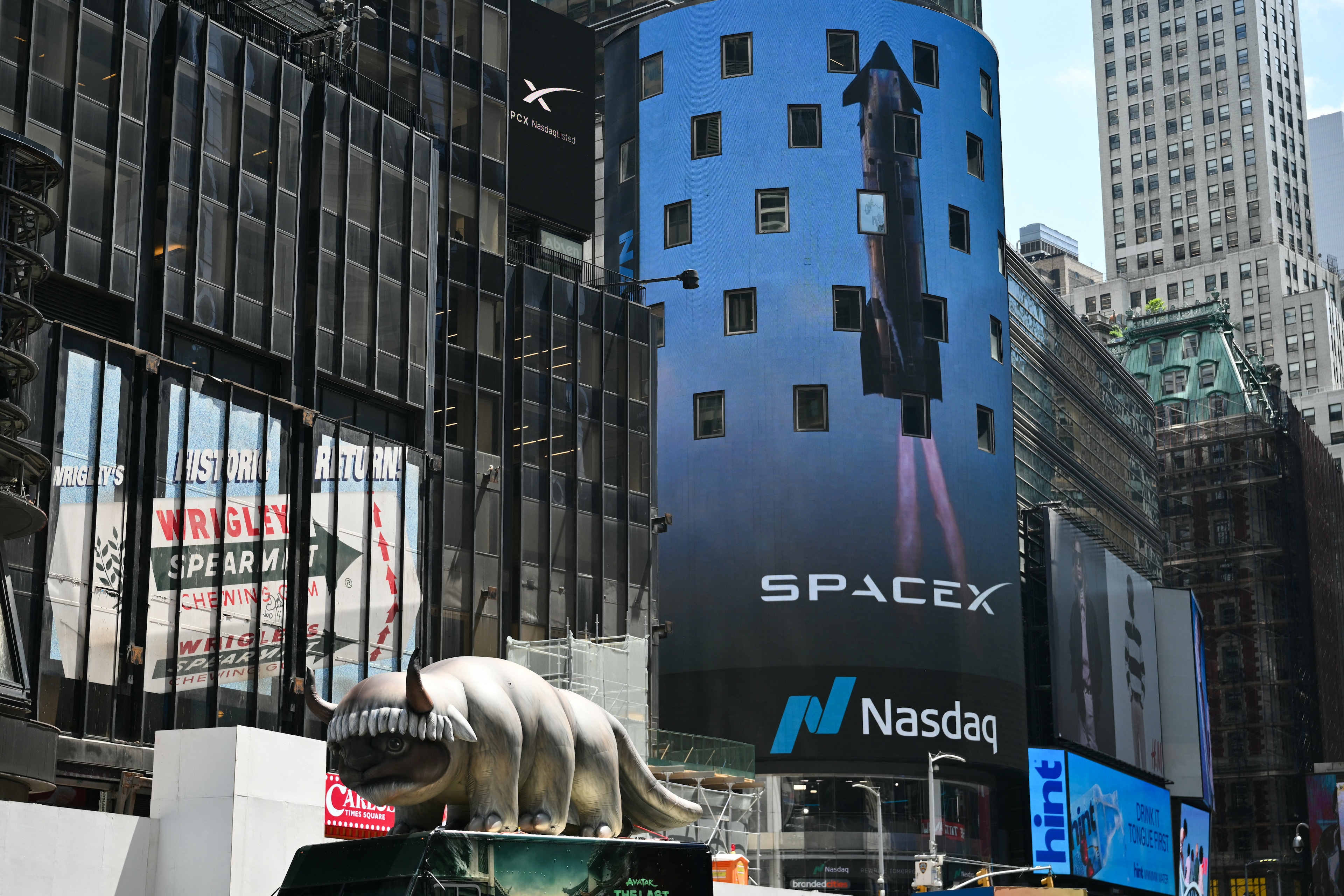
A combination of Tesla and SpaceX would bring electric vehicles, satellites, launch services, AI infrastructure and energy technology under one roof. The strategic overlap is real, but valuation, governance and regulation still make a full merger difficult to imagine.
Doubts about the profitability of artificial intelligence investment, higher funding costs and rising Chinese competition have cooled enthusiasm for big tech. Microsoft, Meta and Amazon are reporting near key support levels, while consensus still points to significant upside if AI capex concerns ease.