Shares trading
Trade across 15,000+ global shares from 25 countries
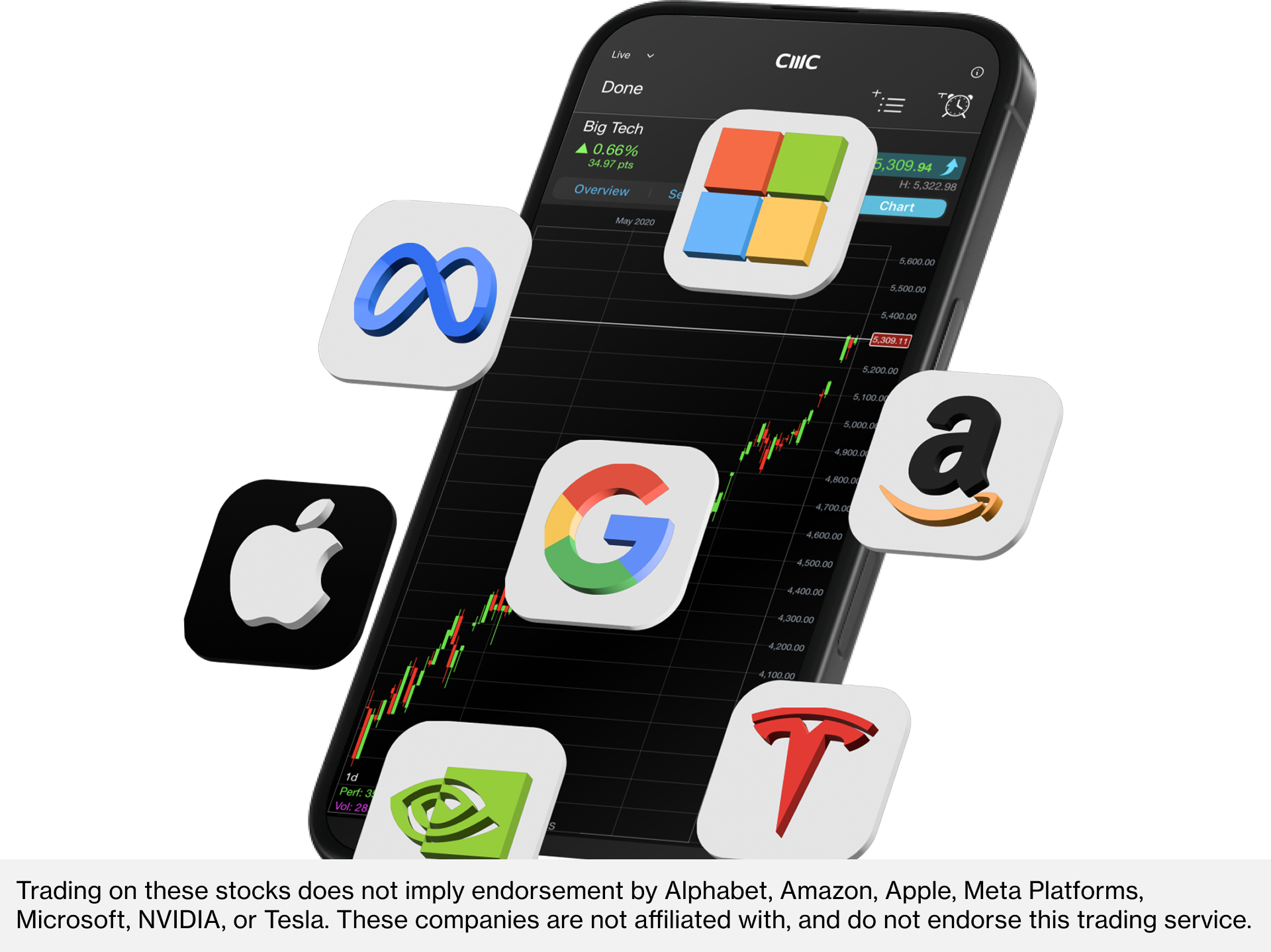
Spread bet or trade CFDs 24/5 on 5,000+ US stocks, including the Mag 7
0% commission on 2,500+ UK and European share CFDs
Fast execution¹, no partial fills and 24/5 customer service



Good Money Guide Awards 2026
ADVFN International Financial Awards
ForexBrokers.com Awards

Trade 24/5 on 10,000+ US shares and ETFs
React to earnings reports, market news and events throughout the trading week
Manage your open positions during the main session or out of hours
Enjoy a seamless trading experience, with access to the same order types and execution
Why buy or trade shares with us?

Trade commission-free on 2,500 UK and European shares and ETFs (excludes Greek shares).

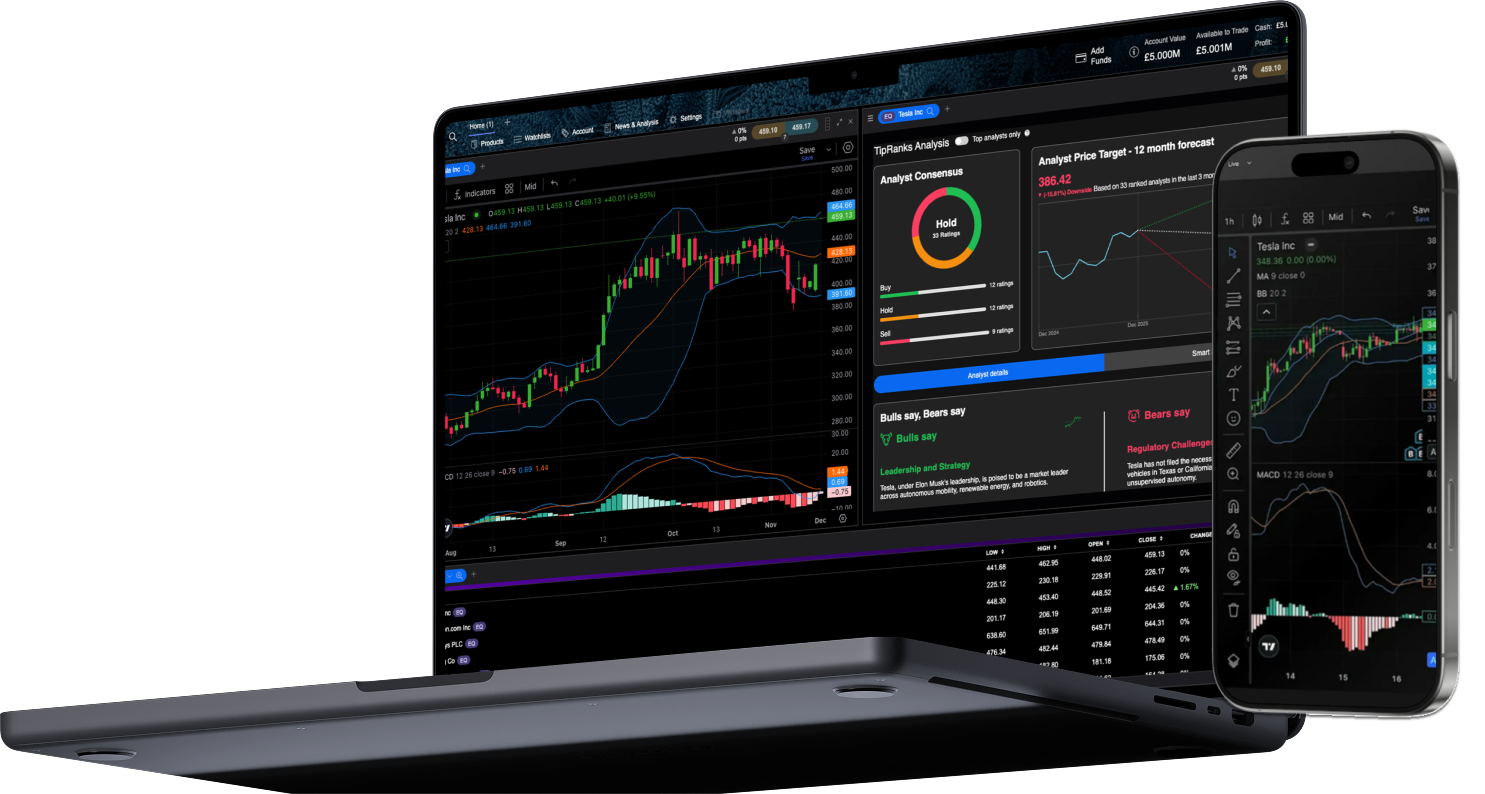
Free access to equity analysis and research from Morningstar and TipRanks, plus streaming news from Reuters.

Share trading costs
PRODUCT | PRICE | DAY | WEEK | TREND |
|---|---|---|---|---|
PRODUCT | PRICE | DAY | WEEK | TREND |
|---|---|---|---|---|
PRODUCT | PRICE | DAY | WEEK | TREND |
|---|---|---|---|---|
PRODUCT | PRICE | DAY | WEEK | TREND |
|---|---|---|---|---|
PRODUCT | PRICE | DAY | WEEK | TREND |
|---|---|---|---|---|
PRODUCT | PRICE | DAY | WEEK | TREND | MIN SPREAD | Holding Cost Buy Overnight | Holding Cost Sell Overnight | MARGIN RATE |
|---|---|---|---|---|---|---|---|---|
PRODUCT | PRICE | DAY | WEEK | TREND | MIN SPREAD | HOLDING COST BUY | HOLDING COST SELL | MARGIN RATE |
|---|---|---|---|---|---|---|---|---|
PRODUCT | PRICE | DAY | WEEK | TREND | MIN SPREAD | HOLDING COST BUY | HOLDING COST SELL | MARGIN RATE |
|---|---|---|---|---|---|---|---|---|
PRODUCT | PRICE | DAY | WEEK | TREND | MIN SPREAD | HOLDING COST BUY | HOLDING COST SELL | MARGIN RATE |
|---|---|---|---|---|---|---|---|---|
PRODUCT | PRICE | DAY | WEEK | TREND | MIN SPREAD | HOLDING COST BUY | HOLDING COST SELL | MARGIN RATE |
|---|---|---|---|---|---|---|---|---|
PRODUCT | PRICE | DAY | WEEK | TREND | MIN SPREAD | HOLDING COST BUY | HOLDING COST SELL | MARGIN RATE |
|---|---|---|---|---|---|---|---|---|
PRODUCT | PRICE | DAY | WEEK | TREND | MIN SPREAD | HOLDING COST BUY | HOLDING COST SELL | MARGIN RATE |
|---|---|---|---|---|---|---|---|---|
PRODUCT | PRICE | DAY | WEEK | TREND | MIN SPREAD | HOLDING COST BUY | HOLDING COST SELL | MARGIN RATE |
|---|---|---|---|---|---|---|---|---|
PRODUCT | PRICE | DAY | WEEK | TREND | MIN SPREAD | HOLDING COST BUY | HOLDING COST SELL | MARGIN RATE |
|---|---|---|---|---|---|---|---|---|
PRODUCT | PRICE | DAY | WEEK | TREND | MIN SPREAD | HOLDING COST BUY | HOLDING COST SELL | MARGIN RATE |
|---|---|---|---|---|---|---|---|---|
PRODUCT | PRICE | DAY | WEEK | TREND | MIN SPREAD |
|---|---|---|---|---|---|

0% commission
on UK & European shares
Trade commission-free on 2,500+ UK and European share CFDs (excluding Greece shares). Other fees may apply.
Ways to trade shares

Equities trading
Buy and sell shares and ETFs outright and take ownership of the underlying asset. You pay the full value of the shares and can hold them for the long term, receiving any dividends and shareholder rights where applicable.

Spread betting
Speculate with leverage on whether a share price will rise or fall without owning the underlying asset. You place a bet per point of price movement and profits or losses depend on how far the market moves in your favour or against you.

CFD trading
Trade on the price movement of shares without owning them. CFDs allow you to go long or short and use leverage, meaning you only put down a deposit, but your profits and losses are based on the full position size.

Options trading
Trade contracts that give you the right, but not the obligation, to buy or sell select shares at a set price on or before a specified date. Options can be used to speculate on price movements or manage risk.
What do our customers say about trading with us?


The new way to trade tax-free*
We’ve reimagined spread betting, for those who prefer a more measured, investment-style approach. Trade a wide range of markets, go long or short, and enjoy greater control over your risk.
No financing costs
No capital gains tax
Go long without leverage
*Tax treatment depends on individual circumstances. Capital at risk.
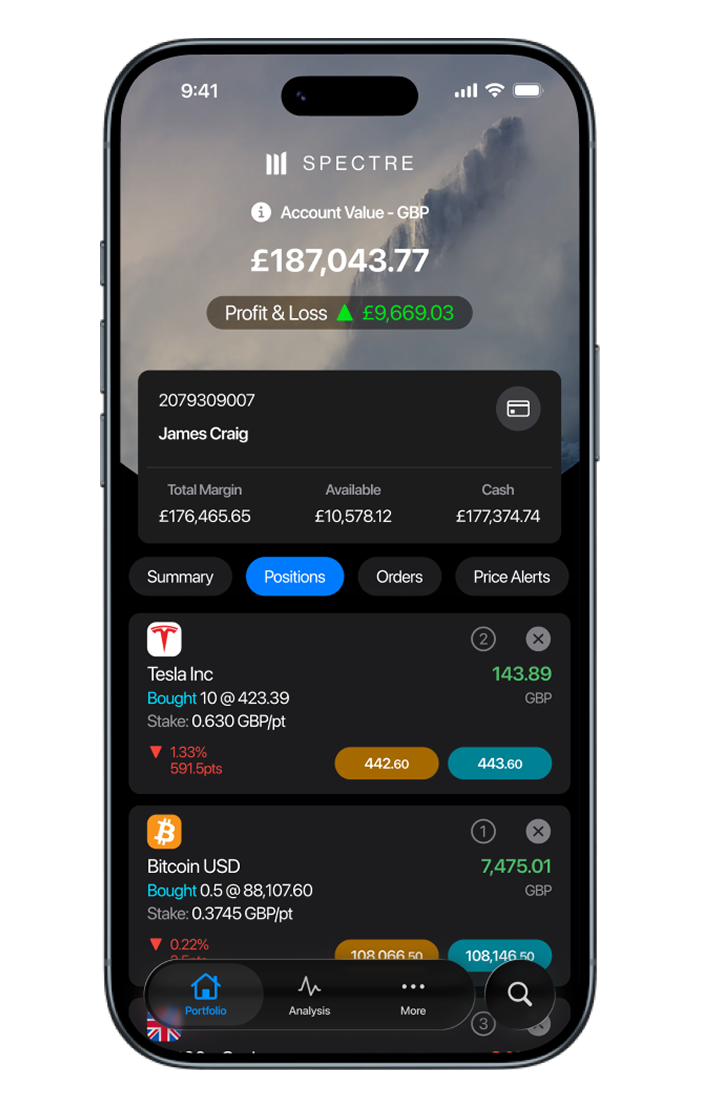
Spread betting involves risk. Although the Spectre account has no leverage, you may lose your full committed amount.
FAQs
A share represents a portion of the ownership of a public company. The shares of a publicly listed company will be available on a stock market, such as the FTSE 100 index, whose constituent stocks are listed on the London Stock Exchange.
Trading shares in the underlying market involves the buying and selling of a company's shares, with the aim of profiting through the company's share price rising over time. The aim would be to sell your shares at a higher price than when you bought them.
You can invest in shares with us and own a portion of a company's stock, or spread bet and trade CFDs or options on shares, without actually owning the underlying stock. Learn more about shares trading
When investing in shares, you buy and own company shares outright, usually with longer-term investment in mind.
When trading share CFDs, you don't take ownership of the underlying shares. Instead, you speculate on whether share prices will rise or fall. CFDs are leveraged products, meaning you only deposit a percentage of the total position value to open a trade.
You can invest directly in over 13,000 global shares, and spread bet or trade CFDs on 15,000+ stocks.
Our share offering covers companies listed across as many as 28 countries and major international stock exchanges, including the London Stock Exchange, New York Stock Exchange, Nasdaq, and Frankfurt Stock Exchange.
This allows you to speculate on a wide range of sectors and industries, and gives you access to the world's largest and most actively traded companies, including the 'magnificent seven' US tech stocks.
The value of shares can rise or fall based on market conditions, company performance and economic events. When trading derivative products such as spread bets and CFDs, profits and losses are based on the full value of the position. It's important to understand the risks before trading and use risk-management tools where appropriate.
When you spread bet or trade CFDs on shares on our platform, you don't buy or sell the underlying share. Instead, you're taking a position on whether you think the company's share price will go up or down.
With spread betting, you buy or sell an amount per point movement for the share instrument you’re trading, such as £5 per point. This is known as your stake. With CFD trading, you buy or sell a number of units for a particular instrument. For every point or unit that the price moves in your favour, you gain multiples of your stake, and vice versa.
As an example, say you wanted to buy £1,300 worth of Lloyds penny shares at £65 per share. For the spread betting equivalent of this trade, you would specify a stake size of £20 per point to get the same exposure as you would if you bought 20 Lloyds shares at £65 through traditional share dealing. Due to the leverage available with spread betting (5:1 in this case), you would be able to enter this position with an initial outlay of £260, instead of £1,300. However, your profits and losses are based on the full value of the trade (£1,300).
As a retail (non-professional) client, negative balance protection means that you will never lose more than the available cash in your account. View our spread betting versus CFDs comparison.
Non-UK, non-European and Greek share spread bets have an additional spread added either side of the existing spread. See our US share spread bet example below.
US shares example:
Share price / Cost
$0-15 | 1 cent (each side)
$15-25 | 2 cents (each side)
$25-35 | 3 cents (each side)
$35+ | 4 cents (each side)
CFD/underlying sell/buy price = $25.50 / $25.58
The share price falls into the $25-35 bracket. So, 3 cents is added to both sides, widening the spread: $25.50 - $0.03 / $25.58 + $0.03
Spread bet sell/buy price = $25.47 / $25.61
Spread betting allows you to trade tax-free on a wide range of financial markets up to 24 hours a day, from Sunday night through to Friday night. Spread bet on your mobile device or PC on a wide range of instruments with leverage.
When a stock goes ex-dividend (ie when a company's dividend allocations have been specified), the value of that stock effectively falls by the dividend amount. This means if you hold a spread bet or CFD position on a company which announces a dividend, your account will be credited or debited on the day the stock goes ex-dividend.
If you were long (holding a buy position), you would have been disadvantaged by the drop in the market caused by the pay out of the dividend, so we would credit your account with the dividend amount, less any applicable dividend withholding taxes. If you were short the stock, you would benefit from the drop in the price, so the equivalent amount would be deducted. So, overall, you don't lose or gain anything from the adjustment. There are no withholding taxes on short positions. The dividend will appear as a 'Price Adjustment' in your account history within the platform.
For more details on trading in extended hours, visit our extended trading hours FAQs.
*The main US session trading hours (when the New York Stock Exchange and NASDAQ are open) are 2.30pm to 9pm (UK time). Please note: there is a three-week period during March, and one week in October, between the US and UK clocks changing for daylight saving time (DST), when the underlying US exchanges will open and close one hour earlier than usual.
Yes, there is a higher risk when you trade outside of the core trading session hours (when the underlying exchange is closed). There is likely to be a greater level of price volatility, due to lower trading volumes. This is because there are fewer participants than during normal market hours, resulting in less liquidity, which means that markets are more volatile as a result.
These market conditions mean that prices are likely to fluctuate more rapidly than usual, and some trades could be more difficult to execute, owing to the lower trading volumes. Our spreads may also be wider compared with the main trading session.
You can place the same order types as normal during extended-hours trading, although we lower trading and position limits compared with the main trading session. This helps us to manage risk during periods of lower liquidity in the market. Because of this lower liquidity, your pending orders may not always execute as they would in the main trading session. For limit orders, take-profit orders, stop-loss orders, trailing stop-loss orders, stop-entry orders and guaranteed stop-loss orders, we won't execute the order if the target price is reached until we can validate this price against broader market activity. This is to protect you, and helps us ensure that execution occurs at a representative market price. Account liquidations also function as normal, so it's important to ensure that your account is properly funded, and that you allow enough time to deposit funds, if required.
There's no cost to open a live trading account with us. You can also view prices and use tools such as charts, Reuters news, or Morningstar quantitative research equity reports, free of charge. You'll need to deposit funds in your account to place a trade.
Yes, CMC Markets UK plc (registration number 173730) is fully authorised and regulated by the Financial Conduct Authority (FCA) in the UK. Retail client money is held in segregated client bank accounts and money held on behalf of clients is distributed across a range of major banks, which are regularly assessed against our risk criteria.
Under the FCA's Client Money rules, we're required to segregate client money (unless you agree with us otherwise) from CMC's own funds. The funds held in segregated bank accounts do not belong to CMC, and will be held in a way that enables it to be identified as client money. Learn more about client money regulations
CMC Markets earns revenue through spreads and other applicable fees and charges. The fees and charges that apply may vary depending on the product and account type.
Dive deeper

What is share trading?
Explore how share trading works and how you can buy and sell shares of publicly listed companies.
How to trade shares
Learn the essential steps to start trading shares, from researching companies to placing your first trade.
Any questions?
We're available whenever the markets are open, from Sunday night through to Friday night.