Lagarde's ECB guidance may matter more than the rate rise
The ECB rate rise was widely expected, leaving markets focused on Christine Lagarde's tone and what it means for further tightening. The risk is that sticky inflation and higher energy prices are arriving as eurozone growth loses momentum, keeping EUR/USD, bonds and European equities sensitive to policy guidance.

CMC Markets Poland
Guidance is now the main ECB risk
The European Central Bank's June rate decision was heavily anticipated, with markets almost fully pricing a 25-basis-point move before the meeting. That means the larger market risk is less about the headline rate change and more about how strongly Christine Lagarde signals the path for the rest of the year.
The Polish source frames the problem clearly. If Lagarde sounds firmly hawkish and encourages expectations for further tightening, investors could push rate forecasts higher again. That would help defend the ECB's inflation credibility, but it could also leave the central bank with less room to retreat if growth data keep softening.
Markets had already started to price the possibility of several rate rises by year-end. For traders, the immediate question is whether the ECB wants to validate that view or slow it down.
The growth backdrop makes tightening harder
The case for higher rates is being supported by inflation concerns, especially after energy prices rose in response to renewed geopolitical tension around Iran. Higher oil prices can quickly complicate the inflation outlook, making it harder for central banks to declare victory over price pressure.
But the growth side of the equation is less comfortable. The source notes that eurozone GDP contracted by 0.2% in the first quarter of 2026, while consumer confidence, services activity and household credit growth have all weakened. Those are not the usual conditions in which higher borrowing costs are easy to absorb.
That leaves the ECB caught between two risks. If it underreacts to inflation, credibility may suffer. If it tightens too aggressively into a slowing economy, it could deepen the downturn and increase recession risk across the eurozone.
The Trichet comparison is back in focus
Bank of America analysts have drawn attention to the July 2008 ECB rate rise under Jean-Claude Trichet, when the central bank responded to oil prices near $150 a barrel shortly before the global financial crisis intensified. With hindsight, that move is often treated as one of the most controversial policy decisions in modern central banking.
The comparison is not perfect, but it explains why investors are sensitive to the current setup. Energy prices are rising again because of geopolitical stress, while the eurozone economy is already losing momentum. That combination raises the risk that policy tightens just as activity weakens.
For markets, the key question is whether the ECB is focused mainly on inflation persistence or whether it is giving enough weight to recession risk. Lagarde's tone may therefore matter as much as the decision itself.
EUR/USD sits at the centre of the policy trade
The ECB decision can affect EUR/USD, European equity indices, bond yields, share valuations, CFD markets and borrowing costs for households and companies. The source chart shows EUR/USD trading around important support and resistance zones, making the pair especially sensitive to any shift in rate expectations.
A more hawkish ECB message could support the euro in the short term if traders decide that policy divergence is moving in its favour. But that support may be fragile if tighter policy is seen as a drag on growth rather than a sign of economic strength.
European equities face a similar balance. Higher rates can pressure valuations and make investors less willing to pay for cyclical earnings, especially if energy costs are also rising. Bonds may remain the clearest transmission channel, with yields reacting quickly to any sign that the ECB is comfortable with more tightening.
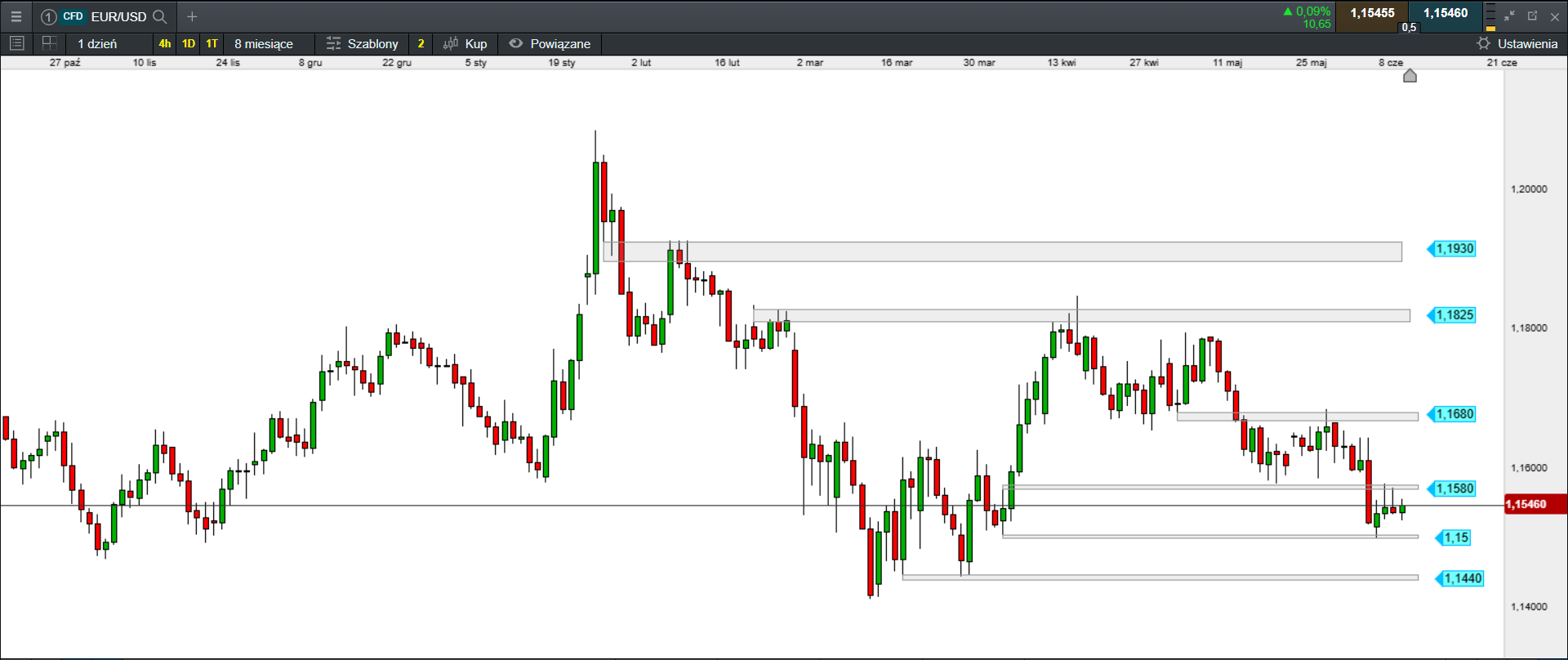
Source: CMC Markets, as at 11 June 2026. The source chart retains minor Polish platform labels.
What traders may need to watch next
The next phase is likely to be data-dependent. Inflation readings, energy prices, PMI surveys and lending data will all help determine whether the ECB can keep policy restrictive without increasing the pressure on growth.
For traders, the cleanest signal may come from how markets react after the initial rate move. If EUR/USD rises while bond yields stay contained and European equities stabilise, investors may be treating the decision as manageable. If yields rise sharply and equities weaken, the market may be warning that policy risk is becoming harder to absorb.
That is why Lagarde's guidance matters. The ECB can raise rates once and still keep optionality, but a strongly hawkish message could encourage markets to price a longer tightening cycle at a moment when the eurozone economy already looks vulnerable.

ECB raises rates as Eurozone stagflation risk deepens
The ECB has delivered the 25-basis-point rate rise flagged in the Spanish source, but the move lands in an uncomfortable mix of weaker growth and higher inflation projections. With energy costs still driving the shock, the euro and European equities may remain sensitive to every hint on the next rate move.
EUR/USD may weaken further as key support breaks
EUR/USD has slipped below support around 1.166, increasing the risk that a double-top pattern is now taking shape. If the break holds, the pair could come under further pressure in the days ahead, although a quick recovery back above the neckline would still leave room for a false-break rebound.