Loading...
Loading...
The ECB has delivered a 25-basis-point rate rise, but the move lands in an uncomfortable mix of weaker growth and higher inflation projections. With energy costs still driving the shock, the euro and European equities may remain sensitive to every hint on the next rate move.

Market Analyst
The European Central Bank's June decision was largely priced in, and the expected move has now arrived. The ECB raised all three key interest rates by 25 basis points, taking the deposit facility rate to 2.25%, the main refinancing rate to 2.40% and the marginal lending rate to 2.65%, with effect from 17 June.
That makes the decision important, but not surprising. Markets had already been leaning heavily towards a quarter-point rise, so the more important question is what the move says about the policy path from here. The source framed the meeting as a test of whether the eurozone is moving closer to the adverse scenario the ECB described earlier in the year: higher inflation pressure, weaker growth and less room for policy comfort.
That is now the heart of the market debate. The rate rise may help defend inflation credibility, but it also tightens financial conditions at a moment when activity indicators are already soft.
The ECB's updated projections underline why this decision is uncomfortable. In its baseline scenario, the central bank now sees headline inflation averaging 3.0% in 2026, 2.3% in 2027 and 2.0% in 2028. Inflation excluding energy and food is projected at 2.5% in both 2026 and 2027, before easing to 2.2% in 2028.
At the same time, growth has been marked down. The ECB now expects the eurozone economy to expand by 0.8% in 2026, 1.2% in 2027 and 1.5% in 2028, with the downward revision reflecting the impact of the war on commodity markets, real incomes and confidence.
That combination is precisely why the source's stagflation framing matters. Higher inflation may justify tighter policy, but slower growth makes every further rate signal more difficult to deliver without increasing pressure on households, businesses and risk assets.
Because the June increase was so widely expected, markets are likely to focus less on the decision itself and more on the ECB's tolerance for additional tightening. The Spanish source noted that traders had been pricing further rate rises later this year, but the ECB has avoided pre-committing to a fixed path.
That leaves the next few meetings highly data-dependent. If energy prices stay elevated and second-round effects start to broaden, the ECB may have to keep the door open to more tightening. If activity weakens faster, that same stance could become harder to sustain.
The source also pointed to weakening eurozone momentum, including a composite PMI reading in contraction territory. That matters because a central bank can usually sound more hawkish when growth is solid. It is much harder to do so when the inflation shock is coming from imported energy rather than domestic strength.
A rate rise is not automatically positive for the euro when it arrives alongside weaker growth. For EUR/USD, the key issue is whether tighter ECB policy narrows the gap with the US in a way that looks sustainable, or whether it simply highlights the eurozone's greater exposure to the energy shock.
If investors see the rate rise as a credibility move rather than the start of a stronger economic story, the euro may struggle to build durable momentum. Higher inflation driven by oil and gas costs can support nominal rates, but it can also damage real incomes and business confidence.
That leaves EUR/USD sensitive to both sides of the policy mix. A firmer ECB tone could offer short-term support, but any sign that growth is deteriorating faster than expected may quickly turn higher rates into a headwind rather than a tailwind.
European equities now have to absorb a less forgiving macro backdrop. The source's warning is not just about the ECB, but about the combination of higher energy costs, weaker activity and rising discount rates. That mix can weigh on valuation multiples even before earnings expectations start to move lower.
For the Germany 40 and other cyclical European benchmarks, the risk is that investors become less willing to pay for growth while financing conditions tighten. Banks may benefit from higher rates at the margin, but industrials, consumer names and energy-sensitive sectors may face a tougher demand and cost environment.
Brent crude therefore remains an important signal. If oil prices stabilise, markets may treat the ECB's move as uncomfortable but manageable. If the energy shock intensifies again, the stagflation trade could become harder to ignore across the euro, bonds and European equities.
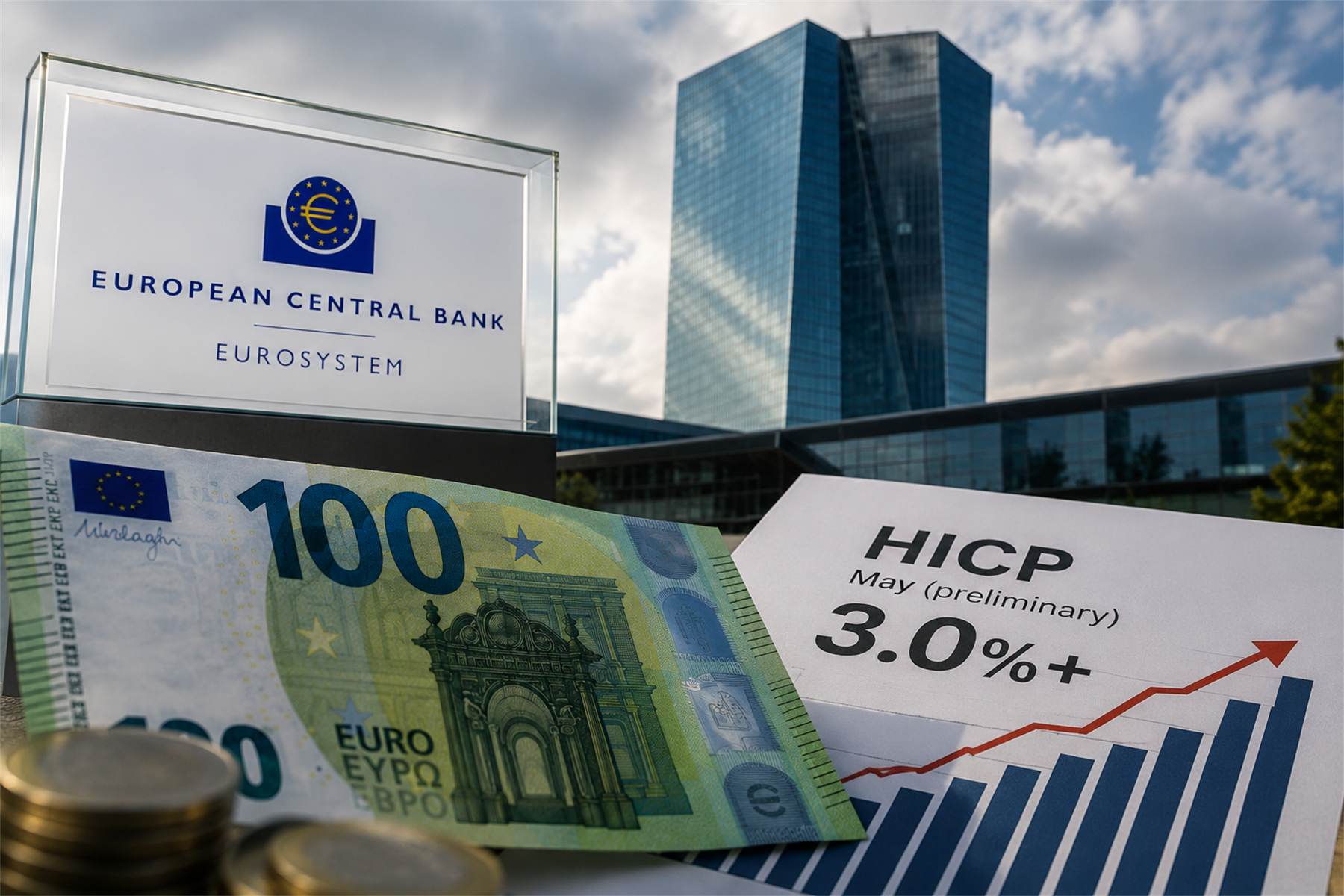
Eurozone inflation is back in focus just as growth momentum remains weak, leaving the ECB caught between sticky prices and a fragile economy. If Tuesday's CPI data surprise to the upside again, traders may start to question whether higher inflation is helping the euro or simply deepening the stagflation squeeze.