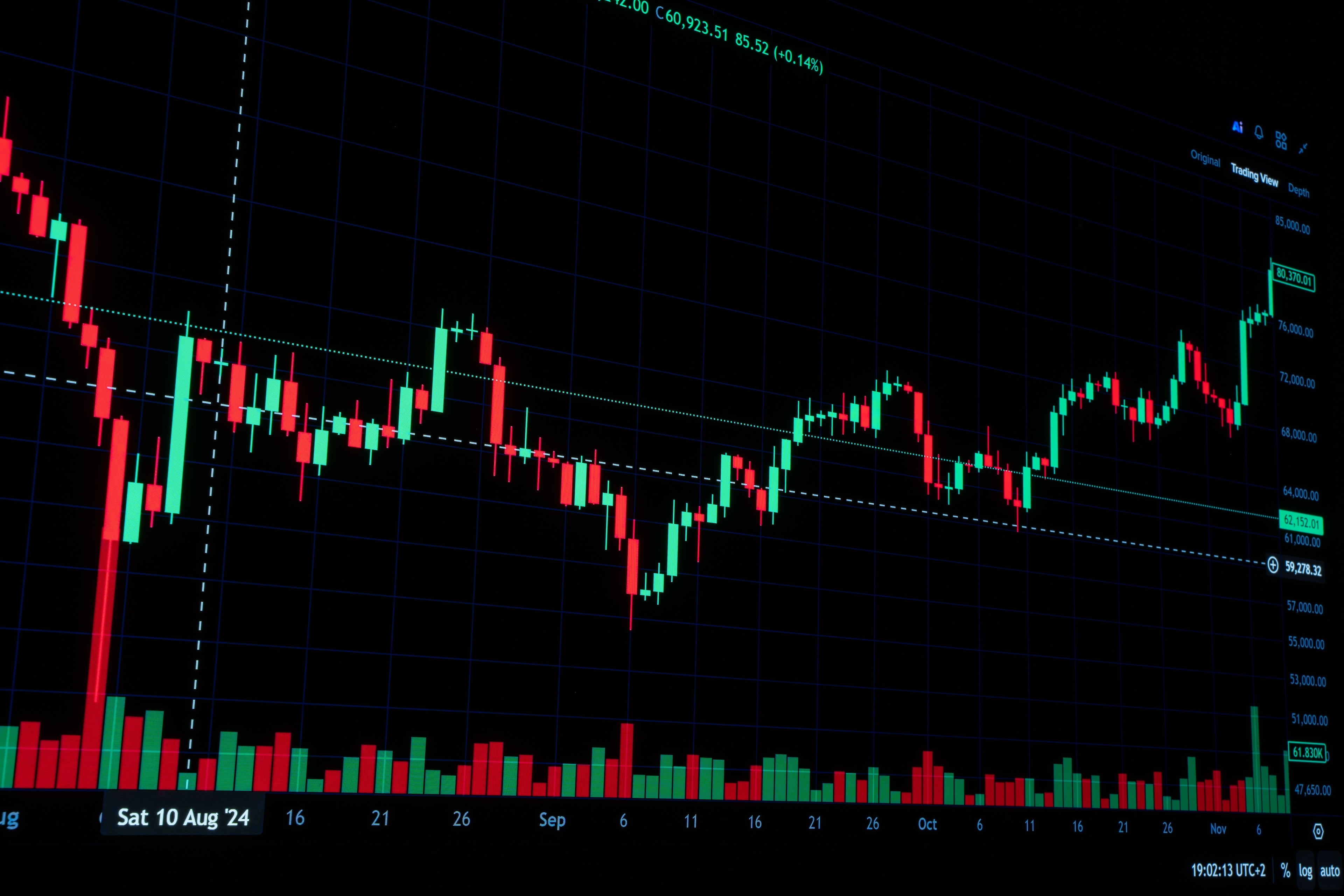
Outlook 2026: Is bitcoin entering a new era?
As part of our series exploring the outlook for key financial instruments and markets in the year ahead, our market analyst Daniel Kostecki looks at what 2026 might have in store for bitcoin.

CMC Markets Poland
Although the Financial Conduct Authority, Britain's financial regulator, bans UK retail traders from trading on cryptocurrencies through derivatives like spread bets and CFDs, you can trade with us on crypto-related shares. These stocks, sometimes referred to as crypto proxies, include the crypto exchange Coinbase, the data centre operator Iren, listed companies that hold large amounts of bitcoin such as Strategy, and the chip giant Nvidia, whose graphics-processing units (GPUs) are used for crypto mining.
In 2026, we may see a meaningful shift in how the bitcoin market behaves. Rather than being driven mainly by its traditional four-year halving cycle, bitcoin is increasingly influenced by broader economic conditions, institutional involvement and changes in regulation. Current liquidity trends in the US may also weaken the relevance of past market patterns.
Liquidity and regulation as key drivers
The most important potential support for bitcoin in 2026 may be a significant increase in system-wide liquidity, driven by changes in US monetary policy and banking regulation.
Interest rate cuts by the US Federal Reserve have historically supported bitcoin by reducing the appeal of cash and other low-risk assets. Lower rates make non-yielding assets such as bitcoin relatively more attractive. At the same time, the Fed has stopped shrinking its balance sheet and has resumed adding liquidity through Treasury bill purchases of around $40bn a month, alongside roughly $15bn a month from reinvested mortgage-backed securities. Together, these actions add fresh reserves to the financial system and help stabilise money markets, which are now operating with adequate rather than excess liquidity.
Another important development is a planned easing of the Enhanced Supplementary Leverage Ratio for major global banks. This change comes into force on 1 April 2026, with banks allowed to adopt it earlier from January. The adjustment is expected to release around $219bn of ‘Tier 1’ (read: core) capital across large banking groups. Some of this capital is likely to seek higher-return opportunities, including regulated crypto investments. This could significantly accelerate institutional exposure to bitcoin.
Institutional adoption and a new market dynamic
Bitcoin is becoming increasingly embedded in mainstream financial infrastructure. Exchange-traded funds (ETFs) have played a central role, absorbing a large share of available supply. Total inflows into spot bitcoin ETFs could exceed $100bn to $120bn by the end of 2026.
Demand from institutions such as pension funds and sovereign wealth funds is growing, while available supply is tightening. Exchange balances are at their lowest levels since 2018, and more bitcoin is being held for the long term. This combination supports the idea of a so-called ‘super-cycle’, where new capital inflows have a disproportionate impact on price.
There are also signs of deeper integration into traditional finance. Organisations such as the Commodity Futures Trading Commission (CFTC) and major banks including JPMorgan are exploring the use of bitcoin and ethereum as collateral in lending and derivatives markets. If implemented, this would mark an important step towards cryptocurrencies being treated as standard financial assets.
Price expectations and regulatory constraints
Most forecasts for bitcoin in 2026 fall within a broadly optimistic range of $120,000 to $170,000. JPMorgan’s volatility-adjusted model, which compares bitcoin to gold, points to the upper end of this range. Under a more aggressive adoption scenario, prices of $200,000 or higher are sometimes cited.
However, it’s worth bearing in mind that at the start of 2025 many commentators set a target of $100,000 to $150,000 for bitcoin this year. Yet prices fell as low as $86,000 at the start of December 2025 – below the $93,500 level where bitcoin began the year.
As ever, regulation remains a key constraint. New Basel III rules taking effect in January 2026 require banks to apply a 100% risk weight to unsecured crypto assets. In practice, this means a bank must hold the full value of bitcoin in core, high-quality capital if it accepts it as collateral. This sharply reduces the attractiveness of direct crypto lending, unless banks use regulated structures such as ETFs to manage capital requirements.
Key risks: growth, credit and leverage
The main downside risks come from the broader economy. A sharp slowdown or a period of deflation following the recent inflation cycle could trigger widespread deleveraging. In that scenario, falling asset prices could outweigh the positive effects of looser monetary policy.
There are also signs of stress in private credit markets. Recent defaults and missed repayments highlight vulnerabilities, and US corporate bankruptcies are rising. A broader deterioration in private credit could spread through the financial system. Watching the US dollar and credit spreads will be important indicators of these risks.
Conclusion
Bitcoin appears to be moving beyond the simple four-year halving pattern that has shaped past cycles. Current conditions do not strongly support the idea of regular annual corrections. The US economy remains resilient, financial conditions are easing, and regulatory changes are making it easier for institutions to operate in capital and money markets. At the same time, institutional and regulatory acceptance of crypto assets continues to expand. Together, these factors suggest that 2026 could mark a more mature and structurally different phase for bitcoin.

The Week Ahead: US CPI, eurozone CPI, JPMorgan earnings
Welcome to Michael Kramer's pick of the key market events to look out for in the week beginning Monday 12 October.