Financial sector in investors’ crosshairs
Concerning signals are emerging from the financial sector, pointing to weakening momentum after a strong rally. This raises the risk of a broader correction across equity markets if the trend persists.

CMC Markets Poland
Financial sector in investors’ crosshairs
Concerning signals are emerging from the financial sector, pointing to weakening momentum after a strong rally. This raises the risk of a broader correction across equity markets if the trend persists.
Warning signals from the financial sector
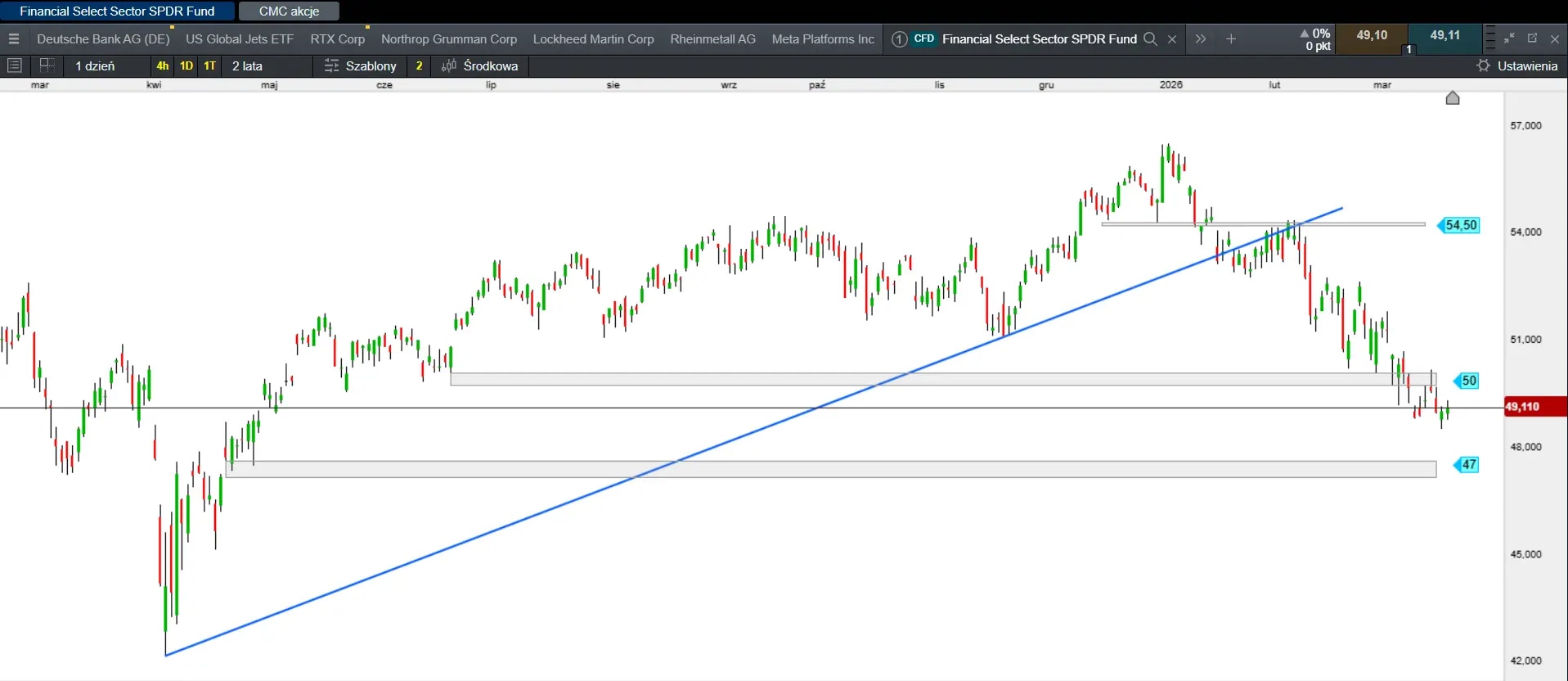
Concerning technical developments in the financial sector are drawing increased attention from market participants, as they may indicate the early stages of a wider equity market pullback. The sector, including the State Street Financial Select Sector ETF, has begun to lose ground relative to its highs from early 2026, signalling a deterioration in relative strength. Although its correlation with the S&P 500 index has remained elevated over the past three years, this relationship is now weakening, which analysts view as a potential warning for the broader market. As the second largest sector within the S&P 500, its performance remains a critical barometer for overall market direction.
Source: own study, as of 23 May.
Breakdown in trend and rising risks
Experts such as Frank Cappelleri of CappThesis point to a break in trend following a move below key support levels. The first warning signal was the breach of the short term upward trendline in February, with the situation deteriorating further as the fund fell below its 200-day moving average. Such price behaviour suggests that the recent bull run is losing momentum, while a downward trend is beginning to dominate.
An additional risk factor is the build-up of tensions in private credit markets and uncertainty around banks’ exposure to this area. Mike O’Rourke of JonesTrading emphasises that banking is built on trust, and the risk of contagion to other sectors means the industry should currently be approached with caution.
Deteriorating breadth and market implications
The technical picture is further weakened by the fact that the financial sector’s underperformance is spreading across a broader group of institutions, suggesting that downside risks may not yet be fully realised. Technical indicators, such as the number of stocks hitting new lows relative to those at highs, are sending signals typically seen ahead of deeper market downturns.
If the financial sector fails to stabilise quickly and move back above key technical levels, selling pressure may extend into other parts of the economy. Until either a meaningful correction resets valuations or clear signs of stabilisation emerge, the sector remains an area of elevated risk, with its current behaviour acting as a negative signal for the broader bull market.
Summary of the session in Europe and the US
Last week on European markets was dominated by concerns over energy security and, consequently, fears of rising inflation and slowing economic growth. Investors began pricing in interest rate hikes by the European Central Bank (ECB) and the Bank of England (BoE), which was reflected in yesterday’s session. The key question is whether investors have come to terms with the prospect of a deeper correction and whether bullish sentiment will return to trading floors. All major indices declined, from 1.14% (IBEX 35) to 2.01% (DAX).
Sentiment on Wall Street also remains fragile. Yesterday’s session once again ended in negative territory. The Dow Jones fell by 0.66%, the S&P 500 declined by 1.51%, and the Nasdaq 100 closed down 2.01%.
Asia starts the week lower
Asian markets opened the week in bearish mood, with sizeable declines dominating trading. The prospect of rising inflation and the end of the low-interest rate environment is weighing on investors. The Nikkei 225 fell by 3.49%. Australia’s S&P/ASX 200 is down 0.74%, while South Korea’s KOSPI has dropped 6.37%. Other markets also recorded losses: Hong Kong (-3.72%), Shanghai (-3.31%), Sensex (-2.34%), Singapore (-2.22%). The Asia Dow index is down 3.63%.
Summary of the session on the Warsaw Stock Exchange (WSE)
The triple witching session played out in favour of sellers. Since Wednesday, upward momentum has weakened, while the broader global backdrop remains tense. Negative sentiment has spread across international markets, placing additional pressure on emerging markets. Rising US Treasury yields have intensified concerns over inflation, which in turn may lead to higher interest rates later in the year and consequently higher financing costs.
Sentiment has shifted sharply in recent weeks. On the exchange at Książęca Street, market conditions remain dynamic, with signs of a correction becoming more visible. Demand, which had previously supported gains, has been overtaken by supply. The deterioration in sentiment across major European markets and on Wall Street has reinforced this trend. The bearish view that optimism on the WSE is fading appears increasingly justified, while profit taking on long positions may further contribute to downside pressure.
The domestic market remains closely linked to global trends, and if negative sentiment persists internationally, a correction becomes more likely, particularly following recent strong gains. However, only a sustained move below the low from 4 December 2025 would pose a more significant risk and could open the way towards the 2,378-point level. The WIG20 opened higher but quickly turned lower. Mid-session trading saw a balance between buyers and sellers, with the index fluctuating around the reference level, before the final phase ended with sellers in control.
Turnover on the broad market reached 5.78bn PLN. The WIG fell by 1.07%. The blue-chip index declined by 0.87%. WIG20 futures dropped by 1.28%, closing at 3,236 points. Mid and small cap stocks also followed the broader trend, with the mWIG40 down 2.06% and the sWIG80 lower by 0.65%.

DAX sell-off accelerates – US ultimatum to Iran fuels escalation and weighs on equity markets
Geopolitical escalation linked to a US ultimatum to Iran has triggered a sharper decline in the DAX, as investors reduce risk exposure. Rising oil prices and inflation concerns are key transmission channels driving weakness in European equity markets.