Why people invest?
Lesson 2 of 5
If you have money sitting in cash and sense it is not working hard enough, you are already on the right track. You may be asking yourself if the time has come to start investing. The answer depends less on how much you have and more on what that money is for and when you will need it.
Most people invest because saving alone rarely keeps pace with inflation, and time plus compounding does much of the work on long-term goals. Investing suits money you will not need for years and are willing to see fluctuate. That is the general principle, but the reasoning behind it is worth understanding before you decide.
Investment returns are affected by fees/charges; savings rates can change and may be below inflation.
Why this matters
Cash in a savings account feels safe. The number on screen typically does not fall. But over years, the prices of the things you want to buy tend to rise. That quiet shift is inflation, and it means a fixed sum of cash buys less in the future than it does today. Cash is generally more stable day to day; some deposits may be protected by the FSCS up to limits, but inflation can still reduce purchasing power.
A saver with a goal 10 or 20 years away faces a real trade-off. Leave money in cash and accept that its purchasing power will likely shrink, or put it somewhere with the potential to grow, accepting that its value will move up and down along the way. The reasons to invest start here: not with excitement, but with the recognition that standing still can have a cost.
Time is the one advantage a beginner can use without trying to time the market. The earlier you start the clock, the longer compounding has to work. Wait too long and that advantage shrinks, regardless of how much you eventually contribute.
The idea in plain English
Investing means putting money into assets, such as shares, bonds or funds, that can grow in value over time. In exchange for that potential growth, you accept that the value can also fall. That is the core bargain.
As seen in the graph below, the return on your investment can vary over time, and depends on the investment product you opt for.
Saving is different. When you save, you prioritise safety and access. A savings account aims to protect your money and lets you reach it quickly, but the return is usually modest and may not keep up with rising prices.
If you are asking why invest at all, the simplest answer is that investing is designed for long-term growth, while saving is designed for short-term stability. Both have a role, and the better question is which job each part of your money needs to do.
The key points to understand
Saving and investing serve different purposes. Saving protects money you need soon. Investing works on money you can leave for years. Mixing them up, keeping long-term money in cash or investing money you might need next month creates problems that have nothing to do with markets.
Inflation is the quiet reason cash alone can fall short. When prices rise faster than your savings interest, the real value of your money shrinks even though the number stays the same. Over a long period, this erosion can be meaningful.
Compounding is why time matters more than timing. When your returns stay invested, they can themselves earn returns. The effect is small at first but strengthens the longer money is held. Starting early gives compounding room to work. Waiting for the perfect entry point often costs more in lost time than it saves in avoided dips.
Investing carries risk that saving mostly avoids. The value of investments can fall as well as rise, and you may get back less than you put in. This up-and-down movement is called volatility. Volatility is easier to live with when your time horizon is long enough to allow for recoveries after falls, but it can be a poor fit for money you cannot afford to see drop.
A simple example
Imagine two people, each setting aside the same amount every month for a goal 20 years away. One keeps the money in a cash savings account. The other invests it in a diversified fund.
Over two decades, the cash saver sees a steady but modest return. After accounting for inflation, the real growth is smaller than it looks. The money is there, but what it can buy has not increased by much.
The investor sees something different. Some years the value rises, some years it falls. The journey is not a straight line. But over 20 years, the returns that stayed invested had the chance to earn returns of their own. By the end, the invested pot may be higher than the cash pot, not because of any clever timing, but because compounding had more room to work.
This is not a guarantee. Markets can underperform, and some periods are worse than others. The principle is simply that a long holding period can give compounding time to have an effect. Diversification can reduce single-company risk, but funds can still fall in value.
How to use this in your next decision
One common approach is to think in ‘short-term’ and ‘long-term’ buckets. Short-term needs may include emergencies, upcoming purchases and anything you might need within the next few years. That money generally suits saving, where it is accessible and stable.
Long-term goals may include retirement, a future home deposit or other plans many years away. This is the money that has more capacity to tolerate volatility because it has time to recover from falls.
Once you have that split, ask yourself a practical fit question. Can you leave this money untouched for years, even if its value drops temporarily? If yes, investing may fit the goal. If no, saving may be the better home for now.
This is not a universal verdict. Your goals, your timeline (your time horizon) and how you would react to normal market swings all play a part. Framing it as a fit test, rather than a leap, makes the decision clearer.
This is general information, not personal financial advice.
Common mistakes
Treating investing and saving as an either-or choice. Most people use both. Saving handles the short term. Investing handles the long term. Choosing one and ignoring the other can leave gaps.
Expecting a straight line, then reacting to normal falls as if something has broken. Markets move; a drop in value becomes a realised loss if you sell while it’s down. Selling during a dip can turn a temporary fall into a permanent outcome. Nevertheless, the value can remain lower for long periods, and you could still end up with less than you invested.
Waiting for the perfect entry point. For most people, consistently timing markets is difficult; a long-term, regular approach is often used instead. Starting with a modest amount can be more effective than delaying for conditions that feel calmer.
Assuming investing is only for people with large sums. What often matters more is the time horizon and the ability to contribute regularly, even if the amounts are small.
Key takeaways
People invest mainly to grow money over the long term and to outpace inflation.
Saving suits money you need soon. Investing suits money you can leave for years.
One of the benefits of investing is that compounding can reward time held, so starting the clock can matter more than timing the market.
Investing means accepting volatility, and the value can fall as well as rise.
Whether you should invest depends on your goals, your time horizon and what you can leave untouched.
Frequently Asked Questions
It depends on when you need the money. Saving typically suits short-term needs and emergencies. Investing is designed for money you can leave untouched for many years. Many people use both, each doing a different job.
One reason is inflation. Cash can lose purchasing power over time as prices rise. Investing offers the potential for growth that may help offset that, though it comes with the risk that value can fall as well as rise.
When prices rise faster than the interest your savings earn, the real value of your money shrinks. The number in your account might stay the same or rise slowly, but it can buy less over time.
Investing is generally better suited to longer time horizons, because you may need time to ride out market falls and allow compounding to work. A shorter time horizon usually calls for more emphasis on access and stability, which is what saving is for.
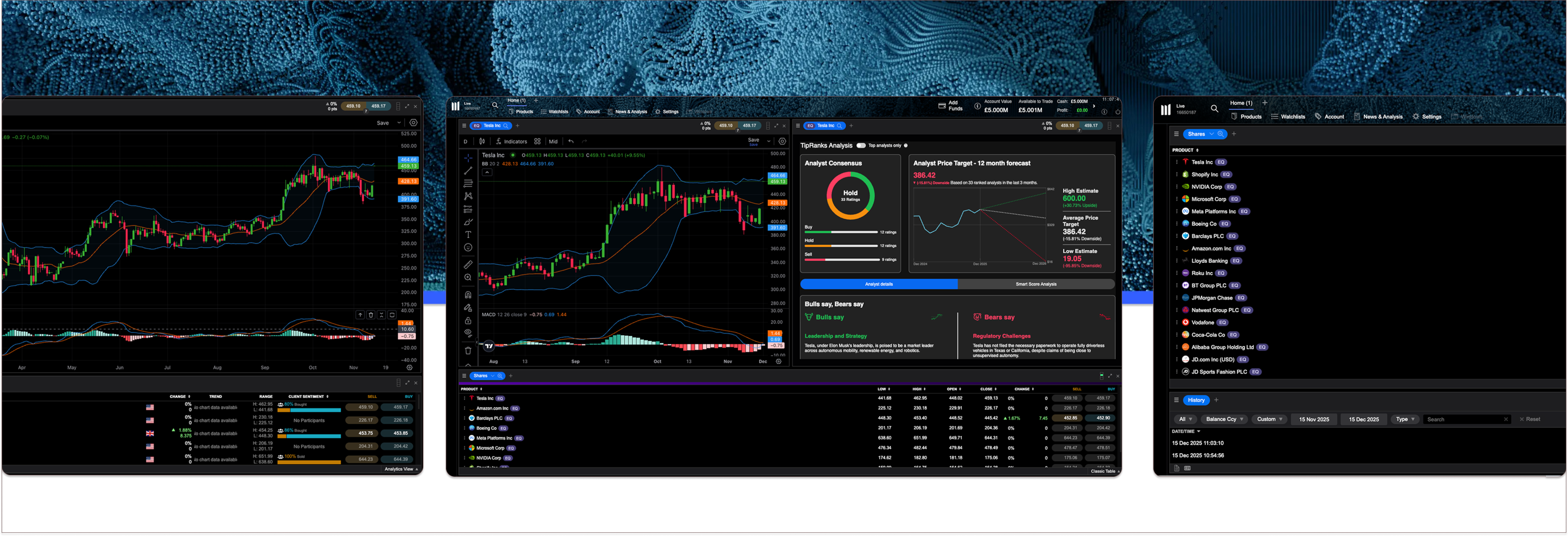

Ready to get started?
When you invest, your capital is at risk.
Any questions?
We're available whenever the markets are open, from Sunday night through to Friday night.