Forex Day Trading: Complete Strategy Guide for Canadian Traders
- :
- :
The appeal of forex day trading is quite straightforward. Not only can you leverage multiple opportunities in a single session, but you don’t have to hold positions overnight and you can potentially capitalize on intraday volatility when markets are active.
But it’s not a shortcut. Day trading forex takes patience and solid risk controls, plus the discipline to follow a plan even when a trade doesn’t go your way. We’ve put together this guide for forex day trading in Canada for traders who want structure. If you’re looking to understand how forex market timing (in EST), currency pair activity, and common day trading approaches work, this guide outlines key concepts you can explore in a demo before risking capital.
What is forex day trading?
Forex day trading is when you open and close trades on the same trading day – usually within a few hours – so you don’t carry positions through overnight market gaps. It’s a type of trading that may appeal to people who want a defined routine, want to focus on high-liquidity windows and can commit to at least 2–6 hours of active screen time during major sessions.
But how does it differ from other trading styles?
Swing trading: Holds positions for days to weeks, with the intention to capture larger moves
Scalping: Takes multiple trades per hour, usually targeting anywhere from 1–5 pips
Position trading: Holds trades for weeks to months. More focused on long-term macro trends than anything else
Some of the bigger characteristics of intraday forex trading include:
Timeframes used (1-minute, 5-minute, 15-minute, 1-hour charts).
Number of trades
Profit objectives are typically short-term and may focus on smaller price movements relative to longer-term strategies
Time commitment
No overnight exposure
No rollover fees/swap charges if positions are closed the same day. Be aware that there are holding costs if you hold past the session cut-off
Why day trade forex? Advantages and challenges
Day trading is popular because many FX markets are active across multiple sessions, and the ‘in and out’ nature can cut down overnight uncertainty. Still, factors such as leverage, liquidity, speed, etc., heighten the need for discipline.
Advantages of forex day trading
There are typically more opportunities in a shorter timeframe. Instead of waiting days for a setup, some traders find that there are more frequent setups during the London and New York sessions compared to longer-term styles. In other words, day traders generally aim to avoid exposure to unexpected moves caused by out-of-hours headlines, though this is not always guaranteed
Trading more frequently may provide more data points for evaluating what is and isn't working, though this does not guarantee improvement in outcomes
Majors may see higher liquidity during session overlaps, which could contribute to tighter spreads, though conditions vary
Flexible pair selections might allow traders to specialize in a few liquid pairs (e.g. USD/CAD, EUR/USD, GBP/USD) and grow to understand their characteristics over time
Challenges of forex day trading
Costs add up. Spreads and, if applicable, commissions and slippage matter more when you’re taking more trades
Time pressures with this type of trading can tempt you with impulsive entries, especially after a loss
More opportunities can result in more mistakes if you don’t cap your daily trades and create valid setups
Volatility can spike without any warning. Major data releases (CPI, rate decisions, jobs, etc.) can move markets fast and widen spreads
Leverage impacts outcomes. While margin can help with capital efficiency, it can also heighten your losses if sizing is too large
What you need to know before day trading forex
A few simple concepts matter more than most beginners realize. So, keep a strong focus on liquidity, volatility and trading volume.
Liquidity
FX is regarded as the world’s most liquid market, but liquidity still differs between pairs. The USD and CAD currency pair is generally more liquid than exotic pairs, for example. Liquidity tends to peak during the London session and the London–New York overlap, which is why many day traders concentrate their efforts into a few high-activity hours. But while overlaps can create higher activity and tighter spreads, there’s also the trade-off of greater volatility.
Volatility
Volatility is neither good nor bad. Instead, think of it like ‘fuel’. Too little movement can make it hard to achieve realistic intraday targets. Too much, on the other hand, can cause slippage and stop-outs. Many traders aim for controlled volatility conditions - enough movement to reach targets, but not so chaotic that price blows through your risk limits. If you’re trading majors, volatility will increase around scheduled releases (US CPI, Fed decisions) and in session overlaps.
Trading volume
As spot FX is decentralized, there isn’t a single exchange volume print like with equities. Instead, traders use proxies – think session timing, liquidity conditions, spreads and sometimes tick activity on charts. Some traders develop a sense of volume conditions through execution over time, including tighter spreads, cleaner moves, and less random noise. It’s just one reason why so many forex trading strategies focus on the same liquid windows each day instead of trying to trade 24/5.
Before you put your money at risk, make sure you understand leverage and margin on the specific pair you’re trading.
When is forex trading most active in Canada?
Forex is open 24 hours a day from Sunday evening to Friday evening, but not all hours are equal. Liquidity and volatility change by session, which has knock-on impacts for spreads, speed and how cleanly patterns might play out. The London session is 3:00 am to 12:00 pm (EST), so keep an eye out for the most active crossover period.
So, what are the most active trading hours for forex in Canada? For most active day traders, it’s usually one of these blocks:
London open to mid-morning (roughly 3:00 am–7:00 am EST):
Often associated with EUR/USD and GBP/USD for momentum and breakouts as European liquidity comes online
London–New York overlap (roughly 8:00 am–12:00 pm EST):
The highest liquidity window, with regular US data releases and strong moves in USD pairs. If you want activity and tighter pricing – with the caveat that volatility can spike on news
New York afternoon (roughly 12:00 pm–2:00 pm EST):
Some traders observe that this period may be associated with mean reversion or post-news setups as volatility cools
To help get you on your way, here are a few pair-specific notes for Canadian traders to keep an eye on:
USD/CAD: Most active during New York hours and the overlap because CAD responds to US data, oil narratives, etc.
EUR/USD: Most liquid during London and overlap
GBP/USD: Can move fast around UK data and during London open volatility
For a better breakdown, take a look at the forex market hours. You can also dig into forex majors, minors and exotics.
5 forex day trading strategies
It can be helpful to have a few forex day trading strategies in your arsenal, which you can test and refine.
1. The London open range breakout
Commonly applied to: EUR/USD, GBP/USD
Time window: First 30–60 minutes after London liquidity arrives (use EST times from the market hours page)
How traders commonly use the London open range breakout strategy:
Some traders begin by marking the opening range as a reference level (e.g. the high/low of the first 30 minutes)
Some traders watch for a candle close beyond the opening range and may look for a retest of that level before considering a position
Some traders place a stop on the other side of the range (or behind the retest swing)
2. Trend continuation pullback (15-minute structure)
Commonly applied to: EUR/USD, GBP/USD, sometimes USD/CAD
Time window: London–New York overlap (often the highest liquidity)
How traders commonly use the trend continuation pullback strategy:
Some traders identify the day’s direction from the timeframe
Some traders might use a value zone, like the 20/50 EMA area on the 15-minute chart
Traders often wait for the price to pull back into the zone and show a reversal cue (engulfing candle, higher low/lower high)
A stop is sometimes placed behind the swing point that invalidates the structure
Traders find it helpful to set a target prior, such as a swing high/low or a measured move
3. USD/CAD post-news ‘second move’ setup
Commonly applied to: USD/CAD
Time window: 8:30 am–10:30 am EST on major release days
How traders commonly use the USD/CAD post-news strategy:
Some traders choose to avoid the initial spike and allow the initial impulse to form before looking for an entry
Some traders then wait for a retracement to a clear level before considering a position
Some traders choose to move when the price reaccelerates in the direction of the post-news trend
Some traders stop beyond the retracement swing
4. Midday mean reversion (range and risk cap)
Commonly applied to: USD/CAD and EUR/USD during quieter stretches
Time window: After major releases, when spreads normalize and momentum cools
How traders commonly use the midday mean reversion strategy:
Traders often start by finding a clear intraday range
Some traders look to fade the extremes, but typically only after price has rejected the level on at least two occasions
Some traders stop just beyond the range boundary
Some traders use the mid-range as a target
5. USD strength filter across pairs
Commonly applied to: Combining EUR/USD, GBP/USD, USD/CAD
Time window: Overlap (8:00 am–12:00 pm EST)
How traders commonly use the USD strength filter across pairs:
Traders sometimes use EUR/USD and GBP/USD as a real-time read on USD strength - If EUR/USD and GBP/USD are both trending down strongly, USD strength is broad
Some traders interpret this as confirmation of broader USD strength
Traders often use a structure-based stop (below the breakout/retest level)
Some traders look to target a measured move or the next daily level
Is forex day trading profitable?
It can be, but profitability is never guaranteed – and as you can probably glean from the above strategies, it’s harder than it looks from the outside. The biggest misconception with currency pairs is that day trading is about finding the perfect entry. Some traders focus on factors such as
Consistent risk limits (small, repeatable losses).
Trading only liquid windows.
A small cache of well-tested setups.
Strong control over leverage and position size.
Be aware that CFDs come saddled with a high degree of risk and you should be prepared for the possibility of losing your entire investment – and potentially more. So if you’re serious about improving your forex trading, practice on a demo first and track your performance like a business would.
How to start day trading forex
Learn the fundamentals
Pick a few pairs and learn everything about them
Some beginners like to start with liquid majors to build familiarity. USD/CAD is one that Canadian traders sometimes gravitate towards, given its sensitivity to domestic and US economic data. EUR/USD and GBP/USD are also commonly traded during the London session.
Understand how leverage works
When it comes to leverage, margin rates can start at around 3.3% (equivalent to 30:1 leverage) for major pairs. Position sizing decisions are often made with consideration of how leverage magnifies both profits and losses on the full notional value of a position.
Build a daily routine around the best liquidity windows
Our forex market hours guide breaks down active sessions in EST - a useful reference for identifying windows where spreads and price movement conditions might be more aligned with a trader’s strategy.'
Past performance is not indicative of future results.
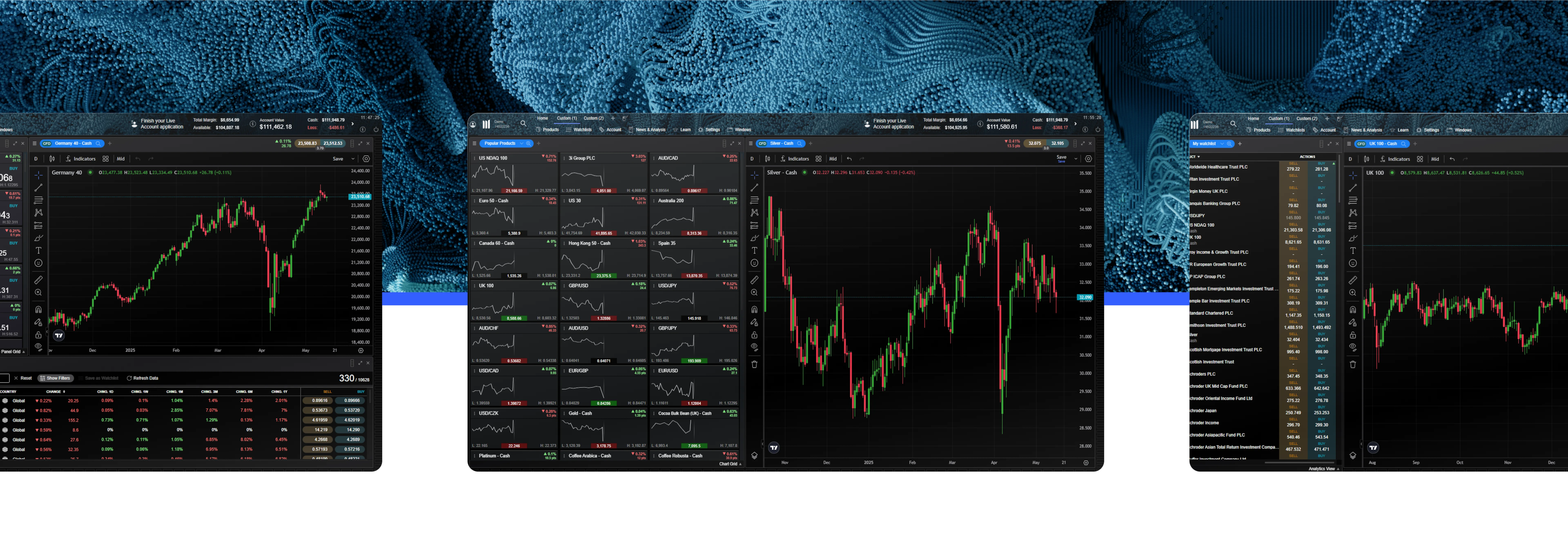
Practice your plan in a free demo
Our demo account includes $10,000 in virtual funds so you can practice execution and risk controls before going live with real money.
Go live small, measure, iterate, repeat
When transitioning from demo to live trading, some traders choose to begin with smaller position sizes. Tracking the following can help build a clearer picture of performance over time:
Set up quality
Risk per trade
Daily max loss
Whether you followed your own rules
Most people can learn the basics, but not everyone will enjoy active trading. It demands time during liquid sessions and a willingness to follow rules. Start with a demo to see if it fits your style of trading.
Yes, trading forex CFDs is legal through regulated providers where the product is offered. Always make sure you understand the product and the risks, as well as any eligibility rules that apply in your province.
Some of the biggest risks include leverage magnifying losses, volatility and gaps around news, slippage, overtrading and more. That’s why risk controls (position sizing, stops, daily loss limits) are so important.
Use our Knowledge Hub for free education and platform resources.
Disclaimer: CMC Markets is an execution-only service provider. The material (whether or not it states any opinions) is for general information purposes only, and does not take into account your personal circumstances or objectives. Nothing in this material is (or should be considered to be) financial, investment or other advice on which reliance should be placed. No opinion given in the material constitutes a recommendation by CMC Markets or the author that any particular investment, security, transaction or investment strategy is suitable for any specific person. The material has not been prepared in accordance with legal requirements designed to promote the independence of investment research. Although we are not specifically prevented from dealing before providing this material, we do not seek to take advantage of the material prior to its dissemination.

Open a demo account
Start trading with a live account today or try a demo with $10,000 of virtual funds.