The first publicly traded company to reach a valuation of one trillion dollars was tech giant Apple, in August 2018. It was also the first company to surpass the $2tn mark, in August 2020. Several more companies based in the US have since followed and surpassed a $1tn market cap.
Join 2 million+ global traders and investors
Discover why 2 million+ global traders and investors choose us.
← Swipe →
Company | Approx Market cap (USD) | Sector | Date achieved |
|---|
Nvidia | $4.6tn | Semiconductors | 13 June 2023 |
Apple | $4.0tn | Consumer electronics & Services | 2 August 2018 |
Microsoft | $3.8tn | Software & cloud services | 25 April 2019 |
Alphabet | $3.35tn | Software & cloud services | 16 Jan 2020 |
Amazon | $2.5tn | E-commerce & cloud | 2 September 2018 |
Broadcom | $1.6tn | Semiconductors & infrastructure Software | 12 Dec 2024 |
Saudi Aramco | $1.7tn | Energy/oil & gas | 11 Dec 2021 |
Meta Platforms | $1.55tn | Social media & ai ads | 28 June 2021 |
Taiwan Semiconductor Manufacturing Co | $1.5tn | Information technology | 19 July 2021 |
Tesla | $1.3tn | Electric vehicles | 25 Oct 2021 |
Berkshire Hathaway | $1.1tn | Finance | 8 Aug 2024 |
This data is taken from Yahoo Finance and is up to date as of 14 November 2025. Market capitalisations are approximate, rounded to the nearest $0.05 trillion, and subject to daily fluctuations. Past performance is not a reliable indicator of future results.
Nvidia has become the defining company of the AI era. Its graphics processing units (GPUs) power the world’s leading data centres, AI models, and autonomous driving platforms. The company’s dominance in high-performance computing made it the first to briefly exceed a $5 trillion valuation in mid-2025, overtaking Apple and Microsoft. Nvidia’s story marks the shift from consumer tech to infrastructure as the foundation of modern innovation.
Microsoft’s cloud platform Azure and its integration of AI across Office, Windows, and enterprise services have made it one of the most diversified tech giants. The company passed $1 trillion in 2019, capitalising on early cloud adoption and enterprise demand. Its investments in OpenAI and Copilot-powered software reinforce its role at the heart of business digitalisation.
As the first publicly listed company to surpass the $1tn mark in August 2018, Apple still remains a cornerstone of the global economy. Beyond iPhones and Macs, its services ecosystem includes Apple Pay, iCloud, and the App Store, which generates steady recurring revenue.
Apple continues to innovate through mixed-reality products, wearables, and its expanding AI ecosystem. Its blend of hardware, software, and brand loyalty keeps it a long-term market leader.
Microsoft’s cloud platform Azure and its integration of AI across Office, Windows, and enterprise services have made it one of the most diversified tech giants. The company passed $1 trillion in 2019, capitalising on early cloud adoption and enterprise demand.
Microsoft's investments in OpenAI and Copilot-powered software reinforce its role at the heart of business.
The parent company of the world’s most popular search engine by visitors, Google, made it into the trillion-dollar club at the start of 2020. Alphabet combines revenue from search, advertising, cloud, and AI innovation under one umbrella.
Alphabet continues to lead in digital advertising and cloud infrastructure while advancing generative AI through Gemin i and DeepMind. It’s a reminder that data and how it’s organised remain among the most valuable assets in the digital age.
Despite being founded in 1994 as an online bookstore, Amazon is now an e-commerce leader, a cloud powerhouse, and a player in the streaming and artificial intelligence (AI) industries, enabling the company to reach record highs.
Amazon crossed the $1 trillion mark in 2018. Amazon Web Services (AWS) is still its profit engine, while logistics automation, AI-driven retail, and advertising are driving new growth. The company’s continued expansion into healthcare, entertainment, and smart homes underscores its unmatched reach into everyday life.
Broadcom became a trillion-dollar company in December 2024, propelled by its critical role in AI networking chips and data-centre infrastructure. The successful integration of VMware expanded its software footprint, makes Broadcom one of the few semiconductor firms with both hardware and enterprise software revenue streams.
It exemplifies how the AI boom benefits not just chip designers but the broader connectivity ecosystem.
Saudi Aramco remains the world’s largest oil producer and one of the few non-tech members of the trillion-dollar club. Following its record-breaking IPO in 2019, Aramco’s valuation surged above $2 trillion during high oil-price periods.
While facing long-term decarbonisation pressures, it continues to deliver vast cash flows and fund Saudi Arabia’s economic diversification efforts.
Meta, formerly Facebook, joined the trillion-dollar ranks in 2021 thanks to its dominance in social media and digital advertising. After a sharp drop in 2022, it regained its status in 2024 as AI-powered ad tools and cost discipline boosted profits.
Meta’s long-term plans focus on being a frontrunner in virtual and mixed-reality platforms, including Horizon and Quest, keeping it central to the discussion about the future of online interaction.
TSMC reached $1 trillion in 2024, cementing its role as one of the world’s most important semiconductor foundry. It manufactures the advanced chips used by Apple, Nvidia, and nearly every AI hardware firm.
The company’s strategic position at the heart of global supply chains makes it essential to both technology and geopolitics.
Electric car giant Tesla became the sixth official US company and first automaker to join the trillion-dollar club on 25 October 2021, driven by the global transition to electric vehicles
Tesla’s valuation was boosted in October 2021 by an order for 100,000 vehicles by car rental company Hertz, skyrocketing the EV’s share price by almost 13% to reach a milestone $1tn market cap.
After volatility in 2023-24, it regained momentum through AI-driven autonomous systems and energy storage. Tesla now positions itself as both an EV leader and a software-powered energy company.
Warren Buffett’s Berkshire Hathaway joined the club in August 2024, becoming the first diversified conglomerate to exceed $1 trillion. Its portfolio spans insurance, energy, railroads, and major equity stakes in companies like Apple and Coca-Cola.
Berkshire represents a different kind of success story through long-term value compounding rather than high-growth tech.
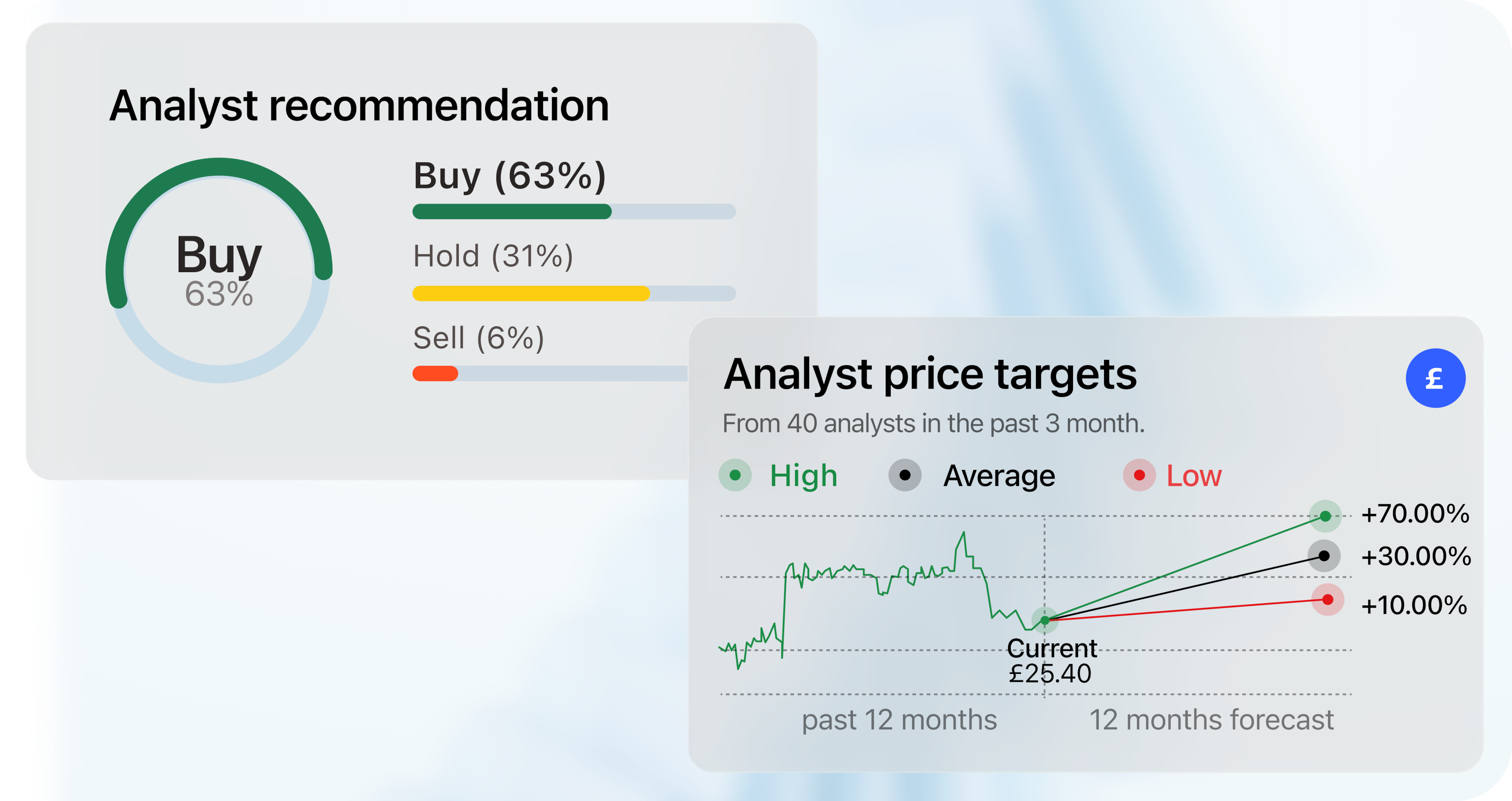
See where analysts think a share is heading
See what analysts expect from a share before you buy or sell: consensus ratings, 12-month price targets, and the bull and bear case side by side.
Open a live account to spread bet or trade CFDs on these stocks, and to gain access to our Morningstar equity reports and live Reuters newsfeed.
Decide which product you want to trade: view our spread betting versus CFD trading article for more information.
Place a buy or sell order to open a long or short position, based on your analysis and trading strategy.
Add risk-management controls, such as a stop-loss order, which can help close you out of a trade when your position moves against you.
You can also trade on a group of stocks through our bespoke share baskets. For example, our Big Tech share basket offers exposure to 20 major US tech stocks, including Alphabet, Apple, Nvidia and Microsoft, from a single position. Share baskets have lower holding costs and no commission charges (other trading costs may apply).
There are several companies that could join the trillion-dollar club in the future, with growing market capitalisations and annual revenues. We've highlighted a few companies below that have demonstrated substantial growth year-on-year.
← Swipe →
Company | Approx market cap (USD) | Sector | Key Growth Drivers |
|---|
Eli Lily (LLY) | $974bn | Healthcare | A leader in GLP-1 weight-loss and diabetes treatments (Mounjaro/Zepbound). Strong demand, new oral formulations in development, and expanding insurance coverage make it the closest to $1tn. |
JPMorgan Chase (JPM) | $830bn | Finance | The largest US bank, with diversified earnings from consumer, corporate, and investment banking. Benefits from higher interest income, digital transformation, and AI-driven risk management. |
Visa (V) | $640bn | Finance | Global payments leader positioned for long-term gains from the shift to digital and cross-border transactions. Growth in embedded finance and fintech partnerships could accelerate revenue. |
Oracle (ORCL) | $620bn | Information Technology | Strong demand for Oracle cloud infrastructure (OCI) as enterprises adopt AI workloads. Ongoing AI-data-centre expansion could lift margins and valuation toward the trillion-dollar mark. |
Looking at all of the companies mentioned in this article, technological advancement and AI is a common factor in the growth rate of many of these stocks. They include software and services, and the manufacture of semiconductors, hardware, and equipment.
Given the emphasis in modern society on technology development, this doesn’t come as a great surprise. As the table above shows, Eli Lily, Visa, and JP Morgan Chase represent alternative sectors that may be next in line to achieve trillion-dollar valuations.