

USD/JPY compresses below resistance
USD/JPY appears to be gearing up for a significant move. The currency pair has established firm resistance around 162.5 and has recorded a series of higher lows since 3 July.
That leaves the pair compressing into an increasingly tight range, forming either a symmetrical triangle or an ascending triangle. Both patterns are often treated as continuation patterns, suggesting that USD/JPY could break out and move significantly higher if resistance gives way. A failure, however, could send the pair back towards 160, and potentially lower.
Momentum signals are mixed but improving
Longer-term upward momentum appears to be strengthening, with the relative strength index forming a series of higher lows since the end of January. In the shorter term, however, USD/JPY has remained below resistance for several weeks, while its RSI has begun to trend lower.
That makes the current compression important. The longer-term momentum backdrop still points higher, but the pair needs to resolve the short-term stall before the bullish setup can be confirmed.
USD/JPY daily chart
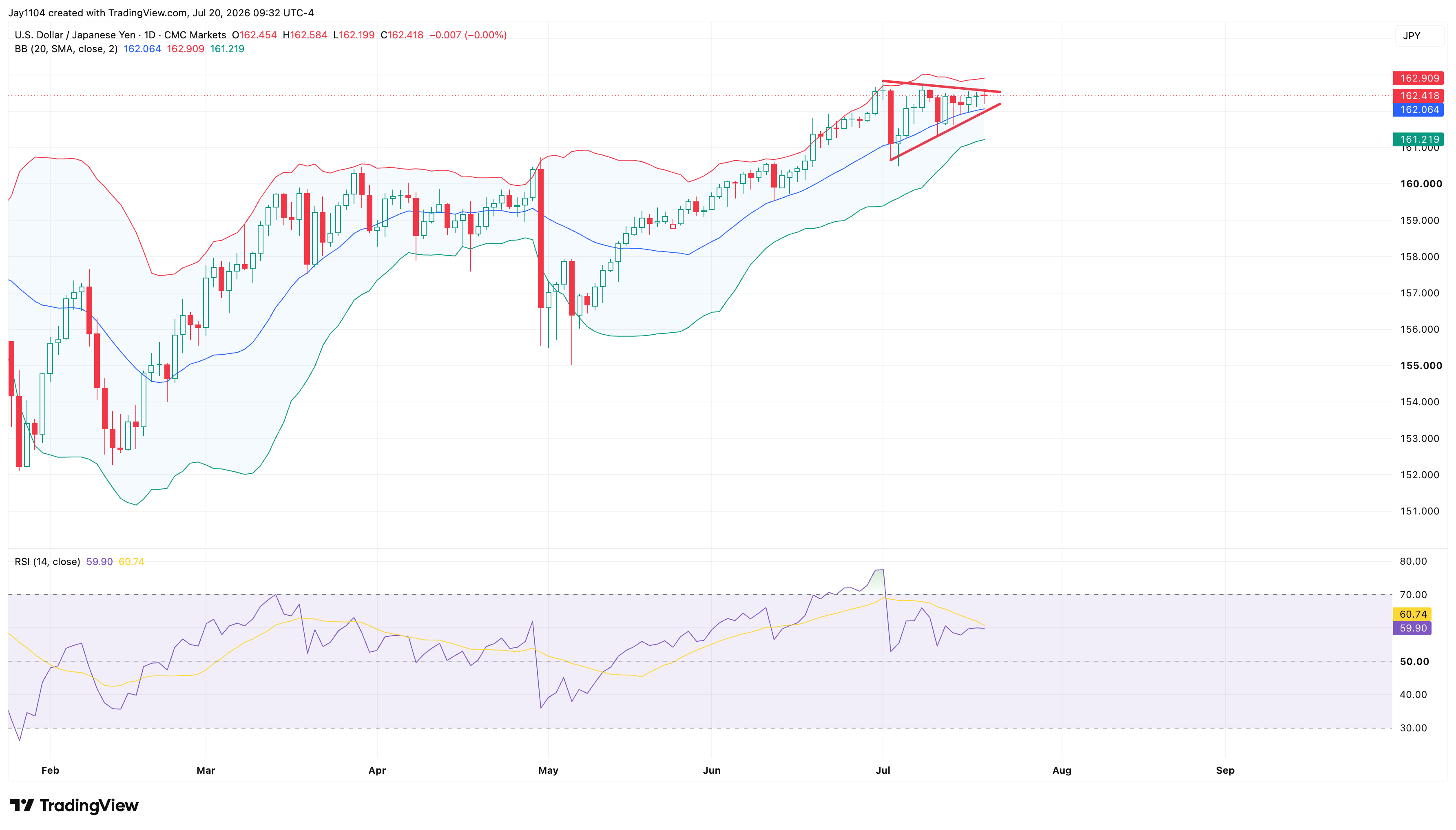
USD/JPY, daily. Sources: TradingView, Michael J Kramer.
The 20-day moving average remains the key support
The 20-day moving average has provided firm support, and the pair has remained above that level since mid-May. That makes it an important dividing line for the near-term technical picture.
As long as USD/JPY holds above the 20-day moving average, there remains scope for the pair to break above resistance and move towards the upper Bollinger Band around 163. A break below the 20-day moving average would be a clear negative signal, potentially indicating that momentum has shifted in favour of the Japanese yen.
A break above 162.5 could open the way towards 164-165
The immediate upside trigger is a move through resistance around 162.5. If USD/JPY can clear that level while staying above the 20-day moving average, the next area to watch is the 164-165 region.
Failure to break higher would leave the pair vulnerable to a reversal from the top of its range. In that scenario, a move back towards 160 would become the first important downside test.