2026 Energy Outlook: Energy at the Heart of the AI Revolution

Fraser Allan
Head of Premium Client Management, ANZ
9 minute read
|9 Dec 2025
Blue power lines
Table of contents
  • 1.
    2025 Review: Utility Unpreparedness, Big Tech Partnerships and Trump’s Policies
  • 2.
    2026 Outlook: AI and Energy Couple as Bottlenecks Emerge
  • 3.
    2026 Watchlist: Energy Stocks and ETFs to Monitor 
  • 4.
    Conclusion 

Key Takeaways: 

  1. President Donald Trump’s administration has designated nuclear power deployment as a matter of national security. In contrast, clean energy is losing political favour, with several renewable tax credits rolled back. 

  1. An offshoot of the electricity demand boom is a deepening shortage of gas turbines used in natural gas power plants. Related companies have seen their stocks surge in 2025. 

  1. Price-cap and other reforms, surging consumer electricity prices, AI efficiency breakthroughs and project attrition are key risks to the AI energy story.

After decades of slow and predictable growth, the energy sector is undergoing a dramatic shift brought on by the advent of artificial intelligence (AI) technology. The sector enters 2026 as a key enabler of the AI revolution.

The new year will likely see power-hungry AI data centres continue to reshape electricity prices, push ageing grids to their limits, influence clean energy markets and breathe life into the once-neglected nuclear energy sector. 

Amid this disruption could emerge both challenges and opportunities across the energy landscape. The key will be identifying which segments of the market may be best positioned to adapt to this generational realignment. 

2025 Review: Utility Unpreparedness, Big Tech Partnerships and Trump’s Policies

Three themes defined the energy sector story in 2025: demand shock, public policies and power deals. 

According to the US Energy Information Administration, domestic electricity consumption was “essentially flat” for nearly two decades as efficiency improvements offset increases associated with population growth. While the electrification of cars propped up power demand, the recent demand from AI data centres is unprecedented. 

In the US, analysts predict that power requirements from AI data centres will result in the biggest surge in energy demand since air conditioning gained popularity in the 1960s. Each ChatGPT query, for instance, consumes roughly 10 times more energy than a standard internet search.

US Electricity

Yet despite the current or projected boom in demand, the utilities sector has struggled to translate that momentum into outperformance in 2025. Ageing grid infrastructure, limited generation capacity and long lead times for new projects have continued to constrain the sector. In the US, utilities have performed roughly in line with the S&P 500 this year, with the Utilities Select Sector SPDR Fund (XLU), which holds leading names such as NextEra, Constellation and Vistra, rising 16% in the year to 2 December.

While utilities tracked the broader market, nuclear stocks outperformed thanks to supportive policy shifts. President Donald Trump’s administration has designated nuclear power as a matter of national security, channelling significant funding into the sector. It has introduced new tax credits, backed small modular reactor (SMR) innovation and recommissioned shuttered plants. In contrast, clean energy has lost political favour, with several renewable tax credits rolled back.

Oklo [OKLO] has soared around 300% in the year to date (at one point 700% YTD) after signing deals with the US Government to build nuclear reactors and fuel lines. Meanwhile, uranium supplier Centrus Energy’s [LEU] share price has risen more than 200% year to date on the back of the US Government’s push for nuclear energy dominance.

Meanwhile, big tech’s energy partnerships are reshaping power markets. Companies like Alphabet [GOOGL], Amazon [AMZN], Microsoft [MSFT] and Meta [META] have signed decade-long power purchase agreements with nuclear, solar, wind and hydro providers to secure clean, low-carbon electricity for their data centres.

Alphabet’s $3bn deal with Brookfield Asset Management [BAM] to source up to 3GW of US hydropower marked the world’s largest corporate clean-power contract. Meta’s agreement with Constellation Energy [CEG] to keep a nuclear reactor in Illinois operating for another 20 years was also a first-of-its-kind. 

The underperformance of the oil- and gas-focused Energy Select Sector SPDR Fund [XLE] (up 5% year to date) against the iShares Global Clean Energy ETF [ICLN] (up 43% year to date) and VanEck Uranium and Nuclear ETF [NLR] (up 50% year to date) suggested a preference for clean energy assets over traditional fossil fuels among investors in 2025. 

2026 Outlook: AI and Energy Couple as Bottlenecks Emerge

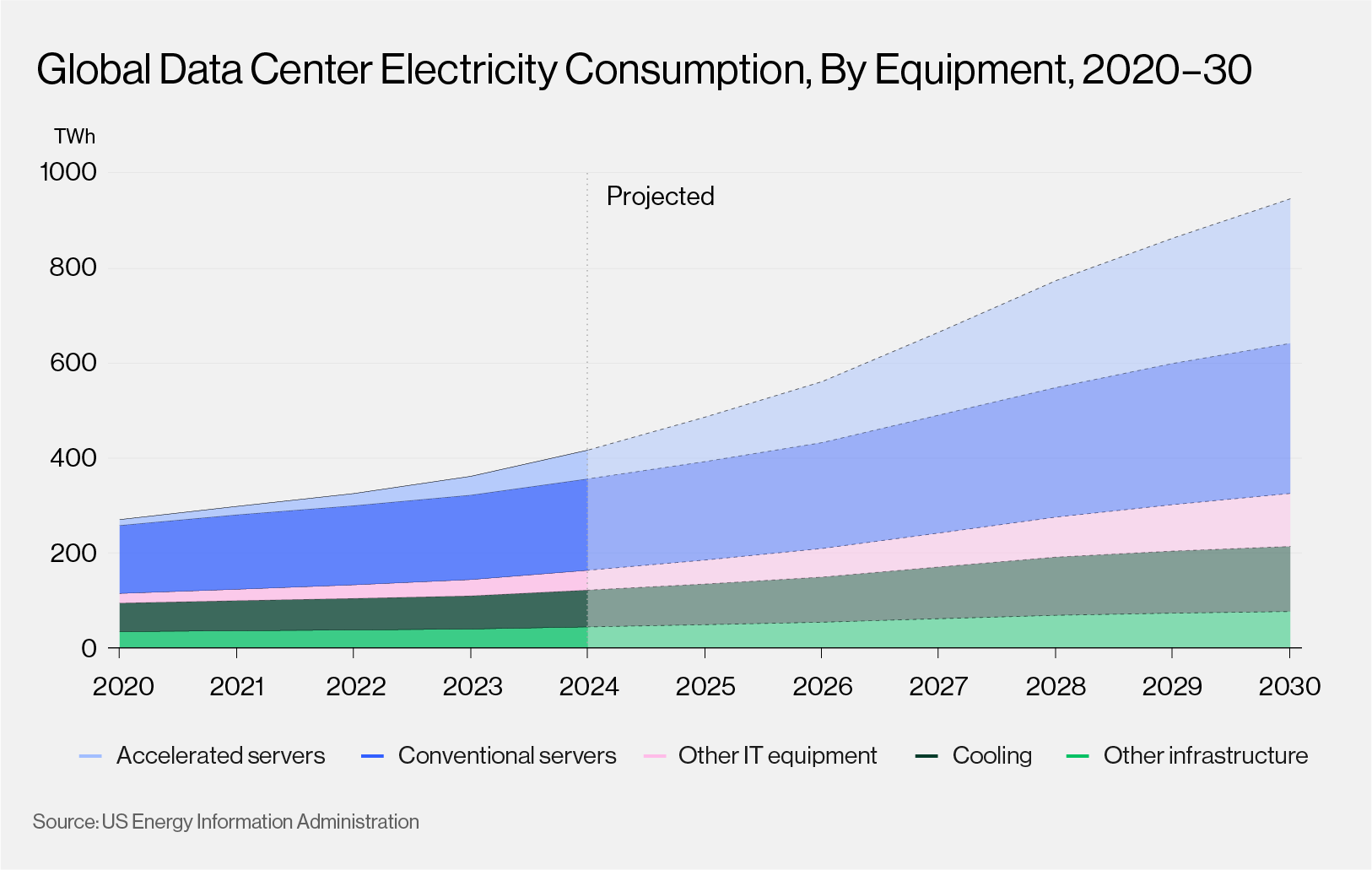
Global electricity demand is forecast to grow by 3.7% in 2026, described by the International Energy Agency (IEA) as among “some of the highest growth rates observed over the last decade”.

Energy and AI appear on track to remain closely linked through 2026 and beyond, with the IEA expecting electricity consumption from AI-driven servers to grow about 30% per year from 2024 to 2030 under its base-case scenario. 

As the agency put it: “There is no AI without energy; at the same time, AI has the potential to transform the energy sector.”
Global Data Centre Electrical Consumption, By Equipment 2020-2030

As we noted in our 2026 AI Outlook, the AI boom has the potential to continue well into next year. Multi-trillion-dollar investment plans announced by leading tech companies could continue to drive massive infrastructure spending, with a growing share directed toward energy, now viewed as the key bottleneck in AI’s expansion. 

Clean energy remains a clear path for hyperscalers and investors aiming for carbon neutrality. Given the backlash faced by bitcoin mining, an energy-intensive process that almost saw it banned in the EU in 2022, demand for low-carbon power seems likely to remain strong in 2026 despite the termination of clean energy tax credits in the US.

Green Power 1

An offshoot of the electricity demand boom is a deepening shortage of gas turbines, which are a critical component in natural gas power plants.

According to ING, natural gas has emerged as a “favoured generation source” to power AI growth thanks to its low cost and ability to provide uninterrupted electricity. Yet, more than $400bn worth of planned gas-fired power plants face delays or cancellations, reported Bloomberg, due to limited turbine supply. 

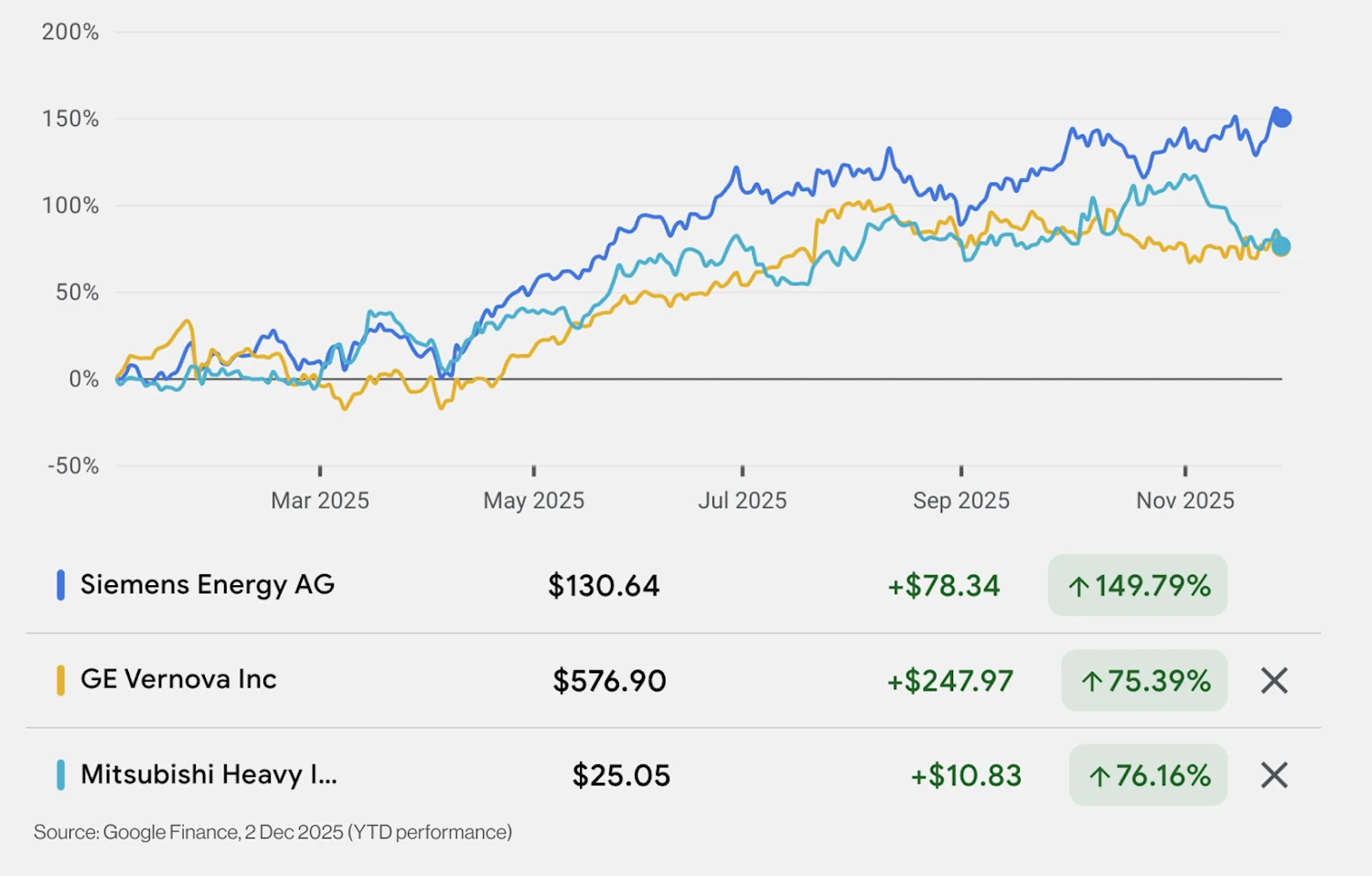
The bottleneck stems from the fact that three companies, Siemens Energy [SMNEY], GE Vernova [GEV] and Mitsubishi Heavy Industries [MHVYF], manufacture 70% of the large-scale utility turbines output. Each is struggling to ramp up production amid long development cycles and highly specialised engineering requirements. 

These firms remain central to the broader energy story heading into 2026, after exceptional share-price gains in 2025. Siemens Energy AG surged 131% year to date, GE Vernova rose 75.1% and Mitsubishi Heavy Industries jumped 106.2% in the year so far. 

Energy Stock Comparison Google Finance 2.12.2025

Those bottlenecks are also pushing data-centre operators to consider on-site nuclear solutions and sites adjacent to existing reactors. SMRs have become the centrepiece of long-term planning for 24/7 clean energy. 

AI companies have announced feasibility studies and partnerships with SMR developers such as Oklo and NuScale Power [SMR], but none are expected to be fully operational in 2026. Experts project the first commercial SMR plants will begin operating at the end of this decade. 

“The projected higher contribution of nuclear to the US power mix remains a medium- to long-term story. Now, all the additional nuclear capacity expected to become available in the next year or two will be from restarts of idle traditional plants. No SMR plants are running in the US today,” wrote Coco Zhang, ESG research analyst at ING, in a recent note. 

Until then, more retired coal and gas plants are likely to be repurposed into “energy parks” for data-centre operations, taking advantage of existing grid links and water access. Energy companies with large fossil-fuel assets could see renewed profits from AI-driven power demand in 2026. 

Source: Oklo Inc, YouTube

Several risks shadow this outlook. Efficiency breakthroughs in AI could reduce power consumption faster than anticipated. New architectures may lower computing energy, potentially undermining bullish demand forecasts. Additionally, the sector faces significant volatility as investors continue to weigh the AI narrative against real-world computing and energy demands. 

If such improvements arrive just as utilities and developers ramp up capital expenditure, the result could be costly overcapacity. 

Policy risk is another concern. In 2025, parts of the US experienced unprecedented electricity-price spikes that triggered public outrage and price-cap reforms. Regulatory intervention may intensify in 2026, affecting profitability for generators and utilities. 

Project attrition is also emerging as a theme. Some hyperscalers are pausing or cancelling power deals amid rising costs and permitting hurdles. Microsoft, for example, reportedly shelved data-centre projects totalling about 2GW of planned load across the US and Europe earlier in 2025. 

The energy map entering 2026 is one of tension and opportunity. Demand from AI and electrification is colliding with an outdated grid and policy bottlenecks. 

Clean power remains the goal, natural gas the “bridge” and nuclear the long-term promise. But just as limited electricity capacity continues to hold back data-centre expansion, energy growth itself is constrained by infrastructure bottlenecks. 

2026 Watchlist: Energy Stocks and ETFs to Monitor 

Asset / Ticker 

Type 

Why We’re Watching 

GE Vernova [GEV] 

Stock 

Energy equipment manufacturing and services company with exposure to gas turbines, grid hardware and electrification infrastructure.

Oklo [OKLO] 

Stock 

Backed by US government contracts to deploy small modular reactors.

NextEra Energy [NEE] 

Stock 

The world’s largest electric utility holding company by market capitalisation.

Constellation Energy Corporation [CEG] 

Stock 

The nation’s largest producer of carbon-free energy with the biggest US nuclear fleet of 21 reactors across 12 sites. 

Cameco Corporation [CCJ] 

Stock 

One of the world’s largest uranium producers. 

Paladin Energy [PDN] 

Stock 

Australian mining company with a focus on supplying uranium for nuclear energy.

Origin Energy [ORG] 

Stock 

Australian energy firm with a significant clean energy portfolio spanning natural gas, wind, solar and hydro. 

Energy Select Sector SPDR Fund [XLE] 

ETF 

Offers broad exposure to traditional oil and gas supermajors. 

First Trust Nasdaq Clean Edge Smart GRID Infrastructure Index Fund [GRID] 

ETF 

Focuses on grid modernisation and electrification. 

VanEck Uranium and Nuclear ETF [NLR] 

ETF 

Tracks global nuclear energy and uranium miners. 

Conclusion 

Readers will have noticed that we chose not to focus on a traditional oil and gas outlook for 2026, as market conditions for fossil fuels will most likely hinge on geopolitical events such as the Russia-Ukraine war and Organization of the Petroleum Exporting Countries supply decisions. 

The real story lies elsewhere. AI has disrupted the energy landscape, pulling investors back into a sector once seen as mature and slow-moving. The energy narrative of 2026 is unlike anything before. 

While Wall Street waits for AI investments to yield profits, the energy sector is already benefitting, supplying the power and infrastructure that make the revolution possible. In the next article, we’ll explore how AI is reshaping the physical world through automation and robotics. 

Series Overview 

Furious Five: CMC’s 2026 Outlook 

Five forces. One furious charge into 2026.

CMC’s Furious Five series examines five pivotal themes that defined 2025, how far these powerful forces could extend through the year ahead, and what might stand in their way.

Explore our market outlook across AI, Energy, Robotics, Defence, and Debasement to see where the next wave of momentum and disruption could emerge in 2026.

  • 2026 AI Outlook

    AI spending is set to surge in 2026 as compute shortages fuel massive infrastructure investment. Will agentic AI breakthroughs justify the hype or are we headed for an AI bubble? Explore key risks and opportunities.

    Read more
  • 2026 Robotics Outlook

    2026 marks a pivotal year as Tesla, Waymo, Baidu, and XPeng scale their robotaxi and humanoid robot ambitions. Which strategy will win the automation race?

    Read more
  • 2026 Defence Outlook

    Palantir leads a new era of software-driven defence as the US overhauls military procurement and AI reshapes cyber warfare. Will legacy primes adapt or fall behind?

    Read more
  • 2026 Debasement Outlook

    Gold and Bitcoin hit all-time highs in 2025, reigniting fears of currency debasement amid rising debt, shifting Fed policy, and global reserve changes. What’s next for 2026?

    Read more

Disclaimer: This article provides general information only. It has been prepared without taking account of your objectives, financial situation or needs. It is not to be construed as a solicitation or an offer to buy or sell any financial instruments, or as a recommendation and/or investment advice. It does not intend to support an investment decision and it should not be relied upon by you in evaluating the merits of investing in any financial instruments. You should consider your objectives, financial situation and needs before acting on the information in this article. CMC Markets believes that the information in this article is correct, and any opinions and conclusions are reasonably held or made on information available at the time of its compilation, but no representation or warranty is made as to the accuracy, reliability or completeness of any statements made in this article. CMC Markets is under no obligation to, and does not, update or keep current the information contained in this article. Neither CMC Markets nor any of its affiliates or subsidiaries accepts liability for loss or damage arising out of the use of all or any part of this article. Any opinions or conclusions set forth in this article are subject to change without notice and may differ or be contrary to the opinions or conclusions expressed by any other members of CMC Markets.