• Analysis
  • Market outlook
  • 2026 AI Outlook: Soaring AI Spend Amid Compute Constraints, Agentic Breakthroughs and Bubble Risks

2026 AI Outlook: Soaring AI Spend Amid Compute Constraints, Agentic Breakthroughs and Bubble Risks

Kurt Mayell
Head of Distribution, ANZ
11 minute read
|9 Dec 2025
 Nvidia CEO Jensen Huang delivers the keynote address at the GTC AI Conference
Table of contents
  • 1.
    2025 Review: The Year of AI Mega-Deals and the “OpenAI Trade” 
  • 2.
    2026 Outlook: Agentic AI, Application Verticalisation Amid Bubble Concerns 
  • 3.
    2026 Watchlist: AI Ecosystem Stocks and ETFs to Monitor
  • 4.
    Conclusion 

Key Takeaways: 

  • With compute supply strained, AI companies are expected to continue their capital expenditure spree in 2026 to build new data centres, which could benefit chipmakers and ancillary firms. 

  • The focus is shifting from generative AI to agentic AI. These autonomous agents are said to require up to 100x more compute per task. 

  • Sky-high spending and inflated AI valuations have sparked warnings about an AI bubble. Weak adoption and the emergence of more efficient AI models could trigger a market correction. 

The artificial intelligence (AI) revolution is reshaping the global economy.  

In 2025, OpenAI’s mega-deals with big tech ignited a trillion-dollar rally across markets, making AI the defining investment theme of the year. As capital expenditure soars and compute supply tightens, 2026 will test whether this momentum can translate into lasting productivity gains. 

For investors and traders, the next phase of AI could be shaped by two key forces: the rise of agentic, industry-specific applications, and growing concerns that AI is a gigantic bubble, one which is ready to pop.

2025 Review: The Year of AI Mega-Deals and the “OpenAI Trade” 

This year OpenAI turned everything it touched to gold. The ChatGPT creator signed multi-billion-dollar deals with major US tech companies, including Microsoft [MSFT], Advanced Micro Devices [AMD] and Broadcom [AVGO], sending their stock prices soaring each time. 

Microsoft’s market cap surged to over $4trn in late October after OpenAI committed to purchase $250bn in additional cloud services. The same announcement introduced a new for-profit entity, OpenAI Group PBC, in which Microsoft holds a 27% stake. 

Oracle [ORCL] also joined the OpenAI frenzy, partnering through the Stargate Project, a joint effort to invest over $500bn in US AI infrastructure.  

On September 10, ORCL shares hit an all-time high of $345.72, jumping 35% in one session on reports of a $300bn cloud-computing contract with OpenAI. 

Chipmakers AMD and Broadcom signed their own OpenAI deals in October. As of the December 1 close, AMD stock was up 82% year-to-date and AVGO was up 66%. Both companies have outperformed rival Nvidia [NVDA], which was up 30% year-to-date over the same period.

In early October, OpenAI took a stake in AMD and agreed to deploy 6 GW of AMD’s graphics processing unit (GPU) chips in its upcoming data centres.  

Meanwhile, the OpenAI-Broadcom deal saw the two companies collaborate on developing custom AI chips, with a commitment to deploy 10 GW worth of capacity. 

AI frontrunner Nvidia signed a deal of its own with OpenAI to deploy at least 10 GW of its GPU chips in the latter’s upcoming data centres. Nvidia also said that it intends to invest up to $100bn in OpenAI. 

OpenAI’s Busy 2025 

Date 

Partner 

Deal details  

January 21, 2025 

SoftBank, Oracle, MGX, Arm, Microsoft, Nvidia 

$500bn to be invested over the next four years to build new AI infrastructure for OpenAI in the US 

July 22, 2025 

Oracle 

Oracle to develop 4.5 GW in a partnership worth over $300bn over next five years 

September 22, 2025 

Nvidia 

Partnership to deploy 10 GW of Nvidia's chips 

October 6, 2025 

Advanced Micro Devices 

Takes stake in AMD and commits to deploy 6 GW of AMD's GPU 

October 13, 2025 

Broadcom 

Collaboration for 10 GW of custom AI accelerators 

October 28, 2025 

Microsoft 

Agrees to purchase an incremental $250bn of Azure services 

Soaring expectations that AI will transform every aspect of human life fuelled a powerful rally in AI stocks throughout the year, highlighted by Nvidia’s historic milestone on October 29 as it became the first company to reach a $5trn market value. 

The AI wave has also revived interest in fallen tech giants such as Intel [INTC].  

The INTC share price is up about 100% in the year to date after the US government bought a stake worth $8.9bn to boost domestic chip manufacturing. 

Market attention has turned to Intel’s foundry business, which may strengthen its position against established industry leaders such as Taiwan Semiconductor Manufacturing Company [TSM], Samsung Electronics [SSNHZ] and Micron Technology [MU]. 

To cap off a strong year, in late November the US Government signed into law a new national initiative, the Genesis Mission. The administration has likened it to a mobilisation on the scale of the Manhattan Project, highlighting the urgency and ambition behind using AI to accelerate scientific discovery. The move may further reinforce structural tailwinds for AI infrastructure and related industries.

2026 Outlook: Agentic AI, Application Verticalisation Amid Bubble Concerns 

After spending nearly $400bn in 2025, big tech companies are expected to extend their capital spending spree into 2026. According to Morningstar, Alphabet [GOOGL], Meta [META] and Microsoft plan to allocate up to 35% of annual revenue toward AI-related investments. 

Most of the money will go into data centre construction, as compute supply remains extremely tight. While such market conditions benefit data centre operators and cloud compute providers, the supply-side shortage is said to be so severe that companies must spend heavily to capitalise on surging demand.  

On this front, companies like IREN [IREN], Nebius Group [NBIS] and Cipher Mining [CIFR] emerged as key players in 2025 for their role in building out the backbone of the AI economy. Each has recently landed major multi-billion-dollar contracts with hyperscalers. Their growing role in AI infrastructure has drawn strong attention this year, with share prices soaring by hundreds of percent, though the climb has come with sharp swings along the way. 

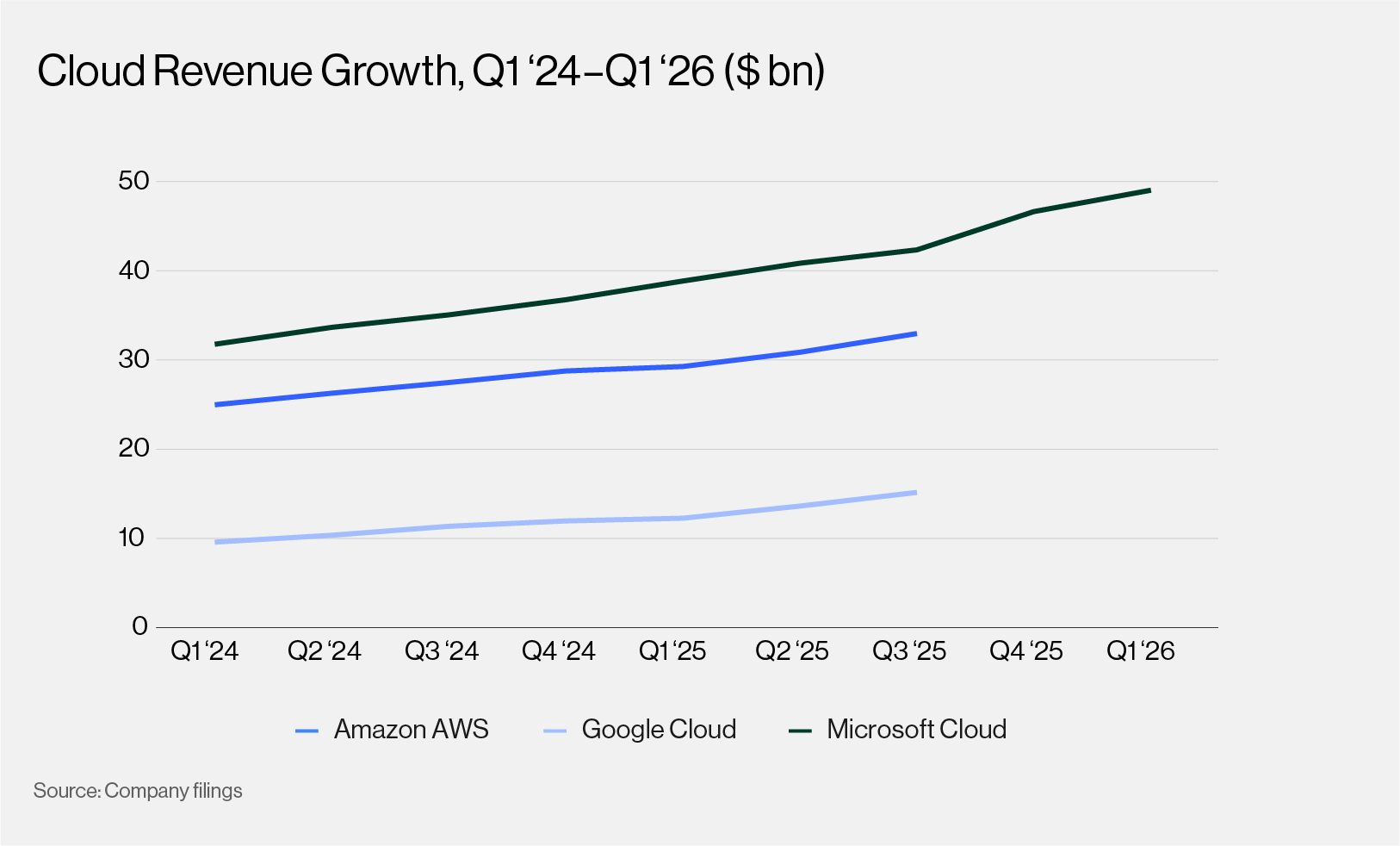
At the upper end of the market, the cloud divisions of Amazon, Alphabet, and Microsoft have also seen strong growth in 2025.  

In the quarter ended September 2025, Microsoft’s cloud revenue, which accounted for 63% of total revenue, increased 26% year-over-year, and Google Cloud saw a 34% jump in revenue to $15.2bn. AWS revenue climbed 17% year-over-year to $60.14bn in the first half of the year.  

Cloud Revenue Growth, Q1'24-Q1'26

Investors are still focused on how cloud compute providers manage this shortage while meeting the AI industry’s appetite for compute. A Bloomberg report, citing an internal source, said that many of Microsoft’s Azure data centres, which outpaced rivals Amazon and Alphabet to generate over $75bn in cloud revenue in fiscal 2025, are experiencing shortages of physical space and servers.

This capacity crunch could worsen if agentic AI, described by some experts as the next phase of AI, takes off in 2026.

These autonomous AI agents use reasoning and planning to solve complex problems that could require “100x more compute per task” than simpler generative AI tasks. Recent tech layoffs across Meta, Amazon, Chegg [CHGG], Salesforce [CRM] and UPS [UPS] totalling nearly 172,000 jobs in October 2025 alone may be an early sign that corporate America is positioning itself to integrate or capitalise on emerging AI capabilities. 

A McKinsey & Co survey in early 2025 found that most companies had yet to see a “bottom-line impact” from generative AI. But the shift from general-purpose AI tools to industry-specific applications could change that in 2026.  

This trend, known as AI verticalisation, involves developing AI tools purpose-built for sectors such as healthcare, defence, and finance, designed to handle specialised tasks and data more effectively within each field. 

Palantir [PLTR] has stood out in the verticalisation wave, with strong demand for its defence and government AI solutions contributing to notable share price gains. Among the sectors, healthcare has emerged as the fastest adopter of AI, with Menlo Ventures reporting that healthcare companies were deploying AI at twice the rate of the broader economy for tasks such as documentation, imaging and patient care. 

Another key storyline for 2026 could be the potential public listings of major private AI firms like OpenAI. In October, Reuters reported that the company is exploring a public listing in the second half of 2026, which could value it at up to $1trn, potentially the largest IPO in history. However, OpenAI’s Chief Financial Officer, Sarah Friar, has since stated that an IPO is ‘not on the cards’ for the near term, tempering expectations. 

In any case, the eye-popping valuation of the loss-making firm, along with its multi-billion-dollar spending on compute and infrastructure, is fuelling fears of an AI bubble. 

Swiss asset manager Atonra warned that OpenAI’s spending “seems detached from financial common sense,” pointing to $100bn spent on backup servers and $350bn on cloud services over five years. 

Source: CNBC Television, YouTube

“The question is whether investors will continue funding at this pace without clearer evidence of a path towards profitability: the company is currently losing money on every request, even from higher-tier plans, and increasingly complex requests only accelerate this trend,” said Atonra. 

Investor nerves have already been tested. In January 2025, Nvidia shares plunged 17% in a single session following the emergence of DeepSeek, a low-cost Chinese AI model that delivered competitive results using fewer compute resources. 

If more efficient models like this gain traction, demand for data centre capacity and semiconductor chips, among the market’s most crowded trades in 2025, could cool sharply.

AI innovation in China, where the government is investing heavily in the sector, could therefore be a key development to monitor in the year ahead. In October, Nikkei Asia reported that Chinese manufacturers had started undercutting rivals by offering 12-inch silicon wafers at half the price of leading Japanese firms. 

In October, the Bank of England (BoE) compared the AI boom in US equities to the dot-com bubble. 

The BoE noted that equity market valuations appear “stretched”, and that the earnings yield of the US equity market was close to the lowest level in 25 years. 

The UK’s central bank added that weak AI adoption, bottlenecks from power, data or commodity supply chains, and breakthroughs that reduce AI infrastructure needs could lead to sharp corrections. 

These risks are not theoretical. On October 30, Meta’s stock fell over 10% after the company announced that AI capital expenditures would be “notably larger” in 2025, showing how sensitive investors remain to big spending without immediate returns. 

Still, AI bulls would argue that this isn’t 1999.  

They say that, unlike the dot-com era, today’s AI boom is led by profitable, cash-rich big tech firms that don’t rely solely on AI to drive earnings. Even Federal Reserve Chair Jerome Powell emphasised this recently, noting that “these companies actually have business models and profits and that kind of thing. So it’s really a different thing.” 

2026 Watchlist: AI Ecosystem Stocks and ETFs to Monitor

AI in 2026 isn’t a single technology story. Here are some publicly listed companies and instruments that encompass the entire AI stack, from chipmakers to fabricators, and model providers to data centre operators. 

Category 

Definition 

Stocks 

Chipmakers 

Design chips used to train and run AI models 

Nvidia [NVDA], Advanced Micro Devices [AMD], Broadcom [AVGO] 

Fabricators 

Manufacture semiconductor chips 

Taiwan Semiconductor Manufacturing Company [TSM], Samsung Electronics [SSNHZ], Intel [INTC] 

Semiconductor equipment suppliers 

Make the machines used to produce chips 

ASML [ASML], Applied Materials [AMAT], Tokyo Electron [8035:JP] 

Hyperscalers 

Operate large cloud platforms that deliver computing and storage at global scale 

Microsoft [MSFT], Amazon [AMZN], Alphabet [GOOGL], Alibaba [BABA] 

AI infrastructure providers 

Build and run AI-optimised data centres and lease high-performance computing power, such as GPUs 

Cipher Mining [CIFR], Nebius Group [NBIS], IREN [IREN], CoreWeave [CRWV] 

Colocation providers 

Rent data centre space, power, and cooling where clients install and manage their own hardware 

Equinix [EQIX], Digital Realty [DLR], NEXTDC [NXT] 

Model providers 

Develop and train AI models for commercial use 

OpenAI [Private], Alphabet [GOOGL], Meta [META], Microsoft [MSFT], Amazon [AMZN] 

 And here are some notable ETFs that offer exposure to the AI sector. 

ETF 

Ticker 

AUM 

Expense ratio 

iShares US Technology ETF 

IYW 

$22.40bn 

0.38% 

Global X Artificial Intelligence & Technology ETF 

AIQ 

$7.08bn 

0.68% 

VanEck Semiconductor ETF 

SMH 

$36.52bn 

0.35% 

iShares Semiconductor ETF 

SOXX 

$16.11bn 

0.34% 

Dan Ives Wedbush AI Revolution ETF 

IVES 

$0.99bn 

0.75% 

Conclusion 

Market cycles rarely move in straight lines. Euphoria can last longer than logic dictates.  

For investors, AI carries both significant promise and genuine risk. History shows that the trajectory of groundbreaking technologies rarely follows a predictable path. The same is true of asset bubbles, if this ultimately proves to be one. 

As Howard Marks observes, bubbles are less about numbers and more about mindset. When optimism hardens into the belief that this time is different and there’s no price too high, caution fades. Bubbles start with progress, grow on euphoria, and burst when belief gives way to reality, even if reality later proves the trend was world-changing all along. The hard part, as always, is timing. 

Speaking to the New York Times, former Clinton White House economic adviser and Harvard economist Jason Furman recalled Alan Greenspan’s 1996 warning on “irrational exuberance” in the dot-com market. 

“And what happened after he gave that speech? The stock market ended up almost doubling over the next three-plus years and then the bubble burst.”  

Series Overview 

Furious Five: CMC’s 2026 Outlook 

Five forces. One furious charge into 2026.

CMC’s Furious Five series examines five pivotal themes that defined 2025, how far these powerful forces could extend through the year ahead, and what might stand in their way.

Explore our market outlook across AI, Energy, Robotics, Defence, and Debasement to see where the next wave of momentum and disruption could emerge in 2026.

  • 2026 Energy Outlook

    AI is transforming the global energy sector, sparking a surge in demand, reshaping policy, and reviving nuclear power. How will utilities, tech giants, and investors navigate the challenges and opportunities of 2026?

    Read more
  • 2026 Robotics Outlook

    2026 marks a pivotal year as Tesla, Waymo, Baidu, and XPeng scale their robotaxi and humanoid robot ambitions. Which strategy will win the automation race?

    Read more
  • 2026 Defence Outlook

    Palantir leads a new era of software-driven defence as the US overhauls military procurement and AI reshapes cyber warfare. Will legacy primes adapt or fall behind?

    Read more
  • 2026 Debasement Outlook

    Gold and Bitcoin hit all-time highs in 2025, reigniting fears of currency debasement amid rising debt, shifting Fed policy, and global reserve changes. What’s next for 2026?

    Read more

Disclaimer: This article provides general information only. It has been prepared without taking account of your objectives, financial situation or needs. It is not to be construed as a solicitation or an offer to buy or sell any financial instruments, or as a recommendation and/or investment advice. It does not intend to support an investment decision and it should not be relied upon by you in evaluating the merits of investing in any financial instruments. You should consider your objectives, financial situation and needs before acting on the information in this article. CMC Markets believes that the information in this article is correct, and any opinions and conclusions are reasonably held or made on information available at the time of its compilation, but no representation or warranty is made as to the accuracy, reliability or completeness of any statements made in this article. CMC Markets is under no obligation to, and does not, update or keep current the information contained in this article. Neither CMC Markets nor any of its affiliates or subsidiaries accepts liability for loss or damage arising out of the use of all or any part of this article. Any opinions or conclusions set forth in this article are subject to change without notice and may differ or be contrary to the opinions or conclusions expressed by any other members of CMC Markets.