Understanding online trading platforms: a UK beginner's guide
- :
- :
What is an online trading platform?
An online trading platform is a type of software that connects you to financial markets, allowing you to buy and sell various instruments from your computer or phone. For UK residents considering how to start trading online, understanding what these platforms do, how they operate, and what risks they carry is essential groundwork before committing any money.
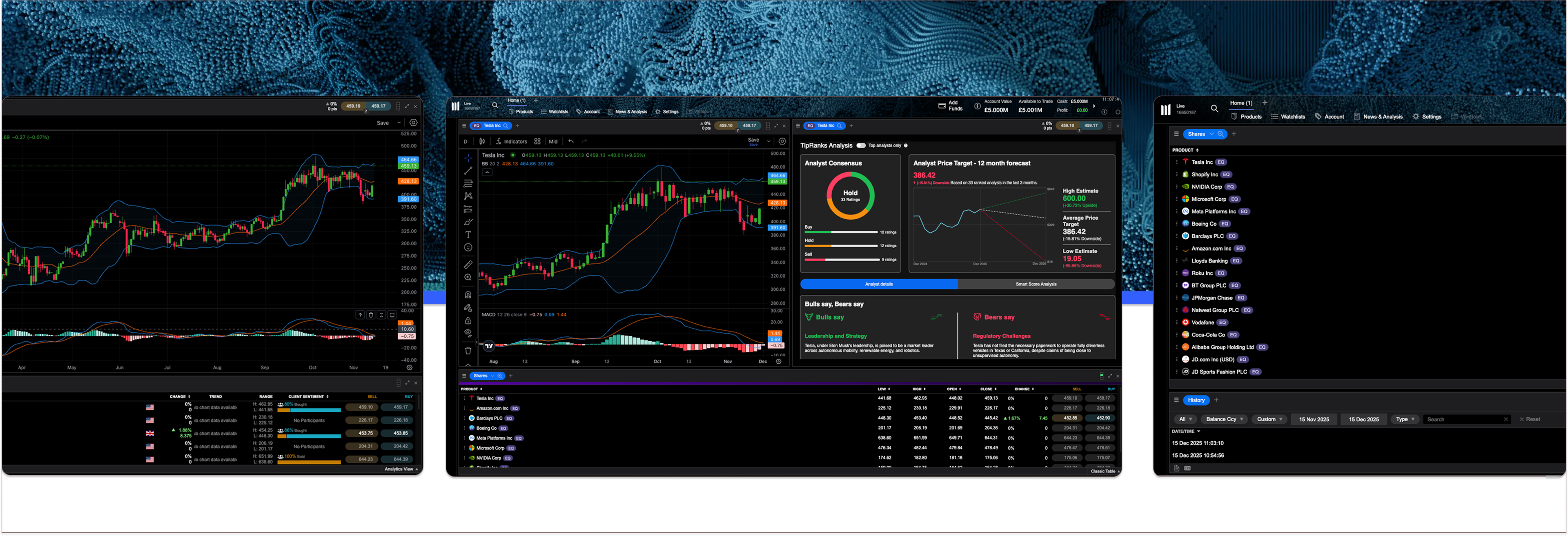
An online trading platform is a digital interface provided by a broker or financial services firm. It lets you place orders to buy or sell financial instruments, view price charts, monitor your positions, and manage your account.
Think of it as the middleman between you and the markets. When you want to purchase shares in a company listed on the London Stock Exchange, for example, you enter that order through the platform. The platform routes your instruction to the relevant exchange or market maker, and the transaction executes.
Before online platforms existed, trading required phone calls to stockbrokers or physical visits to banks. Technology changed this. Today, anyone with an internet connection and some capital can access markets that were once the preserve of professionals and institutions.
This accessibility brings opportunity but also responsibility. Markets do not distinguish between experienced fund managers and newcomers. Prices move on supply and demand regardless of who is watching.
How do online trading platforms work?
When you open an account with a trading platform UK providers offer, you deposit funds into that account. The platform then allows you to use those funds to open positions in various financial instruments.
Here is the basic sequence:
Step 1 | You identify an instrument you want to trade, such as a share or currency pair
Step 2 | You decide whether to buy or sell, and in what quantity
Step 3 | You submit the order through the platform interface
Step 4 | The platform transmits your order to the market
Step 5 | The order executes if a counterparty matches your price
Step 6 | Your account reflects the new position and any change in balance
Most platforms operate in real time, meaning prices update continuously during market hours. Some instruments trade around the clock, while others follow specific exchange schedules.
Key features to look for
Not all platforms offer identical functionality. When comparing options, certain features matter more than others for beginners.
Feature | What it means | Why it matters |
Order types | Market, limit, stop-loss orders | Controls how and when trades execute |
Charting tools | Price graphs with technical indicators | Helps analyse historical price movements |
Demo account | Practice trading with virtual funds | Learn without risking real money |
Mobile access | Trading via smartphone app | Flexibility to monitor positions |
Educational resources | Guides, webinars, tutorials | Supports learning curve |
A demo account deserves particular mention. Practising with simulated funds lets you understand how the platform works before real money is at stake. This does not replicate the psychological pressure of live trading, but it familiarises you with the mechanics.
Understanding FCA regulation in the UK
The Financial Conduct Authority regulates financial services firms operating in the UK. When a trading platform holds FCA authorisation, it must meet specific standards around client money protection, fair treatment, and operational conduct.
FCA regulated trading platforms must segregate client funds from company funds. This means if the firm faces financial difficulty, your money sits in separate accounts rather than being mixed with the company's operating capital.
Regulation also requires firms to provide clear information about products, fees, and risks. Platforms cannot make misleading claims about potential returns or downplay the possibility of losses.
To verify whether a platform is FCA authorised:
Visit the FCA Register at register.fca.org.uk
Search for the firm by name or registration number
Check the firm's permissions match the services they offer you
Confirm the website you are using matches the registered firm details
Important: FCA regulation does not guarantee you will not lose money. It provides a framework of standards and some protections, but trading losses from market movements remain entirely your responsibility. Regulation protects against certain firm misconduct; it does not insulate you from market risk.
Types of products available on trading platforms
Trading platforms offer access to various financial instruments. Each carries different characteristics, costs, and risk profiles.
CFDs and spread betting
Contracts for Difference and spread betting are leveraged products. Leverage means you control a larger position than your initial deposit would otherwise allow. A small market movement can therefore create proportionally larger gains or losses.
Risk warning: CFDs and spread betting are complex instruments. Most retail investor accounts lose money when trading these products. You should consider whether you understand how these products work and whether you can afford to risk losing your money.
With CFDs, you do not own the underlying asset. You are speculating on price movements. If you believe a share price will rise, you open a buy position. If the price does rise and you close the position, you profit. If it falls, you lose.
Spread betting works similarly but is structured as a bet on price direction. In the UK, spread betting profits are currently free from Capital Gains Tax, though tax treatment depends on individual circumstances and may change.
Both products amplify risk considerably. Losses can exceed your initial deposit if the market moves sharply against you.
Shares and ETFs
Buying shares means purchasing actual ownership stakes in companies. When you buy shares through a platform, you typically own that equity directly. Share prices rise and fall based on company performance, market conditions, and broader economic factors.
Exchange-traded funds bundle multiple assets into a single tradable product. One ETF might track the FTSE 100 index, giving you exposure to 100 companies through a single purchase. ETFs offer diversification but still carry market risk.
Product type | Ownership | Leverage | Risk level |
Shares | Direct ownership | No (typically) | Market risk |
ETFs | Units in fund | No (typically) | Market risk |
CFDs | No ownership | Yes | Higher risk due to leverage |
Spread Betting | No ownership | Yes | Higher risk due to leverage |
Risks to consider before you start trading
Every trading discussion should address risks prominently. Markets can and do move against traders, and losses are a normal part of trading activity.
Capital loss is the primary risk. The money you trade with can decrease in value or disappear entirely if positions move against you severely enough. This applies to all instruments, though leverage magnifies the effect.
Additional risks include:
Market risk: prices fluctuate based on factors beyond your control
Liquidity risk: some instruments may be difficult to sell at your desired price
Gap risk: prices can jump over weekends or after news events, bypassing stop-loss orders
Counterparty risk: the firm you trade with could face financial difficulties
Psychological risk: emotional decisions often lead to poor trading outcomes
No strategy, platform feature, or mindset technique eliminates these risks. They are inherent to market participation. Anyone suggesting otherwise is either mistaken or misleading you.
How to choose a trading platform
Selecting a platform involves weighing several factors against your personal circumstances and trading intentions.
Start by confirming FCA authorisation. This is non-negotiable for UK-based traders seeking regulatory protection.
Next, consider what instruments you want to trade. Not every platform offers every product. If you plan to focus on shares, ensure the platform provides access to the exchanges you need. If you want forex or indices, check those are available.
Costs matter significantly over time. Platforms charge through various mechanisms:
Cost type | Description |
Spreads | Difference between buy and sell price |
Commissions | Fixed fee per trade |
Overnight fees | Charges for holding leveraged positions overnight |
Withdrawal fees | Charges for moving money out |
Inactivity fees | Charges if account sits unused |
Compare these costs across platforms. Small differences compound substantially with frequent trading.
Finally, test the platform interface. Does it feel intuitive? Can you find information quickly? A clunky platform creates friction that may lead to errors.
Getting started: practical steps for beginners
If you have decided to explore trading, here is a sensible sequence of steps:
Educate yourself beyond this article. Read about the specific instruments you plan to trade. Understand how prices form, what influences movements, and how orders execute. The FCA and other bodies provide free educational material.
Define what you can afford to lose. This is not a rhetorical exercise. Write down a number that represents money you could lose entirely without affecting your essential living costs or financial security. Trade only within that figure.
Open a demo account. Practice placing orders, setting stop-losses, and navigating the platform. Do this for several weeks, not several hours.
Start small with real money. When you transition to live trading, use position sizes that feel almost trivially small. This reduces financial harm while you learn how your psychology responds to real stakes.
Keep records. Document every trade: why you entered, what happened, why you exited. Reviewing this log teaches you more than almost anything else.
Expect to lose money as you learn. Virtually everyone does. The goal is to lose small amounts while building knowledge, not to profit immediately.
An online trading platform is software that connects you to financial markets through a broker or financial services firm. It allows you to buy and sell instruments like shares, currencies, or CFDs from your computer or mobile device. The platform handles order routing, account management, and provides tools for analysing markets.
Check the FCA Register directly at register.fca.org.uk. Search for the firm by name or reference number. Verify that their authorisation covers the services they offer you and that website details match the registered information. Be cautious of firms claiming regulation without appearing on the register, or firms registered in jurisdictions with weaker oversight.
The primary risk is losing your capital. Market prices can move against your positions, reducing your account value. With leveraged products like CFDs, losses can exceed your initial deposit. Other risks include difficulty selling at desired prices, emotional decision-making, and the possibility of firm insolvency. No trading approach eliminates these risks entirely.
Most platforms offer access to shares, ETFs, forex, indices, commodities, and often CFDs or spread betting. The specific range varies by provider. Some platforms specialise in particular markets while others offer broad coverage. Check that any platform you consider offers the instruments relevant to your interests.
Beginners should understand that trading involves genuine risk of capital loss and that most retail traders do not consistently profit. Start with education about your chosen instruments, practise on demo accounts, and trade only money you can afford to lose. Keep expectations realistic and be prepared for a learning curve measured in months or years, not days.
Disclaimer: CMC Markets is an execution-only service provider. The material (whether or not it states any opinions) is for general information purposes only, and does not take into account your personal circumstances or objectives. Nothing in this material is (or should be considered to be) financial, investment or other advice on which reliance should be placed. No opinion given in the material constitutes a recommendation by CMC Markets or the author that any particular investment, security, transaction or investment strategy is suitable for any specific person. The material has not been prepared in accordance with legal requirements designed to promote the independence of investment research. Although we are not specifically prevented from dealing before providing this material, we do not seek to take advantage of the material prior to its dissemination.

Ready to get started?
When you invest, your capital is at risk.