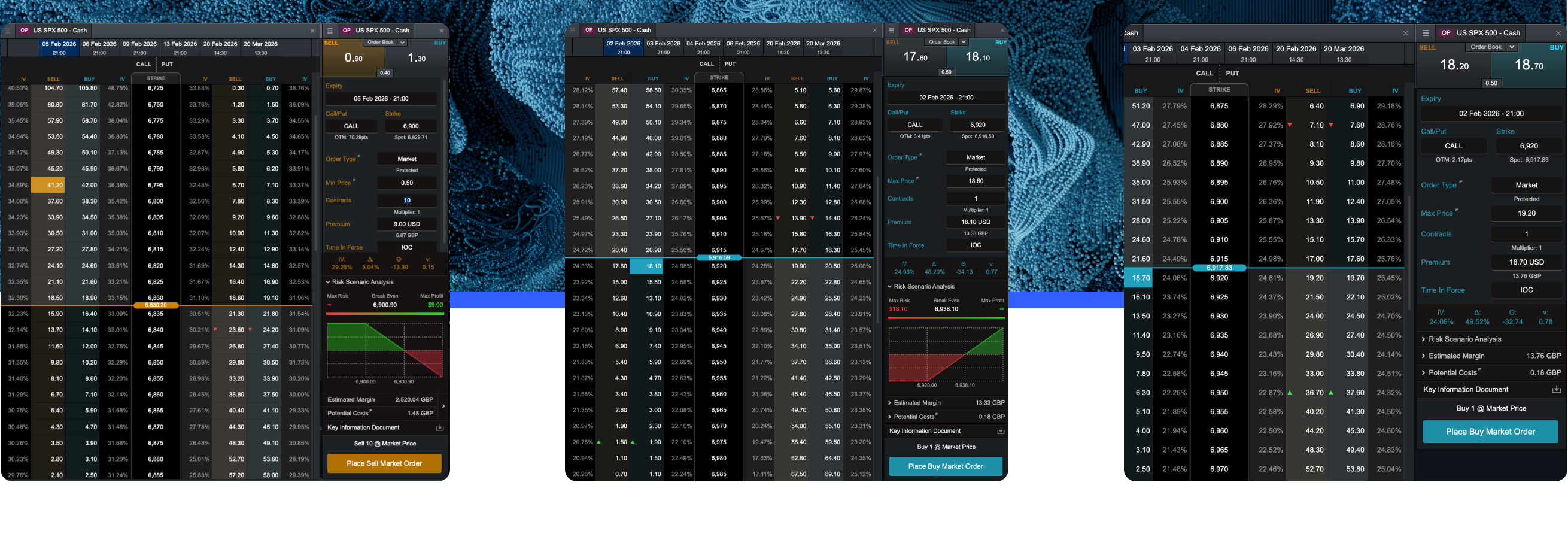
The Black-Scholes model is a mathematical framework for calculating the theoretical fair value of European-style options. European options can only be exercised at expiration, unlike American options, which can be exercised at any point before expiry.
At its core, the model answers a deceptively simple question: given what we know today about an underlying asset, interest rates and market volatility, what should an option contract be worth?
The model provides a single number representing theoretical fair value. This figure gives traders, market makers and risk managers a common reference point. Without it, options markets would lack the pricing consistency needed for efficient trading.
Think of it as a property valuation formula. Just as surveyors use comparable sales, location data and property characteristics to estimate house prices, the Black-Scholes formula uses market inputs to estimate option prices. Neither method produces a perfect answer, but both provide a defensible starting point for negotiation.
Fischer Black and Myron Scholes published their foundational paper in 1973, the same year the Chicago Board Options Exchange opened. Robert Merton published related work expanding on their approach and later shared the 1997 Nobel Prize in Economics with Scholes. Black had died in 1995 and was therefore ineligible for the prize, though the Nobel committee acknowledged his contribution.
The timing proved significant. The model arrived just as exchange-traded options became available to a broader audience, providing the theoretical foundation these new markets needed.
Their work built on earlier research into option pricing, but Black, Scholes and Merton were first to produce a complete, closed-form solution. The Black-Scholes-Merton model, as it is sometimes called, became the industry standard within years of publication.
The Black-Scholes formula looks intimidating at first glance. It contains logarithms, exponentials and references to the normal distribution. However, its underlying logic is more accessible than its appearance suggests.
The options pricing model requires five inputs to generate a theoretical value. Each input captures something important about the option contract or current market conditions.
← Swipe →
Input | Symbol | What it represents |
Current asset price | S | The market price of the underlying stock or index today |
Strike price | K | The price at which the option holder can buy or sell the underlying |
Time to expiration | T | How long until the option expires, expressed in years |
Risk-free interest rate | r | The return available from a theoretical riskless investment |
Volatility | σ (sigma) | A measure of how much the underlying price is expected to fluctuate |
Some sources count the option type (call or put) as a sixth input, though this simply determines which version of the formula you apply rather than representing a market variable.
Each input matters. Change any one of them and the theoretical price shifts. Understanding these relationships helps explain why option prices move even when the underlying asset stays flat.
The formula works by combining two components. For a call option, it calculates the expected value of receiving the underlying asset minus the expected cost of paying the strike price, both adjusted for the probability of the option finishing in the money.
Step one involves calculating two intermediate values, typically labelled d1 and d2. These values incorporate all five inputs and measure how far the current asset price sits from the strike price, adjusted for time and volatility.
Step two feeds d1 and d2 into the cumulative normal distribution function. This function converts them into probabilities, essentially asking: given current conditions, how likely is this option to have value at expiration?
Step three combines these probabilities with the current asset price and the present value of the strike price. The result is a single number representing the theoretical call option value.
For put options, the formula uses the same inputs but arranges them differently, reflecting the opposite payoff structure.
The mathematics involve calculus and probability theory, but the core intuition is straightforward. The model estimates what an option should be worth by weighing potential payoffs against the likelihood of those payoffs occurring.
The Black-Scholes formula achieves elegance by making several simplifying assumptions about markets and asset behaviour. Understanding these assumptions reveals both the model’s power and its limitations.
← Swipe →
Assumption | What It Means | Real-World Reality |
Constant volatility | Price fluctuations remain steady throughout the option’s life | Volatility changes constantly, often spiking during market stress |
No dividends | The underlying asset pays no dividends before expiration | Many stocks pay dividends, affecting option values |
European exercise | The option can only be exercised at expiration | Many traded options are American-style, exercisable anytime |
Efficient markets | Prices reflect all available information | Information asymmetries exist |
Log-normal price distribution | Asset prices follow a specific statistical pattern | Extreme price moves occur more often than log-normal suggests |
Continuous trading | Markets operate without gaps or pauses | Markets close overnight and over weekends |
No transaction costs | Buying and selling incurs no fees | Trading involves commissions, spreads and taxes |
No single assumption fatally undermines the model, but collectively they explain why Black-Scholes values rarely match observed market prices exactly. The model describes an idealised market that does not exist.
Modified versions of the formula adjust for dividends and other factors. The core approach remains influential even as practitioners acknowledge its limitations.
Despite its imperfections, the Black-Scholes formula serves several practical functions in modern markets.
Market makers use it as a reference point when quoting bid and ask prices. They rarely price options exactly at Black-Scholes values, but the model provides a baseline from which to adjust based on supply, demand and their own risk positions.
Risk managers rely on outputs derived from the model to hedge portfolios. The formula produces values called the Greeks, which measure how sensitive an option price is to changes in each input. Delta, for example, indicates how much an option’s value should move when the underlying price changes by one unit.
Traders use implied volatility, which is the volatility level that would make the Black-Scholes formula produce the current market price, as a way of comparing options across different strikes and expirations. This common language facilitates communication and analysis.
Corporate finance teams sometimes apply option pricing concepts to value employee stock options or assess strategic decisions with option-like characteristics.
The model provides a framework for thinking about value under uncertainty, even when its specific outputs require adjustment.
Model outputs and Greeks are estimates and can be unreliable in volatile or illiquid markets; trading options can result in significant losses.
The Black-Scholes formula has attracted sustained criticism since its publication. Some objections focus on its mathematical assumptions; others highlight its poor performance during market crises.
Fat tails represent perhaps the most significant theoretical challenge. The model assumes asset returns follow a normal distribution, which implies that extreme price movements are vanishingly rare. Historical data shows that large moves, both up and down, happen far more frequently than the model predicts.
During the 1987 stock market crash, the 2008 financial crisis and other periods of severe stress, option prices diverged dramatically from Black-Scholes values. Models built on assumptions of orderly markets struggle when disorder arrives.
The constant volatility assumption also breaks down in practice. Volatility clusters: calm periods give way to turbulent ones, and turbulence tends to persist. The model treats volatility as fixed, missing this dynamic.
Some critics argue that widespread use of the model creates feedback loops. If many participants price options using the same formula, their collective behaviour may influence the very market dynamics the model tries to describe.
If Black-Scholes were perfectly accurate, implied volatility would be constant across all strike prices for options on the same underlying asset with the same expiration date. In practice, implied volatility varies systematically with strike price, creating patterns traders call the volatility smile or volatility skew.
For equity options, implied volatility typically rises for out-of-the-money puts, reflecting demand for downside protection. This pattern, sometimes called a smirk rather than a smile, emerged strongly after the 1987 crash and has persisted since.
The smile reveals that market participants do not believe asset returns are normally distributed. By paying higher premiums for options that protect against extreme moves, they express scepticism about the model’s assumptions.
Traders adjust for the smile through various methods, including using different volatility inputs for different strikes or applying more complex models that accommodate variable volatility.
Black-Scholes in context: why traders still use it
Given its known limitations, why does the Black-Scholes model remain central to options markets nearly 50 years after publication?
First, simplicity has value. The formula produces a single number from five observable inputs. More sophisticated models require additional parameters that may be difficult to estimate or unstable over time. Black-Scholes offers a tractable starting point.
Second, everyone knows it. When market participants share a common reference framework, communication becomes easier. Quoting prices in terms of implied volatility, for instance, only works because everyone understands the underlying model.
Third, the model remains useful for many purposes despite imperfect accuracy. A rough estimate of fair value still helps identify potentially mispriced options. Hedging ratios derived from the model work reasonably well under normal conditions, even if they require adjustment during crises.
Fourth, no replacement has achieved dominance. Alternative models exist, including those that allow volatility to vary stochastically or incorporate jumps in asset prices. These models address specific Black-Scholes weaknesses but introduce additional complexity and their own limitations.
Practitioners generally treat Black-Scholes as a tool rather than a truth. They apply judgement to its outputs, adjust for known biases and supplement it with other analysis. The model informs decisions without dictating them.
The Black-Scholes model provides a mathematical framework for estimating the theoretical fair value of European-style options using five market inputs.
Fischer Black, Myron Scholes and Robert Merton developed the foundational approach, published in 1973, which later earned a Nobel Prize.
The five key inputs are current asset price, strike price, time to expiration, risk-free interest rate and volatility.
The model assumes constant volatility, no dividends, log-normal price distributions and efficient markets, none of which hold perfectly in practice.
The volatility smile demonstrates that market prices systematically deviate from Black-Scholes predictions, particularly for options away from current market prices.
Despite its limitations, the model remains widely used because it provides a common language, a tractable calculation and a useful reference point for more detailed analysis.
Options and derivatives are complex financial instruments carrying significant risk of loss. This guide is for educational purposes and does not constitute advice to trade.