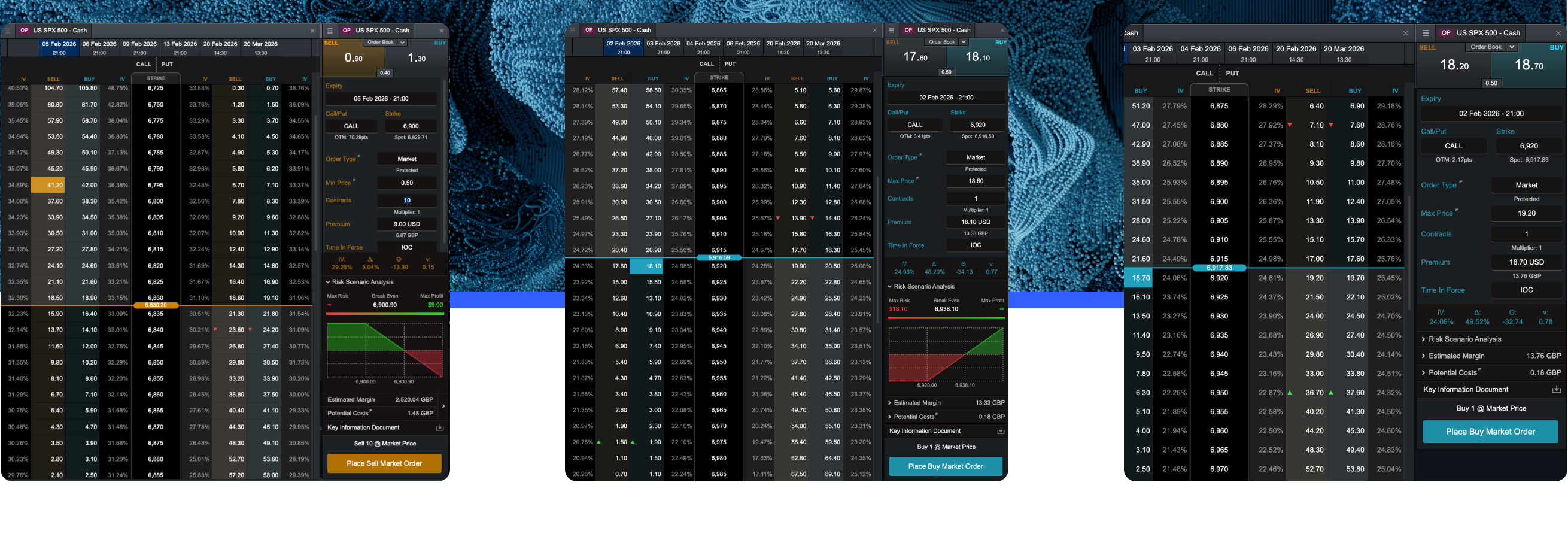
Stock options trading: your complete UK guide to calls and puts
Stock options give traders the ability to speculate on share price movements without owning the underlying shares. For UK traders, options provide opportunities to profit from rising or falling markets, hedge existing portfolios and gain leveraged exposure to global stocks.
This guide explains what stock options are, how calls and puts work, and how UK traders can access options markets through spread betting or contracts for differences (CFDs).
- :
- :
What are stock options?
Stock options are derivative contracts that give you the right, but not the obligation, to buy or sell a specific stock at a predetermined price before a set expiry date. You pay a premium upfront for this right.
Unlike buying shares directly, options let you control a larger position with less capital. This leverage can amplify gains, but it equally magnifies losses. You could lose your entire premium if the trade moves against you.
There are two types of stock options: calls and puts. Call options profit when prices rise. Put options profit when prices fall. Both have defined expiry dates, after which they become worthless if they are not exercised.
Options trading has a long history, dating back to 17th century Japan. However, regulated options trading originated when the Chicago Board Options Exchange (CBOE) launched back in 1973. Today, global options markets trade trillions in notional value annually. Many UK retail traders gain exposure to options prices via spread betting or CFDs, which are leveraged derivatives and differ significantly from trading exchange-traded options directly.
How do stock options work?
Options work through a contract between two parties: the buyer and the seller (also called the ‘writer’). The buyer pays a premium to the seller. In return, the buyer gains the right to buy or sell shares at a fixed price within a specified time period.
Think of it like a reservation fee. You pay a small amount now to lock in a price for later. If the price moves favourably, you benefit. If it moves against you, you lose only the reservation fee.
Every options contract specifies four elements: the underlying stock or asset, the strike price, the expiry date, and the premium. The strike price is the level at which you can buy or sell. The expiry date is your deadline. The premium is your upfront cost paid to the seller.
When the market price exceeds the strike price on a call option, that option is ‘in the money’ and has intrinsic value. When the market price sits below the strike price on a put option, that put is in the money. Options that would result in a loss if exercised are ‘out of the money’.
Call options explained
A call option gives you the right to buy shares at the strike price before expiry. You buy calls when you expect the stock price to rise.
For example, suppose you buy a call option on a UK-listed stock trading at £100. The strike price is £105, and you pay a £3 premium. If the stock rises to £115 before expiry, your call is worth £10 in intrinsic value (£115 minus £105). After subtracting your £3 premium, your profit is £7 per share.
If the stock stays below £105, the option is out of the money so you would not exercise it. Therefore, your call expires worthless and you lose the £3 premium. This is your maximum loss when buying calls.
Your break-even point equals the strike price plus the premium paid. In this example, the stock must reach £108 (£105 + £3) for you to break even.
Call buyers benefit from theoretically uncapped upside potential alongside a capped downside risk. In practice, profits will depend on volatility, liquidity and transaction costs, and many options expire worthless. Time also works against you: every day closer to expiry erodes the option’s value.
Put options explained
A put option gives you the right to sell shares at the strike price before expiry. You buy puts when you expect the stock price to fall.
Using a similar example to the one above, imagine a stock trades at £100. You buy a put with a £95 strike price for a £2 premium. If the stock drops to £85, your put is worth £10 in intrinsic value (£95 minus £85). Your profit after the premium is £8 per share.
If the stock stays above £95, your put expires worthless. You lose the £2 premium.
Your break-even point equals the strike price minus the premium paid. Here, the stock must fall to £93 (£95 minus £2) for you to break even.
Buying put options allows traders to profit from falling prices or hedge existing share holdings. Portfolio managers often buy puts as insurance against market downturns. This strategy limits losses if markets crash while allowing continued upside participation.
Key terminology: strike price, premium, expiry and greeks
Mastering options requires you to understand some core terminology. Here are the essential terms every UK trader should know.
Strike Price
The strike price is the fixed price at which you can buy (for calls) or sell (for puts) the underlying stock. Selecting the right strike price affects both the cost and probability of profit. Lower strike calls cost more but have higher success rates. Higher strike calls cost less but are less likely to finish in the money. The reverse will be true for put options: higher strikes will cost more but have higher success rates, while lower strike puts will be cheaper but have lower success rates.
Premium
The premium is the price you pay to buy an option or receive when selling one. Premiums reflect the option’s current value, incorporating both intrinsic value and time value.
Expiry Date
Every option has a deadline. After expiry, unexercised options become worthless. Shorter-dated options cost less but give prices less time to move favourably.
The Greeks
The Greeks are variables that measure how different market factors affect an option’s price. Each one is assigned a different Greek letter. Understanding them can help you manage risk and select appropriate trades.
Greek | What It Measures | Meaning in Practice |
Delta | Price sensitivity | How much the option moves per £1 change in stock price |
Theta | Time decay | How much value the option loses each day |
Gamma | Delta’s rate of change | How quickly delta shifts as the underlying asset’s price moves |
Vega | Volatility sensitivity | How much the option gains or loses when volatility changes |
Theta is a particularly important indicator of risk. It represents time decay, which erodes option value daily. Options are wasting assets. The closer to expiry they become, the faster they lose time value. This decay accelerates in the final weeks before expiration.
How to trade stock options in the UK
Many UK retail traders gain exposure to options via spread betting or CFDs, which are leveraged derivatives. Both methods let you speculate on options price movements without owning the underlying contracts.
Step 1: Choose an FCA-regulated platform
Select a broker authorised by the FCA. Check the FCA’s Financial Services Register to verify their authorisation. Regulated platforms must segregate client funds and provide negative balance protection.
Step 2: Open and fund your account
Complete the application process, which includes appropriateness testing. Regulators require platforms to assess whether leveraged products suit your experience level. You can fund your account once you are approved.
Step 3: Learn the platform
Use demo accounts to practise before risking real money. Familiarise yourself with order types, margin requirements and risk management tools like stop-losses.
Step 4: Select your market and direction
Decide which stock you want to trade options on and whether you expect prices to rise (buy calls or sell puts) or fall (buy puts or sell calls). Retail traders typically focus on buying options, as selling options involves materially higher risk and margin exposure.
Step 5: Set position size and manage your risk
Calculate your position size based on how much you can afford to lose. Many traders choose to limit position sizes to manage their risk, with approaches varying depending on individual circumstances. They also set stop-losses to limit potential losses.
Spread betting vs CFDs for options trading
UK traders can access options markets through spread betting or CFDs. Both are leveraged derivatives, but they differ in structure and tax treatment.
Feature | Spread Betting | CFDs |
Tax on profits | Tax-free (no Capital Gains Tax or Stamp Duty) | Subject to Capital Gains Tax |
Loss offset | Losses cannot offset other gains | Losses may offset capital gains |
Contract structure | Bet per point of movement | Contract mirrors underlying price of asset |
Regulation | FCA-regulated | FCA-regulated |
Negative balance protection | Yes (retail clients) | Yes (retail clients) |
Under current UK tax rules, spread betting profits are generally not subject to Capital Gains Tax. This makes spread betting attractive for profitable traders. However, treatment depends on individual circumstances and regulations may change. Because spread betting qualifies as gambling for tax purposes, you cannot offset losses against other capital gains.
CFD profits are generally taxed under Capital Gains Tax rules for most individuals, though income tax may apply in some cases. Losses on CFDs can offset gains elsewhere in your portfolio, which may benefit traders who experience mixed results.
Your choice will depend on your individual circumstances. Some traders who generate consistent profits may consider spread betting for tax reasons, though many retail clients lose money and tax treatment should not drive product choice.
Those expecting losses alongside gains elsewhere may prefer CFDs for loss offset potential. Consult a tax professional for advice specific to your situation.
Understanding options pricing and value
Option prices consist of two components: intrinsic value and extrinsic value (also called time value).
Intrinsic value is the option’s worth if exercised immediately. A call option has intrinsic value when the stock price exceeds the strike price. A put option has intrinsic value when the stock price sits below the strike price. Out-of-the-money options have zero intrinsic value.
Extrinsic value represents the premium above intrinsic value. It reflects the time remaining until expiry and the expected volatility. More time equals more extrinsic value because there is more opportunity for favourable price movement.
Option Status | Call Option | Put Option |
In the money | Stock price > Strike price | Stock price < Strike price |
At the money | Stock price = Strike price | Stock price = Strike price |
Out of the money | Stock price < Strike price | Stock price > Strike price |
Volatility significantly affects extrinsic value. Higher expected volatility increases option premiums because larger price swings become more likely. The CBOE Volatility index (VIX), often called the ‘fear gauge’, measures expected volatility in US markets and influences global options pricing.
Time decay erodes extrinsic value daily. According to commonly used options pricing models such as Black-Scholes, this decay is not linear. Options lose time value slowly at first, then accelerate rapidly in the final 30 days before expiry. Traders buying options fight this constant erosion.
Risks of trading stock options
Options trading carries substantial risks that you must understand before committing capital.
Leverage amplifies losses
Options provide leveraged exposure. While this magnifies potential profits, it equally magnifies losses. You can lose your entire investment quickly if markets move against you.
Time decay works against buyers
Every option loses value as expiry approaches. Even if the underlying stock moves in your favour, time decay can still result in losses if the movement is too slow.
Complexity increases mistakes
Options are more complex than shares. Mispricing risk, incorrect strategy selection and misunderstanding Greeks can lead to unexpected losses.
Selling options carries potentially unlimited risk
When you sell (write) call options without owning the underlying shares, your potential losses are theoretically unlimited. The stock could rise indefinitely, and you would be obligated to sell at the lower strike price. Selling options, particularly uncovered positions, involves significantly higher and potentially unlimited risk and is generally inappropriate for retail clients.
Volatility can move against you
If you buy options when volatility is high, you pay inflated premiums. If volatility subsequently falls, your options lose value even if the stock moves favourably.
Liquidity risk
Some options markets have wide bid-ask spreads, increasing the trading costs. Less liquid options may be difficult to exit at fair prices.
Basic options strategies for beginners
New traders often begin by learning simpler option positions before considering more complex strategies.
Long call
Buy a call when you expect prices to rise. Maximum loss will be the premium paid. This is the simplest bullish options strategy.
Profit potential for buyers is theoretically uncapped above the break-even point. However, in reality, profits will depend on a combination of factors such as timing, volatility, liquidity and transaction costs. Remember that options can expire worthless.
Long put
Buy a put when you expect prices to fall. Maximum loss will be the premium paid. Profit increases as the stock falls toward zero. This strategy suits bearish outlooks or hedging existing holdings.
Covered call
If you own shares, you can sell call options against them to generate income. You collect the premium but cap your upside if the stock rises above the strike price. This conservative strategy suits investors seeking income from existing holdings.
Protective put
Buy puts on shares you already own to limit downside risk. This acts like insurance. You pay a premium for protection against sharp falls while keeping upside potential. Portfolio managers commonly use this approach during uncertain markets.
[VISUAL: Table or comparison chart showing the four beginner strategies with columns for: Strategy Name, Market View, Maximum Risk, Maximum Reward, Best Used When. Purpose: Help beginners quickly identify suitable strategies]
You should avoid complex multi-leg strategies until you thoroughly understand basic positions. Strategies involving selling uncovered options expose you to potentially unlimited losses and require significant experience and capital.
When buying options, your maximum loss is the premium paid. You cannot lose more than your initial investment. However, selling uncovered options exposes you to potentially unlimited losses. With spread betting and CFDs, negative balance protection limits retail client losses to deposited funds, though you can still lose your entire account balance rapidly.
Both are leveraged derivatives that let you speculate on options price movements. The key difference is tax treatment. Under current UK tax rules, spread betting profits are generally not subject to Capital Gains Tax, though treatment depends on individual circumstances and may change. CFD profits attract Capital Gains Tax. CFD losses can offset other capital gains, whereas spread betting losses cannot.
Spread betting profits are exempt from Capital Gains Tax and Stamp Duty under current HMRC rules. CFD profits are subject to Capital Gains Tax at 18% or 24% depending on your income tax band. Tax rules can change. Consult a qualified tax adviser for guidance specific to your circumstances.
The Greeks are tools that measure how various factors affect option prices. Delta measures price sensitivity. Theta measures time decay. Gamma measures how quickly delta changes. Vega measures volatility sensitivity. Understanding the Greeks can help you assess risk and select appropriate trades.
For call options, add the premium to the strike price. For put options, subtract the premium from the strike price. The underlying stock must move beyond this break-even point before expiry for your trade to profit.
Disclaimer: CMC Markets is an execution-only service provider. The material (whether or not it states any opinions) is for general information purposes only, and does not take into account your personal circumstances or objectives. Nothing in this material is (or should be considered to be) financial, investment or other advice on which reliance should be placed. No opinion given in the material constitutes a recommendation by CMC Markets or the author that any particular investment, security, transaction or investment strategy is suitable for any specific person. The material has not been prepared in accordance with legal requirements designed to promote the independence of investment research. Although we are not specifically prevented from dealing before providing this material, we do not seek to take advantage of the material prior to its dissemination.