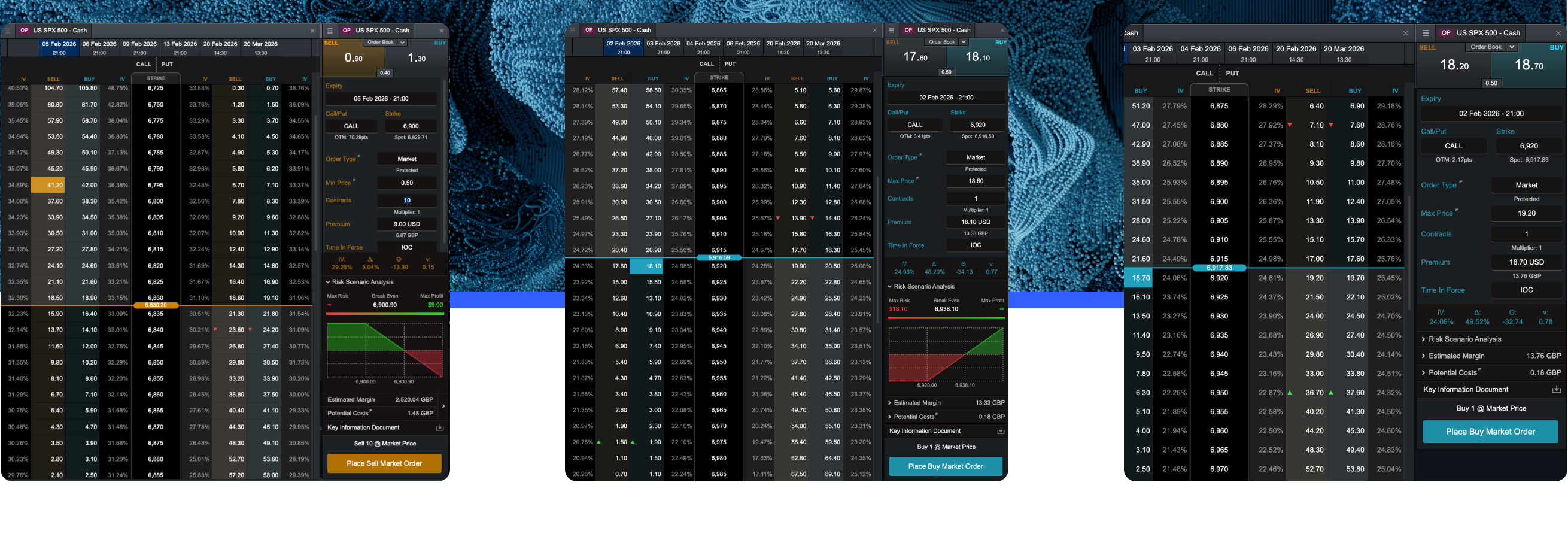
ITM is shorthand for “in the money.” An ITM option has intrinsic value, meaning it has positive value if exercised immediately, though exercising early is not always optimal. This intrinsic value exists because the option gives the holder the right to buy or sell the underlying asset at a price more favourable than the current market price.
ITM describes the relationship between two prices: the strike price written into the options contract and the current trading price of the underlying asset. When this relationship favours the option holder, the option is in the money.
Think of it like holding a voucher. If you have a voucher to buy something at £80 and that item currently sells for £100, your voucher has real value. That £20 difference represents intrinsic value, and your voucher would be considered ITM.
The meaning behind ITM differs slightly depending on whether you hold a call option or a put option. Both types can be ITM, but the conditions that create this status are opposite.
ITM call options occur when the underlying asset’s price sits above the strike price. A call option gives you the right to buy at the strike price. If that strike price is lower than the market price, you hold a valuable right.
Hypothetical example: Imagine a call option on Company X shares with a strike price of £45. If Company X shares currently trade at £50, this call option is ITM by £5. That £5 represents the intrinsic value. You could theoretically exercise your right to buy at £45 and immediately sell at £50.
The total value of an ITM call includes this intrinsic value plus any remaining time value until expiration. In practice, spreads, commissions and early-exercise considerations mean the realised outcome may differ, and holders often sell the option rather than exercise.
Put options work in reverse. A put gives you the right to sell at the strike price. An in the money option in this case means the strike price exceeds the current market price.
Hypothetical example: Consider a put option on Company Y with a strike price of £45. If Company Y shares trade at £40, this put option is ITM by £5. You hold the right to sell at £45 something currently worth £40 in the market.
Options traders use three terms to describe moneyness: in the money, at the money and out of the money. Understanding the contrast between out of the money vs in the money helps clarify when an option has intrinsic value and when it does not.
← Swipe →
Moneyness | Call Option Condition | Put Option Condition | Intrinsic Value |
In the Money (ITM) | Market price above strike | Market price below strike | Yes |
At the Money (ATM) | Market price equals strike | Market price equals strike | No |
Out of the Money (OTM) | Market price below strike | Market price above strike | No |
An OTM option has no intrinsic value. Its entire premium consists of time value and reflects the possibility that conditions might change before expiration. An ATM option sits precisely at the boundary, with the market price equalling the strike price.
An OTM option is not worthless. It still has time value if expiration has not yet occurred. However, it would expire worthless if held to expiration without the underlying price moving favourably.
Determining whether an option is ITM requires comparing just two numbers: the strike price and the current market price of the underlying asset.
For call options:
Find the current market price of the underlying asset
Compare it to your option’s strike price
If market price exceeds strike price, your call is in the money
For put options:
Find the current market price of the underlying asset
Compare it to your option’s strike price
If strike price exceeds market price, your put is ITM
Most trading platforms display options chains that indicate moneyness status. ITM options typically appear highlighted or separated from OTM options in these displays. The intrinsic value is usually calculated and shown alongside the option premium.
Moneyness affects several aspects of options behaviour and pricing. Understanding where an option sits on the ITM to OTM spectrum helps traders assess what they are paying for.
Premium composition changes with moneyness. ITM options have premiums consisting of intrinsic value plus time value. OTM options have premiums made up entirely of time value. This distinction affects how the option’s price responds to movements in the underlying asset.
Delta, which measures how much an option’s price moves relative to the underlying asset, correlates with moneyness. Deep ITM options have high deltas, meaning their prices track the underlying asset more closely. OTM options have lower deltas.
Probability considerations also shift. ITM options have a higher probability of finishing with value at expiration, though this probability is already reflected in their higher premiums. This does not mean ITM options are safer or more likely to generate profits. The higher premium means more capital at risk.
ITM options carry substantial risks that warrant careful consideration. These risks exist regardless of moneyness, though some manifest differently for ITM positions.
ITM options involve higher capital outlay. In short, they cost more because they contain intrinsic value. This means more money is at risk per contract. A larger premium does not equate to a better or safer position.
Time decay applies to all options. While ITM options have less time value to lose compared to equivalent OTM options, they still experience erosion as expiration approaches. The intrinsic value portion remains only if the underlying price maintains its position.
Market movement requirements differ. ITM options need the underlying price to maintain its current relationship to the strike price, or move further ITM, to retain or grow value. Adverse price movements can eliminate intrinsic value quickly.
Exercise and assignment risks exist for ITM options, particularly near expiration. This can require margin or collateral plus sufficient capital to meet delivery or settlement obligations. Deep ITM options may be exercised early by holders or assigned to writers, creating obligations that require sufficient capital or positions to fulfil.
No option strategy guarantees profit. Even ITM options can result in losses if the premium paid exceeds any value recovered at expiration or upon closing the position.
ITM options are those with intrinsic value. For call options, this occurs when the underlying asset trades above the strike price. For put options, it occurs when the underlying asset trades below the strike price.
Key points to remember:
ITM options have intrinsic value; OTM options do not.
ITM call options have strike prices below the current market price.
ITM put options have strike prices above the current market price.
Higher premiums for ITM options mean higher capital at risk.
Moneyness affects option behaviour but does not determine profitability.
Options remain complex instruments with significant risks. Understanding terminology like ITM is a starting point, not a complete education. Before trading options, ensure you understand the specific risks involved and consider whether these instruments align with your circumstances and risk tolerance.