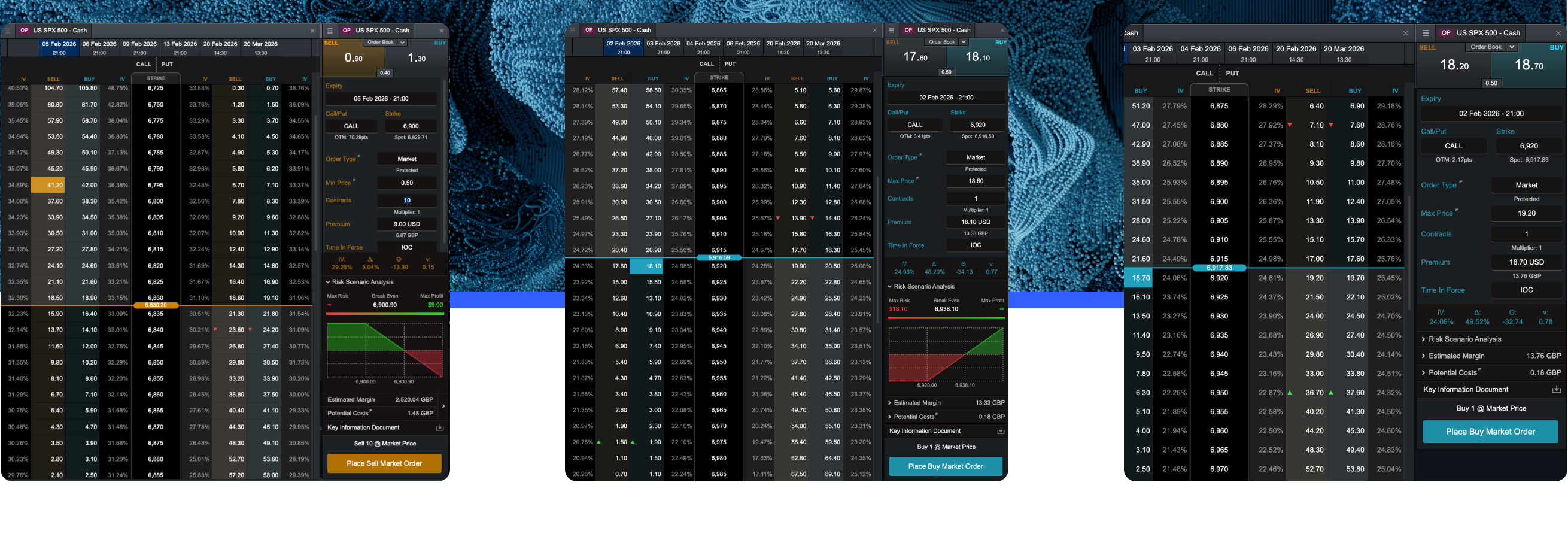
A call option is a type of option contract that grants the buyer the right, but not the obligation, to purchase an underlying asset at a specified price before or on a specified date. The underlying asset is typically shares in a company, though options also exist on indices, commodities and other financial instruments.
When you buy a call option, you are essentially paying for the opportunity to benefit if the underlying asset rises in price. If the asset does not rise as expected, your maximum loss is limited to the premium you paid. However, that premium can represent a total loss of the capital you committed to the trade.
Think of it like reserving a house at today’s price. You pay a reservation fee, and if property values increase, you can complete the purchase at the agreed price. If values fall, you walk away, losing only the reservation fee. The reservation fee is your premium.
Every call option contract contains several essential elements that determine its characteristics and value:
← Swipe →
Strike Price | The predetermined price at which you can buy the underlying asset |
|---|
Expiration Date | The final date by which you must exercise your right or let the option expire |
Premium | The upfront cost you pay to purchase the option |
Underlying Asset | The security that the option gives you the right to buy |
Contract Size | Typically represents 100 shares per options contract in standard markets |
The strike price is central to understanding an option’s potential value. If shares currently trade at £50 and you hold a call option with a strike price of £45, that option has intrinsic value because you could buy shares below their current market price.
The expiration date creates a time limit. Options are sometimes described as wasting assets because their value erodes as expiration approaches, all else being equal. This time decay accelerates in the final weeks before expiry.
Consider a hypothetical scenario to illustrate how call options function in practice. This example is purely illustrative and does not represent any real securities or guaranteed outcomes. For simplicity, this example ignores commissions, exchange fees, financing and bid-ask spreads, which can reduce returns or increase losses.
Suppose shares in Company ABC currently trade at £100. You believe the price will rise over the next three months. Rather than buying 100 shares for £10,000, you purchase one call option contract with a strike price of £105, expiring in three months. You pay a premium of £300 for this contract.
Scenario One: Share price rises to £120
Your option is valuable. You have the right to buy 100 shares at £105 each (£10,500 total) when they are worth £12,000 at market price. The intrinsic value is £1,500. After subtracting your £300 premium, your net position is £1,200 better than break-even. Alternatively, you could sell the option itself rather than exercising it.
Scenario Two: Share price stays at £100
Your option expires worthless. Why would you exercise the right to buy shares at £105 when the market price is only £100? You lose your entire £300 premium.
Scenario Three: Share price falls to £80
Your option expires worthless. You lose your entire £300 premium. However, this loss is fixed at £300 rather than the £2,000 loss you would face if you had purchased the shares outright.
Options traders use specific terminology to describe where the current share price sits relative to an option’s strike price:
← Swipe →
In the Money (ITM) | Call option where share price is above the strike price | Has intrinsic value |
At the Money (ATM) | Call option where share price equals or nearly equals strike price | Minimal intrinsic value |
Out of the Money (OTM) | Call option where share price is below the strike price | No intrinsic value |
A call option with a strike price of £50 is in the money when shares trade at £55. The same option is out of the money when shares trade at £45. Understanding this classification helps you assess whether an option has immediate exercise value or relies entirely on future price movement.
Out of the money options are cheaper because they require the underlying asset to move significantly before they gain intrinsic value. Many out of the money options expire worthless, resulting in total loss of the premium paid.
Understanding the distinction between call options and put options is fundamental to grasping what are options as a broader category of financial instruments. While call options give you the right to buy, put options give you the right to sell an underlying asset at a specified price.
← Swipe →
Feature | Call Option | Put Option |
Right granted | To buy the underlying asset | To sell the underlying asset |
Buyer profits when | Underlying asset rises | Underlying asset falls |
Maximum loss for buyer | Premium paid | Premium paid |
Directional view | Bullish | Bearish |
In the simplest terms, a put option represents the opposite directional view to a call. If you expect a share price to decline, a put option could gain value from that movement. If you expect a share price to rise, a call option could gain value.
Both put and call option contracts share the same structural elements: strike price, expiration date and premium. The key difference lies in the direction of the expected price movement and the right conveyed to the buyer.
Some strategies combine put and call options to create positions that respond to volatility rather than direction, or to limit risk in various ways. These combinations add complexity and are beyond the scope of this beginner’s guide.
Traders may consider call options for several reasons, though these potential benefits must always be weighed against the substantial risks involved.
Limited capital outlay: Purchasing a call option typically requires less capital than buying the underlying shares outright. In the earlier example, controlling exposure to 100 shares worth £10,000 cost only £300. However, this leverage cuts both ways and can amplify losses relative to the capital deployed.
Defined maximum loss: When buying a call option, your maximum loss on the option position is typically limited to the premium paid (plus any fees). If you exercise and buy the underlying asset, you then take on the risks of owning that asset. This is in contrast to a short position in shares, where losses can theoretically be unlimited. That said, losing your entire premium is a common outcome, particularly with out of the money options.
Flexibility: Options can be sold before expiration, allowing you to exit positions as circumstances change. You are not obligated to hold until expiry.
The risks associated with call options are substantial and should not be underestimated. Options are complex instruments, and many participants lose money trading them.
Total loss of premium: If the underlying asset does not move as expected, you lose your entire investment in the option. This happens frequently, especially with short-dated out of the money options.
Time decay: Options lose value as they approach expiration, independent of price movements in the underlying asset. Even if the share price moves in your favour, time decay can erode profits or deepen losses.
Complexity: Options pricing depends on multiple factors including the underlying price, strike price, time to expiration, volatility and interest rates. Understanding these interactions requires significant study.
Liquidity risk: Not all options trade actively. Wide bid-ask spreads can make entering and exiting positions costly.
Volatility risk: Changes in implied volatility affect option prices. Even if the underlying asset moves in the expected direction, adverse volatility shifts can reduce option values.
The term “long call option” refers to buying a call option, which is what this guide has primarily discussed. When you are long a call, you pay the premium and receive the right to buy the underlying asset.
A short call position means selling a call option to someone else. The seller receives the premium but takes on the obligation to sell the underlying asset at the strike price if the buyer exercises the option.
← Swipe →
Position | Action | Receives | Maximum Gain | Maximum Loss |
Long Call | Buy the option | Right to buy asset | Theoretically unlimited | Premium paid |
Short Call | Sell the option | Premium | Premium received | Theoretically unlimited |
Short call positions carry substantially different risks. If you sell a call option without owning the underlying shares (a naked short call), , your potential losses are theoretically unlimited because there is no cap on how high the underlying asset might rise. This strategy is unsuitable for beginners and carries extreme risk.
Selling covered calls, where you own the underlying shares, is a different approach that limits some risk but still involves complexity beyond introductory options concepts.
Before exploring options further, ensure you understand these foundational terms:
Premium: The price paid to purchase an option, often the maximum loss on the option itself for the buyer (plus fees), assuming you do not exercise and take on underlying market risk.
Strike price: The fixed price at which the option holder can buy (for calls) or sell (for puts) the underlying asset.
Expiration date: The date when the option contract expires. After this date, unexercised options become worthless.
Exercise: The act of using your right to buy (for calls) or sell (for puts) the underlying asset at the strike price.
Underlying asset: The security that the option derives its value from, typically shares.
Intrinsic value: The amount by which an option is in the money. A call with a strike price of £40 when shares trade at £50 has intrinsic value of £10.
Time value: The portion of an option’s premium above its intrinsic value, reflecting the possibility that the option could become more valuable before expiration.
Option contract: A standardised agreement that specifies all terms including the underlying asset, strike price, expiration date and contract size.
Options trading is not appropriate for everyone. Before considering whether to trade options, ask yourself several important questions.
Do you understand how options work, including the factors that affect their pricing? Options are complex, and superficial knowledge can lead to significant losses.
Can you afford to lose the entire amount you might invest in options? Premium loss is a common outcome, and you should never trade with money you cannot afford to lose.
Are you comfortable with the time commitment required to monitor positions and understand market conditions? Options require ongoing attention due to time decay and changing market dynamics.
Do you have experience with simpler investments such as shares or funds? Many experienced investors recommend building foundational knowledge before exploring derivatives.
Options trading involves substantial risk of loss and is not suitable for all investors. The complexity of options means that even experienced traders can and do lose money. If you are uncertain whether options suit your situation, consider seeking guidance from a qualified financial adviser who can assess your individual circumstances.
A call option grants the buyer the right, but not the obligation, to purchase an underlying asset at a predetermined strike price before or on the expiration date. You pay a premium for this right, and that premium represents your maximum loss if the option expires worthless.
Call options differ from put options in their directional expectation. Call buyers anticipate rising prices, while put buyers anticipate falling prices. Both option types share the same structural components and risk of total premium loss.
Key points to remember:
Call options involve paying a premium for the right to buy an asset at a fixed price.
The main components are strike price, expiration date, premium and underlying asset.
Options are classified as in the money, at the money, or out of the money based on the relationship between share price and strike price.
Buying call options limits maximum loss to the premium but total loss of premium is common.
Selling call options (short calls) carries substantially different and potentially unlimited risk.
Options are complex instruments unsuitable for many investors.
Options trading carries significant risks including total loss of capital invested. Take time to educate yourself thoroughly before considering any options positions, and ensure you understand both the potential benefits and the substantial risks involved.
Risk Warning: Options are complex financial instruments. Selling options can create obligations and may result in large or potentially unlimited losses. You may lose all of the capital you invest. Ensure options trading aligns with your financial situation, experience and risk tolerance before proceeding.