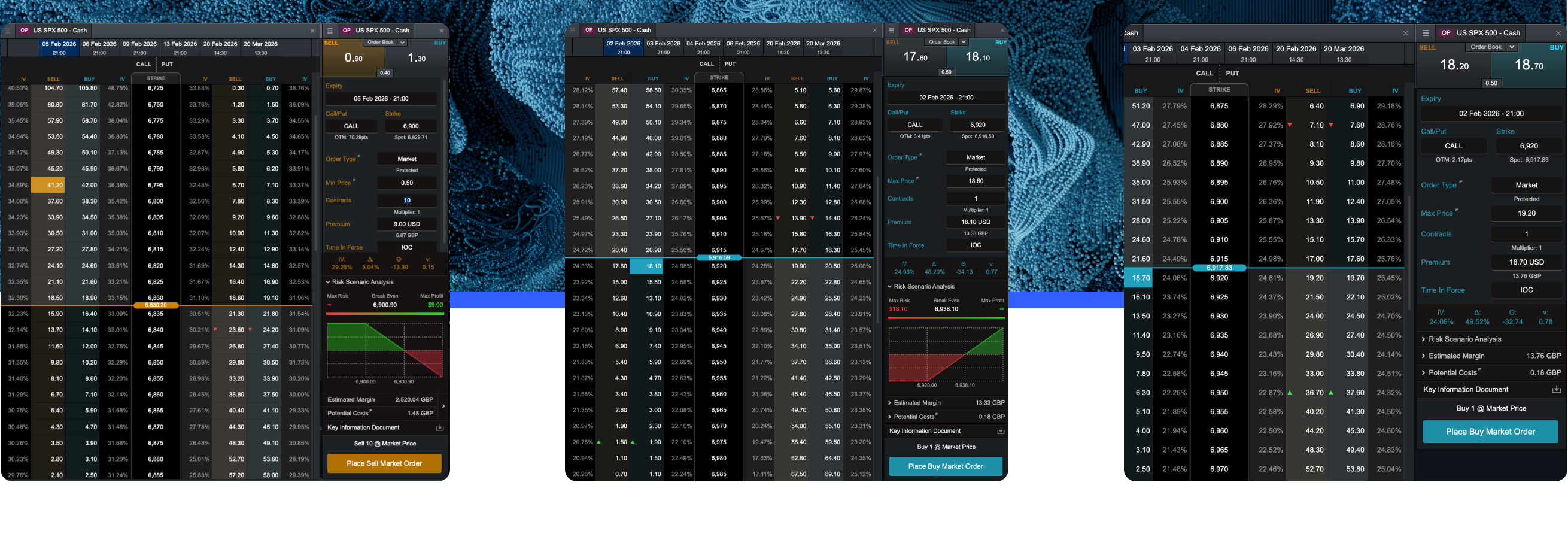
0DTE stands for zero days to expiration. In practical terms, a 0DTE option is any options contract that will expire at the end of the current trading session. When you purchase or sell a 0DTE option in the morning, that contract will cease to exist by market close that same day.
To understand this, consider how standard options work. A typical options contract might have weeks or months until expiration. During that time, the option holder has the right to exercise the contract or let it expire worthless. With 0DTE options, that entire lifecycle compresses into hours rather than days or weeks.
The term has become shorthand for same-day expiration trading, though technically any option becomes a 0DTE option on its final trading day. What distinguishes dedicated 0DTE trading is the deliberate choice to enter positions in contracts with only hours of life remaining.
0DTE options follow the same basic mechanics as any options contract. A call option gives the holder the right to buy an underlying asset at a specified strike price. A put option gives the right to sell. The key difference lies in timing.
When you trade a 0DTE option, you are working with an extremely compressed timeframe. The contract must either be exercised, sold or allowed to expire by the end of that trading session. Most 0DTE traders close their positions before expiration rather than exercising them, as the goal is typically to capture short-term price movements in the option premium itself.
Settlement procedures vary by product and exchange. Index options often settle in cash, meaning no actual delivery of underlying securities occurs. If your option finishes in-the-money, you receive the difference between the strike price and the settlement price in cash. Equity options typically allow for physical settlement, though most 0DTE traders exit beforehand.
← Swipe →
Settlement Type | Process | Common Products | ITM Outcome |
Cash settlement | Cash difference paid | Index options | Cash credit to account |
Physical settlement | Shares exchanged | Equity options | Shares bought or sold |
0DTE options are most commonly available on highly liquid underlying assets. Major stock indices have been at the forefront, with daily expirations now offered on several benchmark indices. High-volume individual equities also feature 0DTE options, though availability is more limited than for indices.
The expansion of daily expiration cycles has been driven by exchange initiatives to meet trader demand. Previously, options typically expired on monthly or weekly cycles. The introduction of daily expirations on certain products created the 0DTE trading phenomenon as a distinct activity rather than simply trading existing options on their expiration day.
Not all underlying assets offer daily expirations. Liquidity requirements mean that only the most actively traded products support viable 0DTE markets. Lower-volume underlyings would produce wide bid-ask spreads and poor execution quality.
Understanding the distinction between European options vs American options becomes relevant when trading 0DTE contracts. This classification refers to when an option can be exercised, not where it trades.
American-style options can be exercised at any point before expiration. If you hold an American-style call that moves into the money, you could exercise it immediately. European-style options can only be exercised at expiration. You must wait until the contract expires to exercise it, regardless of what happens during its life.
← Swipe →
Feature | American Style | European Style |
Exercise timing | Any time before expiration | Only at expiration |
Flexibility | Higher | Lower |
Common products | Equity options | Many index options |
0DTE implication | Early exercise possible | Exercise only at close |
For 0DTE traders, this distinction matters less than it might for longer-dated options. Since the contract expires the same day anyway, the window for early exercise is narrow. However, American-style 0DTE options can theoretically be exercised throughout the session, while European-style contracts lock in exercise only at the end.
Most 0DTE traders do not intend to exercise their positions. They seek to profit from changes in the option premium during the day. Whether the option is American or European style becomes relevant mainly if the position moves significantly in-the-money and the trader considers exercise rather than sale.
Zero-day options behave quite differently from their longer-dated counterparts. Several characteristics define the 0DTE experience.
Premium values are typically lower than equivalent longer-dated options. Since little time remains, the time value component of the option price is minimal. This lower absolute cost attracts traders who want leveraged exposure without large capital outlays. However, lower cost does not mean lower risk.
Price sensitivity to underlying movements is heightened. Small moves in the underlying asset can produce large percentage swings in option premium. A 0DTE option that costs a few points might double or halve in value within hours based on relatively modest underlying price changes.
Gamma, which measures how quickly an option’s delta changes, reaches extreme levels near expiration. This means that an out-of-the-money 0DTE option can suddenly become highly sensitive to underlying price moves if the market shifts toward its strike price. Conversely, an in-the-money option can see its directional sensitivity decline rapidly if the market moves away.
Time decay accelerates dramatically. Theta, the rate of time decay, is not linear. Options lose time value faster as expiration approaches. A 0DTE option experiences this decay at its most intense rate throughout the trading day.
Options trading carries inherent risks, and these risks are amplified in zero-day contracts. Traders considering this space should understand the specific hazards involved.
Time decay in 0DTE options is relentless. Every hour that passes erodes option premium, all else being equal. If you buy a 0DTE option and the underlying asset does not move in your favour quickly enough, time decay alone can significantly reduce your position’s value.
This creates a race against the clock. Option buyers need the underlying to move in the right direction with enough magnitude to overcome the time decay working against them. Option sellers collect premium that decays throughout the day, but face unlimited or substantial risk if the underlying moves sharply against their position. If you sell options and/or trade on margin, your losses can exceed your initial investment and you may be required to deposit additional funds at short notice.
Volatility effects compound these dynamics. Implied volatility can shift rapidly intraday, affecting option prices independent of underlying moves. A spike in implied volatility benefits option buyers but harms sellers. A volatility crush does the opposite. For anyone exploring an options trading for dummies-style education, grasping how volatility and time interact in 0DTE contracts is essential.
Liquidity varies significantly across different 0DTE products. Popular index options generally maintain tight bid-ask spreads throughout the day. Less actively traded underlyings may see spreads widen, especially as expiration approaches.
Wide spreads translate directly into execution costs. If the bid-ask spread is several points wide, entering and exiting a position costs you that spread twice. This can materially affect profitability, particularly for strategies that seek small gains.
Execution speed matters greatly in fast-moving markets. 0DTE options can change price rapidly. A quote you see may no longer be available by the time your order reaches the exchange. Slippage and partial fills become more problematic in volatile conditions.
Market makers may also reduce their activity as expiration approaches, particularly for strikes that are near the money. Reduced liquidity provision can lead to temporarily dislocated prices and difficulty exiting positions at reasonable levels.
Institutional traders, market makers and active retail traders all participate in 0DTE markets, though for different reasons.
Some traders use 0DTE options to express short-term directional views. If a trader believes the market will move today based on an economic announcement or other catalyst, a 0DTE option offers leveraged exposure without committing capital to a longer-dated position.
Hedging represents another use case. Portfolio managers might purchase 0DTE puts to protect against same-day downside risk without paying for time value they do not need. This can be more capital-efficient than holding longer-dated protection, but protection is limited to that single day and can expire worthless.
Income strategies involve selling 0DTE options to collect premium, betting that the underlying will not reach certain strike prices by end of day. These strategies carry significant risk if the underlying moves sharply, but attract traders seeking to collect option premium (which can result in significant losses if the market moves against the position).
Some traders use 0DTE options in more complex structures. A risk reversal options strategy, for instance, combines selling one option and buying another to create a directional position with defined risk parameters. Applying this to 0DTE contracts compresses the exposure into a single session.
It bears repeating that none of these approaches eliminates risk. All carry the potential for substantial losses.
UK retail traders face several practical considerations regarding 0DTE options access and suitability.
Product availability varies by platform. Not all UK brokers offer access to markets where 0DTE options are most liquid. Some platforms may restrict options trading to certain products or require enhanced account approval. Before assuming you can trade 0DTE options, verify what your specific platform offers.
Tax treatment of options profits in the UK depends on individual circumstances. Options trading gains may be subject to capital gains tax or, for frequent traders, potentially income tax. Tax treatment is complex and situation-specific. Professional tax advice is recommended for those trading actively.
Margin requirements can differ from those in other jurisdictions. UK traders using margin to trade options should understand their broker’s requirements and how these might change intraday, particularly for short option positions that could move against them.
The regulatory environment in the UK emphasises investor protection. Options trading requires appropriate knowledge and experience. Most regulated platforms will assess your suitability before granting options trading access. This is designed to ensure you understand the risks involved.
0DTE options are contracts that expire on the same day they are traded. They offer compressed timeframes for expressing directional views, hedging or collecting premium, but come with amplified risks compared to longer-dated options.
Key points to remember:
0DTE means zero days to expiration, referring to options that expire at the end of the current trading session.
Time decay is most severe in 0DTE options, eroding premium throughout the day.
The distinction between European options vs American options affects exercise timing but matters less for traders who close before expiration.
Liquidity and bid-ask spreads directly impact execution costs.
0DTE options are most commonly available on major indices and highly liquid equities.
UK traders should verify platform availability and understand that not all brokers offer these products.
Options trading involves significant risk of loss, particularly with short-dated contracts.
This article provides educational information only. It is not a recommendation to trade 0DTE options or any other financial product. Trading options, especially short-dated options, involves substantial risk and may not be suitable for all traders. Consider whether you understand how these products work and whether you can afford the high risk of losing your money before trading.