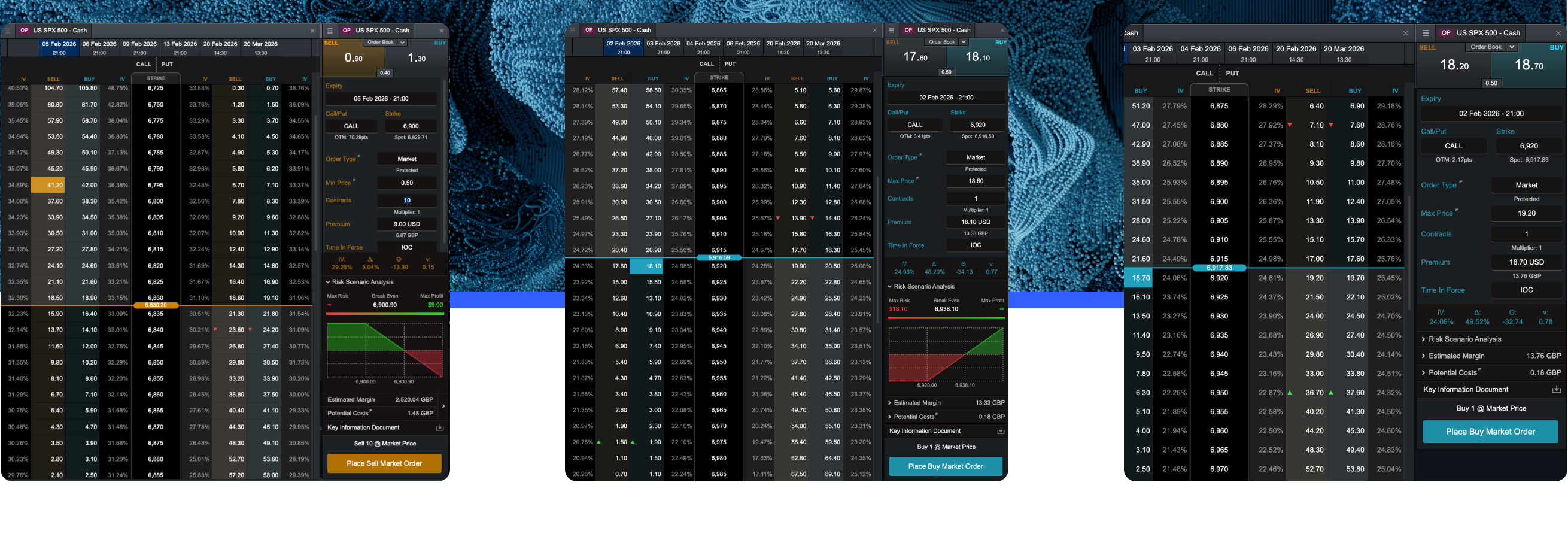
A put option gives the buyer the right to sell an underlying asset at a specific price (the strike) at a specific time in the future. At CMC Markets, options are cash settled. You do not physically sell the stock. Instead, you receive a cash payment if the underlying price is below the strike at expiration, net of the premium you paid.
A long put benefits from falling prices. The maximum profit is the strike price minus the premium, because the underlying cannot fall below zero. The maximum loss is limited to the premium paid — regardless of what happens to the underlying.
VISUAL: Put option payoff diagram showing strike at 455, premium of $9, break-even at 446, with red zone (loss) and green zone (profit) labelled on Y-axis. X-axis: underlying price at expiry.
A payoff chart shows the profit and loss of an option at the expiry date. The X-axis represents the underlying price at expiration. The Y-axis represents the option P&L.
For a long put with a strike of 455 and a premium of $9, the break-even price is 446. That figure comes from deducting the premium from the strike. The underlying must fall below 446 before you move into profit — similar to how a CFD position needs to move by enough to cover the spread before you start making money.
A protective put is a combination of two things: a long stock position (or CFD/spread bet) and a purchased put option on the same underlying.
The scenario it addresses is straightforward. You hold a stock that has rallied. You have unrealised gains. You do not want to sell, because that would surrender any further upside. You could add a guaranteed stop loss order, but if it triggers, your position closes permanently and you cannot participate in any recovery.
A protective put offers a third option. You pay a premium — like an insurance policy — to set a floor on your losses. If prices rise, the put expires worthless and you keep the gains, minus the premium. If prices fall sharply, the put increases in value and offsets losses below the strike.
The payoff combines the stock's diagonal line with the put's hockey-stick shape. Together, they produce a profile where the upside remains open but the downside is capped at a defined level.
VISUAL: Combined payoff diagram showing two lines — orange (stock only) as a straight diagonal, and blue (protective put = stock + long put) showing a floor at -$17.50. Strike at $410, entry at $420, premium $7.50.
You hold one Tesla CFD at $420. You buy a 410 strike put and pay a premium of $7.50.
Scenario
← Swipe →
Scenario | Stock P&L | Put Intrinsic Value | Premium Paid | Net P&L |
Tesla rises to $470 | +$50.00 | $0 (expires OTM) | -$7.50 | +$42.50 |
Tesla stays at $420 | $0 | $0 (expires OTM) | -$7.50 | -$7.50 |
Tesla drops to $400 | -$20.00 | +$10.00 (410 – 400) | -$7.50 | -$17.50 |
Tesla drops to $380 | -$40.00 | +$30.00 (410 – 380) | -$7.50 | -$17.50 |
If Tesla rises, the put expires worthless. You keep the stock gains minus the $7.50 premium. You would have been $7.50 better off without the hedge, but you had downside protection throughout.
If Tesla stays flat, you lose only the premium. The put was not needed — the cost of an uneventful period, just like an insurance premium in a year with no claims.
If Tesla drops to $400, the stock loses $20 but the put is $10 in the money. After the premium, your net loss is $17.50 rather than $20.
If Tesla drops all the way to $380, the stock loss is $40. The put is now $30 in the money (410 – 380). After the $7.50 premium, the net loss is still $17.50.
This is the defining feature of the protective put. Below the strike, every additional dollar of stock loss is exactly offset by a dollar of option gain. The net loss stays flat at $17.50 no matter how far the stock falls — to $380, $300, or zero.
Maximum loss = (entry price – strike price) + premium paid
For this example: ($420 – $410) + $7.50 = $17.50.
This formula holds for any price below the strike at expiry. It defines the floor — the worst possible outcome from the combined position.
Selecting the strike price works exactly like choosing the deductible on an insurance policy.
A small deductible means you get protected quickly — you only need to absorb a small amount of damage before the insurer pays. But the premium is higher. A large deductible reduces your premium, but you absorb more of the initial loss yourself. If the damage is less than the deductible, you get nothing back.
Options work the same way. A higher strike (closer to the current price) provides more protection but costs a higher premium. A lower strike is cheaper, but the protection kicks in later and you absorb more loss before the hedge activates.
If you choose a very low strike because the premium is cheap, a moderate decline will hurt you fully. The hedge only helps in severe drops.
VISUAL: Three side-by-side payoff diagrams showing protective put on Tesla ($420 entry) with 390/410/430 strike puts, each showing the different floor levels and premium costs.
Tesla at $420. Three put options compared:
← Swipe →
| 390 Strike Put | 410 Strike Put | 430 Strike Put |
Premium | $2.80 | $7.50 | $17.00 |
Moneyness at entry | OTM by $30 | OTM by $10 | ITM by $10 |
Maximum loss (floor) | $32.80 | $17.50 | $7.00 |
Tesla at $470 (net P&L) | +$47.20 | +$42.50 | +$33.00 |
Tesla at $400 (net P&L) | -$22.80 | -$17.50 | -$7.00 |
Tesla at $380 (net P&L) | -$32.80 | -$17.50 | -$7.00 |
The 390 strike barely dents your upside ($47.20 vs $50 stock-only) but only kicks in after a $30 fall. The 430 strike caps your loss at just $7.00 in a crash, but costs $17 in premium and reduces a $50 rally to $33 of net profit.
The 410 strike sits in the middle. This is not a recommendation — the right level depends on how much loss you are willing to absorb and how much you are willing to pay for certainty.
The expiry date determines how long your hedge lasts. Think of it as the policy term on your insurance.
A shorter-dated option has a lower premium. But it expires sooner, and you need to renew it — buying a new put (rolling) each time the current one lapses. Each roll costs a fresh premium and a fresh bid-ask spread. If volatility has risen between rolls, the new premium could be materially higher than the last.
A longer-dated option costs more upfront but provides continuous protection. There is no risk of coverage gaps and no need to monitor renewal dates.
Short-dated options also carry higher time decay (theta) and higher gamma risk, meaning their value can fluctuate sharply near expiry. For investors who want steady, predictable protection, longer-dated puts generally deliver a smoother experience.
One practical risk: if you buy a one-week put and the price decline arrives in week two, you have no protection. With a one-month put, that risk is reduced.
Both tools limit downside. The difference is structural.
← Swipe →
Feature | Protective Put | Guaranteed Stop Loss |
Position after trigger | Stays open until expiry | Closed permanently |
Recovery participation | Yes — benefit from rebound | No — locked out |
Premium | Always paid, regardless | Refunded if not triggered |
Maximum loss | (Entry – strike) + premium | (Entry – stop) + premium + commissions |
Complexity | Higher (Greeks, time decay) | Lower (set and forget) |
You do not need a separate put for every stock you hold. If you own several large-cap positions, a put option on a relevant index can serve as a proxy hedge, partially offsetting losses across the portfolio.
This is not a perfect hedge — individual stocks do not move in lockstep with an index. But it is a cost-effective way to reduce overall portfolio risk without the expense and complexity of hedging each position separately.
At CMC, contract sizes start at 0.01. This allows you to calibrate even small hedges precisely.
You do not need to wait until expiry. If conditions change — the risk event passes, the stock rallies, or you close the underlying — you can sell the put at the prevailing market price.
Before expiry, the put's value reflects both intrinsic value and time value. A put bought several weeks ago may retain meaningful value if expiry is not imminent. If you close both the CFD and put simultaneously, the hedge may not perfectly offset the stock loss — option prices are influenced by volatility and time, not just the underlying.
The premium is non-refundable. If the market rises or stays flat, you lose it entirely. Repeated premium payments erode returns over time.
Timing risk exists. If the put expires before the decline occurs, you are unprotected.
The hedge is imperfect in moderate declines. If the stock falls by less than the gap between entry and strike, the put provides no offset.
The bid-ask spread on options can widen during volatile markets — precisely when you may most want to buy or sell protection.
Trading hours for options may differ from CFD hours. You may not be able to close your option hedge at the same time as the underlying.