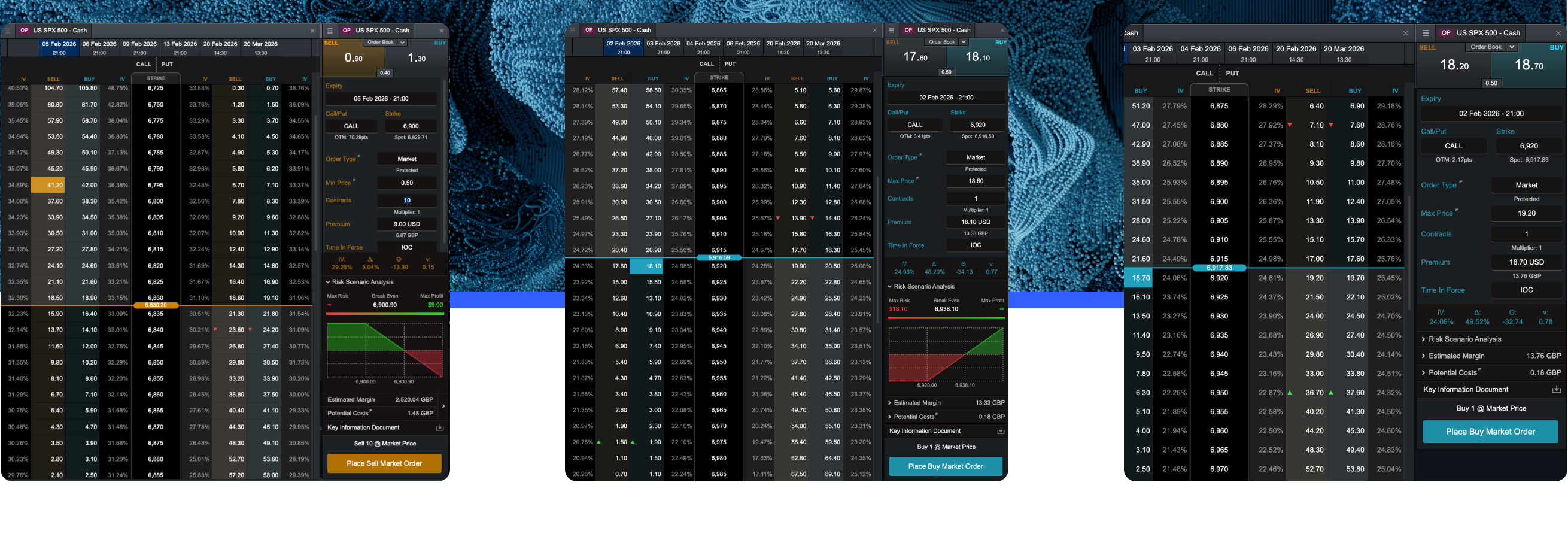
A long call or long put is the simplest use of options. You profit from a directional move with losses capped at the premium. But options become considerably more versatile when you combine them.
By buying and selling options at different strikes, different expiries, or both, you can build positions suited to a wide range of views: strongly bullish, mildly bullish, neutral, bearish, range-bound, or a view on volatility itself with no directional bias at all.
Each strategy involves trade-offs between maximum profit, maximum loss, and probability of success. Understanding these trade-offs before placing the trade is what separates considered risk-taking from guessing.
A cash-secured put involves selling a put option while holding enough cash to cover the obligation if the option is exercised. You receive premium upfront. If the underlying stays above the strike at expiry, the put expires worthless and you keep the premium as income.
If the underlying falls below the strike, you take a loss equal to the difference between the strike and the settlement price, offset by the premium received. But this is a price you were already willing to buy at.
VISUAL: Payoff diagram for short 350 put on a stock at $385, showing premium received as max profit, with loss increasing below strike minus premium.
Think of it as getting paid to place a limit buy order — or, as it is sometimes described, getting paid to wait to buy at a discount.
Stock at $385. You sell a 350 strike put for $5:
← Swipe →
Scenario | Outcome |
|---|
Stock stays above $350 | Put expires worthless. You keep the $5 premium. |
Stock drops to $340 | You lose $10 (350 – 340), keep $5. Net loss: $5. Equivalent to buying at $345. |
Stock drops to $320 | You lose $30, keep $5. Net loss: $25. |
Maximum profit: the premium received. Maximum loss: the strike price minus the premium (if the underlying falls to zero). This strategy suits a neutral to mildly bullish view on an asset you would genuinely purchase at the strike.
A covered call adds income to an existing stock or CFD position. You sell a call option above the current price. You collect the premium regardless of outcome.
If the stock stays below the strike at expiry, the call expires worthless. You keep the stock and the premium — effectively generating yield on a position that might otherwise sit idle.
The trade-off: if the stock rallies above the strike, your profit is capped. The sold call creates an obligation equivalent to selling at the strike price. You give up potentially unlimited upside in exchange for immediate, certain income.
VISUAL: Payoff diagram showing stock-only (orange diagonal) vs covered call (blue, capped at call strike), with the premium income gap labelled between the two lines.
This is essentially a limit sell order that pays you while you wait. Covered calls are best suited to a neutral or mildly bullish view where you are comfortable selling at the strike and do not expect a sharp rally.
If you hold a stock and want to limit downside without selling, you buy a put option on the same underlying. This is the protective put — a combination of the stock and a long put.
The put acts as insurance. If prices rise, it expires worthless and you keep the gains minus the premium. If prices fall sharply, the put increases in value, offsetting losses below the strike. The maximum loss is floored at a known level.
The gap between the stock-only line and the protective put line on a payoff chart is the option premium — the cost of that insurance.
A collar adds a short call on top of the protective put. You hold the stock, buy a put for downside protection, and sell a call to generate premium that offsets some or all of the put's cost.
The result: defined upside and defined downside. If the call premium exceeds the put premium, the collar has a net credit. If not, the net cost is at least reduced.
Your maximum profit is capped at the call strike. Your maximum loss is floored at the put strike.
If you expect a large price move but are unsure which direction, a long straddle lets you profit from volatility itself. You buy both a call and a put at the same strike — typically at the money — with the same expiration.
Your total cost is the combined premium of both options. You profit if the underlying moves far enough in either direction to exceed that cost.
VISUAL: Straddle payoff diagram showing V-shape centred on strike 10, with combined premium cost of 2, break-even points at 8 and 12.
Strike of 10. Call costs 1, put costs 1. Total premium: 2.
← Swipe →
Scenario | Call Value | Put Value | Net P&L |
|---|
Underlying at 14 | $4 | $0 | +$2 |
Underlying at 10 | $0 | $0 | -$2 (full premium lost) |
Underlying at 6 | $0 | $4 | +$2 |
Break-even: the underlying must move at least 2 in either direction. If it stays near 10, time decay erodes both options and you lose both premiums. Straddles work best ahead of known catalysts where the market is underpricing the expected size of the move.
A strangle is similar to a straddle but uses different strikes — a lower-strike put and a higher-strike call. Both options are out of the money, making the strangle cheaper. The underlying needs to move further before you break even.
On the selling side, a short straddle or short strangle collects premium from both legs. You profit if the underlying stays within a defined range. As long as the price remains above the break-even points, you keep the income.
The risk: a sharp move in either direction produces significant losses. Short volatility positions suit experienced traders with robust risk management.
A bull call spread involves buying a call at a lower strike and selling a call at a higher strike, both with the same expiration. The sold call partially funds the purchased one, reducing net premium and lowering break-even.
The trade-off: maximum profit is capped at the higher strike.
Buy 370 call for $9.90. Sell 400 call for $2.90. Net cost: $7.00.
← Swipe →
Metric | Value |
|---|
Net premium (cost) | $7.00 |
Maximum profit | $23.00 (spread of $30 minus $7 premium) |
Maximum loss | $7.00 (net premium paid) |
Break-even | $377 (lower strike + net premium) |
Full profit at | $400 or above |
This strategy suits a moderately bullish view — you expect the underlying to rise, but not dramatically. It costs significantly less than buying a naked call and offers clearly defined risk on both sides.
The same logic works in reverse for bearish views. Buy a put at a higher strike and sell a put at a lower strike. The sold put reduces the net premium, and maximum profit is capped at the spread between strikes minus the premium.
Bear put spreads suit a view that the underlying will decline moderately.
An iron condor combines a bull put spread and a bear call spread. You sell an out-of-the-money put and an out-of-the-money call, then buy further out-of-the-money options on each side to define maximum loss.
VISUAL: Iron condor payoff diagram showing flat profit zone between the two short strikes, declining into capped losses on either wing, with all four strike prices labelled.
You profit if the underlying stays within the range defined by the two short strikes. This is a short strangle with "wings" — the bought options cap your loss on each side, making the strategy defined-risk.
← Swipe →
Component | Role |
|---|
Buy lower-strike put | Caps loss on downside |
Sell higher-strike put | Collects premium, short downside exposure |
Sell lower-strike call | Collects premium, short upside exposure |
Buy higher-strike call | Caps loss on upside |
Maximum profit: net premium collected. Maximum loss: width of either spread minus net premium. Iron condors suit low-volatility environments where you expect sideways trading.
A butterfly spread uses four options across three strikes. The most common form: buy one lower-strike call, sell two middle-strike calls, buy one higher-strike call.
Maximum profit occurs if the underlying settles exactly at the middle strike at expiry. The cost is low relative to the potential payout. The probability of hitting maximum profit is also low — it requires a precise outcome.
Think of it as selling a straddle but protecting both wings to cap losses. Butterflies suit traders with a strong view on where the underlying will settle at expiry.
The strategies above are all vertical spreads — different strikes, same expiry. Two other categories exist:
← Swipe →
Spread Type | Strikes | Expiries | Best For |
|---|
Vertical | Different | Same | Directional views with defined risk |
Calendar | Same | Different | Time decay, volatility term structure |
Diagonal | Different | Different | Multi-factor views with flexibility |
A calendar spread (also called a horizontal spread) uses the same strike but different expirations. You typically sell a near-term option and buy a longer-term one, profiting from the faster time decay of the short-dated leg.
Calendar spreads are useful when near-term volatility appears overvalued relative to longer-term volatility, or when you want to exploit accelerating theta in the final days before a short-dated option expires.
Diagonal spreads combine both dimensions — different strikes and different expirations. They offer the most flexibility but also the most complexity. Both directional risk and relative time decay need active management.
Multi-leg strategies require attention to execution costs. Each leg carries its own bid-ask spread, and the cumulative cost of entering and exiting a four-leg position is higher than a single option.
The Greeks of the overall position can shift as the underlying moves. A strategy that was delta-neutral at entry may develop directional exposure as the underlying drifts toward one of the strikes.
Start simple. A single covered call or protective put teaches a great deal about how options behave before you move to more complex structures. As noted in the CMC webinar series: the most commonly used multi-leg strategies among CMC clients are call spreads and put spreads.
CFDs, spread bets, and OTC options are complex products and come with a high risk of losing money rapidly due to leverage. Consider whether you understand how these products work and whether you can afford to take the high risk of losing your money.