



Published: Friday, 5 June 2026 at 12:45 (UK) The week ahead may be light on economic data and corporate earnings, but a few key events could help shape expectations for US monetary policy heading into the Federal Reserve's rate-setting meeting (16-17 June), the first under new chair Kevin Warsh. Foremost among the week's major events are updates on US inflation, with the consumer price index (CPI) report out on Wednesday, followed by the producer price index (PPI) on Thursday. Meanwhile, rate decisions from the Bank of Canada on Wednesday and the European Central Bank on Thursday will reveal how policymakers are responding to higher energy costs and other price pressures. On the corporate side, Oracle's fourth-quarter results, due on Wednesday, will provide another test of investor appetite for companies linked to AI infrastructure spending.
US May CPI
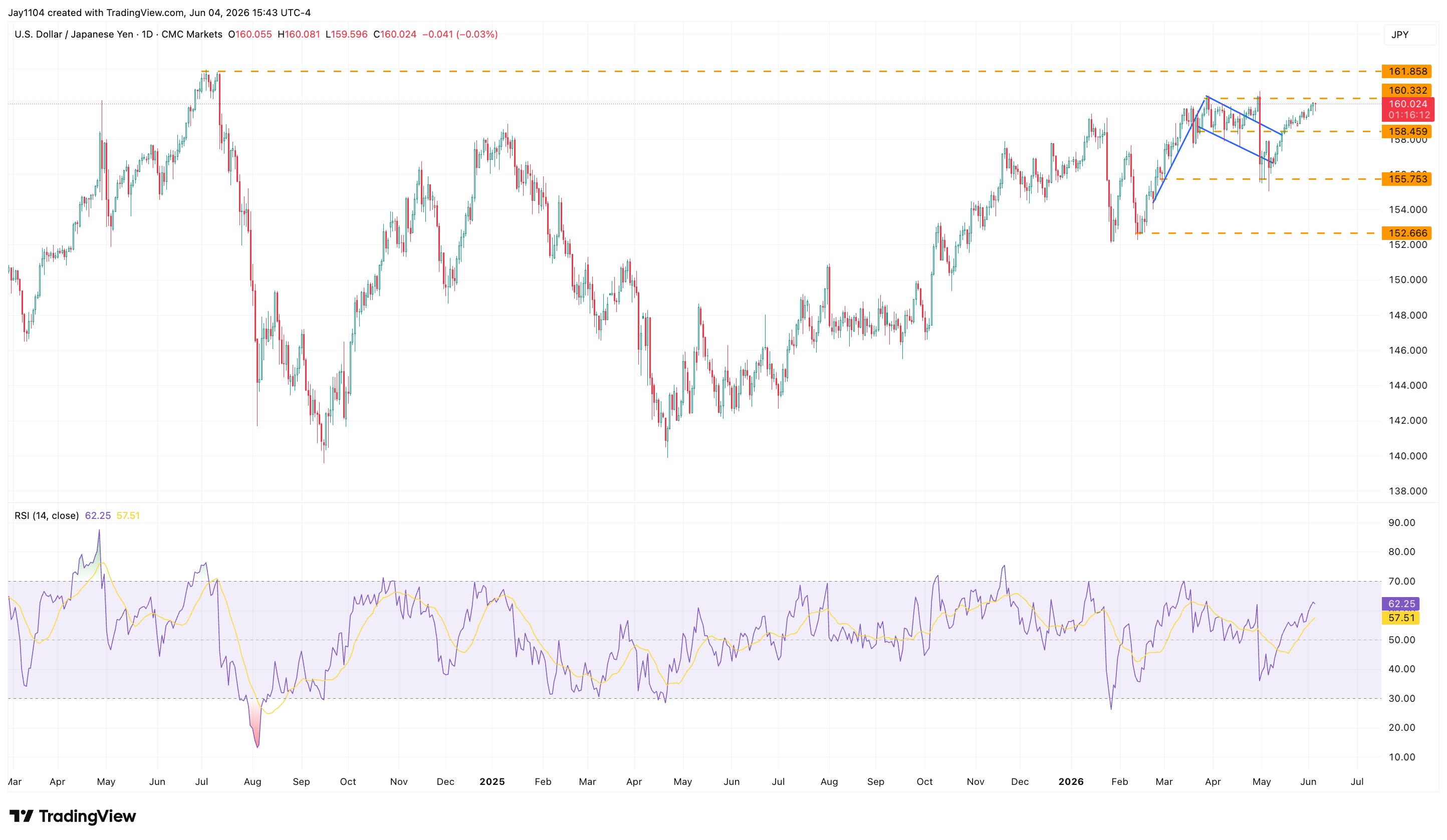
Wednesday 10 June Headline CPI is expected to have risen 4.2% in the year to May, up from 3.8% in April, while the monthly increase is forecast to have slowed to 0.5%, down from 0.6%. Core CPI, which excludes volatile food and energy prices to highlight underlying inflation trends, is expected to have increased 2.9% year-on-year (up from 2.8% in April) and 0.3% month-on-month (down from 0.4%). Given that the CPI report arrives just one week before the Fed's June meeting, markets may view the inflation data as an important indicator of how the central bank's outlook could evolve under its new leadership. Currency markets may be particularly sensitive to any surprises. USD/JPY has been testing the ¥160-per-dollar level in recent sessions, a threshold that has attracted significant market attention over the past year. A stronger-than-expected CPI reading on Wednesday could reinforce expectations that US interest rates might remain elevated for longer, potentially supporting further dollar strength. In that scenario, a break above ¥160.50 could pave the way for a move back towards the July 2024 highs around ¥161.60. Conversely, softer inflation data may ease some of the upward pressure on the pair. USD/JPY, March 2024 - present
Sources: TradingView, Michael Kramer
Oracle Q4 earnings
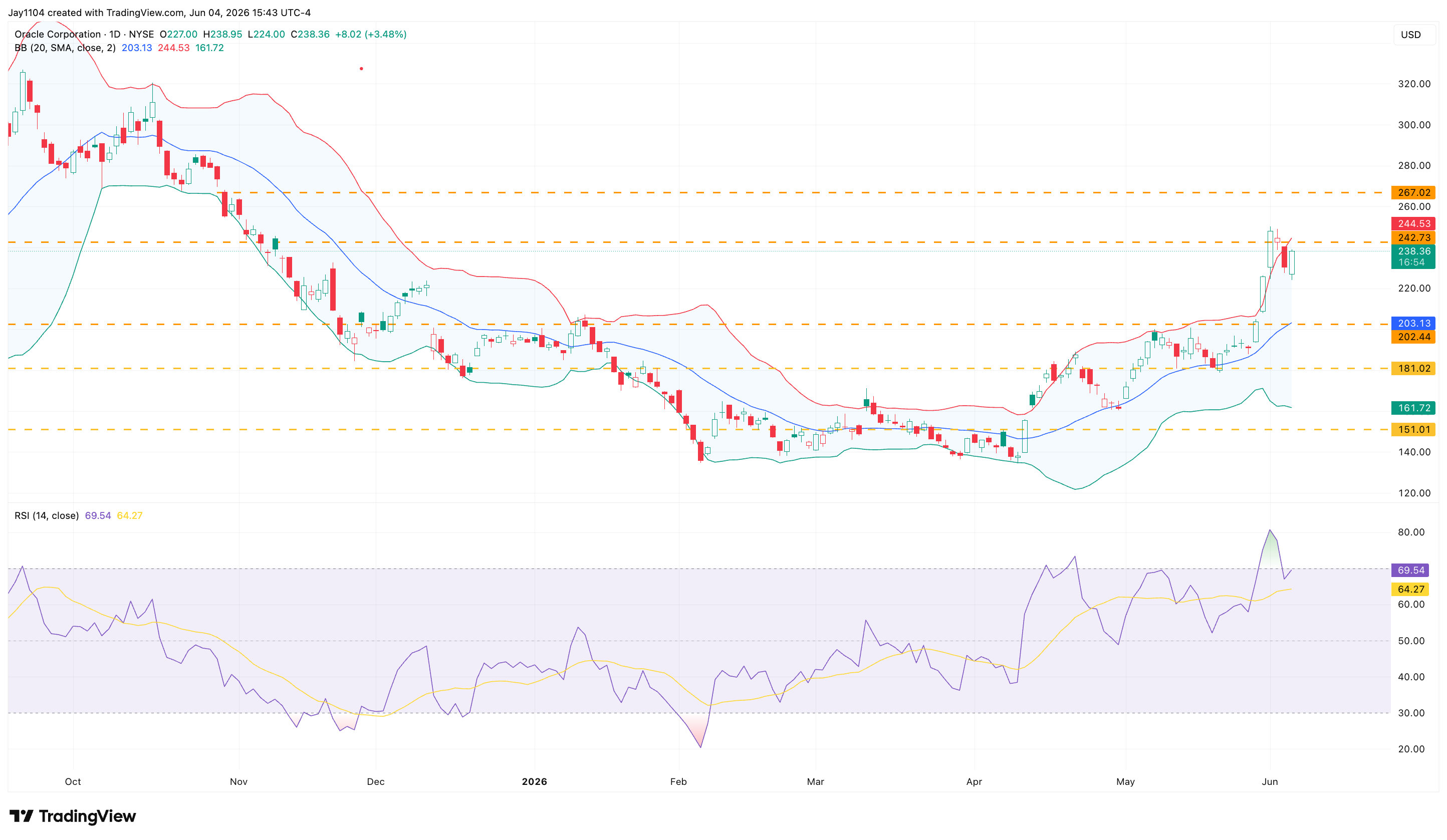
Wednesday 10 June Oracle is expected to report Q4 earnings of $1.96 a share, up 15.4% from a year earlier, with revenue forecast to rise 20.1% to $19.1bn, based on analysts' estimates. Capital expenditure is expected to increase 32.5% to $12bn as Oracle continues to invest heavily in infrastructure capacity. Guidance may prove equally important. Analysts currently expect Q1 earnings to climb 14.2% year-on-year to $1.68 a share on revenue growth of 27.6% to $19bn, while capital expenditure is forecast to rise 60.8% to $13.7bn. The options market implies that the software company's share price – up roughly 40% this year at $236.34, as of Thursday's close – could move 11.3% in either direction following the earnings announcement. Options positioning suggests that the bias could lean towards the downside, with support around $190. From a technical perspective, Oracle has struggled to move above $250, which remains a key resistance area. If the Q4 results beat expectations and the stock – a component of the S&P 500 – breaks above $250, the next significant area of resistance is near $270. However, technical indicators suggest the shares may be overbought, as they're trading above their upper Bollinger Band, and the relative strength index (RSI) is nearing 70. These gauges signal the risk of a potential pullback towards support near $200. Oracle share price, October 2025 - present
Sources: TradingView, Michael Kramer
ECB interest rate decision
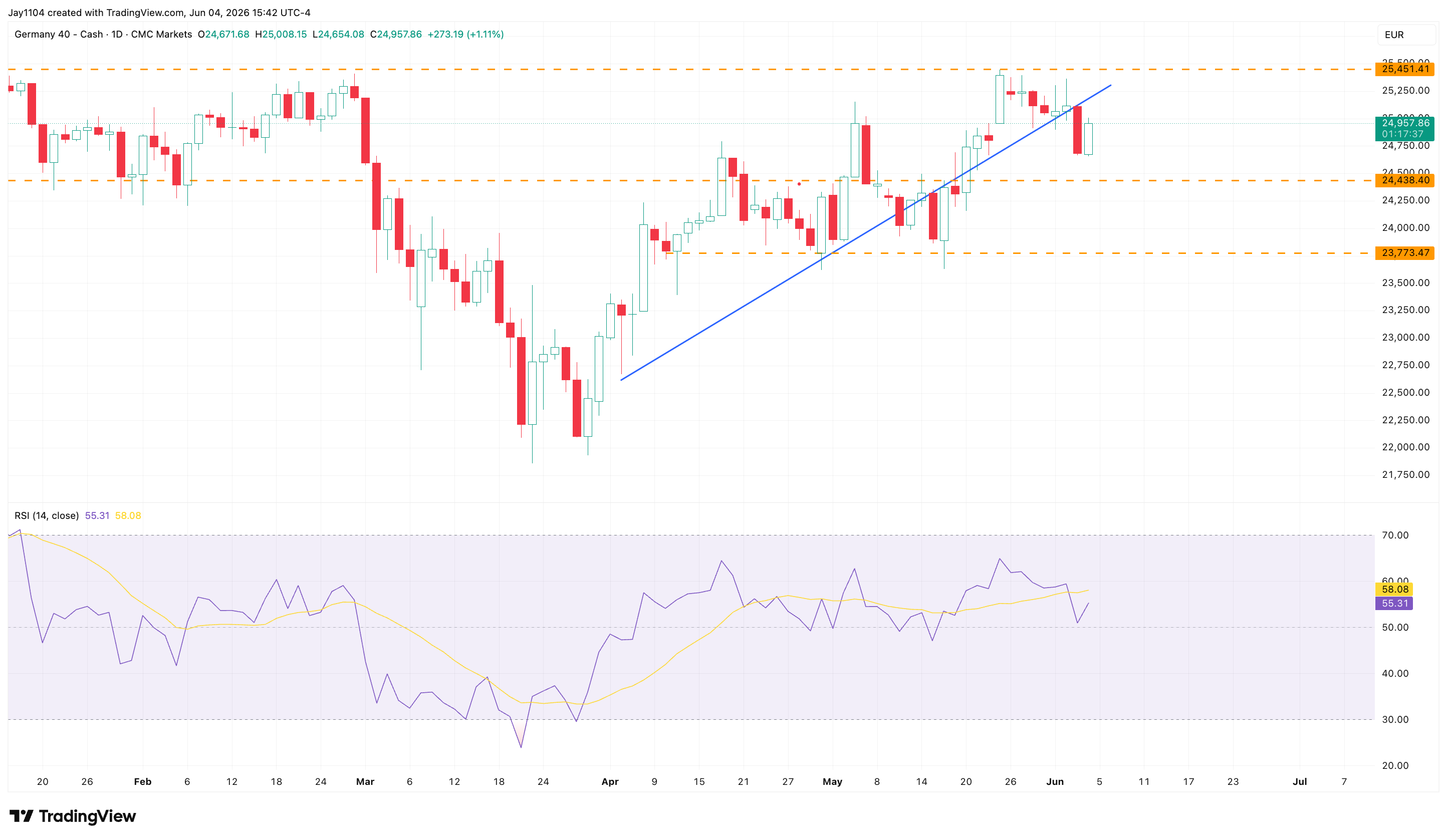
Thursday 11 June Markets are pricing in a more than 95% probability that the ECB will raise borrowing costs by a quarter of a percentage point to 2.25%. With the rate hike seen as a foregone conclusion by many market participants, attention is likely to focus less on the decision and more on signals about the future path of monetary policy. Investors foresee further tightening over the medium term, with the market expecting an additional rate increase in October 2026 and another by March 2027. Any indication that policymakers are becoming more concerned about inflation risks could reinforce those expectations, while a more cautious tone may prompt markets to reassess the outlook. European stock markets may be particularly sensitive to the ECB's projections. Germany's DAX index has underperformed several global peers in recent months and has struggled to surpass the record intraday high of 25,508 that it set on 13 January. The index, hovering at around 25,000 points on Friday morning, has support near 24,430 and faces resistance around 25,450. The technical chart, below, indicates that the German share index has dipped below a short-term uptrend. If support near 24,430 breaks, the index could drop towards 23,750. The decline in the RSI also suggests that momentum may be weakening. If the ECB signals an intention to lower rates, that could alter the picture, but such a policy stance seems unlikely in the face of rising price pressures. Germany 40, 20 January 2026 - present
Sources: TradingView, Michael Kramer
Economic and company events calendar
Major scheduled data releases and UK- or US-listed company results include: Monday 8 June - Germany: April factory orders - Japan: Q1 gross domestic product (GDP) Results: Campbell's (Q3) Tuesday 9 June - Australia: June Westpac consumer confidence index - China: May exports, imports and trade balance - Germany: April industrial production - UK: May like-for-like retail sales - US: May existing home sales Results: JM Smucker (Q4), Oxford Instruments (FY), SailPoint (Q1) Wednesday 10 June - Canada: Bank of Canada interest rate decision - China: May consumer price index (CPI) - US: May CPI Results: Casey's General Stores (Q4), Chewy (Q1), Core & Main (Q1), Fuller, Smith & Turner (FY), Oracle (Q4), Pennon (FY) Thursday 11 June - Australia: June consumer inflation expectations - Eurozone: European Central Bank interest rate decision - US: May producer price index (PPI), weekly initial jobless claims Results: Adobe (Q2), Wizz Air (FY) Friday 12 June - France: May CPI - Germany: May harmonised CPI - UK: April GDP - US: June flash University of Michigan consumer sentiment index Results: Lennar (Q2)
Note: While we check all dates carefully to ensure that they are correct at the time of writing, the above announcements are subject to change.