Could Microsoft change the AI market as cheaper models raise price-war risk? | CMC Markets
Could Microsoft change the AI market as cheaper models raise price-war risk?
Microsoft is developing cheaper AI models to reduce rising costs for customers. Could Satya Nadella's strategy trigger a price war with OpenAI and Anthropic and change how businesses use AI?
AI is changing the development philosophy as Microsoft backs cheaper artificial intelligence models
The artificial intelligence (AI) market is entering a new stage of development. After a period marked by a race to build the largest language models, deployment costs and business efficiency are starting to play a growing role. For investors tracking technology companies, equity markets and CFDs on AI-sector stocks, this represents a shift in one of the most important trends of recent years.
In a high-profile interview with The Wall Street Journal, Microsoft CEO Satya Nadella set out a vision that could significantly change the way the development of artificial intelligence is viewed. In his opinion, the future of AI should not depend solely on a handful of the largest laboratories developing increasingly expensive models, but on much wider use of smaller and cheaper solutions tailored to business needs.
According to Nadella, concentrating the full value of the AI market in the hands of a few major players could become not only a business problem, but also a challenge for regulators and economic policy. In his view, artificial intelligence should support the productivity of companies and workers, rather than lead to excessive market centralisation.
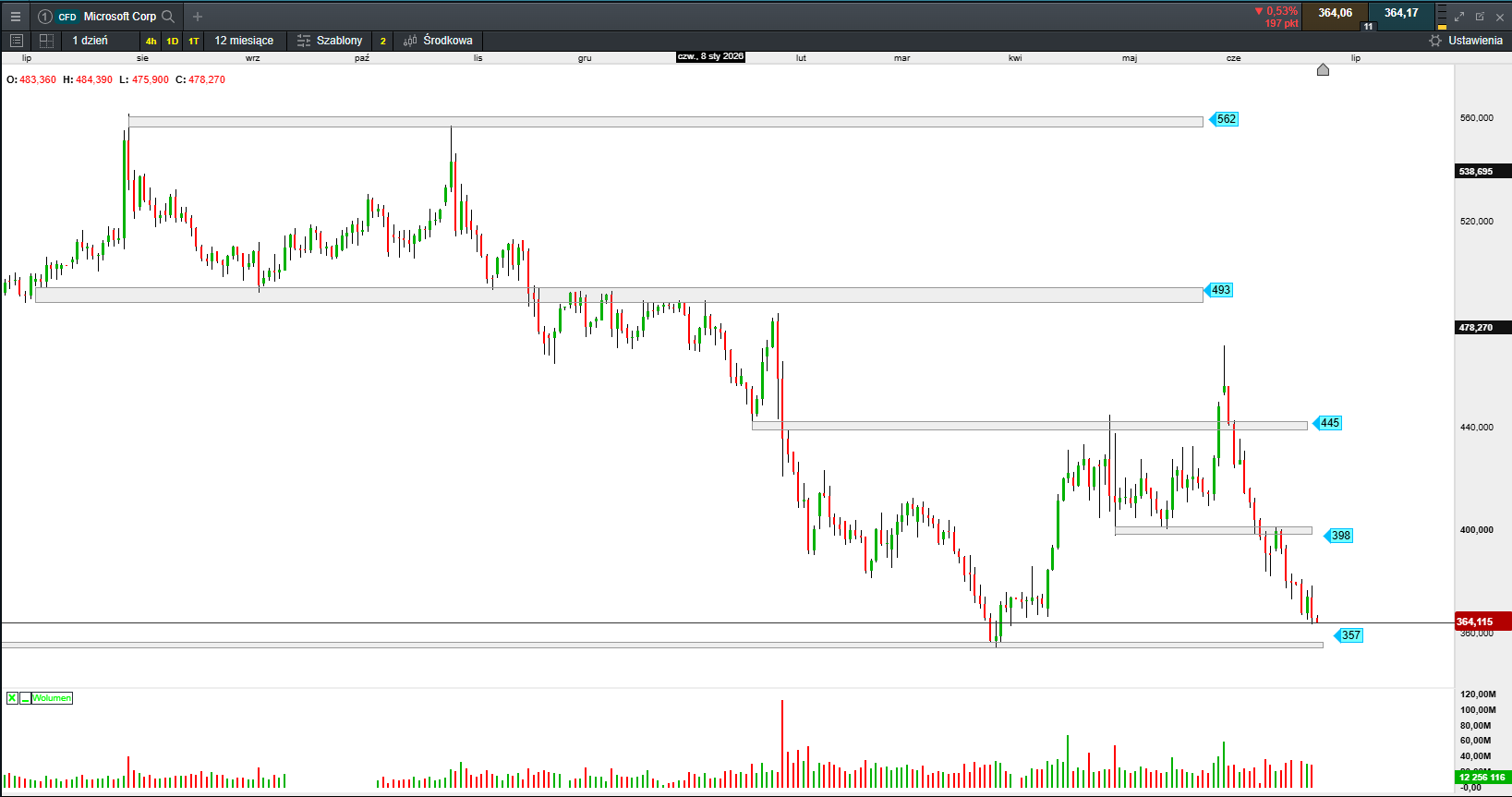
Microsoft Corp, July 2025 - present
Source: CMC Markets, as of 25 June 2026.
Microsoft backs cheaper artificial intelligence
The Microsoft CEO's comments are reflected in the company's actions. In recent weeks, the company presented a package of new, more affordably priced AI models designed to reduce the cost of using artificial intelligence for businesses.
Microsoft is also developing solutions such as Copilot Cowork, an autonomous AI agent that allows users to choose different artificial intelligence models when performing more complex tasks. The strategy is based on greater flexibility and the ability to use cheaper models where the most advanced systems are not required.
This direction of development may be a response to growing customer concerns about the cost of AI implementation. More companies are focusing not only on the capabilities of language models, but also on the total cost of using them in daily operations.
Is the AI market heading for a price war?
Microsoft is also considering adding models from DeepSeek, the Chinese AI provider whose development is attracting growing interest across the industry, to its offering.
Such a move could significantly increase competition among the largest artificial intelligence providers. OpenAI and Anthropic already operate in a market where price pressure is gradually increasing, and the emergence of additional lower-cost models could intensify competition further.
For investors, this means the AI sector is starting to move from the stage of building a technological advantage to the stage of fighting for profitability and market share. In the longer term, the winners may turn out to be not only the companies with the best models, but above all those able to offer the most cost-effective solutions for business.
Is Microsoft changing strategy or protecting its position?
Satya Nadella's comments are particularly interesting because Microsoft remains OpenAI's largest partner and investor. Publicly stressing the need for greater competition in the AI market may be seen as an attempt to change the narrative around the entire sector.
At the same time, Microsoft is under increasing pressure from regulators in the US and Europe, who are examining the relationship between the company and OpenAI from an antitrust perspective.
Regardless of management's motivation, the market is starting to see a clear shift in philosophy. Until recently, the most important objective was to build ever-larger AI models. Today, implementation costs, access to technology and the practical ability to use it within businesses are becoming increasingly important.
This is the stage that may determine which technology companies remain leaders in the AI market in the years ahead.
Europe and US session summary
Investors on the Old Continent continue to look for a clear direction. Concerns about interest rates remaining high in the eurozone, together with the Federal Reserve's more hawkish stance, are limiting risk appetite.
Yesterday's session ended with mixed results. The DAX, FTSE MIB and IBEX 35 finished in negative territory, while the other major European indices closed the day with moderate gains.
Caution also dominated on Wall Street. The Dow Jones rose 0.35%, the S&P 500 fell 0.10%, and the Nasdaq 100 ended the session down 0.43%.
Is optimism returning in Asia?
Most Asian markets returned to gains. The Nikkei is up 4.5%, Australia's S&P/ASX 200 is down 0.4%, and South Korea's KOSPI is up 0.6%.
Elsewhere: Hong Kong: -1.52%; Shanghai: +0.25%; Sensex: +0.74%; Singapore: +0.02%.
Warsaw Stock Exchange session summary
The correction on the Warsaw Stock Exchange is gathering pace. Both last week and this week have brought a stronger supply-side bias in the WIG20.
After Wednesday's open, the index remained under selling pressure throughout the day. Weakness in the domestic market is also visible in the iShares MSCI Poland Capped ETF, which includes the largest, mid-cap and smaller companies listed on the GPW.
Across global financial markets, investors continue to focus primarily on the US bond market. Rising yields are increasing concerns that interest rates may remain high, which could translate into higher corporate financing costs and greater equity-market volatility.
The Warsaw market remains closely correlated with sentiment on Wall Street. So far, buyers have not managed to keep the WIG20 index above 3,700 points, which remains an important technical level.
Turnover on the broader market amounted to PLN 2.47bn.