IPOs often move markets long before the first official listing. With our Pre-IPO market, you can trade on a company's expected share price movements even before its IPO.
Go long or short
Trade 24/5
Leverage (amplifies both gains and losses)
With our pre-IPO market, you can take a position on a company before its IPO, based on what you think its share price will be when it lists.
Example: ABC Company is expected to list at 500p.
If you think the list price will be higher, you would go long (buy)
If you think the list price will be lower, you would go short (sell)
Once the shares start trading, your position rolls over into a regular share spread bet or contract for difference (CFD), giving you control over whether you close the trade or keep it open.
Leveraged trading products, such as spread bets and CFDs magnify profits and losses equally, so it’s important to manage risk carefully.
If the IPO is cancelled or doesn’t happen for any reason, your open trades will be closed at the price at which they were opened, and no profit or loss will be realised.

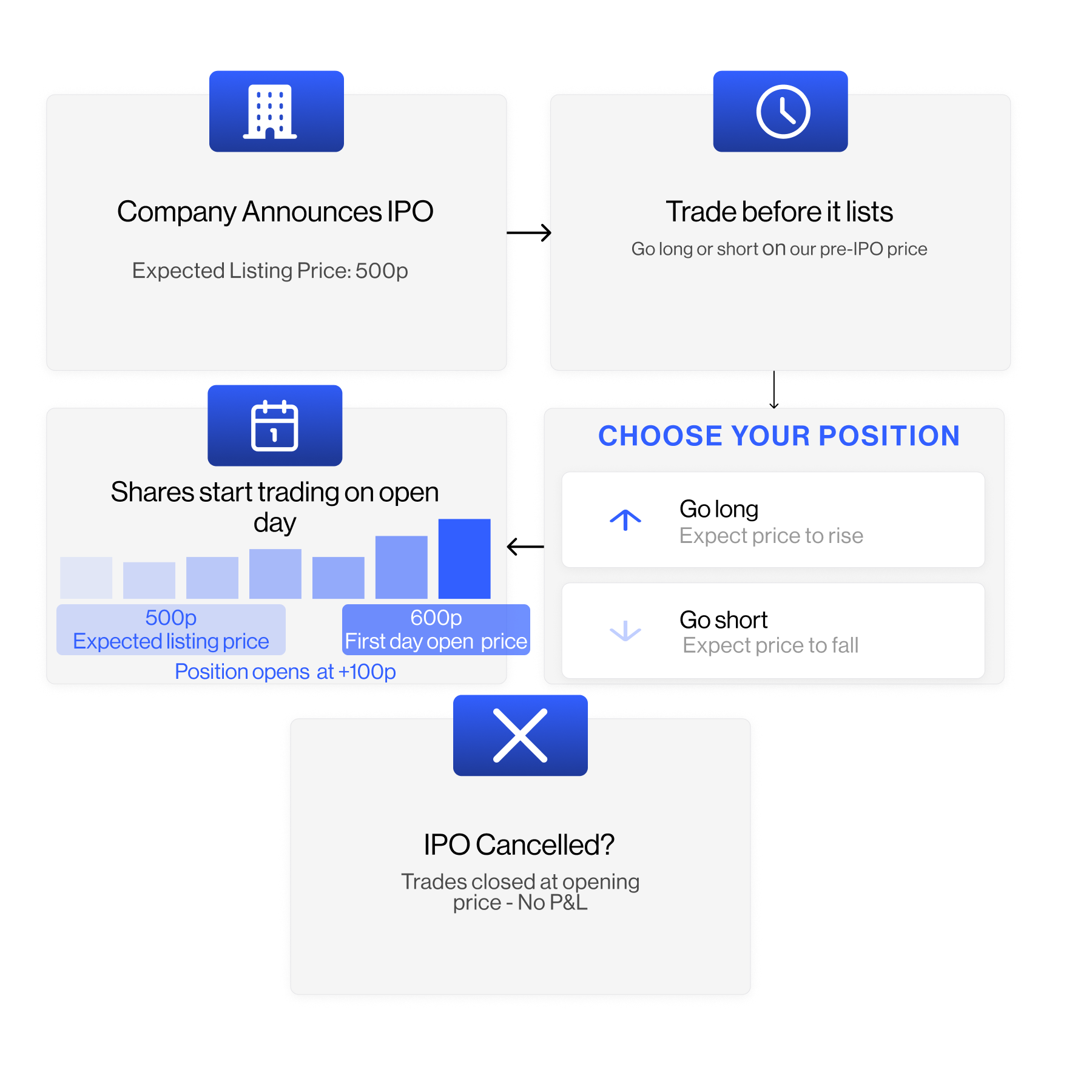
When a company announces plans to go public, we may open a pre-IPO market, based on our view of what the shares could be worth. When the company goes public and lists, your pre-IPO spread bet or CFD position rolls into the listed share spread bet/CFD. This means your position continues and you retain full control over when to close it.
Companies that could announce IPO plans in the future include Revolut and OpenAI. Follow the links below to learn more about potential IPO stocks.

Expected listing: TBD

Expected listing: TBD
Track your trades at home or on the move with our web platform, iOS and Android app.
Go long or short on shares before they go public.
Leverage amplifies potential profits and losses equally, so manage risk carefully.
Pre-IPO trading, also known as grey market trading, allows you to take a position on a company’s potential share price ahead of its initial public offering (IPO). Unlike investing through an IPO application, you're not buying or applying for shares. You're place a spread bet or contracts for difference (CFD) position based on a synthetic price which reflects market expectations of a potential IPO valuation.
The pre-IPO price can move significantly as new public information and market sentiment evolve. Your trade rolls into the listed share spread bet/CFD once the company lists. The position remains open and you retain control over how long you wish to keep it open, and when to close it.
You can trade once the pre-IPO market is open, usually from when an IPO is announced up until the company lists.
When the company successfully lists, your pre-IPO spread bet or CFD transitions seamlessly into a standard spread bet/CFD on the listed share. The instrument then references exchange-based pricing and normal trading conditions apply. There is no forced settlement or manual intervention required – the position continues under the same listing. Your position remains open and you retain control over when to close it.
If the IPO is cancelled, or the company says it will not go ahead, open positions will be cancelled at the original execution price, so no profit or loss is realised. Any positions that were closed before the cancellation won't be reversed, and so will remain binding.
Yes, you can take a short (sell) position if you believe the company’s share price will fall below our pre-IPO price once the company lists.
Pre-IPO markets can move quickly and may be volatile. It's important to note that there is a risk the IPO opens at a price significantly different from the pre-IPO level. This is known as 'gap risk' and is an inherent feature of pre-IPO trading. The divergence can occur because pre-IPO pricing is based on expectations, while the listing price is determined by the actual IPO process and early exchange trading.
When you trade with leverage, your potential profits and losses are magnified based on the full value of the trade. However, as a retail client, you can't lose more than your account value, due to negative balance protection. If your margin level is insufficient to maintain your position, it may be automatically closed out. Learn more about managing your risk
Upcoming pre-IPO markets will appear in the product library under shares in our platform when available.
Yes. You can close your position during our normal trading hours at any time from when the pre-IPO instrument is made available on our platform until it transitions to the listed share spread bet or CFD at IPO.
The pre-IPO instrument provides synthetic exposure to the expected share price of a company before it lists on a stock exchange. Before listing, prices are based on our assessment of the company’s expected list price, drawing on publicly available information such as:
The indicative IPO price range, where available
Valuations of comparable listed companies
Market conditions and sentiment
Prices are not based on private secondary market transactions and may differ significantly from private market valuations. There is no active underlying market on a company’s shares before it lists, which means there is no exchange-traded reference price that we can use before the IPO. This may have the following implications:
Prices may be volatile
Spreads may be wider than for other share CFDs
The product cannot be hedged in the open market
The IPO may open at a price materially different from the pre-IPO price, potentially exposing you to gap risk and potentially significant losses
Price updates vary by company and depend on how close the IPO date is. As more information becomes publicly available, including updates to the expected price range or demand for the shares, prices may be updated more frequently. Updates may be irregular and pricing may change quickly.
When the company lists, your pre-IPO instrument converts into a standard share spread bet or CFD, depending on which product you're trading. From that point, pricing is based on the underlying exchange-traded share. You can close your position during normal market hours, subject to market conditions. Spreads may initially be wide and volatility may be high while the market establishes a price.
An OTC option on the expected share price of a company ahead of its stock exchange listing. CMC offers CFDs on pre-IPO grey markets, and the same grey market price is used as the underlying price for these options. The options are European-style and cash-settled.
It works like other CMC OTC options, with specific settlement rules for pre-IPO markets. You choose a strike price with a set expiry date and pay a premium. A call option expires in the money if the settlement price is above the strike. A put option expires in the money if the settlement price is below the strike. If an option expires in the money, you receive the difference between the settlement price and the strike in cash. Your break-even is your strike plus the premium for a call, or the strike minus the premium for a put.
You can take a bullish or a bearish position, but only by buying options. Buy a call if you expect the price to rise or buy a put if you expect it to fall. You can’t sell options to open a position.
Option prices move with the grey market price. The volatility estimate is reviewed periodically and updated in line with underlying market factors.
Trading hours are 23/5. Trading may be suspended or limited to closing trades only around key events such as IPO pricing and listing day.
Yes. You can sell your option back to CMC at the quoted bid price while the market is open.
Your option stays open. At expiry, it settles against the official closing price of the listed shares on the primary exchange (16:00 ET) on the expiry date.
The option stops trading at 14:00 ET on the expiry date. It settles against the average grey market price between 14:00 and 16:00 ET that day, a time-weighted average price (TWAP) calculated independently of the desk.
Your option keeps running to its expiry date. If the company still hasn’t listed by then, it settles against the grey market average price as described above.
Once the company lists, your option’s underlying becomes the listed share price and your position stays open. At expiry, it settles against the official closing price on the expiry date. When listed options on the stock become available, we’ll use them as the reference for pricing your option, so spreads may narrow. Trading hours may change to match the listed market’s hours.
You can lose the full premium.
Options lose value over time as expiry approaches.
Prices can gap on IPO pricing and listing day.
Spreads may be wider than on other options because listed options are not available before the IPO.
Clients who are eligible to trade both OTC options and grey market products with CMC, subject to the standard appropriateness assessment.
Prices are based on the CMC grey market price for the company and an estimate of future volatility. That estimate reflects how much the price could move before the IPO, on listing day and afterwards. Prices are indicative and don’t predict the actual IPO price.
Trades already opened and closed stand. Any open options settle at an applicable price quoted for the option at or before the official cancellation announcement. This differs from grey market CFDs, where open trades are closed at the opening price.