Source: own calculation, 24 March 2026.
Session summary in Europe and the US
The past week on European exchanges was marked by concerns over energy security and, consequently, fears of rising inflation and slowing economic growth. Bullish investors were encouraged by a post from Trump, prompting a rush into equities that pushed benchmarks into positive territory. The key question is whether investors have come to terms with the possibility of a deeper correction. Apart from the FTSE 100 (−0.24%), other leading indices gained between 0.61% (Stoxx 600) and 1.22% (DAX).
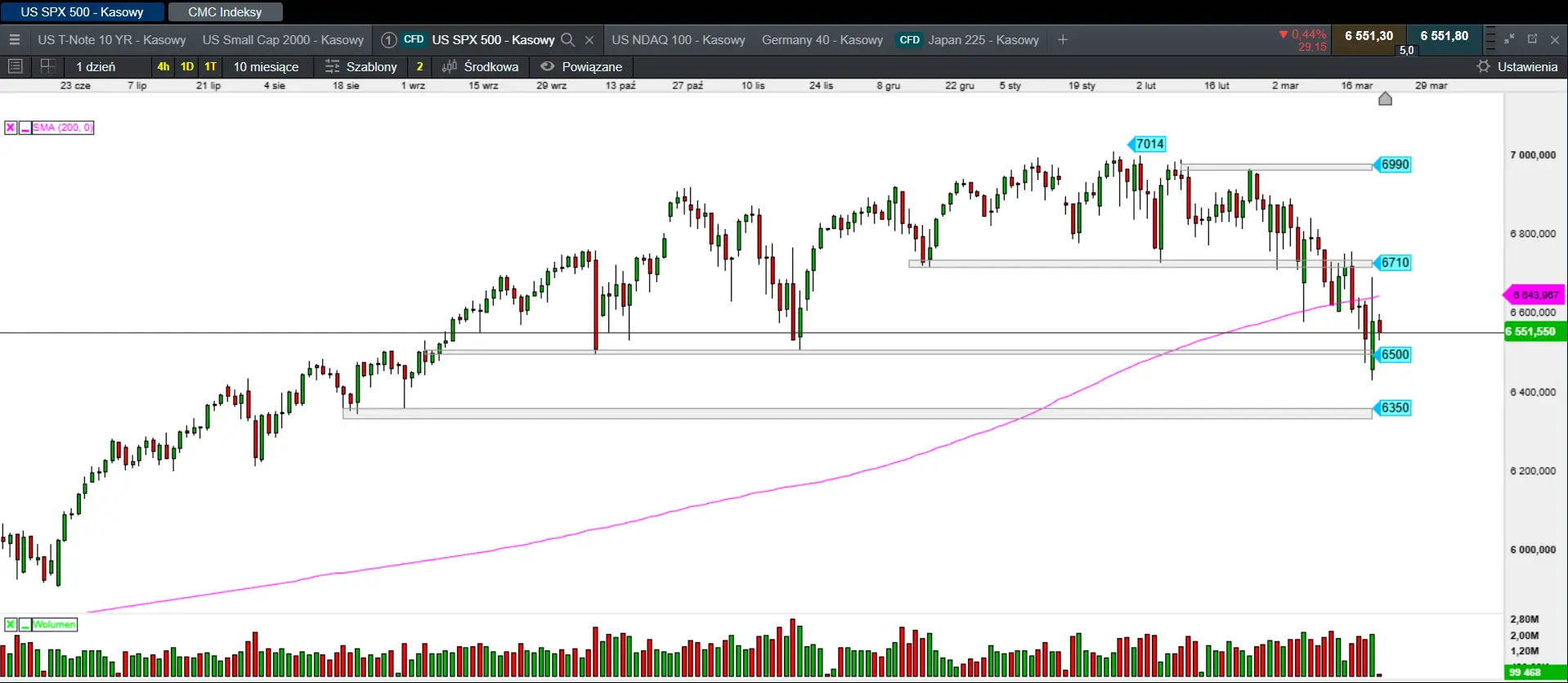
Wall Street is also experiencing heightened volatility. Yesterday’s session, following a series of declines, ended in positive territory. The Dow Jones rose by 1.38%, the S&P 500 increased by 1.15%, and the Nasdaq 100 closed up 1.38%.
Asia session – a return to gains, but for how long?
Asian markets are posting gains today, following yesterday’s session on Wall Street. However, this appears to be largely a rebound after the previous sell-off. The prospect of rising inflation and the end of the low-interest rate environment continues to weigh on investor sentiment. The Nikkei 225 is up 0.61%. Australia’s S&P/ASX 200 has risen by 0.41%, while South Korea’s KOSPI has gained 2.49%. Other markets: Hong Kong (1.39%), Shanghai (0.67%), Sensex (0.81%), Singapore (0.24%). The Asia Dow index is up 1.42%.
Session summary on the Warsaw stock exchange (GPW)
The previous week was dominated by selling pressure. The current week, however, began in a tense atmosphere, with gains driven largely by Trump’s comments on platform X. Globally, the situation in risk assets remains highly strained. Fear has spread not only in Warsaw but across global markets. When markets are under pressure, emerging markets tend to face heightened selling activity. Rising US bond yields have amplified concerns about inflation, which could lead to higher interest rates later in the year and, consequently, increased financing costs.
Market sentiment has shifted dramatically within just a few weeks. On the Warsaw exchange, conditions remain highly dynamic, with early signs of a correction emerging. Demand, which had previously driven the market, has given way to supply pressure. Deteriorating sentiment across major European exchanges and Wall Street has had a clear impact. The bearish camp, which argued that optimism on the GPW was gradually fading, appears to be correct, and profit-taking on long positions may further support a pullback.
The Polish market is not decoupled from global trends, and if scepticism persists globally, a correction becomes increasingly likely, especially after such a strong rally. However, only a sustained drop below the low of 4 December 2025 would constitute a serious risk and could trigger a deeper decline towards 2,378 points.
The WIG20 initially declined after a weak opening. Around midday, a post by Trump about postponing attacks on Iranian power plants boosted demand, quickly pushing the index into positive territory. From that point onwards, trading remained relatively uneventful, with the chart showing limited volatility.
Turnover on the broad market reached PLN 3.2bn. The WIG gained 0.53%. The blue-chip index rose by 0.62%. WIG20 futures increased by 0.8%, closing at 3,262 points. Mid-cap stocks also contributed positively, with the mWIG40 up 0.61%. The sWIG80 was the only index to close lower, falling by 1.33%.