Contango and backwardation in trading

5 minute read
|27 Aug 2025
Green Tiles
Table of contents
  • 1.
    Why is contango and backwardation important?
  • 2.
    What does contango mean?
  • 3.
    What causes contango?
  • 4.
    Backwardation explained

The terms “contango” and “backwardation” apply to the futures market and can indicate whether the delivery price of a particular asset is higher or lower than its current spot price. This helps traders and institutions to assess whether they would rather buy a financial instrument at spot price or use contracts for future delivery.

Why is contango and backwardation important?

While the futures or forward markets were originally designed for commodity merchants to sell their product at a future date and lock in the current price, not everyone who trades the futures and commodities markets​ wants to take ownership of the product that they are trading. For example, a retail trader may buy a crude oil futures contract​ without taking delivery of 1,000 barrels of oil. Instead, they can trade for the profit potential, which is the difference between the price at the start of the contract and the closing price.

Understanding contango and backwardation can help traders make better trading decisions because they will understand how spot prices relate to future prices, called the futures curve. At CMC Markets, our forward CFD contracts are based on the underlying price of a futures contract and are the equivalent product for trading future prices.
Contango and Backwardation Chart

What does contango mean?

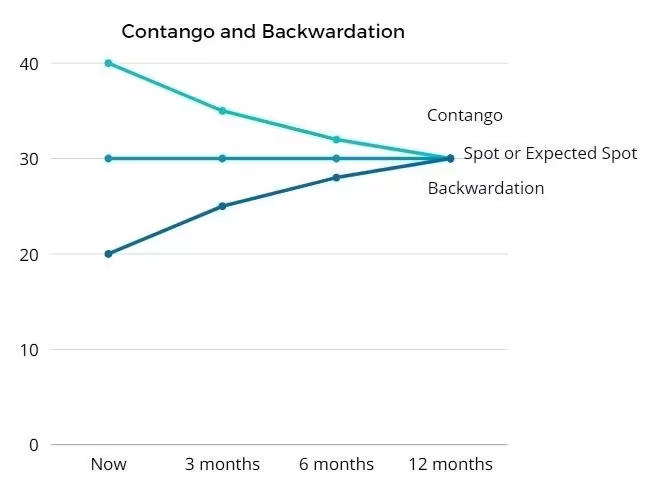
Contango refers to when a commodity futures​ price is above the spot price. For example, let’s say that the spot price of Brent Crude Oil​ today is $70 per barrel. If you buy a futures contract that expires in two months, if the holder of that contract receives their oil and has to pay $75, this means that the market is in contango. This is because the cost of the forward contract is higher than the spot price or the expected future price.

Over time, as that contract nears expiration, it will move closer to the spot price. Therefore, unless the price rises above the price paid, the value of the contango contract will drop to meet the spot price at expiry. If the spot price stays the same, the contract that was bought for $75 will be worth $70 when the contract expires. This is called the futures curve.

What causes contango?

Contango is the result of anything that causes prices to be higher in the future relative to now, such as supply and demand. This could be a belief by market traders that the spot price will increase in the future, thus making it worthwhile to lock in a price now, even if it is above the current spot price.

Contango can also be caused by the “cost of carry”. You may pay a higher price for a product now that will not be delivered for several months, because it is not possible to store the product. Instead, you are essentially paying the person who sold you the contract to store those goods for you. That incurs a cost of carry in the form of a higher-than-spot price.

When trading CFDs​ with us you do not need to worry about taking ownership or storing your physical asset, as our derivative products allow you to speculate on the price movements of the underlying forward contract. This means that you can open a position based on whether you think the price of the asset will rise or fall, leading to profits or losses, depending on if the market moves in your favour.

Crude oil contango

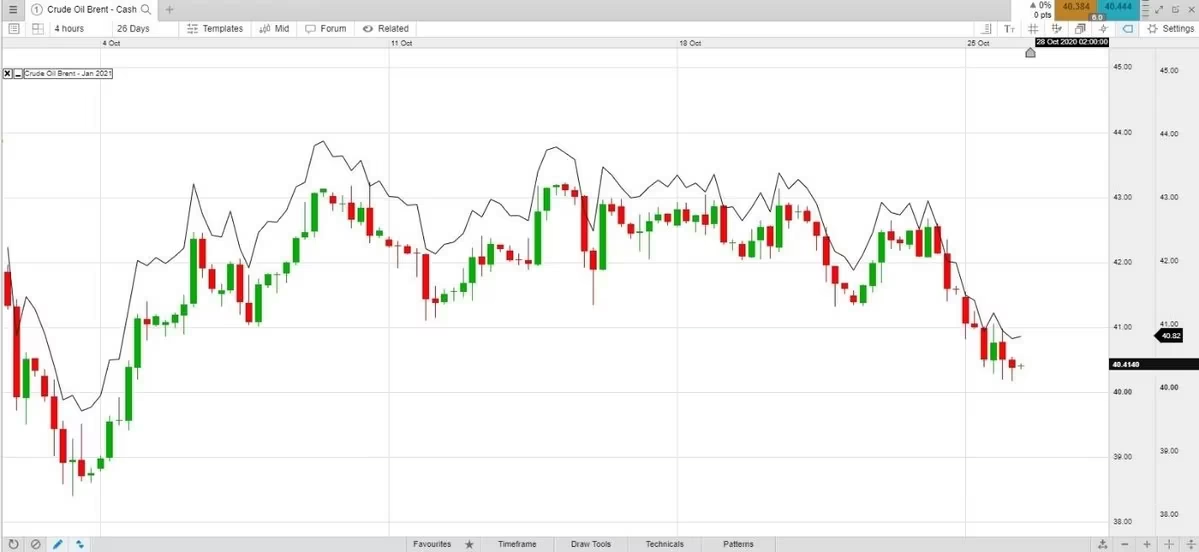
Crude oil, whether Brent or West Texas​, is usually in contango due to the cost of carry of oil. It requires storage until used. The below chart shows the cash price for Brent Crude Oil. The black line is the price of crude for a contract that expires in three months. The forward contract is consistently above the cash price, representing contango. At this time, the cash price was 40.414 and the forward price was 40.82.

Contango-backwardation-2 extra

Silver contango

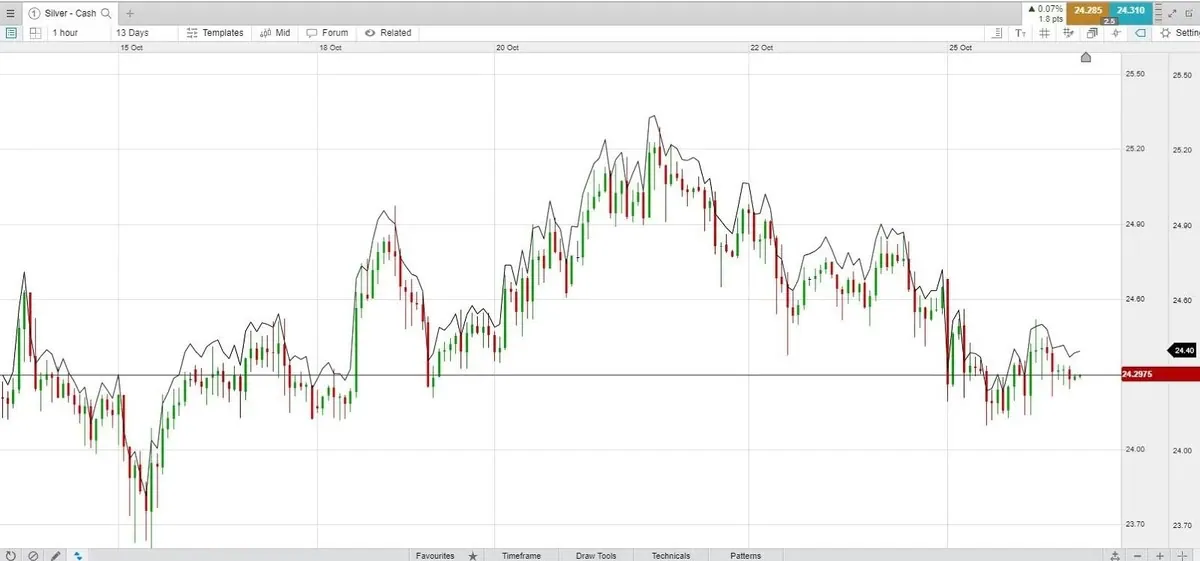
Another example of contango is demonstrated on the following silver chart. This shows the cash price as well as the price of the forward contract two months into the future, with hourly closing prices. During this period, the futures contract trades at a higher price than the spot price, meaning that the market is in contango.

Contango-backwardation-3 extra

Backwardation explained

Backwardation refers to when the future or forward price is below the spot or expected spot price. For example, let’s say that the spot price of crude oil today is $90 per barrel. If you buy an oil forward contract that expires in two months, if the holder of that contract receives their oil and has to pay $85, this means that the market is in backwardation. This is because the price for its future delivery is lower than the current spot price.

Over time, as that contract nears expiration, it will move closer to the spot price. Therefore, the $85 will move up to $90, assuming that the spot price stays the same.

Gasoline backwardation

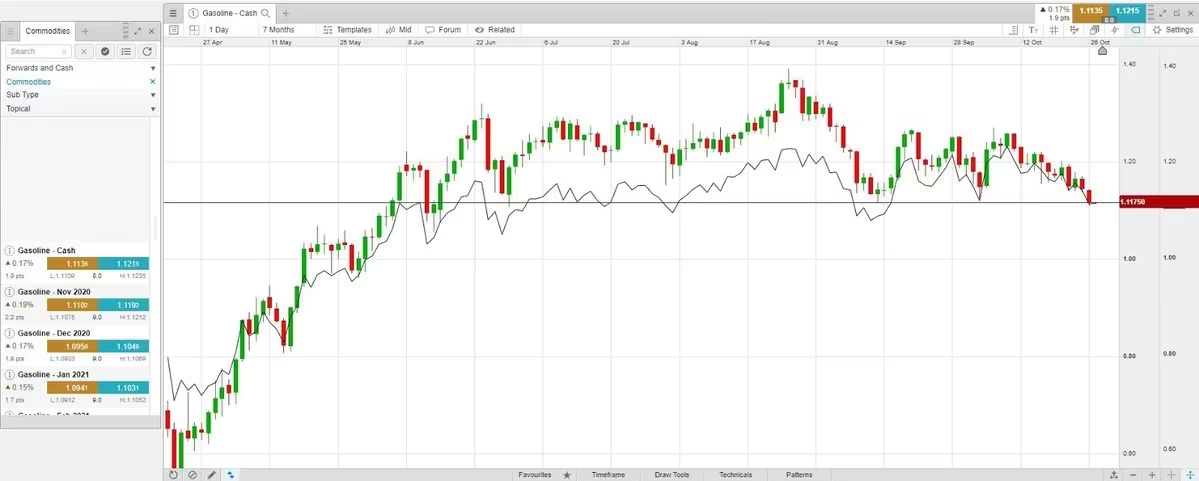
Gasoline is in backwardation when the prices of the futures contracts are lower than the cash spot price. The following chart and price levels show how this can occur. The cash price is 1.1226 and the price a month later, on a forward contract, is 1.1201. The prices continue to decline the further out they go. Looking at the chart, the extent of the backwardation was more severe in the past. The cash price and November price have converged at the far right of the chart.

Contango-backwardation-4 extra

Natural gas backwardation

Backwardation in the natural gas market is not very common. However, there are times when certain contracts are less in contango than others, which could result in backwardation.

Let’s say that the current spot price for natural gas is 2.85. A month later, it is 3.02, then 3.25, 3.37, but then a month later the price drops to 3.29, which is cheaper than the prior month. This is followed by 3.21. These later contracts are potentially heading into backwardation, as the price is decreasing consistently. This market is not in backwardation currently, because the forward contracts still value higher than the spot price, but, if in January, the spot price is 3.37 and February and March contracts are priced below that, backwardation would be present.

Gold backwardation

In a similar way to silver and natural gas, gold is not often in backwardation. This is because gold bullion trading​ is often used as a safe haven for traders in times of political or economic instability, and investors pour their money into physical gold and gold stocks and ETFs, increasing its overall value. However, gold trading is linked with the US dollar, meaning that the fluctuation of interest rates for the currency can push gold into contango or backwardation easily.

Learn more about how to trade commodities​.

Join an award winning CFD provider
Practise CFD trading with $10,000 of virtual funds on a risk-free demo account.
Access 12,000+ instruments on our award-winning CMC Markets Platform. Including indices, forex and shares.
Enhance your CFD trading on MetaTrader4 with CMC Markets and access 175+ forex pairs.
Tight spreads and low margin rates.